
Dressage Arena Dimensions: 20 x 60 and 20 x 40 Layouts
On this page10
- 01Dressage arena dimensions at a glance
- 02Dressage arena fit calculator
- 03Standard 20 x 60 dressage arena layout
- 04Small 20 x 40 dressage arena layout
- 05How far apart are dressage arena letters?
- 06How to square a dressage arena
- 07Standard vs small arena: which one should you use?
- 08Why dressage has invisible centre-line letters
- 09Dressage arena vs riding arena
- 10Common dressage arena setup mistakes
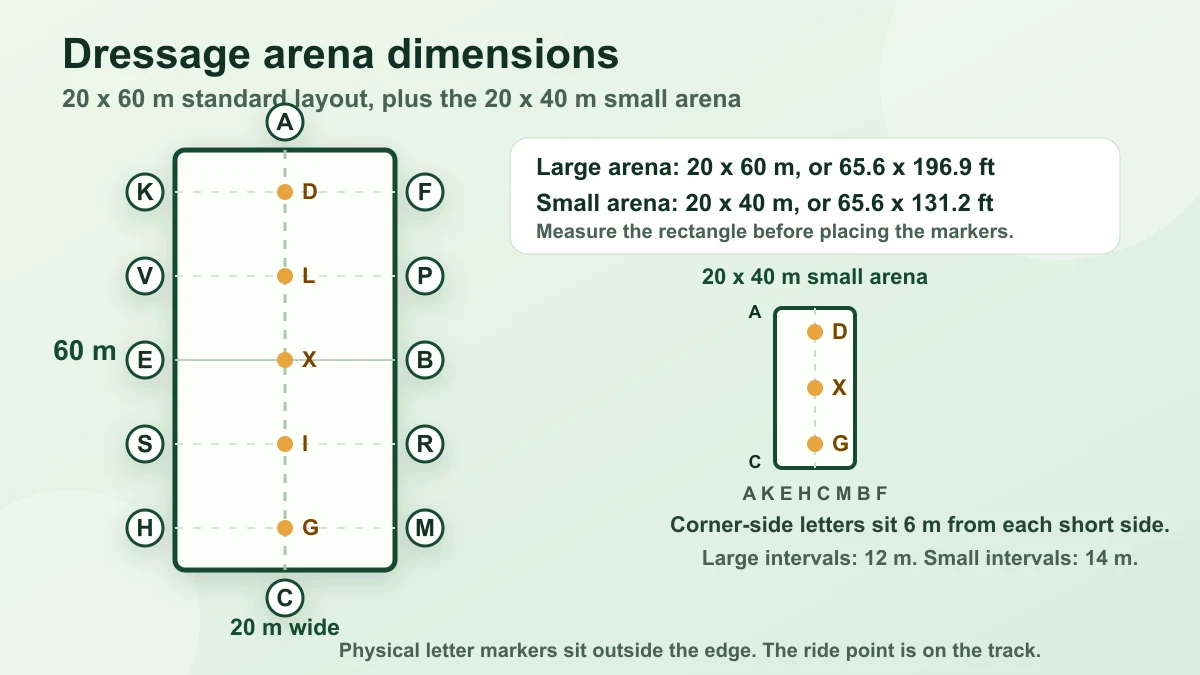
A standard dressage arena is 20 metres wide by 60 metres long. In feet, that is about 65.6 by 196.9. A small dressage arena is the same width but shorter: 20 by 40 metres, about 65.6 by 131.2 feet.
The dimensions are easy to memorize. The letter layout is what usually trips people up. Some letters sit on the outside fence, some are only imagined on the centre line, and the spacing is different in the 20 x 60 and 20 x 40 layouts. Use the tables and fit checker below before you tape a field, order markers or practice a test from memory.
Dressage arena dimensions at a glance
| Arena | Metric size | Feet size | Outer letters | Centre-line points | Common use |
|---|---|---|---|---|---|
| Standard dressage arena | 20 m x 60 m | 65.6 ft x 196.9 ft | A, K, V, E, S, H, C, M, R, B, P, F | D, L, X, I, G | FEI and many higher-level national tests |
| Small dressage arena | 20 m x 40 m | 65.6 ft x 131.2 ft | A, K, E, H, C, M, B, F | D, X, G | Intro, lower-level, club and schooling tests |
The width does not change. What changes is the long-side spacing and the number of markers between the corners.
Dressage arena fit calculator
Enter the clear, flat space you have available. The checker can test only the arena rectangle, or the same arena with 2 metres of setup room around all sides for letters, access and a less cramped schooling layout.
This calculator is for planning, not certification. For a recognized show, the competition authority controls the required arena, fencing, judge position and setup details.
Standard 20 x 60 dressage arena layout
The standard arena is the long rectangle used for FEI competition and many upper-level national tests. USDF explains that dressage tests are ridden in either a 20 x 40 metre or 20 x 60 metre arena, with letters marking points around the ring.
| Standard arena measurement | Metric | Feet |
|---|---|---|
| Length | 60 m | 196.85 ft |
| Width | 20 m | 65.61 ft |
| Area | 1,200 sq m | 12,917 sq ft |
| Diagonal check | 63.25 m | 207.5 ft |
| A and C from each corner | 10 m | 32.8 ft |
| Letters from arena edge | about 0.5 m outside | about 1.6 ft outside |
Walk clockwise from A and the outside letters are:
| Position | Left long side from A | Right long side from A | Centre line from A |
|---|---|---|---|
| 0 m | A on short side | A on short side | A |
| 6 m | K | F | D |
| 18 m | V | P | L |
| 30 m | E | B | X |
| 42 m | S | R | I |
| 54 m | H | M | G |
| 60 m | C on short side | C on short side | C |
The outer order is A, K, V, E, S, H, C, M, R, B, P, F. The centre-line points are A, D, L, X, I, G, C. D, L, X, I and G are not normally physical markers in the riding path. They are locations the rider learns to feel from the side letters.
Small 20 x 40 dressage arena layout
The small arena keeps the same 20 metre width but removes the extra middle length from the standard layout. It is common for lower-level tests, schooling, pony-club practice and barns that cannot dedicate nearly 197 feet of length.
| Small arena measurement | Metric | Feet |
|---|---|---|
| Length | 40 m | 131.2 ft |
| Width | 20 m | 65.61 ft |
| Area | 800 sq m | 8,611 sq ft |
| Diagonal check | 44.72 m | 146.7 ft |
| A and C from each corner | 10 m | 32.8 ft |
| Letters from arena edge | about 0.5 m outside | about 1.6 ft outside |
The outside letter order is A, K, E, H, C, M, B, F.
| Position | Left long side from A | Right long side from A | Centre line from A |
|---|---|---|---|
| 0 m | A on short side | A on short side | A |
| 6 m | K | F | D |
| 20 m | E | B | X |
| 34 m | H | M | G |
| 40 m | C on short side | C on short side | C |
The small arena is not a sloppy or beginner-only version of dressage. It is a valid layout when the test calls for it. What you should not do is practice a 20 x 60 test in a 20 x 40 space and expect the distances to feel the same. The center, the diagonals and the approach to each movement all change.
How far apart are dressage arena letters?
The spacing is not even from letter to letter around the whole arena. The near-corner letters are 6 metres from each short side. After that, the large arena uses 12 metre long-side intervals, while the small arena uses 14 metre intervals between its long-side letters.
| Arena | Corner-side spacing | Middle long-side spacing | Midpoint letters |
|---|---|---|---|
| 20 x 60 m standard arena | 6 m from each short side | 12 m intervals | E, X and B at 30 m |
| 20 x 40 m small arena | 6 m from each short side | 14 m from K to E and E to H | E, X and B at 20 m |
A and C sit in the middle of the short sides, not in the corners. If you are building a temporary arena with cones, put the marker outside the arena line. USDF setup guidance places letters about half a metre away from the arena edge. The marker is a signpost. The ride point is still on the track.
How to square a dressage arena
The quickest way to ruin a temporary dressage arena is to trust your eye. A slightly crooked first corner can turn the whole layout into a parallelogram, and then every diagonal ride feels strange.
USDF’s arena setup guidance uses the classic 30-40-50 right triangle method to establish a square corner, then measures the long and short sides from there. For a standard arena, one long side is 60 metres. For a small arena, one long side is 40 metres. The short side is 20 metres.
A practical setup sequence:
- Pick flat, safe footing first. Do not force the rectangle into a hollow, slope or slippery patch.
- Mark the first corner.
- Measure the first long side to 60 metres for a standard arena or 40 metres for a small arena.
- Use a 30-40-50 triangle, or the metric equivalent, to create a true 90 degree short side.
- Measure the opposite long and short sides and mark the fourth corner where they meet.
- Check both diagonals. A true rectangle has equal diagonals.
- Place the outside letters after the rectangle is square, not before.
For home practice, cones, buckets or temporary boards can work if they are visible, safe and not likely to blow into the riding path. For competition, use the current rulebook and event instructions.
Standard vs small arena: which one should you use?
Use the arena printed on the test sheet or required by the show. That answer sounds boring, but it prevents most mistakes.
For schooling at home, the choice depends on space and level:
| Situation | Better choice | Why |
|---|---|---|
| Learning Intro or lower-level test patterns | 20 x 40 m small arena | Easier to set up and commonly used for early tests |
| Practicing FEI or upper-level national tests | 20 x 60 m standard arena | The movements are written for the longer geometry |
| Backyard schooling with limited space | Small arena or modified cones | Safer than squeezing a long arena into bad footing |
| Western dressage practice | Check the WDAA or show test | WDAA references both small and large arena diagrams |
| Video test or online show | Follow the organizer’s exact instructions | Some programs specify a particular arena size |
If a barn offers both English and Western lessons, dressage may show up in either lane. Our Western vs English riding lessons guide explains the discipline split, and our horseback riding lessons guide covers what a first lesson usually costs and includes.
Why dressage has invisible centre-line letters
The centre-line points create a map for the test without putting signs in the horse’s path. X is the exact center of both arenas. D and G sit 6 metres from the short sides. In the large arena only, L and I fill the extra 12 metre intervals between D, X and G.
That is why test instructions can say things like “halt at X” or “turn down the centre line” even though no X sign is sitting on the ground. The rider is expected to know where the point is from the side letters and the geometry of the arena.
This is also why beginners sometimes ride past X without realizing it. In the small arena, X is 20 metres from A. In the standard arena, X is 30 metres from A. If you move between arenas, your body has to relearn the timing.
Dressage arena vs riding arena
A riding arena can be almost any safe training space. A dressage arena is a measured layout inside that space.
| Term | Meaning |
|---|---|
| Riding arena | General enclosed or open schooling space |
| Dressage arena | Measured 20 x 60 m or 20 x 40 m layout with letters |
| Competition arena | Dressage arena prepared under the governing body’s current rules |
| Temporary schooling arena | Cones, boards or markers used for practice |
If you are pricing a new riding setup, the arena footprint is only one part of the project. Footing, drainage, fencing, lighting, access, maintenance and horse safety matter more than squeezing the last metre into a tight yard. For broader horse costs, see cost to own a horse and horse boarding cost.
Common dressage arena setup mistakes
Most bad temporary arenas fail in predictable ways.
| Mistake | What goes wrong | Better fix |
|---|---|---|
| Measuring from the outside of marker stands | The ride line shifts inward or outward | Measure the arena rectangle first, then place letters outside it |
| Guessing the corners | The arena becomes skewed | Use a right-triangle method and check equal diagonals |
| Mixing standard and small letters | Test patterns feel wrong | Use the letter set for the arena size on the test sheet |
| Forgetting centre-line points | Halts and transitions drift | Mark the side references in practice and learn D, L, X, I and G |
| Squeezing into unsafe footing | The rectangle fits but the riding does not | Choose footing and safety first, then mark the largest correct layout that fits |
For casual schooling, modified space is fine if the horse and rider are safe. For competition prep, do at least some rides in the exact size your test requires. Accuracy feels different in a 20 x 60 arena, especially on diagonals and long-side movements.
Sources
Frequently asked questions
What are the standard dressage arena dimensions?+
A standard dressage arena is 20 metres wide by 60 metres long, about 65.6 by 196.9 feet. It has 12 perimeter letters and five unmarked centre-line letter points.
What are small dressage arena dimensions?+
A small dressage arena is 20 metres wide by 40 metres long, about 65.6 by 131.2 feet. It uses eight perimeter letters and three centre-line letter points.
How far apart are dressage arena letters?+
In a 20 x 60 metre arena, the corner-side letters are 6 metres from the short sides and the remaining long-side intervals are 12 metres. In a 20 x 40 metre arena, the corner-side letters are still 6 metres from the short sides, with 14 metres from K to E and E to H on one side, and F to B and B to M on the other.
What is the order of dressage arena letters?+
In the standard arena, clockwise from A, the outer letters are A, K, V, E, S, H, C, M, R, B, P and F. The centre-line points are D, L, X, I and G. The small arena uses A, K, E, H, C, M, B and F outside, with D, X and G down the centre line.
Where do you measure a dressage arena from?+
Measure the arena rectangle itself, not the outside of a marker stand. USDF setup guidance says letters are placed about half a metre outside the arena edge, while the named letter point is on the track.
Can I practice dressage in a smaller arena?+
Yes, for schooling you can use a modified or temporary layout if it is safe and everyone understands it is not regulation. For a show, use the arena size and test sheet required by the governing body or competition.
Sources
Play & tools
Free browser games and tools — no account, no download.
- Play today's Sports Connections — Today's Sports Connections — daily hints, answers, and play the grid.
- Play Guess the NFL Player — A new mystery NFL player every day. Eight guesses, with a clue on each — plus free unlimited mode.
- Explore all our games →
Related guides
Volleyball Court Dimensions and Space Needed
Official volleyball court dimensions: indoor court size, beach court size, attack line, service zone, free zone, net height and backyard setup.
Bowling Lane Dimensions: Length, Width, Boards and Space Needed
Regulation bowling lane dimensions from USBC: 60 ft to the head pin, 41.5 in lane width, 39 boards, approach, arrows, gutters and space calculator.
Lacrosse Field Dimensions: Men's, Women's, Youth and Box
Lacrosse field dimensions by format: men's, women's, youth, Sixes and box lacrosse, with goal spacing, creases, line markings and field-fit calculator.

What Is a False Start in Track? Rules and Disqualification
A false start happens when a sprinter begins before the legal starting signal or reacts early enough to violate the competition’s reaction-time rule.
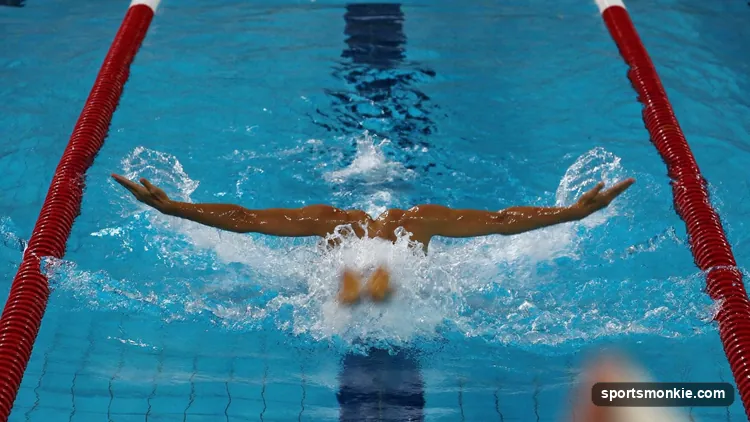
What Is the Individual Medley in Swimming? Order and Rules
The individual medley combines butterfly, backstroke, breaststroke, and freestyle in one race, in that order.

What Is a Faceoff in Lacrosse? Restart and Possession Rules
A lacrosse faceoff starts each quarter and follows goals, with two players competing for the ball while teammates stay outside the restraining area.