
Volleyball Rules Explained: The Full Ruleset
On this page6
Indoor volleyball is played by two teams of six, and the core rules come down to a few numbers: three hits per side, rally scoring, sets to 25, and a clockwise rotation each time you win back the serve. Get those right and you can follow almost any match. This is the full ruleset, from the serve to the faults that quietly lose points.
The sport rewards precision over power. A rally can turn on a foot over the centre line or a fourth touch nobody noticed, so the rules below are worth knowing even if you only ever watch.
The court, the teams and the serve
Each side fields six players, three in the front row and three in the back row. A rally starts with a serve from behind the back line; the server has one attempt to put the ball over the net and inside the opponent’s court. Under rally scoring, whoever wins the rally scores a point, and the winning team serves next.
The receiving team then tries to build an attack. The classic pattern is pass, set, hit: a first touch to control the serve, a second touch to set the ball up, and a third to attack it over the net. That first defensive contact off a hard-driven ball is a dig, and turning a serve or spike into a clean pass is where most rallies are won or lost.
The three-hit rule and contact faults
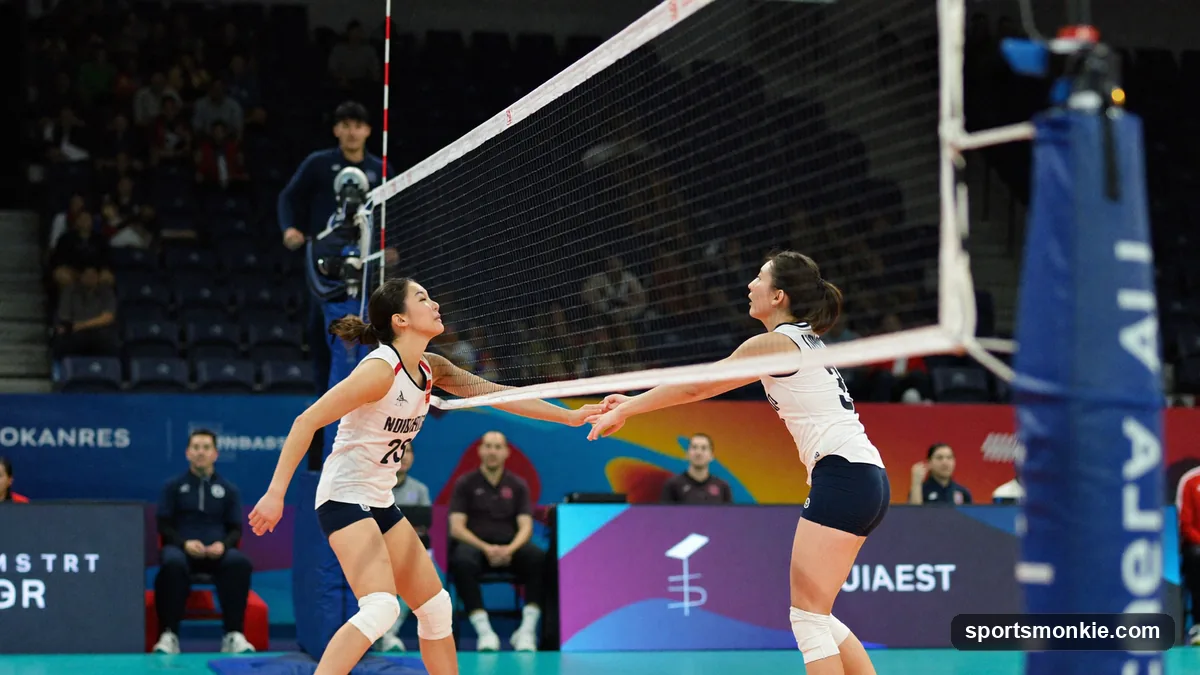
A team may contact the ball a maximum of three times before it must cross the net, and no player may make two contacts in a row. The one exception is the block: a block does not count as a team touch, and the blocker may play the very next ball.
| Rule | What it means |
|---|---|
| Max three hits | The ball must cross the net by the third contact |
| No double contact | A player can’t hit the ball twice in succession (block excepted) |
| Block ≠ a touch | After a block, all three hits are still available |
| No lift or carry | The ball must be hit cleanly, not caught, thrown or held |
| Ball must land in | A ball that lands out, or that a team sends out, loses the rally |
The set is where referees are strictest on clean contact. A ball that visibly rests in the hands, or spins oddly from a double-touch, is called a lift or a double. On the first ball of serve-receive the rules are more lenient, but by the second and third touch the standard tightens.
Rally scoring and how sets are won
Volleyball uses rally scoring, meaning a point is awarded on every rally regardless of who served. Matches are usually best-of-five sets.
- Sets 1 through 4 are played to 25 points, and you must win by two (so 26-24, 30-28, and so on).
- The deciding fifth set is played to 15 points, still win by two.
- The first team to win three sets wins the match.
There is no cap in most rulebooks, so a tight set can stretch well past the target number. If you want the scoring broken down rally by rally, our guide to how volleyball scoring works walks through the numbers and the win-by-two rule in detail.
Rotation and positions
When the receiving team wins a rally and takes over the serve — a “side-out” — all six players rotate one position clockwise. This keeps every player cycling through both front-row and back-row duties and through the serve.
Rotation is also why players don’t stay glued to their specialist spots. As soon as the serve is struck, players switch to where they’re most useful while respecting the overlap rules that govern position at the moment of serve. The full mechanics of that cycle are covered in our volleyball rotation explained guide, and the specialist jobs — setter, hitters, middle, libero — in volleyball positions explained.
One position has its own rulebook: the libero, a back-row defensive specialist in a contrasting jersey who cannot attack the ball from above net height and substitutes freely without counting as a normal sub. Because those restrictions are unusual, we cover them separately in libero rules in volleyball.
The common faults
Most points end on a fault rather than a spectacular kill. The ones you’ll see most often:
- Ball out — landing outside the lines, or a team sending it out.
- Four hits — a team touches the ball a fourth time.
- Double contact — one player hits it twice in a row (block aside).
- Lift / carry — the ball is caught or held rather than hit cleanly.
- Net touch — a player interferes with the net during play.
- Centre-line violation — a foot fully crosses under the net into the opponent’s court.
- Back-row attack fault — a back-row player attacks the ball from in front of the attack line while it is entirely above net height.
- Foot fault on serve — the server steps on or over the end line before contact.
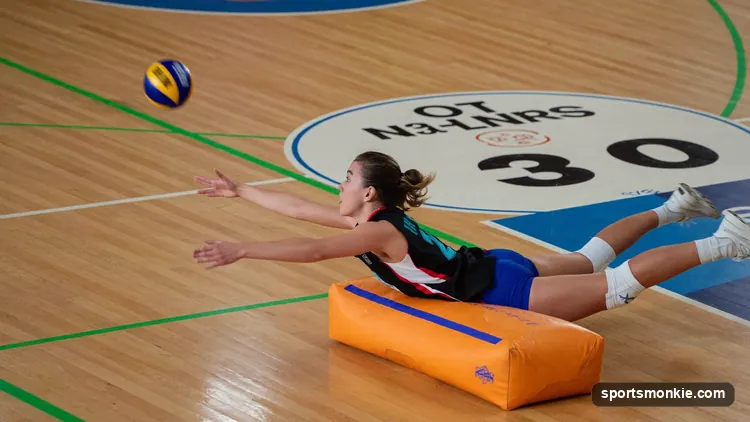
A successful attack that the other team can’t return is a kill, the sport’s basic scoring play, and a diving save that scoops a ball off the floor is a pancake. Knowing the faults is what lets you tell a genuine winner from a point handed over.
Watch a match with the rules in hand
Once the three-hit rule, rally scoring and the rotation click, volleyball reads very differently — you start seeing the setter’s decisions, the overlap traps and why the fixed court zones matter. If you need the physical layout beside the rules, our volleyball court dimensions guide shows the lines, attack zone and free-zone space. If you’d like to see those rules driving elite play, our list of the best volleyball players is a good next stop.
The short version: six a side, three hits maximum, rally scoring to 25 with a fifth set to 15 (win by two), rotate clockwise on every side-out, and expect most points to end on a fault. That’s the whole game in one paragraph — the rest is execution.
Frequently asked questions
How many players are on a volleyball team?+
Six players are on court for each team in indoor volleyball at any moment: three in the front row and three in the back row. A full match roster is larger, with substitutes and usually a designated libero, but only six of them play at once. Beach volleyball is the main exception, using two players a side with no substitutions.
Can you touch the net in volleyball?+
Touching the net is a fault only if it happens between the antennas and interferes with play while the ball is live. A player who contacts the net during their action of playing the ball loses the point. Incidental contact with hair, or contact outside the antennas that has no effect on the rally, is generally not penalised under current FIVB rules, though referees judge interference case by case.
Can the second hit go over the net in volleyball?+
Yes. A team is allowed up to three contacts but is not required to use all three. The second touch can legally cross the net, either as a deliberate 'setter dump' or a second-ball attack. What is not allowed is a fourth contact, or the same player hitting the ball twice in succession outside of a single blocking action.
Does a block count as one of the three hits?+
No. A block is not counted as a team contact, so a team that blocks the ball still has all three hits available afterward. The blocker is also allowed to make the next contact immediately, which is the one situation where a player may effectively touch the ball twice in a row. This rule is specific to blocking at the net.
What is a lift or carry in volleyball?+
A lift, carry or 'held ball' is a fault where the ball comes to rest in the hands or arms rather than being cleanly hit. The contact must be brief; catching, throwing or scooping the ball is illegal. Referees are strictest on the set, which is why hand-setting technique matters. A double contact on the first ball of a serve-receive is usually allowed, but not on later touches.
How long does a volleyball match last?+
There is no game clock in volleyball; a match lasts until one team wins the required number of sets. Most matches are best-of-five, so the first team to three sets wins, and a typical match runs roughly 60 to 90 minutes. Because scoring is rally-based, the length depends entirely on how tightly contested the sets are rather than a fixed time.
Sources
Play & tools
Free browser games and tools — no account, no download.
- Play today's Sports Connections — Today's Sports Connections — daily hints, answers, and play the grid.
- Play Guess the NFL Player — A new mystery NFL player every day. Eight guesses, with a clue on each — plus free unlimited mode.
- Explore all our games →
Related guides
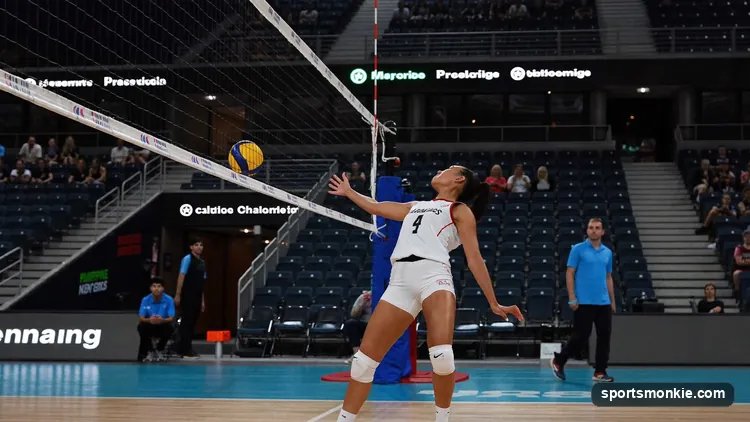
How Volleyball Scoring Works: Rally Scoring Explained
Volleyball uses rally scoring: a point on every rally, sets to 25, a fifth set to 15, win by two. How points, sets and matches are counted, with a table.
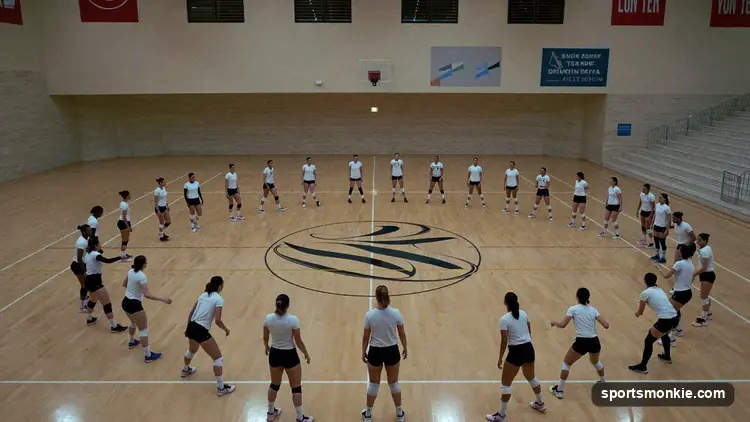
Volleyball Rotation Explained Simply
Volleyball rotation means the six players move one spot clockwise each time their team wins the serve. How rotation, serve order and overlap work.
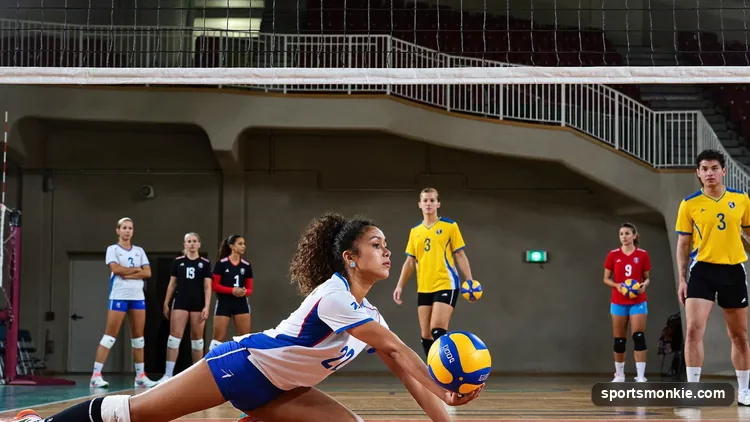
Libero Rules in Volleyball: What They Can and Can't Do
The libero is a back-row defensive specialist who can't attack above the net or block. Full libero rules: the jersey, substitutions and what's allowed.

What Is a Dig in Volleyball? The Defensive Save
A dig is a defensive pass that keeps a hard-driven spike off the floor. What counts as a dig, the technique, and how it differs from a pass or reception.
Defensive Specialist in Volleyball: DS Role Explained
A defensive specialist (DS) in volleyball subs in for weaker-passing front-row players in the back row. DS vs libero rules, jersey, and skills explained.

Libero in Volleyball: What the Position Actually Does
The libero volleyball role: the back-row defensive specialist who passes, digs and reads hitters. Origin, skills, jobs and the players who define it.