
Defensive Specialist in Volleyball: DS Role Explained
On this page6
- 01What does DS mean in volleyball?
- 02Defensive specialist vs. libero: what’s actually different
- 03What a defensive specialist actually does, step by step
- 04Skills and physical profile of a defensive specialist
- 05Who plays defensive specialist at the highest level
- 06When should a coach use a DS instead of relying only on the libero
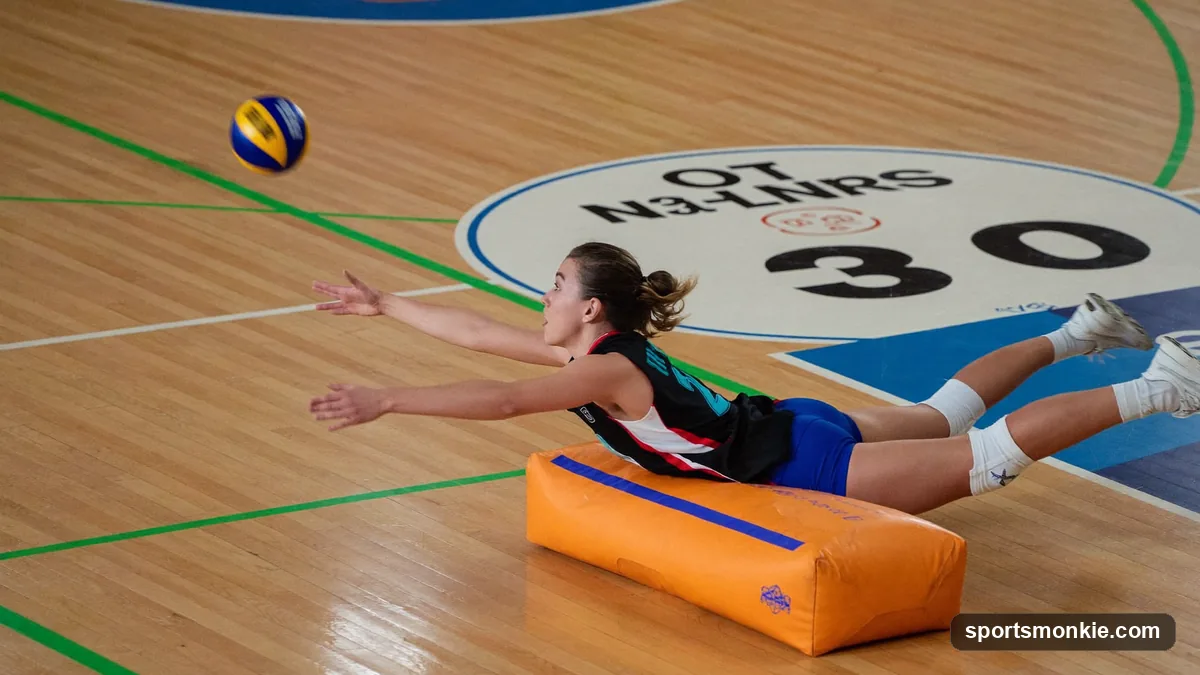
A defensive specialist (DS) is a back-row substitute who replaces a weaker-passing front-row player — typically an outside hitter or middle blocker — once that player rotates into the back row, taking over serve-receive passing and digging for those rotations. It’s a normal substitution, not a special position with its own rulebook entry, which is exactly why it gets confused with the libero so often.
Here’s what the DS actually does on court, how the role is genuinely different from the libero, and when a coach reaches for one instead of the other.
What does DS mean in volleyball?
DS is shorthand for defensive specialist: a player whose entire job is passing and digging, brought in through a standard substitution to strengthen a rotation that would otherwise be defensively weak. Teams use a DS because not every strong attacker is an equally strong passer — a big-swinging outside hitter might struggle in serve-receive, so the coach swaps them out for a DS the moment they rotate to the back row, then swaps the hitter back in once they rotate to the front to attack.
Unlike specialized volleyball terms tied to a single skill, “DS” is a roster designation, not a rule defined by the official rules of volleyball. The FIVB rulebook only recognizes players and the libero; the DS role exists at the level of team strategy and lineup cards.
Defensive specialist vs. libero: what’s actually different
This is the single most-searched question about the position, and the differences come down to five rules.
| Category | Defensive Specialist (DS) | Libero |
|---|---|---|
| Substitution type | Normal substitution, counts against the team’s sub limit | Unlimited free replacement, doesn’t count against sub limit |
| Jersey | Same jersey as the rest of the team | Must wear a visibly contrasting-color jersey |
| Can serve? | Yes, normally, wherever they land in the rotation | No under FIVB rules; some domestic rules (e.g., NCAA) allow serving in one rotation |
| Front-row play | Can play front row and attack/block once rotated up | Confined to the back row at all times |
| Attacking restriction | None once in a legal position | Cannot complete an attack on a ball entirely above net height |
| Roster limit | No special cap; any player can be used as a DS | Up to two liberos on a roster, only one on court at a time |
The core distinction is this: the libero is a rules-defined special position with its own privileges and restrictions, while the DS is simply a normal player used in a defensive substitution pattern. Most competitive teams run both — a libero for the guaranteed, unlimited defensive swap, and one or more DS players to patch specific rotations the libero’s back-row-only restriction can’t reach. For the full rundown of the libero’s rules, jersey requirement, and serving exceptions, see our libero rules in volleyball guide.
What a defensive specialist actually does, step by step
- Waits for the substitution window. The DS enters during a dead ball, when the front-row player they’re replacing is about to rotate into the back row.
- Takes over serve-receive. In serve-receive formation, the DS is positioned to pass a high volume of serves, often the primary passer in their zone.
- Digs in defense. On defense, the DS reads the opposing attacker, moves to cover cross-court or line shots, and turns hard-driven spikes into playable balls.
- Covers tips and out-of-system plays. The DS is responsible for reading setter dumps and off-speed shots the front row can’t see coming.
- Serves their rotation. Because a DS has no serving restriction, they serve normally when their position comes up — often used deliberately for a tough serving run.
- Exits before rotating to the front row. Once their rotation reaches the front row, the coach substitutes the original attacker back in, using another counted substitution.
Skills and physical profile of a defensive specialist
The best DS players share a specific skill set built around ball control rather than power:
- Elite passing platform — a consistently accurate forearm pass under serve pressure
- Low, quick footwork — the ability to get a body behind the ball before contact
- Fast reaction time — reading an attacker’s swing and hand angle in a split second
- Court awareness — anticipating tips, roll shots, and out-of-system sets before they happen
- Communication — calling shots and coordinating coverage with the libero and setter, often after entering mid-set into a defensive scheme already underway
Physically, DS players tend to be shorter and lower to the ground than hitters and middle blockers, since the role never requires reaching over the net.
Who plays defensive specialist at the highest level
Because the DS is a strategic role rather than a fixed lineup position, the clearest examples come from teams building defense-first benches around a strong libero. On the U.S. national and collegiate scenes, programs regularly develop back-row specialists who rotate between DS duty and libero duty across their careers, since both roles demand the same passing and digging foundation. As of 2026, USA Volleyball’s senior women’s and men’s national team rosters continue to carry dedicated back-row defenders alongside their designated liberos — proof that even at the Olympic level, one defensive specialist role is rarely enough to cover every rotation.
When should a coach use a DS instead of relying only on the libero
A coach reaches for a DS when the libero’s back-row-only restriction leaves a gap the libero legally cannot fill — for example, boosting serve pressure at a specific rotation, replacing a front-row player whose passing dips badly in serve-receive, or giving a starting hitter defensive rest without losing digging quality. Because a DS substitution is counted, coaches use it deliberately rather than continuously, saving it for the rotations where the drop-off in passing is most costly. To see how the DS and libero slot into the full six-player rotation cycle, read our volleyball rotation explained breakdown.
The short version: a defensive specialist is a normal substitution used to upgrade back-row defense for a weaker-passing player, distinguished from the libero by a counted sub, a matching jersey, and the freedom to serve and attack. For how the DS fits alongside setters, hitters, and the libero across a full lineup, start with our volleyball positions explained guide.
Frequently asked questions
What does DS mean in volleyball?+
DS stands for defensive specialist, a back-row substitute brought in for players — usually outside hitters or middle blockers — whose passing or digging is weaker than their attacking. The DS takes over serve-receive and defense for those rotations, then comes back off when the original player rotates back to the front row, using a normal, counted substitution each time.
What is the difference between a defensive specialist and a libero?+
The libero has a dedicated, unlimited replacement system, wears a contrasting jersey, and cannot attack a ball entirely above net height or block. A DS uses the team's regular, limited substitutions, wears the standard team jersey, and has no attacking or blocking restrictions once in the front row. A DS can also serve; under FIVB rules, a libero cannot.
Can a defensive specialist serve in volleyball?+
Yes. A defensive specialist has no serving restriction and serves normally in the rotation slot they occupy, the same as any other substituted player. That's a key contrast with the libero, who under international FIVB rules is not permitted to serve at all, though some domestic rulesets like NCAA allow the libero to serve in one rotation.
Why do teams use a defensive specialist instead of just a libero?+
A libero can only replace back-row players and is limited by rules like no attacking above the net, so a team still needs a DS to cover front-row rotations for a weak-passing hitter, to add serving pressure at a specific rotation, or when the libero alone can't fully patch a shaky serve-receive pattern across all six rotations.
How many substitutions does a defensive specialist use?+
Each time a DS enters or exits, it counts as one of the team's allowed substitutions for that set — commonly 15 in NCAA play and up to 18 in US high school rules, per set. Because a DS swap is a regular substitution, coaches track it carefully, unlike libero replacements, which are unlimited and don't count against that total.
Does a defensive specialist wear a different jersey?+
No. A defensive specialist wears the team's standard uniform, identical to every other player on the roster. Only the libero is required to wear a jersey of a visibly contrasting color, so referees and opponents can instantly identify that player's special substitution rights and restrictions.
What skills does a defensive specialist need?+
A DS needs a consistently high serve-receive passing average, reliable digging technique against hard-driven attacks, quick lateral footwork, sharp court reading to anticipate tips and out-of-system sets, and calm communication, since they often enter mid-rotation into a defensive pattern already in progress.
Is defensive specialist a good position to play?+
Yes — it's one of the most valuable bench roles in volleyball. A DS gets significant playing time by specializing in defense rather than competing for an all-around starting spot, and the position is a common path for smaller, quick, ball-control-focused players to earn serious minutes at the high school, club, and college levels.
Sources
Play & tools
Free browser games and tools — no account, no download.
- Play today's Sports Connections — Today's Sports Connections — daily hints, answers, and play the grid.
- Play Guess the NFL Player — A new mystery NFL player every day. Eight guesses, with a clue on each — plus free unlimited mode.
- Explore all our games →
Related guides
Libero in Volleyball: What the Position Actually Does
The libero volleyball role: the back-row defensive specialist who passes, digs and reads hitters. Origin, skills, jobs and the players who define it.
Libero Rules in Volleyball: What They Can and Can't Do
The libero is a back-row defensive specialist who can't attack above the net or block. Full libero rules: the jersey, substitutions and what's allowed.
Volleyball Positions Explained: Every Role
Volleyball has six player roles: setter, outside hitter, opposite, middle blocker, libero and defensive specialist. Each position explained clearly.
Middle Blocker in Volleyball: Role, Skills and Quick Sets Explained
A middle blocker volleyball player anchors the net's block and hits fast quick-tempo sets. Full guide to the role, footwork, quick sets and top players.
Opposite Hitter in Volleyball: Role, Skills & Top Players
The opposite hitter volleyball position attacks from the right side, blocks the outside hitter, and rarely passes serve receive. Full role breakdown.
Outside Hitter in Volleyball: Role, Skills & Why They Lead in Kills
An outside hitter volleyball position attacks from zone 4, leads the team in kills, and also passes serve-receive — here's the full role explained.