
Volleyball Positions by Number: Zones 1-6 Explained
On this page7
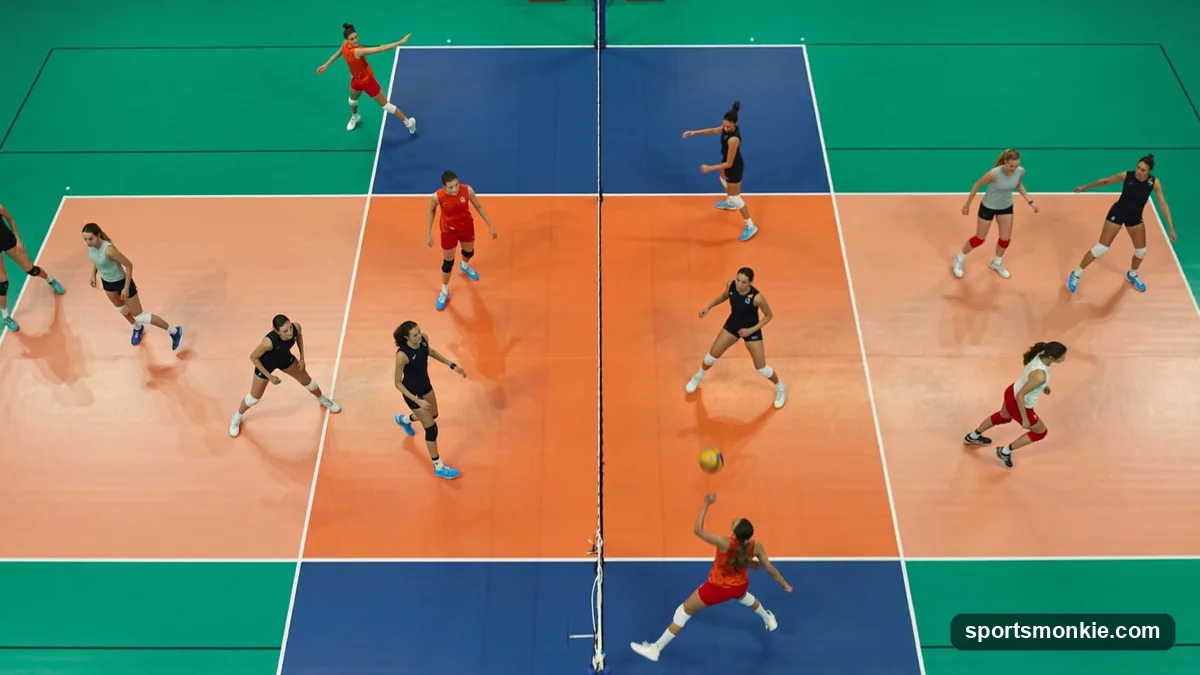
Volleyball positions numbers run 1 through 6 around the court: Position 1 is back-right (the server), 2 is front-right, 3 is front-middle, 4 is front-left, 5 is back-left, and 6 is back-middle — and the whole team rotates one zone clockwise every time it wins back the serve. These numbers are court coordinates, separate from job titles like setter or libero, and the FIVB uses them to enforce the overlap rule that governs legal rotational order.
Newcomers almost always conflate two different systems: the numbered zone a player must stand in at serve, and the specialist role that player actually performs. Here is exactly how the numbering works, why it matters for legality on court, and how it connects to the roles covered in our volleyball positions guide.
What do the numbers 1-6 actually track?
The six numbers label fixed zones on a team’s half of the court, tracked clockwise starting from the back-right corner. They exist so referees and players have an objective, language-neutral way to confirm every player is in the correct spot relative to their teammates the instant the ball is served. Once serve contact happens, the numbering’s legal function ends and players are free to move to their specialist positions.
The six zones, mapped exactly
| Zone number | Court location | Row | Notes |
|---|---|---|---|
| 1 | Back-right | Back | Server’s position for that rotation |
| 2 | Front-right | Front | Can block/attack above the net |
| 3 | Front-middle | Front | Middle blocker’s home zone |
| 4 | Front-left | Front | Can block/attack above the net |
| 5 | Back-left | Back | Major serve-receive and defense zone |
| 6 | Back-middle | Back | Deepest defensive zone, often libero territory |
Zones 2-3-4 make up the front row; zones 1-6-5 make up the back row. That front/back split is not cosmetic — it decides who is legally allowed to jump and hit or block a ball entirely above net height. Back-row players in zones 1, 6 or 5 can still attack, but only by taking off from behind the 3-metre attack line, a rule that also underpins how volleyball scoring works on rally points.
Position vs. role: why the distinction matters
A “position” in the numbered sense is a legal requirement enforced at one instant — the moment of serve. A “role” (setter, outside hitter, opposite, middle blocker, libero, defensive specialist) is the job a player does for the whole match regardless of which zone the rotation has carried them into. A setter might be standing in zone 1, 2, or anywhere else when the ball is served, and still be the setter. Confusing the two is the single most common beginner mistake: “position 6” is not a role like “middle blocker,” it is simply back-middle.
How rotation moves the numbers
Every time a team wins back the serve from its opponent, all six players shift one zone clockwise: 1 → 6 → 5 → 4 → 3 → 2 → 1. Concretely, the player in zone 2 (front-right) drops back to zone 1 to become the new server; the old zone-1 player slides to zone 6; zone 6 moves to zone 5; zone 5 to zone 4; zone 4 to zone 3; and zone 3 advances to zone 2. A team only rotates on a sideout (winning back the serve) — scoring a point while already serving does not trigger a rotation, under both FIVB and USA Volleyball rules.
Why the numbers matter for rotation faults
At the exact instant the server contacts the ball, every player must be in the correct order relative to their immediate neighbours by zone number — the overlap rule. A zone-5 player, for example, must not stand closer to the sideline than the zone-4 player in front of them, and back-row players cannot line up closer to the net than the front-row player directly ahead of them in the same column. Break that order and officials call an overlap fault, costing the serving or receiving team the rally. This overlap system is the entire reason the numbering exists — without it, referees would have no consistent way to check legality, a point covered in more depth in our volleyball rotation guide.
What happens to the numbers after the serve
The moment the ball leaves the server’s hand, the numbered restriction disappears. Teams immediately execute pre-planned switches so specialists reach their preferred real-estate: the setter releases from wherever the rotation dropped them and sprints to the target zone, middle blockers head to zone 3, and a libero swaps in for whichever back-row player the rotation has put in a defensive zone. The numbers only ever policed the starting alignment, never the live rally.
Real teams, real numbering in action
At the elite level, the zone-1 serving assignment is a weapon. USA’s Micah Christenson runs the offense as setter regardless of zone, but when he rotates through zone 1 he becomes the serving threat, forcing opponents to prepare a different serve-receive read. On the women’s side, a libero like Justine Wong-Orantes is almost always tracked into zones 5 and 6 by design, since coaches build rotations that keep their best passer in the deepest defensive numbers as often as legally possible. Both examples show the same truth: the number tells you where a player must stand at serve, not who they are.
Understanding the six numbers first makes every other volleyball concept click faster, from why a libero keeps entering and exiting near zone 6, to why a middle blocker’s quick attack always originates around zone 3. Pair this with the role breakdown in volleyball positions explained and the full mechanics in volleyball rotation explained for the complete picture.
Frequently asked questions
What do the numbers 1-6 mean in volleyball?+
The numbers 1 through 6 label the six court zones a team's players stand in, tracked clockwise starting at back-right. Position 1 is back-right (where the server stands), 2 is front-right, 3 is front-middle, 4 is front-left, 5 is back-left, and 6 is back-middle. Officials and coaches use these numbers to check rotational order and overlap legality at the moment of serve, not to describe a player's specialist role.
What position is number 1 in volleyball?+
Position 1 is the back-right zone of the court, and it is the serving position: whichever player rotates into zone 1 is the one who serves that rotation. It is not a fixed role like setter or libero — over a full rotation cycle, every player on the roster passes through position 1 and takes a turn serving before the team completes six rotations.
What is the difference between a volleyball position and a role?+
A position is the numbered court zone (1-6) a player must legally occupy at the moment of serve, enforced by the overlap rule. A role, such as setter, outside hitter, middle blocker or libero, is the specialist job a player performs regardless of which numbered zone the rotation has placed them in. Teams use pre-serve switching so specialists can slide to their preferred spot the instant the ball is contacted.
Which way does volleyball rotation go by number?+
Rotation moves clockwise through the numbers: 1 to 6 to 5 to 4 to 3 to 2, then back to 1. In practical terms, the player in zone 2 (front-right) drops back to zone 1 to serve, the zone 1 player slides to zone 6, zone 6 to zone 5, zone 5 to zone 4, zone 4 to zone 3, and zone 3 moves up to zone 2. This only happens when a team wins back the serve, not when it scores while already serving.
What zones are front row and back row in volleyball?+
Zones 2, 3 and 4 form the front row (front-right, front-middle and front-left), the only players allowed to block or attack a ball entirely above net height. Zones 1, 6 and 5 form the back row (back-right, back-middle and back-left); back-row players can attack from behind the 3-metre attack line but cannot block, under FIVB and USA Volleyball rules.
What is zone 5 in volleyball?+
Zone 5 is the back-left position on the court, one of the three back-row zones alongside zones 1 and 6. It is a key defensive and serve-receive spot, and many teams station their libero or best passer there because it covers a large share of deep-court defense against cross-court and line attacks.
Why do volleyball positions use numbers instead of names?+
Numbers give officials and players an unambiguous, language-independent way to check legal rotational order at serve contact, which the FIVB overlap rule requires. Role names like setter or hitter describe a job that can move to any zone, so they cannot police position on court the way a fixed 1-6 numbering system can.
Do libero and setter count as numbered positions?+
No. Libero and setter are specialist roles, not numbered court positions. A setter or libero is still assigned a numbered zone (1-6) at every serve based on where the rotation has placed them, and must respect the overlap rule in that zone just like every other player, even though their on-court job stays the same throughout the match.
Sources
Play & tools
Free browser games and tools — no account, no download.
- Play today's Sports Connections — Today's Sports Connections — daily hints, answers, and play the grid.
- Play Guess the NFL Player — A new mystery NFL player every day. Eight guesses, with a clue on each — plus free unlimited mode.
- Explore all our games →
Related guides
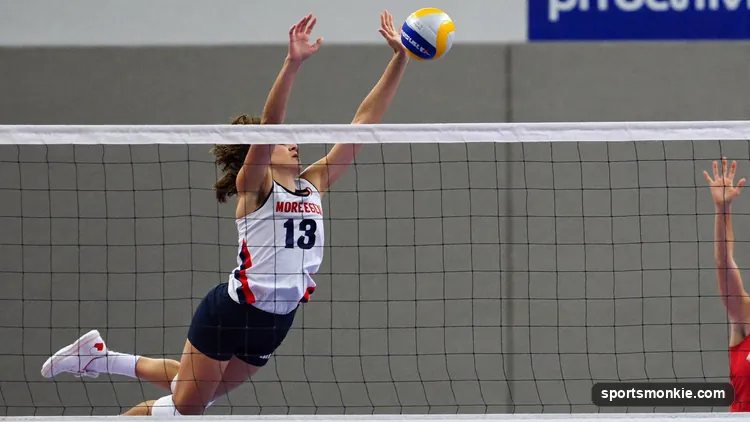
Middle Blocker in Volleyball: Role, Skills and Quick Sets Explained
A middle blocker volleyball player anchors the net's block and hits fast quick-tempo sets. Full guide to the role, footwork, quick sets and top players.
What Is the Volleyball Nations League (VNL)?
The Volleyball Nations League is FIVB's top annual national-team tournament, with 16 men's and 16 women's teams playing a group stage and a Finals each summer.

Beach vs Indoor Volleyball: Differences
Beach volleyball is 2v2 on sand with a smaller court and a softer, larger ball; indoor is 6v6 on a hard court. Key differences in rules, court and ball.

Volleyball Rotation Explained Simply
Volleyball rotation means the six players move one spot clockwise each time their team wins the serve. How rotation, serve order and overlap work.

Volleyball Net Height: Men, Women and Juniors
Official volleyball net height is 2.43 m (7 ft 11 5/8 in) for men and 2.24 m (7 ft 4 1/8 in) for women. Full chart for juniors, coed, beach and sitting.

Volleyball Positions Explained: Every Role
Volleyball has six player roles: setter, outside hitter, opposite, middle blocker, libero and defensive specialist. Each position explained clearly.