
How to Hit a Kick Serve: Grip, Toss, and Brush-Up Technique
On this page8
- 01What a Kick Serve Actually Does
- 02Step 1 — Set the Continental Grip
- 03Step 2 — Change the Toss Placement
- 04Step 3 — Load the Legs and Arch the Back
- 05Step 4 — Brush Up the Back of the Ball (7 to 1)
- 06Step 5 — Progressions to Groove the Kick
- 07Common Mistakes and Quick Fixes
- 08Choosing Gear and Building It Into Your Game
To hit a kick serve, hold a continental grip, toss the ball over your head and slightly to your left, and brush the strings up the back of the ball from 7 o’clock to 1 o’clock while driving upward off bent legs and arching your back. That low-to-high brush loads the ball with topspin, so it dips down into the service box and then jumps up high off the bounce. Done right, the kick serve is the safest aggressive second serve in tennis — it clears the net with margin yet still forces your opponent to hit from shoulder height.
What a Kick Serve Actually Does
A kick serve is a heavy topspin serve. Instead of driving through the back of the ball like a flat serve, you brush up and slightly across it, so the ball rotates end-over-end (topspin) with a touch of sidespin. That forward rotation does two things: air pressure pulls the ball down sharply after it crosses the net, letting you swing hard while still landing in, and the topspin makes the ball bounce high and kick away from the returner. If you already understand how to hit topspin in tennis off the ground, the serve uses the same physics — you are just applying it with the ball above your head.
The trade-off is speed. A kick serve is slower than a flat serve, which is exactly why it works as a second serve: you get net clearance and a high bounce instead of raw pace. Understanding how tennis scoring works makes the value obvious — a reliable kick second serve is what keeps you off the double-fault cliff on the most pressure-filled points.
Step 1 — Set the Continental Grip
The kick serve is built on the continental grip, the same edge-on grip you use for a flat or slice serve. Hold the racket as if you were about to hammer a nail with the frame’s edge, with the base knuckle of your index finger on bevel #2. This grip lets the strings pass up the back of the ball and lets your forearm pronate late in the swing, which is what turns a push into spin.
If you are still sorting out how the serving grip differs from your groundstroke grips, our overview of tennis grips explained maps every bevel to every shot. Note that the serve grip is not the eastern grip or the semi-western grip you may use for your forehand — some coaches do nudge advanced players a hair toward an eastern-backhand grip to exaggerate the brush, but start with a clean continental. Getting a comfortable, relaxed hold on the handle first is worth reviewing in how to hold a tennis racket, because a death-grip kills the wrist snap that spin depends on.
Step 2 — Change the Toss Placement
The toss is what separates a kick serve from a flat one. For a right-handed player:
- Toss over your head and slightly to your left — further back and left than your flat-serve toss.
- Keep it a touch lower than a flat toss so you can catch the ball on the way up, not at full stretch.
- Release from stiff fingertips so the ball has no spin of its own.
That behind-and-left placement forces your body to arch and your racket to travel up the back of the ball from low to high. If you toss out in front like a flat serve, you will hit through the ball and the kick disappears. Practice the toss on its own: set up, toss, and let the ball land — it should drop just behind your front foot and slightly to your left, roughly over your head.
Step 3 — Load the Legs and Arch the Back
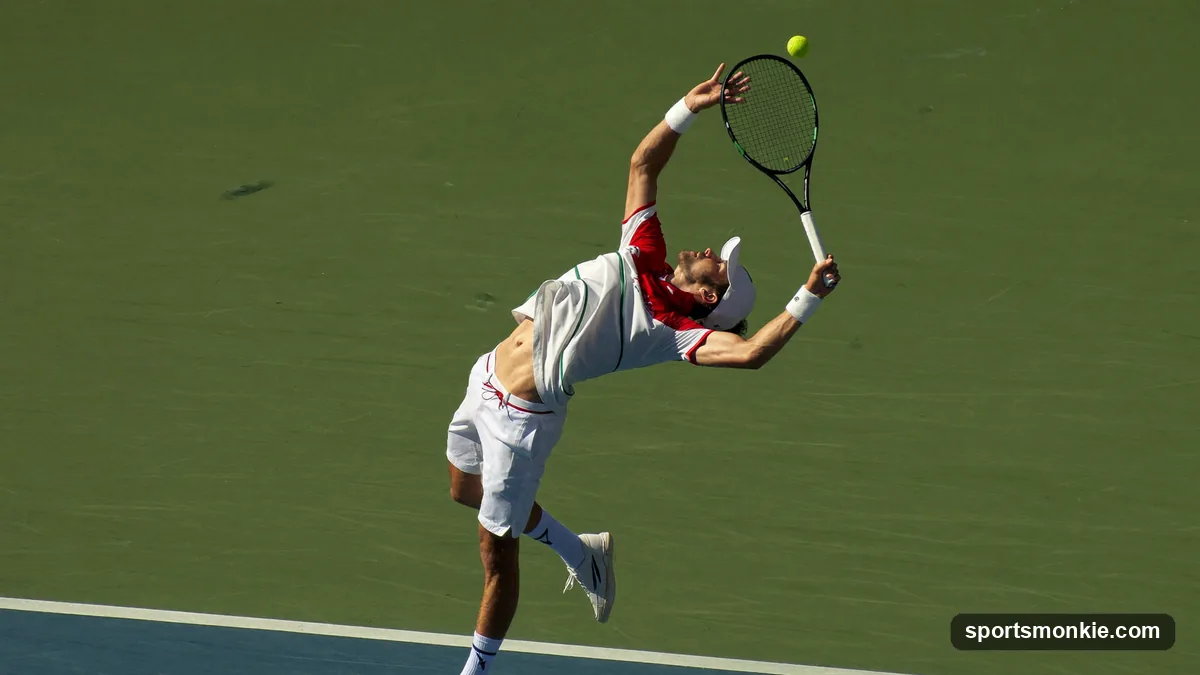
As the ball rises, coil into your trophy position: knees bent, racket dropping behind your back, tossing arm up, and shoulders tilted so your hitting shoulder drops below the front one. Then arch your back into a slight “banana” shape. This is the position that lets the racket swing upward through the ball rather than forward.
Leg drive is not optional here. The upward push from bent knees is what gives the racket head vertical speed, and vertical speed is topspin. A serve powered only by the arm produces a weak, spinless ball. Strong, balanced legs come from the court movement you build with tennis footwork drills, and the same coiled-and-uncoil loading you feel on a serve is the engine behind how to hit a tennis forehand and a heavy tennis backhand.
Step 4 — Brush Up the Back of the Ball (7 to 1)
This is the heart of the kick serve. As you drive up, swing the racket edge up the back of the ball on a low-to-high path — think of brushing from 7 o’clock to 1 o’clock on the back of the ball. Your strings graze up and slightly across the ball rather than smashing through it.
Cue the finish: your racket should travel up and out toward the right net post, and your forearm pronates late so the ball rotates forward. A useful feel is “throw the racket edge up at the sky, then let it fall.” Beginners almost always brush too flat and across, producing sidespin (a slice) instead of topspin (a kick). If the ball is skidding low instead of jumping, you are hitting across it, not up it. Slow everything down and exaggerate the vertical brush until you see the ball tumbling forward in the air.
Step 5 — Progressions to Groove the Kick
Build the serve in stages instead of trying to do everything at full speed:
- Spin-only drop feed. Stand at the baseline, toss, and brush up the back of the ball with a slow, relaxed swing. Ignore where it lands — you only want to see topspin rotation and hear the “zip” of the strings.
- Serve from the service line. Halve the distance and serve into the box, focusing on the up-and-over-left toss and the 7-to-1 brush. Land 7 of 10 before backing up.
- Knees-only, then full drive. Serve kneeling or from a static base to isolate the brush, then add the leg drive back in and feel the extra racket-head speed.
- Target the high bounce. From the baseline, aim to make the ball bounce above your practice partner’s shoulder in the ad court. Height of bounce, not speed, is the goal.
If you are brand new to the motion, fold these into a broader session of tennis drills for beginners so the serve develops alongside your footwork and groundstrokes rather than in isolation. For the full six-step serve motion that the kick builds on, see our guide on how to serve in tennis.
Common Mistakes and Quick Fixes
| Mistake | What it does | Fix |
|---|---|---|
| Toss too far in front | You hit through the ball; serve flattens out | Move the toss over your head and slightly left |
| Brushing across, not up | Sidespin (slice), ball skids low | Exaggerate the 7-to-1 low-to-high brush |
| No leg drive | No vertical racket speed, no topspin | Bend the knees and push up into contact |
| Gripping too tight | Kills wrist snap and pronation | Loosen the hand; let the racket accelerate freely |
| Rushing full speed | Motion never grooves | Build from spin-only feeds up to full serves |
Choosing Gear and Building It Into Your Game
Any racket can hit a kick serve, but a slightly more open string pattern and a comfortable string tension help you feel the brush — worth a look if you are shopping and reading up on how to choose a tennis racket. More important than gear is repetition: the arched-back, brush-up motion feels alien for the first few weeks, so keep the reps slow and frequent rather than long and forced.
Once the kick is landing, make it your default second serve. The margin over the net means fewer double faults, and the high, awkward bounce pushes returners deep behind the baseline or forces a defensive block you can attack. That combination of safety and pressure is why the kick serve is the single most valuable serve for club and college players to own.
Frequently asked questions
What grip do you use for a kick serve?+
Use the continental grip, the same edge-on grip used for slice and flat serves. It lets the strings brush up the back of the ball and pronate late, which is what generates topspin. Beginners sometimes shift slightly toward an eastern backhand grip to exaggerate the up-and-across brush, but the standard continental works for almost everyone.
Where do you toss the ball for a kick serve?+
Toss the ball over your head and slightly to your left (for a right-handed server), a little further behind and left than a flat-serve toss. That placement forces you to arch and brush up the back of the ball from low to high. If the toss drifts in front, you cannot get under it and the serve flattens out.
Why won't my kick serve kick?+
The most common reasons are a toss too far in front, brushing across the ball instead of up it, and no leg drive. Without upward racket-head speed you get sidespin, not topspin, so the ball skids rather than jumps. Fix the toss first, then exaggerate the low-to-high brush at half speed until the ball rotates forward.
Is a kick serve the same as a topspin serve?+
Essentially yes. A kick serve is a heavy topspin serve, sometimes with a small side component (a topspin-slice or twist serve). The pure topspin version bounces high and straight; the twist adds sidespin so the ball kicks up and to the side. Both rely on the same up-the-back-of-the-ball brushing motion.
How long does it take to learn a kick serve?+
Most players get a basic kicking action in a few focused sessions, but a reliable match-ready kick serve usually takes several weeks of regular practice. The brushing motion and arched-back position feel unnatural at first. Start with slow shadow swings and half-speed serves, then add pace and leg drive only once the ball is spinning forward.
Should I use a kick serve as a first or second serve?+
Most players use it as a second serve because the heavy topspin clears the net with margin and still lands in, reducing double faults. Advanced servers also use it as a first serve to pull opponents off the court with the high bounce. Its safety and the awkward bounce make it the go-to second-serve weapon at every level.
Sources
Play & tools
Free browser games and tools — no account, no download.
- Play today's Sports Connections — Today's Sports Connections — daily hints, answers, and play the grid.
- Play Guess the NFL Player — A new mystery NFL player every day. Eight guesses, with a clue on each — plus free unlimited mode.
- Explore all our games →
Related tennis guides
View all →
How to Serve in Tennis: Technique, Stance, and Tips
A tennis serve starts with the right grip, ball toss, and swing. This guide breaks down each step so you can build a consistent, powerful serve fast.
How to Hit a Tennis Backhand: Grip, Turn, Contact, and Drills
To hit a tennis backhand, turn your shoulders early, load with an Eastern backhand or two-handed grip, swing low-to-high, and make contact out in front of your front hip.
How to Hit a Tennis Forehand: Grip, Swing, and Topspin
How to hit a tennis forehand: use a Semi-Western or Eastern grip, turn your shoulders early, drop the racket below the ball, and swing low-to-high to contact out front.
How to Hit Topspin in Tennis: The Low-to-High Swing, Grip, and Drills
To hit topspin in tennis, use a semi-western grip and swing low-to-high so the racket brushes up the back of the ball. Here is the grip, swing path, contact point, and drills that build heavy spin on both wings.
Tennis Volley Technique: Grip, Punch, and Footwork to Win the Net
Master tennis volley technique with a continental grip, a short punch instead of a swing, a split-step, and contact out in front. Step-by-step form plus drills.

What Is an Ace in Tennis? Definition and Why It Matters
An ace in tennis is a legal serve that lands in the service box untouched by the receiver, winning the point outright. It is a server's top weapon.