
How Does Tennis Scoring Work? Points, Games, Sets Explained
On this page6
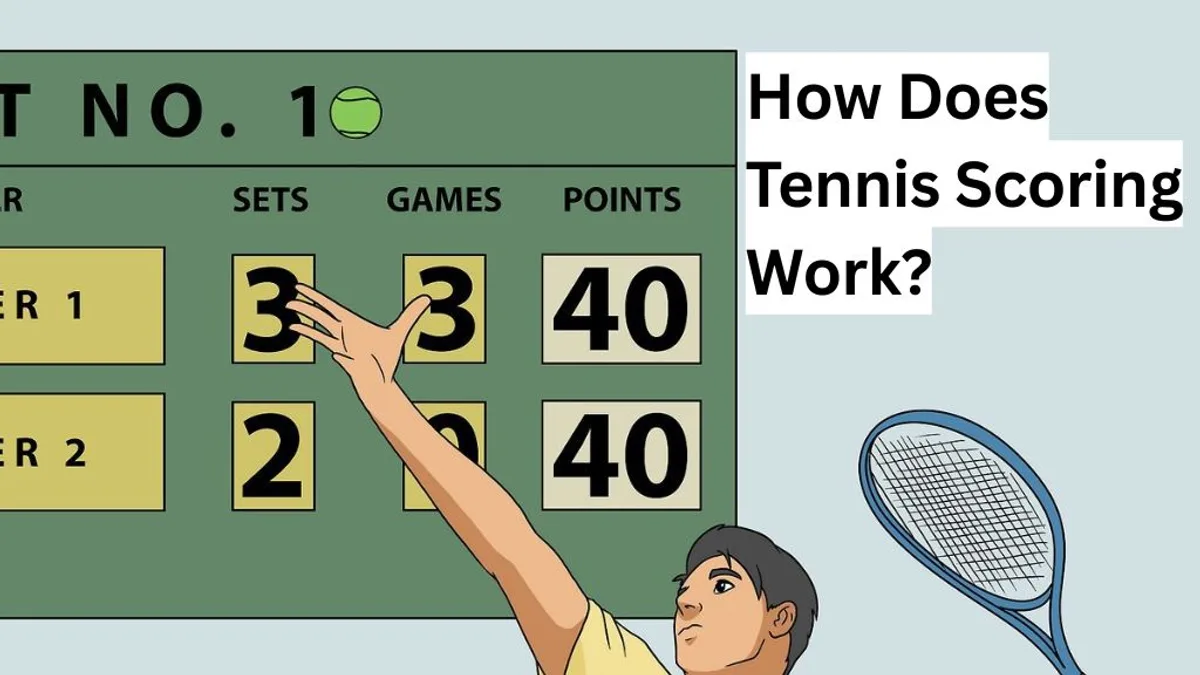
Tennis scoring works in three nested layers: points build into games, games build into sets, and sets decide the match. Within a game, points are called love (0), 15, 30, 40, then game, with deuce and advantage settling tied games. A player wins a set by taking six games with a two-game lead — or a tie-break at 6-6 — and wins the match by taking two or three sets, depending on the format.
This layered system is unique in sport — no other major game uses the 15-30-40 sequence — and it can baffle newcomers. Once it clicks, it explains why tennis produces so much drama: momentum resets constantly, and the right point at the right moment matters more than the raw point count.
The point system
A rally begins with the serve and ends when one player fails to return the ball legally. Each point won advances the score along a fixed sequence.
| Score name | Points won |
|---|---|
| Love | 0 |
| 15 | 1 |
| 30 | 2 |
| 40 | 3 |
| Game | 4 (if uncontested at 40) |
The server’s score is always called first, so “30-15” means the server has won two points and the receiver one. Winning four points is enough to win a game only if the opponent has 30 or fewer; a game tied at 40-40 goes to deuce.
Deuce and advantage
When both players reach 40 — each having won at least three points — the score is called deuce. From deuce:
- The player who wins the next point holds advantage.
- If they win the following point, they win the game.
- If they lose it, the score returns to deuce.
This repeats until one player wins two points in a row from deuce. Some formats use no-ad scoring, where a single point at deuce decides the game — common in doubles, college, and recreational play.
Games and sets
To win a set, a player must win at least six games and lead by at least two.
| Set score | Winner |
|---|---|
| 6-0 to 6-4 | Player reaching 6 first with a 2-game lead |
| 7-5 | Player reaching 7 after leading 6-5 from 5-5 |
| 7-6 | Winner of the tie-break |
If a set reaches 6-6, a tie-break is played to decide it.
The tie-break
In a standard tie-break, players race to seven points with a margin of at least two, and points are counted 1, 2, 3 — not 15, 30, 40. The first player to reach seven with a two-point lead wins the set 7-6. Service alternates: the opening server serves one point, then serve switches every two points, and players change ends every six points.
Since 2022, all four Grand Slams — the Australian Open, French Open, Wimbledon, and US Open — use a unified 10-point tie-break when the deciding set reaches 6-6. The first player to 10 points with a two-point margin wins the match. Before this change each major handled the final set differently, and the French Open played it out with no tie-break.
Reading a scoreline
A scoreline lists each set in order from left to right, with the match winner’s games first. Take 6-4, 3-6, 7-5:
- The listed player won the first set 6-4.
- They lost the second set 3-6.
- They won the third set 7-5, taking the match two sets to one.
Match formats
| Format | Sets to win |
|---|---|
| Best of 3 (WTA all events; ATP most events) | First to 2 sets |
| Best of 5 (ATP Grand Slam singles) | First to 3 sets |
Related terms
Understanding a few connected ideas makes the whole system clearer: deuce and ad describe tied games, a break point is a chance to win the receiver’s service game, and a grand slam refers to the four majors that use best-of-five and the 10-point final-set tie-break for men. Because the format rewards clutch play, a player can win fewer total points than the opponent and still win the match — which is exactly what keeps tennis so tactically unpredictable. To see how players actually construct those points, browse the main types of tennis shots.
Frequently asked questions
Why does tennis scoring go 15, 30, 40?+
The origins are debated, but the most widely accepted theory is that the score was kept on a clock face divided into quarters — 15, 30, 45 — with 45 later shortened to 40 to leave room for the advantage on the clock at deuce. Another theory ties the numbers to medieval French courtly games. No single explanation is confirmed by record.
What does 'love' mean in tennis?+
Love means zero. It is used at the start of a game (0-0 is 'love-all') and whenever a player has yet to win a point in the current game. A game won without conceding a point is a 'love game.' The term is often traced to the French 'l'oeuf' (egg, shaped like a zero), though this etymology is disputed.
What is deuce in tennis?+
Deuce is the score when both players reach 40-40, meaning each has won at least three points. From deuce a player must win two consecutive points to take the game — first earning 'advantage,' then winning the next point. If they lose the point after advantage, the score returns to deuce.
How many sets do you need to win a tennis match?+
In best-of-three matches — the WTA at all events and the ATP at most events outside the majors — a player needs two sets. In best-of-five, used for men's singles at the four Grand Slams, a player needs three sets. Women play best of three across all competitions, including the Grand Slams.
What happens at 6-6 in a set?+
At 6-6 a tie-break is played to decide the set, and the winner takes it 7-6. A standard tie-break goes to the first player to reach seven points with a two-point margin. In the deciding set of a Grand Slam, a longer 10-point tie-break is used instead of a standard one.
Do all four Grand Slams use the same final-set tie-break now?+
Yes. Since 2022 all four majors — the Australian Open, French Open, Wimbledon, and US Open — use a unified 10-point tie-break when the deciding set reaches 6-6. Before that each event handled the final set differently, and the French Open played it out with no tie-break at all.
What is no-ad scoring?+
No-ad scoring removes the advantage stage. When a game reaches deuce, a single 'sudden death' point decides it, with the receiver often choosing the return side. It speeds up matches and is common in college tennis, doubles, and many recreational leagues, but is not used for singles on the main ATP and WTA tours.
How do you read a tennis scoreline?+
Each set is shown in order from left to right, with the match winner's games listed first in every set. A line such as 6-4, 3-6, 7-5 means the listed player won the first set 6-4, lost the second 3-6, and won the third 7-5 to take the match two sets to one.
Sources
Play & tools
Free browser games and tools — no account, no download.
- Play today's Sports Connections — Today's Sports Connections — daily hints, answers, and play the grid.
- Play Guess the NFL Player — A new mystery NFL player every day. Eight guesses, with a clue on each — plus free unlimited mode.
- Explore all our games →
Related tennis guides
View all →
What Is Deuce in Tennis? Scoring Rules Fully Explained
Deuce in tennis is the 40-40 score where both players are tied and one must win two straight points to win the game. It repeats until someone leads by two.

How Does a Tiebreak Work in Tennis?
A tennis tiebreak decides a set locked at 6-6. First to 7 points wins, but you must lead by two. Here's scoring, serving order, and when tiebreaks happen.

What Is a Break Point in Tennis?
A break point is a point that, if won by the returner, wins the game against the server. Here is what it means, why it matters so much, and related terms.

What Does Ad Mean in Tennis? Advantage Scoring Explained
Ad in tennis means advantage, the point after deuce when one player needs one more to win. Win it to take the game; lose it and the score returns to deuce.
Why Do Tennis Players Change Ends?
Tennis players change ends to keep conditions fair when sun, wind, court wear and other environmental factors affect play.

What Is a Walkover in Tennis? Rules and Examples
A walkover in tennis happens when a player wins without playing because the opponent withdraws before the match starts. It differs from a retirement.