
What Is a Grand Slam in Tennis? The Four Major Tournaments
On this page6
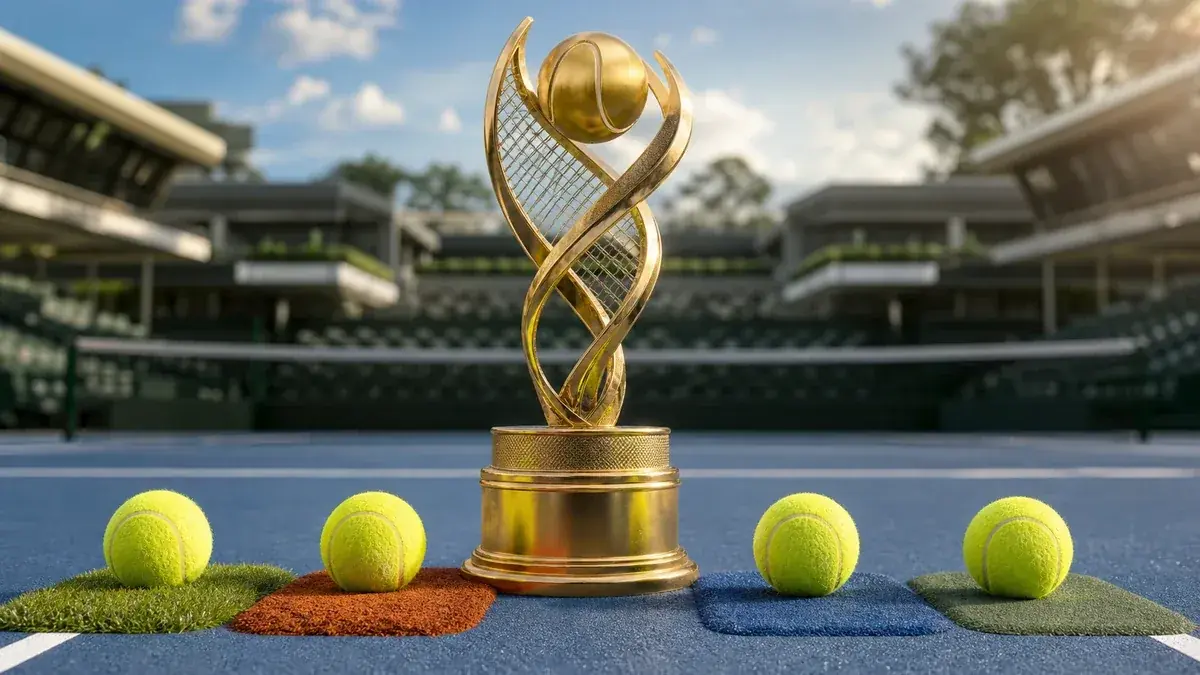
Four tournaments, four surfaces, four different weeks of the year, and yet everyone in tennis measures a career by the same short list: Australian Open, French Open, Wimbledon, US Open. Win one and you’re a champion. Win all four in the same year and you’ve done something almost nobody in the sport’s history has managed.
The Four Grand Slam Tournaments
Each Slam has its own surface and its own demands, which is why the players who win across all four tend to be remembered as the most complete.
| Tournament | Location | Surface | Approx. Date |
|---|---|---|---|
| Australian Open | Melbourne, Australia | Hard | January |
| French Open (Roland Garros) | Paris, France | Clay | May–June |
| Wimbledon | London, England | Grass | June–July |
| US Open | New York, USA | Hard | August–September |
Why Grand Slams Matter More Than Other Tournaments
Grand Slams outrank every other tour event, including Masters 1000s and the ATP/WTA Finals, in history, ranking points, and prize money. They’re the events every professional measures a career by.
Each one draws the full field and runs over two weeks of best-of-five-set matches for the men and best-of-three for the women, a grind that shorter tournaments simply don’t ask of players.
What Is a Career Grand Slam?
A Career Grand Slam means a player has won each of the four majors at least once, not necessarily in the same year. It’s far more common than a Calendar Grand Slam but still marks a serious career achievement, the kind that puts a name in the conversation about the sport’s best.
What Is a Calendar Grand Slam?
Winning all four Slams in a single calendar year is extraordinarily rare. In the Open Era (since 1968), Rod Laver did it in men’s singles in 1969, and he remains the last man to manage it. Novak Djokovic came closest in recent memory, winning the first three majors of 2021 before losing the US Open final. On the women’s side, Steffi Graf pulled it off in 1988, then added an Olympic gold that same year, which is where the “Golden Slam” comes from.
The Golden Slam
A Golden Slam means winning all four major titles plus Olympic singles gold in the same calendar year. Graf remains the only player to have done it.
Grand Slam Records and Milestones
Exact current counts shift with every tournament, so they’re not worth pinning down here. But the record for most Grand Slam singles titles in the Open Era belongs to a small handful of men and women, and the rivalries between them over the past two decades have pushed that total higher than in any previous era.
A natural follow-up read is Indian Wells Masters Tickets.
Frequently asked questions
What are the four Grand Slam tournaments in tennis?+
The four Grand Slams are the Australian Open (January, Melbourne), the French Open (May–June, Paris), Wimbledon (June–July, London), and the US Open (August–September, New York).
What is a Calendar Grand Slam in tennis?+
A Calendar Grand Slam means a player wins all four major titles within the same calendar year. It is one of the rarest achievements in the sport — only a handful of players have ever accomplished it in singles.
How many sets are played in Grand Slam matches?+
Men's singles Grand Slam matches are best-of-five sets. Women's singles and doubles matches across all four Slams are best-of-three sets.
Who was the last man to win the Calendar Grand Slam?+
Rod Laver of Australia, in 1969, when he won all four majors in a single year during the Open Era. He had also done it in 1962 as an amateur. No man has completed a Calendar Grand Slam since, though Novak Djokovic won three of the four in 2021.
What is the difference between a Career and a Calendar Grand Slam?+
A Career Grand Slam means winning each of the four majors at least once across a career, in any years. A Calendar Grand Slam means winning all four in the same calendar year, which is far rarer and one of the hardest feats in the sport.
What is a Golden Slam in tennis?+
A Golden Slam means winning all four Grand Slam singles titles plus Olympic singles gold in the same calendar year. Steffi Graf achieved it in 1988 and remains the only singles player, male or female, ever to have done so.
Why do the four Grand Slams use different surfaces?+
Each major grew from its own national tradition: the Australian and US Opens are on hard courts, the French Open on clay, and Wimbledon on grass. The variety tests different skills, which is why players who win across all four are rated among the most complete ever.
Sources
Play & tools
Free browser games and tools — no account, no download.
- Play today's Sports Connections — Today's Sports Connections — daily hints, answers, and play the grid.
- Play Guess the NFL Player — A new mystery NFL player every day. Eight guesses, with a clue on each — plus free unlimited mode.
- Explore all our games →
Related tennis guides
View all →
The Career Grand Slam in Golf, Explained
The career grand slam means winning all four professional majors in a career. Only six men have done it, most recently Rory McIlroy in 2025.

Who Invented Tennis? The History and Origins of the Sport
Modern tennis was invented by Major Walter Clopton Wingfield, who patented the lawn game Sphairistike in 1874. The first Wimbledon followed in 1877.

What Is a Grand Slam in Baseball?
A grand slam in baseball is a home run hit with the bases loaded, scoring all four runners for the maximum four runs possible on a single swing.
Greatest Tennis Players of All Time (Men's)
A ranked look at the greatest men's tennis players ever, from the Big Three of Djokovic, Nadal and Federer to Laver, Sampras and Borg, updated for 2026.
What Is Deuce in Tennis? Score, Advantage, and Tiebreaks
Deuce in tennis means both players have reached 40, so one player must win two straight points to take the game.
What Is Hawk-Eye in Tennis? How Electronic Line Calling Works
Hawk-Eye uses multiple cameras and ball-tracking software to judge whether a tennis shot landed in or out.