
Types of Tennis Courts: Hard, Clay, Grass & Carpet Explained
On this page9
- 01What are the 4 main types of tennis court?
- 02Hard courts: the modern standard
- 03Clay courts: red clay vs. green clay (Har-Tru)
- 04Grass courts: the original surface
- 05Carpet courts: why they disappeared from pro tennis
- 06Which Grand Slam is played on which surface?
- 07Tennis court surface comparison
- 08How court surface shapes the way you play
- 09The bottom line on tennis court types
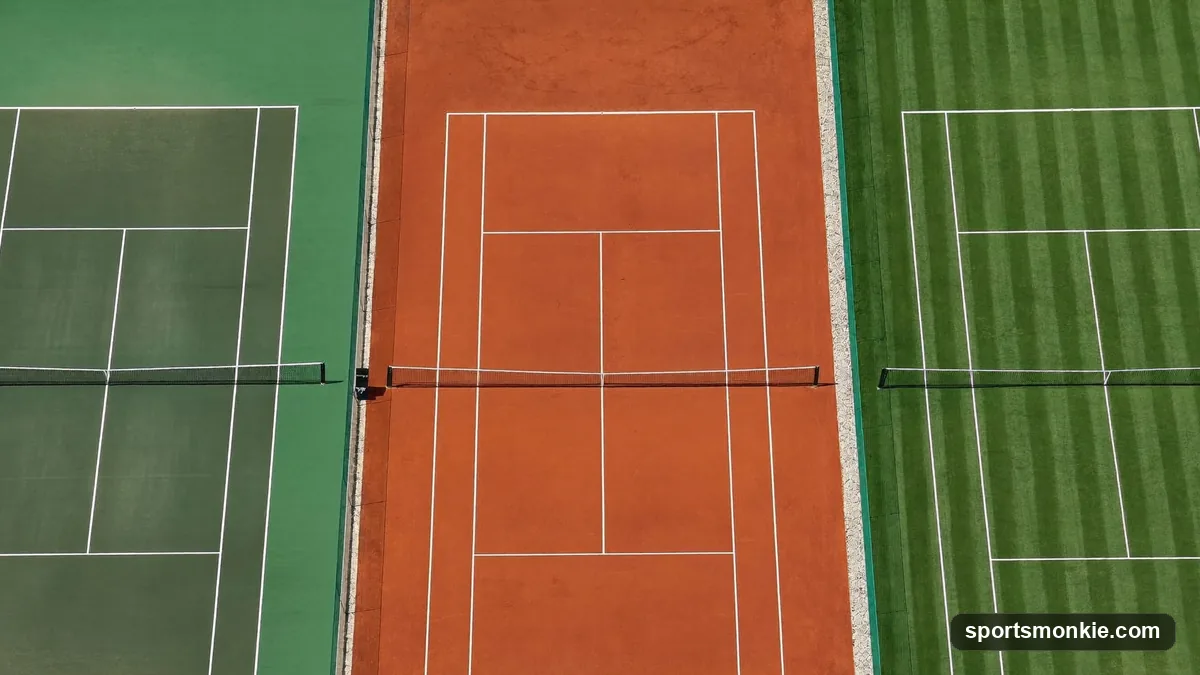
There are four types of tennis court surface — hard, clay, grass, and carpet — and each one changes how fast the ball travels and how high it bounces after landing. Hard courts (acrylic over concrete or asphalt) host the Australian Open and US Open. Clay hosts the French Open. Grass hosts Wimbledon. Carpet, once common indoors, has been phased out of the top professional tours since 2009. Governed globally by the International Tennis Federation (ITF), these four surfaces are the backbone of every level of the game, from racket sports played in a public park to Centre Court.
What are the 4 main types of tennis court?
Every sanctioned tennis court falls into one of four surface categories, and the ITF classifies each on a five-tier pace scale from Category 1 (slowest) to Category 5 (fastest) based on how the surface affects ball speed after the bounce.
- Hard court — acrylic coating over concrete or asphalt; Category 3 (medium-fast)
- Clay court — crushed brick (red) or crushed metabasalt (green/Har-Tru); Category 1-2 (slow)
- Grass court — natural turf over soil; Category 4-5 (fast)
- Carpet court — textile or polymeric material in rolls or sheets; historically Category 4-5 (fast), now rare above ITF World Tennis Tour level
That pace rating is what separates a “fast” court from a “slow” one in official terms — it is not a subjective label, it is a measured classification the ITF assigns to certify surfaces for sanctioned play.
Hard courts: the modern standard
Hard courts are layers of acrylic or polyurethane paint sprayed over a rigid concrete or asphalt base, then textured with sand to control friction. More sand in the top coat slows the bounce; less sand speeds it up. This is why the Australian Open and US Open can both call themselves “hard court” while still playing at noticeably different speeds — DecoTurf at the US Open and an acrylic system at the Australian Open are tuned differently.
Hard courts absorb very little energy on contact, similar to grass but without the low skid, so the ball bounces medium-to-high and keeps much of its pace. That combination of durability, low maintenance, and a predictable bounce is why the vast majority of public and school tennis court dimensions you’ll find anywhere in the world are hard courts.
Clay courts: red clay vs. green clay (Har-Tru)
Clay courts are built from crushed stone — usually limestone or shale — topped with a thin layer of fine clay particles. The surface is loose rather than fixed, which lets players slide into shots, a technique unique to clay.
There are two main variants. Red clay, made from crushed brick, is the surface at the French Open (Roland-Garros) and dominates courts across Europe and Latin America. Green clay, branded Har-Tru, is made from crushed metabasalt instead of brick, making it slightly harder and quicker than red clay; it’s found mainly in the mid-Atlantic and southern United States.
Clay’s granular top layer creates high friction, so the ball loses speed and bounces higher on contact than on any other surface. That favors long, patient rallies and baseline defenders over serve-and-volley attackers. It’s also the highest-maintenance surface: courts must be watered, rolled, and brushed before and during play to keep the texture consistent.
Grass courts: the original surface
Grass is where the sport began. Lawn tennis was invented on grass in the 19th century, and grass courts remain the surface at Wimbledon, the sport’s oldest championship, running continuously since 1877.
Because grass has almost no give and the blades are uneven, the ball skids low and keeps most of its speed rather than bouncing high — it rarely rises above knee height. That makes grass the quickest surface still used at a Grand Slam and rewards big serves, flat groundstrokes, and net play. The tradeoff is upkeep: grass is unplayable in rain, takes hours to dry, and wears out fast under repeated foot traffic, which is why the professional grass season is only a few weeks each June and July.
Grass used to be far more common at the top level. The US Open played its last grass-court edition in 1974, and the Australian Open switched away from grass in 1987, both moving to hard courts for durability and lower cost.
Carpet courts: why they disappeared from pro tennis
Carpet is the type most players today have never touched. The ITF defines it simply as “textile or polymeric material supplied in rolls or sheets,” and it was historically installed indoors over concrete for winter tournaments, playing fast and low like a fast grass court.
The ATP dropped carpet from its tour entirely in 2009, standardizing indoor events on hard courts to reduce the injury risk of switching surfaces mid-season. The WTA followed a similar path, with its last carpet event held in 2018. A handful of ITF World Tennis Tour events still use carpet, but it is effectively extinct at the top of the professional game — a rare case of a whole surface category being phased out by rule and scheduling rather than banned outright.
Which Grand Slam is played on which surface?
The four majors split across three of the four surfaces — no Grand Slam uses carpet.
| Grand Slam | Surface | Surface since |
|---|---|---|
| Australian Open | Hard court | 1988 |
| French Open (Roland-Garros) | Clay (red) | 1891 |
| Wimbledon | Grass | 1877 |
| US Open | Hard court | 1978 |
That spread is also why the “Grand Slam” is considered the toughest title in tennis to win in one calendar year: a player has to master three fundamentally different surfaces, from clay’s high, slow bounce to grass’s low, fast skid, inside four months.
Tennis court surface comparison
Speed and bounce height are the two numbers that actually separate these surfaces on court. This table lines them up alongside who each one favors and how much upkeep it demands.
| Surface | Ball speed | Bounce height | Favors | Maintenance |
|---|---|---|---|---|
| Grass | Fastest | Low, skidding | Big servers, net-rushers | Very high (weekly mowing, dries slowly) |
| Carpet | Fast | Low | Flat hitters, servers | Low, but not used at top level |
| Hard | Medium-fast | Medium-high | All-round, aggressive baseliners | Low (occasional resurfacing) |
| Clay | Slow | High | Defensive baseliners, sliders | High (daily watering, rolling, brushing) |
How court surface shapes the way you play
Surface doesn’t just change the bounce — it changes which shots actually work. On clay, a topspin-heavy player can grind out rallies because the high bounce gives extra time to set up; on grass, the same player has to shorten their swing and take the ball earlier because it stays low. That’s a big part of why types of tennis shots that dominate on one surface can be liabilities on another, and why players sometimes adjust their tennis string tension between clay and grass swings to compensate for the surface’s own speed.
The court itself has fixed geometry regardless of surface. Every regulation court is 78 feet (23.77 m) long, 27 feet (8.23 m) wide for singles, and 36 feet (10.97 m) wide for doubles, per the ITF Rules of Tennis. The tennis net height is fixed too — 3 ft 6 in (1.07 m) at the posts and 3 ft (0.914 m) at the center — on every surface from clay to carpet. What changes between surfaces is friction and give, not the lines; the tennis court lines explained guide covers how those markings stay identical no matter what you’re standing on. For a much tighter racket-sport space, compare it with our squash court dimensions breakdown.
Even equipment choices shift with surface. Players string parts of a tennis racket tighter for the extra bite clay demands and looser for grass’s low, fast exchanges, and the fuzz on a tennis ball matters more on clay, where a fluffed-up, clay-dusted ball behaves differently than a fresh one straight from the can.
The bottom line on tennis court types
Four surfaces, four different sports within a sport: hard courts for consistency, clay for grinding rallies, grass for speed and serve-and-volley, and carpet as a fast, largely retired indoor relic. The Grand Slam calendar puts three of them on full display every year, and knowing which is which explains most of what looks unpredictable about a player’s form swinging from Melbourne to Paris to London to New York.
Frequently asked questions
What are the 4 types of tennis court surfaces?+
The four types are hard, clay, grass, and carpet. Hard courts use an acrylic coating over concrete or asphalt. Clay courts use crushed brick (red) or crushed metabasalt (green/Har-Tru). Grass courts are natural turf. Carpet courts use textile or polymeric rolls and have been dropped from the ATP and WTA top-tier tours.
What is the fastest tennis court surface?+
Grass is the fastest surface still used at a Grand Slam, producing a low, skidding bounce that rewards serve-and-volley play. Carpet, before it was phased out of top-level tennis in 2009, was rated even faster in the ITF's pace classification, ranking as one of the quickest surfaces the sport has used.
Why does Wimbledon still use grass while other Grand Slams switched to hard courts?+
Wimbledon is tennis's oldest championship, dating to 1877, and grass is tradition it has chosen to preserve despite the cost. The US Open switched to hard courts in 1978 and the Australian Open in 1988 mainly because grass needs constant, expensive maintenance and cannot handle heavy year-round play like acrylic surfaces can.
What is the difference between red clay and green clay (Har-Tru)?+
Red clay is made from crushed brick and is the slower, higher-bouncing surface used at the French Open and across Europe and Latin America. Green clay, branded Har-Tru, is made from crushed metabasalt rather than brick, making it firmer and somewhat faster. Green clay is mostly found in the mid-Atlantic and southern United States.
Are carpet tennis courts still used in professional tennis?+
No, not at the top level. The ATP eliminated carpet from its tour in 2009 to standardize indoor events on hard courts and reduce injury risk, and the WTA's last carpet event ran in 2018. Some ITF World Tennis Tour events and lower-tier tournaments still use carpet occasionally.
What surface do most public and recreational tennis courts use?+
Most public tennis courts, especially in the United States, are hard courts made of acrylic layers over asphalt or concrete. Hard courts cost less to maintain than clay or grass, hold up in most weather, and offer a consistent, medium-fast bounce, which is why parks departments and schools favor them.
Does the court surface change how far a tennis ball bounces?+
Yes. Clay produces the highest, slowest bounce because its granular top layer absorbs energy and creates friction. Hard courts give a medium-to-high bounce with little energy loss. Grass gives the lowest bounce because blades and soil absorb pace unevenly, which is also why grass produces more bad bounces than any other surface.
Sources
Play & tools
Free browser games and tools — no account, no download.
- Play today's Sports Connections — Today's Sports Connections — daily hints, answers, and play the grid.
- Play Guess the NFL Player — A new mystery NFL player every day. Eight guesses, with a clue on each — plus free unlimited mode.
- Explore all our games →
Related tennis guides
View all →
Tennis Court Surfaces Explained: Hard, Clay, Grass, and More
Tennis is played on four surfaces, hard, clay, grass, and carpet, each with its own bounce, speed, and conditions. Here's what to know about every one.
Grass Court Tennis: Why the Fastest Surface Plays So Different
Grass court tennis is the fastest, lowest-bouncing surface in the sport, per ITF's own pace rating. How Wimbledon's ryegrass shapes serve-and-volley play.
Hard Court Tennis: Construction, Speed, and Why It's the Most Common Surface
Hard court tennis is played on rigid acrylic-coated asphalt or concrete, the medium-fast, most consistent surface used at the US Open and Australian Open.
How Much Do Tennis Courts Cost to Build? (2023 Guide)
Building a private tennis court typically costs $25,000 to $100,000+ depending on surface, site prep, fencing, and lighting. Hard courts are the cheapest.
Clay Court Tennis: Surface, Rules, and Why It Plays So Slow
Clay court tennis is the slowest surface with the highest bounce. See red vs. green clay, sliding, ball marks, upkeep, and why Nadal owns it.
Types of Tennis Shots: The Complete Guide to Every Stroke
The main types of tennis shots are groundstrokes, the serve, volleys, and specialty shots like the slice, lob, smash, and drop shot.