
Grass Court Tennis: Why the Fastest Surface Plays So Different
On this page8
- 01What is a grass court, and why does it play so fast?
- 02Why does the ball bounce so low on grass?
- 03What grass does Wimbledon use, and how short is it cut?
- 04Grass vs. clay vs. hard court: how the surfaces compare
- 05What playing style wins on grass?
- 06Why do grass court bounces get unpredictable as a tournament goes on?
- 07Why is the professional grass-court season so short?
- 08Who are the greatest grass-court players in tennis history?
Grass is tennis’s fastest surface, officially rated ITF Court Pace Category 5, because the ball skids off the low-friction blades instead of gripping them and rarely bounces above knee height. It’s also the sport’s original surface: lawn tennis was invented on grass in 1873, and the low, fast, skidding bounce it produces still can’t be replicated on clay or a hard court.
What is a grass court, and why does it play so fast?
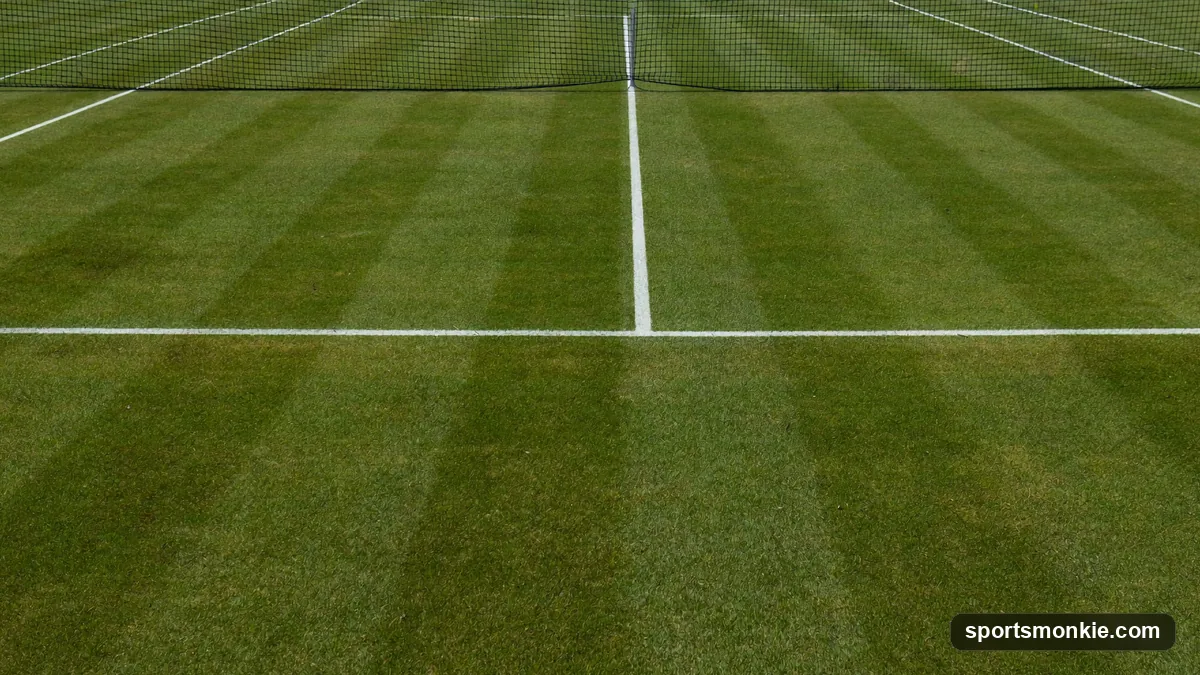
A grass court is a natural turf playing surface, typically ryegrass or a ryegrass-fescue blend grown over compacted soil. The blades of grass offer far less friction than an acrylic-coated hard court or crushed-brick clay, so when the ball strikes the surface it skids forward rather than “grabbing” and slowing down.
The International Tennis Federation quantifies this with its Court Pace Rating (CPR) system, described in Appendix I of the official Rules of Tennis. Surfaces scoring 45 or higher on the CPR scale fall into Category 5, the fastest classification, and the ITF explicitly names “most natural grass, artificial grass and some carpet surfaces” as examples. Hard courts typically sit in the medium-pace Category 3 band (a CPR of 35-39), and most clay courts fall into the slowest band, Category 1 (a CPR under 30).
Why does the ball bounce so low on grass?
Two things happen at once on contact. First, the living turf and the soil beneath it are soft and absorb much of the ball’s vertical energy, which flattens out the bounce. Second, because friction is low, the ball keeps most of its horizontal speed instead of losing it to the surface. The result, according to Wikipedia’s surface-physics summary, is a ball that “rarely rises above knee height” on grass, compared with a bounce that can reach hip or shoulder height on clay.
That combination — low bounce, high retained speed — is what makes grass tennis feel rushed even to elite returners. There’s less time to set up a stroke, and the ball is arriving lower than the swing most players groove on clay and hard courts.
What grass does Wimbledon use, and how short is it cut?
Wimbledon has sown its 18 Championship courts with 100% perennial ryegrass every year since switching from a 70% ryegrass/30% creeping red fescue mix for the 2001 tournament, according to Forbes’ interview with the All England Club’s grounds team. Ryegrass was chosen for durability: it tolerates the repeated foot traffic of a two-week Grand Slam far better than fescue does.
Grass height is managed on a strict seasonal taper. Courts are kept at 13 mm (about 0.5 inches) through the winter. From March onward, groundstaff lower the cut by roughly 1 mm every two weeks until reaching the tournament’s 8 mm (about 0.3-inch) playing height — a standard the club has held every year since 1995. During the Championships themselves, every court is mown daily to keep the surface even.
Grass vs. clay vs. hard court: how the surfaces compare
| Spec | Grass | Clay | Hard court |
|---|---|---|---|
| ITF pace category | Category 5 (fastest), CPR 45+ | Category 1 (slowest), CPR under 30 | Category 3 (medium), CPR 35-39 typical |
| Bounce height | Low, skidding — rarely above knee height | High, hip-to-shoulder height | Medium, consistent |
| Surface material | Perennial ryegrass over soil | Crushed brick, shale or stone | Acrylic-coated asphalt or concrete |
| Favored style | Serve-and-volley, big serving | Heavy topspin, long baseline rallies | All-court, balanced |
| Rain recovery | Many hours (slippery, unplayable) | Playable in light rain | 30-120 minutes |
| Grand Slams | Wimbledon | French Open (Roland Garros) | US Open, Australian Open |
Full breakdowns of each surface, including exact court markings, are in our clay court tennis and hard court tennis guides. For every surface tennis is played on, see our types of tennis courts overview.
What playing style wins on grass?
A fast, low, skidding bounce compresses a returner’s reaction time and makes it harder to load up a heavy topspin passing shot, so grass rewards the server. That’s why grass-court tennis has historically favored serve-and-volley players and big hitters who close the net behind a strong first serve rather than construct points from the baseline. Short, sharp points are the norm; grass matches typically feature far fewer shots per rally than clay-court tennis, where topspin sits up and rewards patient baseline construction.
The ITF’s official court dimensions apply on grass exactly as they do on any other surface: a 78-foot (23.77 m) court, 27 feet (8.23 m) wide for singles or 36 feet (10.97 m) for doubles, with the net at 3.5 feet (1.07 m) at the posts and 3 feet (0.914 m) at the center strap. What changes isn’t the geometry — it’s how the ball behaves once it lands inside it. Players who transition from other racket sports often notice grass rewards the same net-rushing instincts as squash or badminton far more than baseline sports do.
Why do grass court bounces get unpredictable as a tournament goes on?
Grass wears. Repeated footwork chews through the turf around the baseline, the service boxes, and along the “T,” and by the second week of a major tournament those zones can be down to bare, compacted soil. Once the grass thins, the ball’s bounce stops being purely a function of ITF’s pace rating and starts depending on exactly which blade, patch, or worn spot it lands on — it can skid low, sit up, or kick sideways with little warning. That variability is unique to grass; clay and hard courts don’t degrade shot-to-shot in the same way over a two-week event.
Why is the professional grass-court season so short?
Cost and weather. Grass is far more expensive to grow, mow, water and re-lay to tournament standard than clay or an acrylic hard court, and it stays wet and effectively unplayable for many hours after rain — a hard court, by contrast, can resume play in roughly 30 to 120 minutes once it’s toweled down. Those two constraints keep the ATP and WTA grass swing compressed into a tight 4-to-5-week window between the French Open and the end of Wimbledon, by far the shortest of the three surface seasons.
Who are the greatest grass-court players in tennis history?
Roger Federer is the modern benchmark: 8 Wimbledon singles titles, an Open Era-record 19 career grass-court titles, and a 65-match grass winning streak that ran from 2003 to 2008 before Rafael Nadal ended it in the 2008 final. Pete Sampras won 7 Wimbledon titles across two separate runs (1993-95 and 1997-2000), a serve-and-volley résumé that defined 1990s grass tennis. On the women’s side, Martina Navratilova holds the outright Wimbledon singles record with 9 titles, won across 1978-79, 1982-87 and 1990, including six in a row.
Since 1988, Wimbledon has been the only Grand Slam still played on grass — the Australian Open moved to hard courts that year, and the US Open switched away from grass in 1975 — which is why these records now define an entire surface, not just one tournament.
Frequently asked questions
Why is grass the fastest tennis surface?+
Grass has the lowest friction of any surface ITF tests, so the ball skids forward instead of gripping the turf and losing pace. Its Court Pace Rating of 45+ places it in ITF Category 5, the fastest classification, above hard courts (typically Category 3) and clay (typically Category 1).
Why does the tennis ball bounce so low on grass?+
The living turf and soil beneath it absorb vertical energy on impact, which flattens the bounce, while low friction lets the ball keep most of its forward speed. Wimbledon's ball rarely rises above knee height, compared with a hip- or shoulder-high bounce on clay, per Wikipedia's grass court surface data.
What grass does Wimbledon use?+
Wimbledon has sown 100% perennial ryegrass since 2001, replacing an earlier 70% ryegrass/30% creeping red fescue mix. Ryegrass was chosen because it withstands the wear of two weeks of competitive play better than fescue, holding a consistent playing surface from the first round through the final.
How short is Wimbledon's grass cut?+
Courts are mown to 8 mm (about 0.3 inches) for the Championships. Grounds staff bring the height down gradually from 13 mm (0.5 inches) in winter, trimming roughly 1 mm every two weeks from March until reaching the 8 mm playing height, a standard the All England Club has held since 1995.
Why do grass courts favor serve-and-volley players?+
A fast, low, skidding bounce gives returners less time to react and less margin to drive a passing shot with heavy topspin, so big servers who follow their serve to the net win more free points. That is why grass-court honor rolls are dominated by attacking players like Pete Sampras, Martina Navratilova and Roger Federer.
Why do grass court bounces get unpredictable during a tournament?+
Repeated footwork wears the turf down to bare patches, especially around the baseline and service boxes, within days of a major tournament starting. Once the grass thins, the ball can skid, sit up, or kick sideways depending on exactly where it lands, adding a bad-bounce variable that clay and hard courts don't have.
Why is the professional grass-court season so short?+
Grass is expensive to grow and maintain at tournament quality, and it stays wet and unplayable for many hours after rain, unlike a hard court that can resume in 30-120 minutes. Those costs and weather risks keep the ATP and WTA grass swing to roughly 4-5 weeks between the French Open and Wimbledon's close.
Who are the greatest grass-court tennis players ever?+
Roger Federer holds the men's record with 8 Wimbledon singles titles and an Open Era-record 19 grass-court titles overall, including a 65-match grass win streak from 2003-2008. Pete Sampras won 7 Wimbledons (1993-95, 1997-2000), and Martina Navratilova holds the outright record with 9 Wimbledon singles titles.
Sources
Play & tools
Free browser games and tools — no account, no download.
- Play today's Sports Connections — Today's Sports Connections — daily hints, answers, and play the grid.
- Play Guess the NFL Player — A new mystery NFL player every day. Eight guesses, with a clue on each — plus free unlimited mode.
- Explore all our games →
Related tennis guides
View all →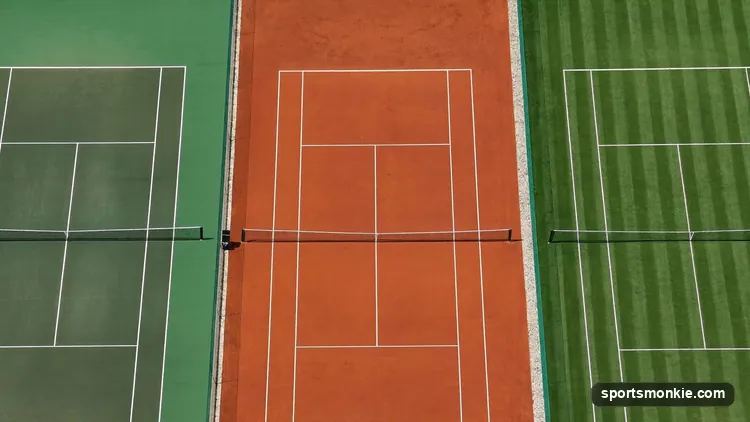
Types of Tennis Courts: Hard, Clay, Grass & Carpet Explained
The 4 types of tennis courts are hard, clay, grass, and carpet. See how each changes speed and bounce, and which surface every Grand Slam uses.
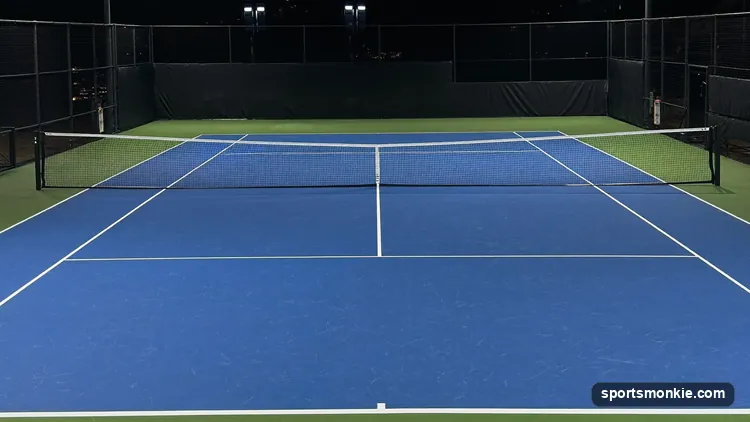
Hard Court Tennis: Construction, Speed, and Why It's the Most Common Surface
Hard court tennis is played on rigid acrylic-coated asphalt or concrete, the medium-fast, most consistent surface used at the US Open and Australian Open.
Tennis Court Surfaces Explained: Hard, Clay, Grass, and More
Tennis is played on four surfaces, hard, clay, grass, and carpet, each with its own bounce, speed, and conditions. Here's what to know about every one.
Clay Court Tennis: Surface, Rules, and Why It Plays So Slow
Clay court tennis is the slowest surface with the highest bounce. See red vs. green clay, sliding, ball marks, upkeep, and why Nadal owns it.
How Much Do Tennis Courts Cost to Build? (2023 Guide)
Building a private tennis court typically costs $25,000 to $100,000+ depending on surface, site prep, fencing, and lighting. Hard courts are the cheapest.
Tennis Court Lines Explained: Every Line, Named and Defined
Tennis court lines explained: baseline, sidelines, service line, centre service line, centre mark and net — ITF dimensions, singles vs doubles, in/out rule.