
Clay Court Tennis: Surface, Rules, and Why It Plays So Slow
On this page8
- 01What makes clay the slowest tennis surface?
- 02Red clay vs. green clay: what’s the difference?
- 03How is a clay court built and kept playable?
- 04Why do players slide on clay?
- 05How do ball marks decide close calls on clay?
- 06Clay court dimensions and surface comparison
- 07Why is Rafael Nadal called the King of Clay?
- 08Clay vs. grass vs. hard courts: which suits your game?
Clay is the slowest surface in tennis and produces the highest ball bounce, because its loose granular top layer grips the ball and kills pace on impact. That single property changes everything about how the game is played: rallies run longer, topspin becomes a weapon instead of a luxury, and players slide into shots instead of stopping their feet. Clay comes in two forms — red clay (crushed brick, the surface at the French Open) and green clay, branded Har-Tru in the United States (crushed metabasalt rock) — and both play radically differently from the grass and hard courts used at the sport’s other three majors.
What makes clay the slowest tennis surface?
Court speed comes down to friction and give. On clay, the top few millimeters are loose, crushed particles rather than a hard, sealed surface, so the ball’s felt digs in and loses energy on contact instead of skidding through. That friction both slows the ball’s forward pace and kicks the bounce noticeably higher than it would go off grass or a hard court, giving players extra time to track the ball down and load up a stroke.
The practical effect is a surface that rewards patience over power. Serve-and-volley tactics that thrive on grass largely die on clay, because a slowed second shot gives the returner time to load a heavy topspin reply before the server can close the net. That is why clay-court tennis is built around the baseline, not the net.
Red clay vs. green clay: what’s the difference?
Not all clay plays the same. Red clay and green clay differ in material, speed, and geography, and mixing them up is one of the most common errors in casual tennis writing.
- Red clay is made from crushed brick over a compacted limestone base, giving it the deep ochre color seen at Roland-Garros. It is the slowest surface used at Grand Slam level and dominates in continental Europe and Latin America.
- Green clay, marketed under the brand name Har-Tru, is crushed metabasalt rock rather than brick. It plays firmer and noticeably faster than red clay, and it is the clay surface most common at American clubs, high schools, and colleges.
Both surfaces still play slower and bounce higher than grass or hard courts, but green clay sits closer to a hard court in feel, while red clay sits at the extreme slow end of the spectrum.
How is a clay court built and kept playable?
A championship-grade clay court is a layered structure, not just a colored dusting on dirt. At Roland-Garros, each court is rebuilt almost from scratch every spring: crews strip and relay roughly five layers totaling about 80 cm (31 in) of material, from large stones and crushed gravel for drainage at the bottom, up through a moisture-retaining clinker layer, a 6–10 cm limestone slab that forms the actual playing base, and finally a thin 1–2 mm top dressing of crushed red brick that gives the court its color and its slide.
That construction demands constant upkeep during a tournament. Grounds crews water clay courts multiple times a day, brush the surface to keep it level, and roll it to stop the top layer from drying into dust or hardening into ruts. Because clay needs moisture to perform correctly, it is also one of the few surfaces still playable in light rain, which is why clay events lose fewer days to weather than grass or hard-court tournaments.
Why do players slide on clay?
Sliding into a shot is clay’s signature technique, and it is not optional at a high level — it is how players cover the extra ground that long, high-bouncing rallies demand. The loose top layer offers just enough resistance to let a player control a skid into the ball rather than either stopping dead or losing their footing entirely, the way they would on grass or a hard court.
Learning to slide changes footwork fundamentally: players plant late, let the front foot skid through the shot, and use that slide to load the next stroke rather than stopping and restarting. It is a skill most non-clay specialists have to build separately, which is one reason players who grow up on clay, especially in Spain and South America, tend to move so efficiently on the surface as professionals.
How do ball marks decide close calls on clay?
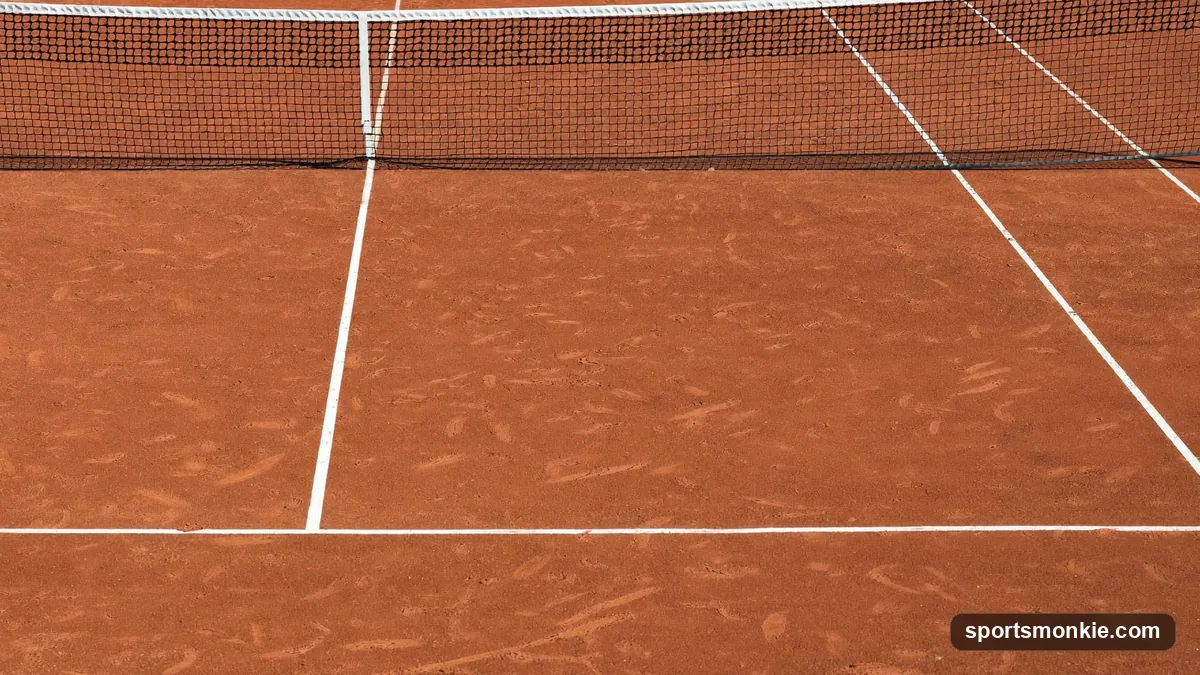
Clay has a built-in replay system that no other surface has: physical evidence. Every ball that lands leaves a visible mark in the loose top layer, and on tour, both players and umpires are permitted to walk over and inspect that mark to settle a disputed call. If the mark contradicts the umpire’s initial call, the call can be overturned on the spot, no electronic review needed.
This is why clay-court matches rarely use Hawk-Eye-style electronic line calling the way hard-court events do — the mark itself is treated as reliable evidence under ITF rules. It also produces some of tennis’s more theatrical moments, with players and umpires crouching over a smudge in the dirt to settle a point.
Clay court dimensions and surface comparison
Court size never changes between surfaces — only the material underfoot does. Every type of tennis court, whether clay, grass, or hard, uses the exact same ITF-mandated layout.
| Spec | Clay court | Grass court | Hard court |
|---|---|---|---|
| Court length | 78 ft (23.77 m) | 78 ft (23.77 m) | 78 ft (23.77 m) |
| Singles width | 27 ft (8.23 m) | 27 ft (8.23 m) | 27 ft (8.23 m) |
| Doubles width | 36 ft (10.97 m) | 36 ft (10.97 m) | 36 ft (10.97 m) |
| Net height (center / posts) | 3 ft / 3 ft 6 in (0.914 m / 1.07 m) | Same | Same |
| Relative speed | Slowest | Fastest | Medium-fast |
| Bounce height | Highest | Lowest, often skidding | Medium, consistent |
| Grand Slam example | French Open | Wimbledon | Australian Open, US Open |
Why is Rafael Nadal called the King of Clay?
No player has ever matched Rafael Nadal’s dominance on a single surface. Nadal won a record 14 French Open singles titles and finished his career with a win percentage over .900 on clay specifically, a level of surface specialization without precedent in the modern game. The nickname “King of Clay” is not marketing hyperbole; it describes a genuine, statistically extreme edge.
Nadal’s game maps almost perfectly onto what clay rewards. His heavy, high-bouncing lefty topspin forehand pushes returns above an opponent’s strike zone, exactly the shot clay’s slow pace and high bounce amplify. Pair that with elite sliding footwork and a physical capacity for five-hour rallies, and you get a player built for the surface’s every demand, from the wider racket-sports skillset of footwork and spin generation down to raw stamina.
Clay vs. grass vs. hard courts: which suits your game?
The three major surfaces reward almost opposite skill sets. A grass court plays fastest and lowest, rewarding flat, first-strike serves and net play because there is little time to set up a return. A hard court sits in the middle, offering a consistent, predictable bounce that suits an all-court, aggressive baseline game. Clay sits at the opposite end from grass entirely: it is slow, high-bouncing, and physically grinding, favoring players with heavy topspin, elite movement, and the patience to construct points over 10, 15, even 20 shots.
That’s also why the same player rarely dominates every surface in one season. A serve-heavy grass specialist can be neutralized on clay simply because the surface removes their biggest weapon — pace — while a clay grinder can struggle on grass because there isn’t enough time to build the long rallies their game depends on. Understanding which surface you’re playing on, and adjusting shot selection accordingly, is one of the most underrated skills in tennis at any level.
Frequently asked questions
Why is clay the slowest tennis surface?+
Clay is slowest because its loose, granular top layer absorbs energy and grips the ball's felt on impact, killing pace and kicking the bounce higher than grass or hard courts. That extra friction gives players more time to set up shots, which is why clay favors heavy topspin and long, patient baseline rallies over flat, first-strike power tennis.
What is the difference between red clay and green clay?+
Red clay is crushed brick over a limestone base, is the slowest of the two, and is used at the French Open and across Europe and Latin America. Green clay, branded Har-Tru in the US, is crushed metabasalt rock, plays noticeably faster and firmer, and is the more common clay surface in American club and college tennis.
Why do tennis players slide on clay courts?+
Players slide into shots on clay because the loose top surface offers just enough grip to control a controlled skid rather than a full stop, letting them cover wide balls without losing balance. Sliding is a learned skill unique to clay; the same technique on grass or hard courts would usually cause a fall.
How do umpires use ball marks to overturn calls on clay?+
Every ball leaves a visible mark in the clay where it lands, and on clay, players and umpires can walk over and inspect that mark to confirm whether the ball was in or out. Clay is the only ITF surface where a physical mark, not electronic review, is the accepted evidence for overturning a disputed line call.
Why did Rafael Nadal dominate clay so completely?+
Nadal won a record 14 French Open titles and built a career .919 win percentage on clay by pairing heavy topspin with elite sliding footwork and rally endurance, the exact skills clay's slow pace and high bounce reward most. His combination of a high-bouncing lefty forehand and relentless court coverage earned him the nickname the King of Clay.
How often are clay courts watered, and can you play in the rain?+
Clay courts are watered multiple times daily, including before play and often between matches, because the surface needs moisture to stay firm and consistent rather than dusty or cracked. Clay also drains and plays acceptably in light rain, unlike grass or hard courts, which is why clay events lose fewer days to weather delays.
Are clay court dimensions different from grass or hard courts?+
No. The ITF sets one set of court dimensions for every surface: 78 feet (23.77 m) long, 27 feet (8.23 m) wide for singles, 36 feet (10.97 m) wide for doubles, with a net at 3 feet (0.914 m) at center and 3 feet 6 inches (1.07 m) at the posts. Only the surface material changes, not the layout.
What is the only Grand Slam played on clay?+
The French Open at Roland-Garros is the only Grand Slam played on clay, using red clay courts rebuilt from the limestone base up every spring. The other three majors use hard courts (Australian and US Open) or grass (Wimbledon), which is why clay-court specialists and grass or hard-court specialists rarely dominate all four the same year.
Sources
Play & tools
Free browser games and tools — no account, no download.
- Play today's Sports Connections — Today's Sports Connections — daily hints, answers, and play the grid.
- Play Guess the NFL Player — A new mystery NFL player every day. Eight guesses, with a clue on each — plus free unlimited mode.
- Explore all our games →
Related tennis guides
View all →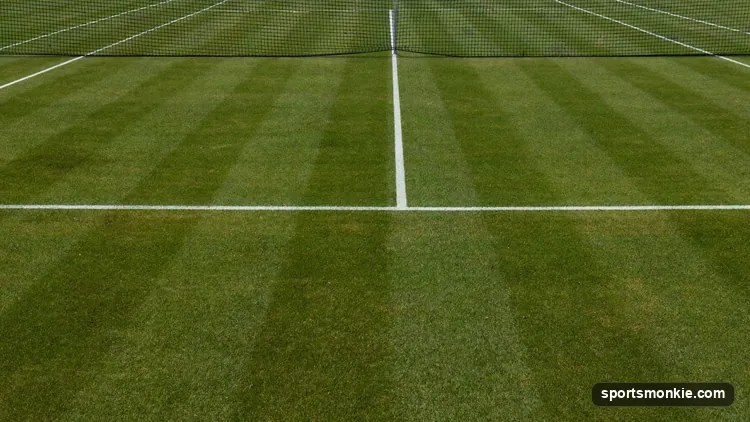
Grass Court Tennis: Why the Fastest Surface Plays So Different
Grass court tennis is the fastest, lowest-bouncing surface in the sport, per ITF's own pace rating. How Wimbledon's ryegrass shapes serve-and-volley play.
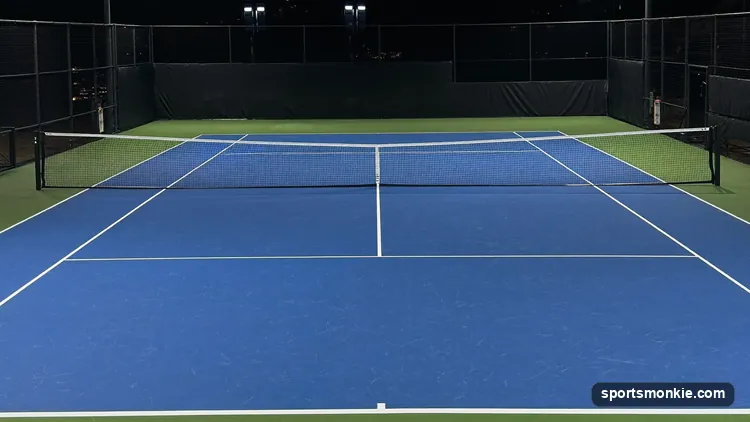
Hard Court Tennis: Construction, Speed, and Why It's the Most Common Surface
Hard court tennis is played on rigid acrylic-coated asphalt or concrete, the medium-fast, most consistent surface used at the US Open and Australian Open.
Tennis Court Surfaces Explained: Hard, Clay, Grass, and More
Tennis is played on four surfaces, hard, clay, grass, and carpet, each with its own bounce, speed, and conditions. Here's what to know about every one.
Tennis Court Lines Explained: Every Line, Named and Defined
Tennis court lines explained: baseline, sidelines, service line, centre service line, centre mark and net — ITF dimensions, singles vs doubles, in/out rule.
Types of Tennis Courts: Hard, Clay, Grass & Carpet Explained
The 4 types of tennis courts are hard, clay, grass, and carpet. See how each changes speed and bounce, and which surface every Grand Slam uses.
Tennis Court Dimensions and Space Needed
Official tennis court dimensions: 78 ft long, 36 ft wide for doubles, 27 ft for singles, plus total space needed, net height, lines and run-off.