
Tennis Court Lines Explained: Every Line, Named and Defined
On this page10
- 01What are the lines on a tennis court?
- 02The baseline: where you serve from and the back boundary
- 03The singles and doubles sidelines: what changes between formats
- 04The service line and service boxes
- 05The centre service line: splitting the service boxes
- 06The centre mark: the smallest line with the biggest job
- 07Do all lines follow the same width rule? ITF line specifications
- 08Is a ball on the line in or out?
- 09Which lines does singles use versus doubles?
- 10How court lines affect play
A tennis court is bounded by six distinct lines per end — the baseline, singles sideline, doubles sideline, service line, centre service line, and centre mark — and under ITF Rule 12, a ball touching any part of a boundary line is ruled in, not out.
Every one of those lines has an exact job. Missing one — thinking the doubles alley is in play during singles, or not knowing which line a serve has to clear — costs points that have nothing to do with skill. Below is what each line does, its official ITF measurement in both feet/inches and metres/centimetres, and how the rules actually use it during a match.
What are the lines on a tennis court?
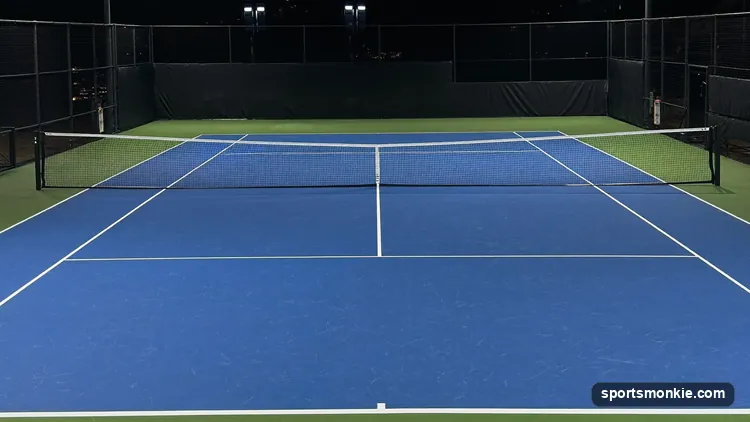
A full-size tennis court (78 ft / 23.77 m long) carries six named lines, mirrored on both ends and both sides:
- Baseline — the back boundary, at each end of the court
- Singles sideline — the side boundary for one-on-one play
- Doubles sideline — the outer side boundary, used only in doubles
- Service line — the line 21 ft (6.40 m) from the net that closes off each service box
- Centre service line — the line splitting each side’s service area into two boxes
- Centre mark — the short line at the midpoint of each baseline
Add the net, which physically divides the court rather than marking a boundary on the ground, and that’s the entire vocabulary of a tennis court’s markings.
The baseline: where you serve from and the back boundary
The baseline is the line at the very back of each half of the court, running the full width — parallel to the net and as far from it as any line gets. It is the court’s back-of-court boundary: any ball that lands beyond it, even by a fraction of an inch outside the line itself, is out.
The baseline also governs serving: ITF Rule 1 requires a server to stand behind it, between the extension of the centre mark and the singles sideline. It is the only line players must stand behind for a legal serve, which is why it takes more foot traffic than any other line — and why the ITF allows it to be painted wider than every other line: up to 4 inches (10 cm), versus 1-2 inches (2.5-5 cm) for the rest.
The singles and doubles sidelines: what changes between formats
Tennis uses two different width standards depending on the match type, and both sets of sidelines are painted on every full-size court at the same time:
- Singles sideline: sets the court at 27 feet (8.23 m) wide. This is the only sideline in play during one-on-one matches.
- Doubles sideline: sets the court at 36 feet (10.97 m) wide — 4.5 feet (1.37 m) further out on each side than the singles line.
The strip of court between the singles and doubles sidelines is called the doubles alley (or tramline). It is dead space in singles — a ball landing there is out — but fully in play in doubles, effectively adding 9 feet (2.74 m) of total width to the playing area.
The service line and service boxes
The service line is drawn parallel to the net, 21 feet (6.40 m) from it on each side, spanning between the singles sidelines. Every serve has to clear the net and land inside the service box — the rectangle bounded by the net, the service line, the singles sideline, and the centre service line — or it’s a fault.
Each service box measures 21 ft long by 13.5 ft wide (6.40 m by 4.11 m), since the centre service line splits the 27-foot singles width exactly in half. That gives four service boxes total on a full court: two on each side of the net, one for the deuce court and one for the ad court.
The centre service line: splitting the service boxes
The centre service line runs from the net to the service line, exactly halfway between the singles sidelines, dividing each side’s service area into the deuce court (right of centre, facing the net) and the ad court (left of centre). Server and receiver alternate which box is live point to point, which is why the score is announced before every serve. Under ITF rules the line is fixed at 2 inches (5 cm) wide — thicker than the minimum sideline width.
The centre mark: the smallest line with the biggest job
The centre mark is a short line, just 4 inches (10 cm) long, drawn at the midpoint of each baseline, perpendicular to it. It doesn’t bound any playing area — its only job is marking the exact centre of the baseline so a server knows where the boundary is between serving into the deuce court and the ad court. Like the centre service line, it’s painted 2 inches (5 cm) wide.
Do all lines follow the same width rule? ITF line specifications
Line width isn’t decorative — it’s a hard ITF spec, and it isn’t uniform across the court.
| Line | Length / span | Width (ITF) |
|---|---|---|
| Baseline | 27 ft / 8.23 m (singles) or 36 ft / 10.97 m (doubles) | Up to 4 in (10 cm) |
| Singles sideline | 78 ft / 23.77 m | 1-2 in (2.5-5 cm) |
| Doubles sideline | 78 ft / 23.77 m | 1-2 in (2.5-5 cm) |
| Service line | 27 ft / 8.23 m (between singles sidelines) | 1-2 in (2.5-5 cm) |
| Centre service line | 21 ft / 6.40 m (net to service line) | 2 in (5 cm), fixed |
| Centre mark | 4 in / 10 cm | 2 in (5 cm), fixed |
All court measurements are taken to the outside edge of each line, and every line must be a single colour that clearly contrasts with the playing surface, per ITF Rule 1.
Is a ball on the line in or out?
In. ITF Rule 12 is unambiguous: “If a ball touches a line, it is regarded as touching the court bounded by that line.” A ball only needs the smallest fraction of its surface to touch any part of a boundary line — baseline, sideline, or service line — to count as landing inside it. That’s why “just out” calls on tour are decided by Hawk-Eye tracking to millimetres: the margin is often invisible to the naked eye.
Which lines does singles use versus doubles?
The two formats share the same court but use different width boundaries:
- Singles uses the singles sidelines (27 ft / 8.23 m apart), the baseline, both service lines, the centre service line, and the centre mark. The doubles alley is not in play.
- Doubles uses the doubles sidelines (36 ft / 10.97 m apart) instead of the singles sidelines for the full length of the court — including the returns and rallies, not just serves. The service boxes stay the same size in both formats, since the service line and centre service line don’t change with format.
Net posts move too: for doubles they sit 3 feet (0.914 m) outside the doubles sidelines, while a dedicated singles net uses posts 3 feet (0.914 m) outside the singles sidelines. Both hold the net to the standard 3.5 ft (1.07 m) at the posts and 3 ft (0.914 m) at the centre strap.
How court lines affect play
Understanding the lines changes how you read a match. A serve clipping the outer edge of the service line is a legal ace, not a let. A groundstroke landing on the outer paint of the singles sideline is in during singles, even though it looks close to the doubles alley. And because the baseline is painted wider than other lines, a ball landing on its inner versus outer edge can be the difference between “deep but in” and genuinely out — exactly the kind of call that separates recreational disputes from tour-level Hawk-Eye reviews.
For the full build spec beyond just the lines — net height at the posts, surface types, and clearance space around the court — see our breakdown of tennis court dimensions. To see how the same lines are laid out across hard, clay, and grass builds, check types of tennis courts. If you’re wondering why the service boxes matter so much point to point, our guide on how tennis scoring works covers the deuce/ad court alternation in full. And for how tennis court markings compare with pickleball, padel, and squash, see our racket sports hub.
Frequently asked questions
What are the lines on a tennis court called?+
There are six named lines per end: the baseline (back boundary), two sidelines (singles and doubles), the service line, the centre service line, and the centre mark on the baseline. Together with the net, these lines define every boundary and target area a player has to track during a point, per the ITF Rules of Tennis.
Does a ball on the line count as in or out in tennis?+
In. ITF Rule 12 states that if a ball touches a line, it is regarded as touching the court bounded by that line — so any part of the ball making contact with any part of a boundary line is a legal, in-bounds shot. The ball does not need to land fully inside the line.
What is the difference between the singles line and the doubles line in tennis?+
The singles sideline sits 27 feet (8.23 m) apart and is the boundary for one-on-one matches. The doubles sideline sits 36 feet (10.97 m) apart, 4.5 feet (1.37 m) further out on each side. The strip between them, called the doubles alley or tramline, is in play only in doubles.
How far is the service line from the net in tennis?+
The service line is 21 feet (6.40 m) from the net on each side, drawn parallel to the net between the singles sidelines. It marks the far boundary of the service boxes, the area a serve must land in for the point to continue legally.
What is the centre service line for in tennis?+
The centre service line splits each side of the court into two equal service boxes — the deuce court (right) and the ad court (left). It runs from the net to the service line, halfway between the singles sidelines, and is 2 inches (5 cm) wide under ITF rules, the same width as the centre mark.
What is the centre mark on a tennis court?+
The centre mark is a short 4-inch (10 cm) line at the midpoint of each baseline. It tells a server exactly where the centre of the baseline is, since a serve must be struck from behind the baseline and between the centre mark and the singles sideline on the correct side.
Are all four lines around a tennis court the same width?+
No. ITF rules set most lines — sidelines and the service lines — between 1 and 2 inches (2.5-5 cm) wide. The centre service line and centre mark are fixed at 2 inches (5 cm), and the baseline is allowed to be wider than every other line, up to 4 inches (10 cm), because it is the most-watched boundary on the court.
Which lines are not used in singles tennis?+
The two doubles sidelines and the doubles alley between them are dead space in singles — any ball landing there is out. A singles match uses only the inner singles sidelines, the baseline, the service lines, the centre service line, and the centre mark.
Sources
Play & tools
Free browser games and tools — no account, no download.
- Play today's Sports Connections — Today's Sports Connections — daily hints, answers, and play the grid.
- Play Guess the NFL Player — A new mystery NFL player every day. Eight guesses, with a clue on each — plus free unlimited mode.
- Explore all our games →
Related tennis guides
View all →
What Is Hawk-Eye in Tennis? How Electronic Line Calling Works
Hawk-Eye uses multiple cameras and ball-tracking software to judge whether a tennis shot landed in or out.
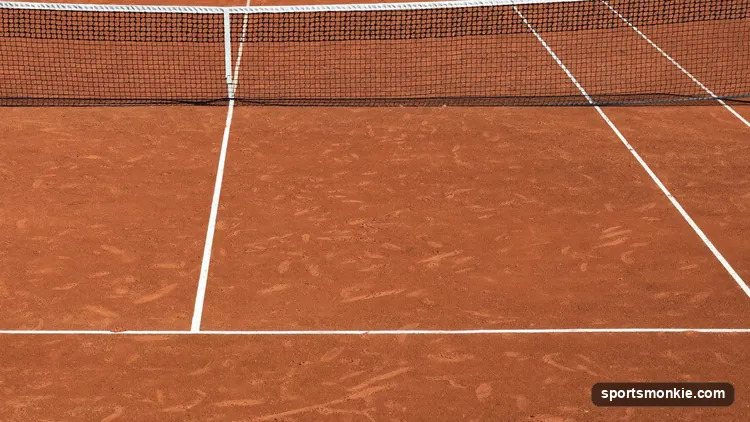
Clay Court Tennis: Surface, Rules, and Why It Plays So Slow
Clay court tennis is the slowest surface with the highest bounce. See red vs. green clay, sliding, ball marks, upkeep, and why Nadal owns it.
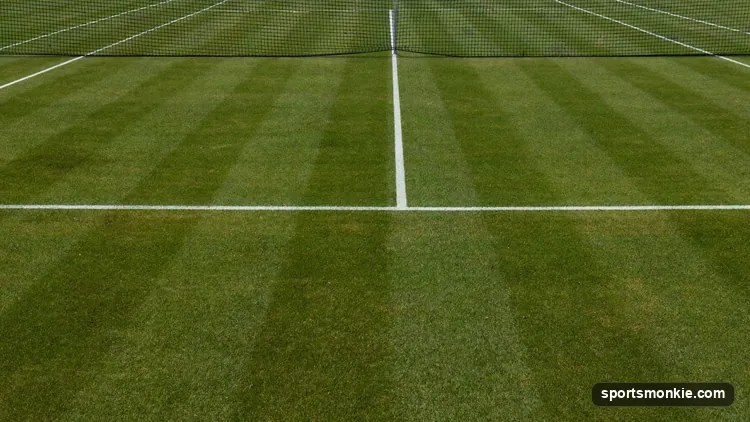
Grass Court Tennis: Why the Fastest Surface Plays So Different
Grass court tennis is the fastest, lowest-bouncing surface in the sport, per ITF's own pace rating. How Wimbledon's ryegrass shapes serve-and-volley play.
Hard Court Tennis: Construction, Speed, and Why It's the Most Common Surface
Hard court tennis is played on rigid acrylic-coated asphalt or concrete, the medium-fast, most consistent surface used at the US Open and Australian Open.
Types of Tennis Shots: The Complete Guide to Every Stroke
The main types of tennis shots are groundstrokes, the serve, volleys, and specialty shots like the slice, lob, smash, and drop shot.
Tennis Court Dimensions and Space Needed
Official tennis court dimensions: 78 ft long, 36 ft wide for doubles, 27 ft for singles, plus total space needed, net height, lines and run-off.