
Hard Court Tennis: Construction, Speed, and Why It's the Most Common Surface
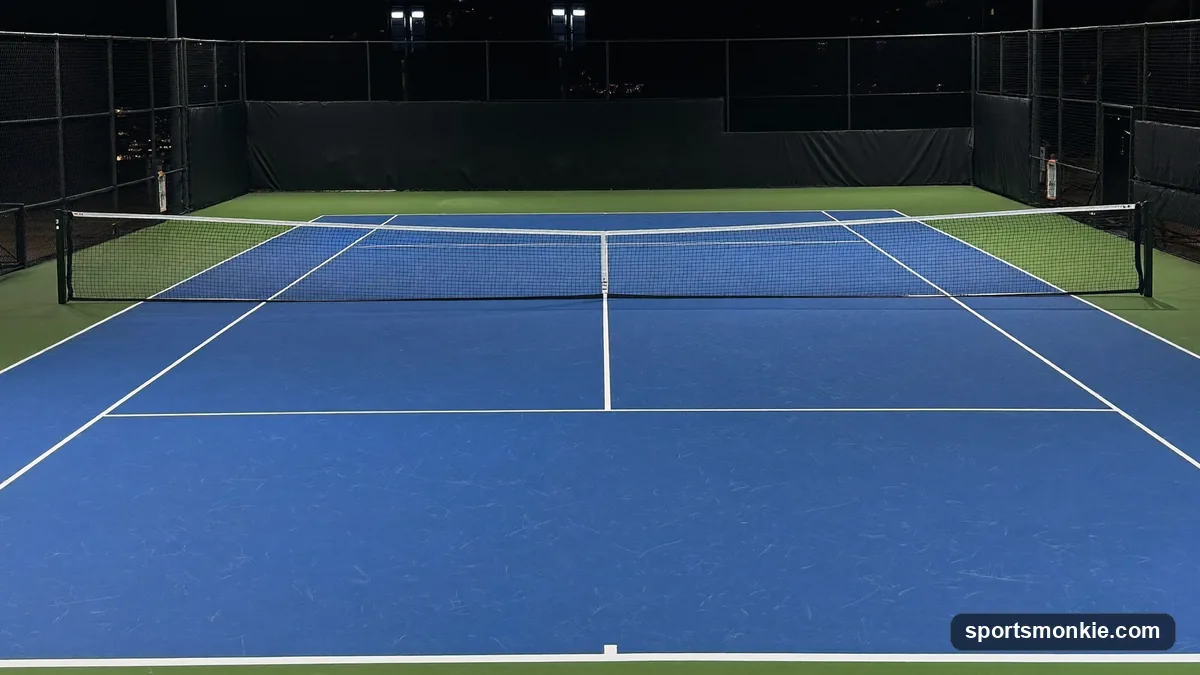
On this page7
- 01How Is a Hard Court Built?
- 02Why Does the Ball Bounce So Predictably on Hard Court?
- 03Can You Change How Fast a Hard Court Plays?
- 04Hard Court vs. Clay vs. Grass: How the Surfaces Compare
- 05Which Tournaments Are Played on Hard Court?
- 06Are Hard Courts Actually Harder on Your Body?
- 07Why Is Hard Court the Surface You’ll Actually Play On?
A hard court is a rigid asphalt or concrete surface sealed with several coats of acrylic resin paint, producing tennis’s most consistent, medium-fast bounce — and it’s the most common tennis surface on Earth. From the 23.77 m (78 ft) long, 8.23 m (27 ft) singles court at your local park to Arthur Ashe Stadium at the US Open, the marked dimensions never change under Rule 1 of the ITF Rules of Tennis — what changes is the surface underfoot, and hard court is by far the version most players actually stand on. This guide covers exactly how a hard court is built, why it plays the way it does, and how it stacks up against clay and grass. For the full rundown of every playing surface, see our guide to the different types of tennis courts.
How Is a Hard Court Built?
A hard court starts with a rigid, load-bearing base — either asphalt or concrete — that does not flex under a player’s weight. On top of that base, court builders apply several layers:
- Leveling and cushioning courses — one or more rubberized or acrylic-cushion layers that smooth out the base and add a small amount of shock absorption.
- Acrylic color coating — multiple coats (systems like Laykold typically use three to four) of colored acrylic resin, mixed with fine silica sand, that seal the surface, set its texture, and mark it visually.
- Line paint and final texture coat — the last layer that sets the exact grip and speed of the finished court.
Because the acrylic topcoat sits on an unyielding base, hard courts absorb far less energy from the ball than clay does, which is the mechanical reason they bounce truer and faster.
Why Does the Ball Bounce So Predictably on Hard Court?
Hard court produces what players and coaches call a true bounce: the ball comes off the surface at a consistent height and angle almost every time, because the acrylic coating is flat, hard, and uniform across the whole court. On clay, loose top dressing can cause skids or bad hops; on grass, uneven turf and low bounce make the ball’s path harder to predict. Hard court’s flat, painted surface removes most of that variability, which is exactly why it’s the surface most coaches recommend for learning shot-making fundamentals.
Can You Change How Fast a Hard Court Plays?
Yes — and this is the detail most surface guides skip. A hard court’s pace is not fixed; it’s tuned during construction by adjusting how much sand is mixed into the acrylic topcoat. More sand roughens the texture, increases friction between ball and surface, and slows the court down. Less sand produces a smoother, faster surface. That’s how the same basic hard-court system can be built to play anywhere from medium to medium-fast.
The ITF classifies every court surface product on a five-category Court Pace Rating (CPR) scale — Slow, Medium-Slow, Medium, Medium-Fast, and Fast — measured by firing a ball at the surface and timing its rebound speed. Hard courts are typically built and classified in the Medium to Medium-Fast bands, which is what puts them between clay (slow) and grass (fast) in real match play.
Hard Court vs. Clay vs. Grass: How the Surfaces Compare
| Hard Court | Clay Court | Grass Court | |
|---|---|---|---|
| Base material | Asphalt or concrete + acrylic coats | Crushed brick/shale on a stone base | Natural turf on soil |
| Typical ITF pace | Medium to Medium-Fast | Slow | Fast |
| Ball bounce | True, consistent, medium-high | Slow, high, sometimes skiddy | Low, fast, can be uneven |
| Grand Slams | Australian Open, US Open | French Open | Wimbledon |
| Joint/injury impact | Highest — no give in the base | Lowest — surface absorbs shock and allows sliding | Low-moderate, but footing can be unstable |
| Maintenance | Low; resurfaced every few years | High; watered, rolled, and swept daily | Very high; mown, watered, and rested constantly |
| Court dimensions | Same everywhere: 23.77 m (78 ft) long, 8.23 m (27 ft) singles / 10.97 m (36 ft) doubles wide | Same as hard court | Same as hard court |
The dimensions and net height — 0.914 m (3 ft) at center, 1.07 m (3.5 ft) at the posts — are identical on every certified surface, hard court included, because Rule 1 of the ITF Rules of Tennis governs the marked court, not the surface material.
Which Tournaments Are Played on Hard Court?
Two of the four Grand Slams are hard-court events, and both currently use branded acrylic systems rather than generic asphalt paint:
- US Open — played on Laykold, which replaced the long-running DecoTurf surface starting in 2020. Laykold uses a high-strength acrylic latex topcoat engineered for a consistent US Open-spec Court Pace Rating.
- Australian Open — played on GreenSet, which replaced the previous Plexicushion surface in 2020. GreenSet was adopted partly to lower court-surface temperature during Melbourne’s extreme summer heat, an issue that mattered less on Plexicushion.
Below the tour level, hard court dominates public and club tennis worldwide, across racket sports facilities from municipal parks to school gyms, because it needs almost no daily maintenance compared with grass or clay and can be played on almost immediately after rain, once dry.
Are Hard Courts Actually Harder on Your Body?
Yes, and this is the trade-off that comes with hard court’s consistency. Because the base underneath the acrylic coating doesn’t flex, the surface returns very little of the shock generated by running, stopping, and jumping — the player’s knees, ankles, hips, and lower back absorb it instead. Hard court’s higher friction also lets players decelerate and change direction more abruptly than they can on clay (where sliding disperses some of that force) or on grass (which has some natural cushioning in the turf). Sports-medicine reviews on tennis injury patterns consistently point to hard court as the surface associated with the most overuse and impact injuries on tour, including patellofemoral pain, ankle sprains, and stress-related tendon issues.
Why Is Hard Court the Surface You’ll Actually Play On?
Outside the pro tour, hard court is overwhelmingly the default. Grass courts require constant mowing, watering, and rest periods between matches, and clay courts need daily rolling, watering, and line-sweeping — both are expensive to maintain and impractical for most public facilities. A hard court, by contrast, can be built once, resurfaced every few years, and played on in nearly any dry weather. That durability and low upkeep is why the large majority of public parks, school courts, and community tennis centers around the world are hard courts, even in regions like the UK and Australia where clay or grass might otherwise be traditional.
Frequently asked questions
What is a hard court in tennis?+
A hard court is a rigid tennis surface built from an asphalt or concrete base topped with cushioning layers and several coats of acrylic resin paint. It produces a medium-fast, true bounce, sits between clay and grass for pace, and is the surface used at the US Open and Australian Open.
What are hard tennis courts made of?+
Hard courts are built on a rigid asphalt or concrete foundation, topped with rubberized cushioning layers for shock absorption, then finished with multiple coats of acrylic resin paint mixed with silica sand. The sand content controls texture and friction, which is why hard courts can be engineered slower or faster.
Is hard court faster than clay?+
Yes. Hard courts play medium to medium-fast on the ITF's five-category Court Pace Rating scale, while clay is a slow, high-bounce surface that absorbs more ball energy. Grass is generally the fastest surface, so hard court sits in between clay and grass for pace, closer to grass in bounce height.
Why are hard courts harder on the body than clay or grass?+
Hard courts have almost no give, so the concrete or asphalt base absorbs very little shock — the player's joints absorb it instead. Combined with high shoe-to-surface friction that lets players stop and cut abruptly, hard courts are widely linked by sports-medicine research to more knee, ankle, and lower-back strain than clay or grass.
Which Grand Slam tournaments are played on hard courts?+
Two of the four majors are played on hard courts: the Australian Open (on GreenSet acrylic, since 2020) and the US Open (on Laykold acrylic, since 2020). The French Open is played on clay, and Wimbledon is played on grass.
What is the difference between Laykold, GreenSet, and Plexicushion?+
All three are branded acrylic hard-court systems, not different surface types. Laykold is the current US Open surface (replacing DecoTurf in 2020). GreenSet is the current Australian Open surface, which replaced Plexicushion in 2020. They differ in cushioning formula and heat/sustainability performance, not in the basic hard-court construction.
Is hard court the most common tennis surface?+
Yes. Hard courts are the most widely used tennis surface in the world, dominating public parks, schools, and recreation centers because they're durable, low-maintenance, and playable in almost any weather compared with grass or clay, which both need constant upkeep.
Can the speed of a hard court be changed?+
Yes. Court builders adjust hard-court speed mainly by changing the amount of sand mixed into the acrylic topcoat — more sand raises friction and slows the ball down, less sand speeds it up. The ITF measures the result with its Court Pace Rating test, firing a ball at the surface to record rebound speed.
Sources
Play & tools
Free browser games and tools — no account, no download.
- Play today's Sports Connections — Today's Sports Connections — daily hints, answers, and play the grid.
- Play Guess the NFL Player — A new mystery NFL player every day. Eight guesses, with a clue on each — plus free unlimited mode.
- Explore all our games →
Related tennis guides
View all →
Grass Court Tennis: Why the Fastest Surface Plays So Different
Grass court tennis is the fastest, lowest-bouncing surface in the sport, per ITF's own pace rating. How Wimbledon's ryegrass shapes serve-and-volley play.
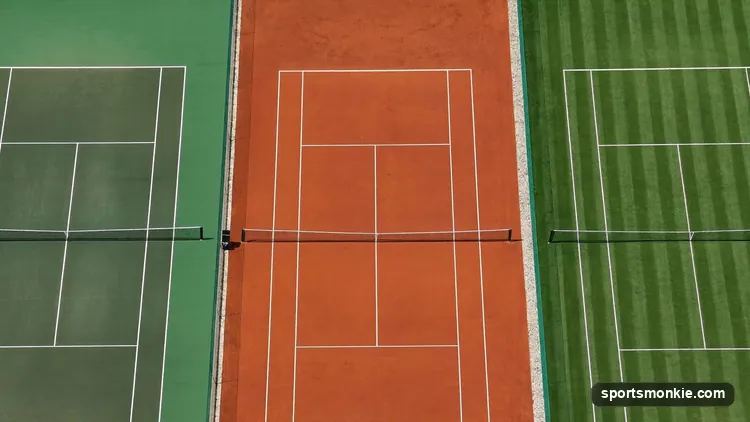
Types of Tennis Courts: Hard, Clay, Grass & Carpet Explained
The 4 types of tennis courts are hard, clay, grass, and carpet. See how each changes speed and bounce, and which surface every Grand Slam uses.
Clay Court Tennis: Surface, Rules, and Why It Plays So Slow
Clay court tennis is the slowest surface with the highest bounce. See red vs. green clay, sliding, ball marks, upkeep, and why Nadal owns it.
How Much Do Tennis Courts Cost to Build? (2023 Guide)
Building a private tennis court typically costs $25,000 to $100,000+ depending on surface, site prep, fencing, and lighting. Hard courts are the cheapest.
Tennis Court Surfaces Explained: Hard, Clay, Grass, and More
Tennis is played on four surfaces, hard, clay, grass, and carpet, each with its own bounce, speed, and conditions. Here's what to know about every one.
Tennis Court Lines Explained: Every Line, Named and Defined
Tennis court lines explained: baseline, sidelines, service line, centre service line, centre mark and net — ITF dimensions, singles vs doubles, in/out rule.