
Tennis String Tension: Full Guide to Power, Control, and What to Choose
On this page7
- 01What Is Tennis String Tension, Exactly?
- 02Standard Tension Range: 40-65 lbs (18-30 kg)
- 03Low Tension vs. High Tension: What Actually Changes
- 04How String Type Changes What Tension Does
- 05What Starting Tension Should You Use?
- 06How Long Does String Tension Last?
- 07Hybrid Stringing: Different Tension for Mains and Crosses
Tennis string tension typically runs 40-65 lbs (18-30 kg), and it’s the single biggest lever a player has over how a racket plays without buying a new frame. Lower tension lets the string bed flex more at contact, which adds power, spin window, and comfort; higher tension holds the bed tighter, which adds control and feel but sends more shock into the arm and gives back less free pace. String type changes how far that range stretches in either direction, and every string — regardless of tension — loses grip on that number from the moment it’s cut.
What Is Tennis String Tension, Exactly?
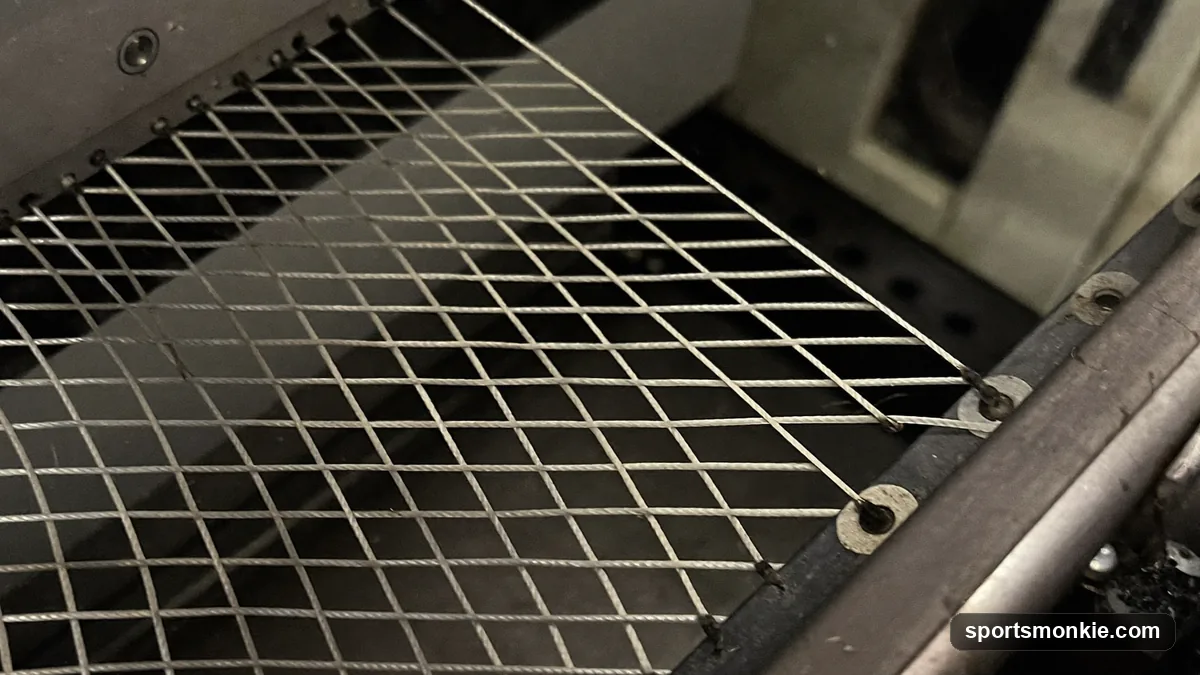
String tension is the pulling force a stringing machine applies to each individual string as it’s woven into the frame, measured in pounds-force (lbs) or kilograms-force (kg). It’s set string-by-string using a drop-weight, spring, or electronic constant-pull machine, and a number like “52 lbs mains / 50 lbs crosses” on a stringer’s work order is that pulling force at the moment of stringing — not a fixed property of the string itself.
Once the racket is strung, that tension immediately starts to drop. According to the ITF’s technical strings brief, even wooden rackets historically warped under sustained string load, and every material — natural or synthetic — is subject to “creep,” a gradual loss of tension over time whether or not the racket is being played.
Standard Tension Range: 40-65 lbs (18-30 kg)
Recreational and club players almost universally string in the 40-65 lb (18-30 kg) window, on a full bed with mains and crosses at the same or similar number. Most frames print a recommended range on the throat, like “50-60 lbs” — staying inside it keeps the frame and string bed behaving as the manufacturer designed.
| Tension band | Pounds (lbs) | Kilograms (kg) | Typical feel |
|---|---|---|---|
| Low / power | 40-50 | 18-23 | Maximum power, softest feel, least control |
| Mid | 50-58 | 23-26 | Balanced — the most common club range |
| High / control | 58-65 | 26-30 | Maximum control, less power, more arm shock |
| Tour extreme | 65-77 | 30-35 | Rare outside the pro tour, used with thin polyester |
The ITF’s own technical data traces how far tension has climbed: average racket tension sat around 20 kgf (44 lbf) in the 1920s and has since risen to over 25 kgf (55 lbf) today, with some professionals stringing polyester as tight as 35 kgf (77 lbf) — well above what’s advisable for a club player’s arm.
Low Tension vs. High Tension: What Actually Changes
The core trade-off is simple and holds true across every racket and every string type:
- Lower tension = more power, more comfort, less control. The string bed deforms more on contact, acting like a trampoline that returns more energy to the ball and absorbs more shock before it reaches your arm.
- Higher tension = more control, more feel, less power, more shock. A tighter bed deforms less, so the ball spends less time on the strings (shorter dwell time), giving you a more direct, predictable response but sending more of the impact force straight into your arm.
The ITF’s technical modeling puts a number on the power side of that trade-off: a 25% decrease in string tension produces roughly a 2% increase in groundstroke ball speed, and about a 1% increase on serves — a real but modest gain, which is why elite players rarely chase power through tension alone.
Control loss at lower tension comes from three compounding effects the ITF documents: the string bed distorts more on off-center contact (widening the angle the ball flies off at), the ball itself deforms less against a looser bed (shrinking the contact patch that steers it), and a longer dwell time lets the racket head rotate more mid-impact. That predictability trade-off is why the way you swing, covered in our guide to types of tennis shots, interacts so directly with tension choice — a flat, hard-swung shot punishes a too-loose string bed far more than a slower, spin-heavy one.
How String Type Changes What Tension Does
Not all strings respond to tension the same way. Material stiffness and construction shift the whole power/control/comfort equation, which is why “50 lbs” plays completely differently strung with polyester versus natural gut.
| String type | Feel at a given tension | Power | Comfort | Durability | Typical tension adjustment |
|---|---|---|---|---|---|
| Natural gut | Softest, most elastic, best tension retention | High | Highest | Low-moderate (moisture-sensitive) | String at the middle of your normal range |
| Multifilament (synthetic gut) | Soft, gut-like, many thin fibers twisted together | High | High | Moderate | String at the middle of your normal range |
| Synthetic gut (solid nylon core) | Firmer than multifilament, budget-friendly | Moderate | Moderate | Moderate | String at the middle of your normal range |
| Polyester (poly/“co-poly”) | Stiffest, least elastic, lowest power | Low | Low-moderate | Highest | String 3-6 lbs (1.5-3 kg) lower than gut/multi to compensate for stiffness |
Natural gut, made from the outer wall of animal intestine (originally sheep, now mostly cow) rather than any synthetic polymer, retains tension and flexes more consistently than any man-made alternative, which is why it’s still common in the cross strings of tour hybrids despite its cost and moisture sensitivity. Polyester sits at the opposite end — it’s so stiff and dead-feeling that most players who switch to it drop their usual tension by several pounds just to recover comparable power and comfort.
What Starting Tension Should You Use?
A tension chart is a starting point, not a rule. Use these as a first setting, then adjust in 2-4 lb (1-2 kg) steps based on how the racket feels after a few sessions:
- Beginners and players prioritizing comfort: 45-55 lbs (20-25 kg) — extra power and cushioning while your swing and consistency are still developing.
- Intermediate, all-around players: 50-58 lbs (23-26 kg) — the most common club range, balancing pace and placement.
- Advanced players with fast, full swings: 55-62 lbs (25-28 kg) — enough control to handle their own power without over-hitting.
- Players managing arm or elbow soreness: drop 3-5 lbs (1.5-2.5 kg) from your normal number, or switch to a softer multifilament or gut string, regardless of level.
Your racket’s own head size and string bed also factor in — a racket’s frame and its part specs, covered in our guide to the parts of a tennis racket, determine how much a given tension actually flexes the bed. Court surface matters too: players who spend most of their time on high-bounce, grippy surfaces (see our breakdown of types of tennis courts) often string a touch tighter for extra control on the longer, higher-bouncing rallies those surfaces produce.
How Long Does String Tension Last?
Tension loss starts the moment a string is cut, not when it eventually snaps. The industry rule of thumb ties restringing frequency to how often you play: restring as many times per year as you play per week. Play tennis twice a week, restring twice a year (roughly every six months); play five times a week, restring five times a year (roughly every ten weeks). Tournament players and coaches often restring even more often, since a string bed can lose meaningful tension — and with it, control — well before it looks worn or frays visibly.
Hybrid Stringing: Different Tension for Mains and Crosses
A hybrid bed uses two different strings — commonly a durable, low-power polyester in the mains (vertical) paired with a softer multifilament or natural gut in the crosses (horizontal) — sometimes at two slightly different tensions to fine-tune the blend. It’s standard on tour and increasingly common at club level, letting a player keep polyester’s spin and durability without giving up all the comfort a full-poly bed sacrifices. The same power/control logic that applies across racket sports broadly governs hybrids too: softer components add power and comfort, stiffer ones add control and durability, and mixing them lands a player somewhere in between.
Frequently asked questions
What tennis string tension should a beginner use?+
Beginners generally do best around 45-55 lbs (20-25 kg), toward the lower end of the standard 40-65 lb range. Lower tension flexes more at contact, which adds free power and cushions mishits — both useful while a beginner is still building a consistent, compact swing and hasn't yet generated much racket-head speed on their own.
Is lower string tension better for power?+
Yes. Lower tension lets the string bed deform more on contact, storing and returning more energy — like a trampoline. Per ITF technical data, a 25% drop in tension increases groundstroke ball speed by about 2% and serve speed by roughly 1%, which is why players chasing free pace tend to string lower.
What tension do professional players use?+
Most tour pros string well above club-player norms. ITF technical notes put average tension around 25 kgf (55 lbf) or higher, with some professionals stringing polyester as tight as 35 kgf (77 lbf) for maximum control on full-speed swings — far tighter than the 40-65 lb range recommended for recreational players.
How often should you restring a tennis racket?+
The standard rule is to restring as many times per year as you play per week — play twice a week, restring twice a year; play five times a week, restring five times a year. Strings lose tension from creep the moment they're cut, even if they never break, so a slack string bed loses control long before it snaps.
Does string tension affect how long strings last?+
Indirectly, yes. Higher tension puts more initial load on the string, which can accelerate notching and fraying at the cross points, especially with thinner gauges. But strings degrade mainly through creep and abrasion regardless of starting tension, so playing frequency matters more than the exact number on the tension head.
What's the difference between hybrid string tension and full-bed tension?+
A hybrid setup uses two different strings — often a durable polyester main and a softer multifilament or gut cross — sometimes strung at two slightly different tensions. This blends the control and spin of polyester with the comfort of a softer cross, without needing to compromise on a single all-around string.
Can tight string tension cause arm pain or tennis elbow?+
It can contribute. Higher tension transmits more shock straight into the arm on off-center hits because the string bed absorbs less energy itself. Players managing elbow or wrist soreness are commonly advised to drop tension a few pounds and/or switch toward a softer multifilament or natural gut string.
Sources
Play & tools
Free browser games and tools — no account, no download.
- Play today's Sports Connections — Today's Sports Connections — daily hints, answers, and play the grid.
- Play Guess the NFL Player — A new mystery NFL player every day. Eight guesses, with a clue on each — plus free unlimited mode.
- Explore all our games →
Related tennis guides
View all →
How to Choose a Tennis Racket: A Buyer's Guide for All Levels
Choosing a tennis racket depends on your skill, style, and build. Beginners want larger heads and lighter frames; pros prefer control and heavier weight.
Tennis Grip Size Guide: How to Measure and Choose (US Sizes)
A tennis grip size guide: measure with the index-finger test or a ruler, match it to the US L0–L5 scale (4 to 4-5/8 in), and size down when you plan to add an overgrip.
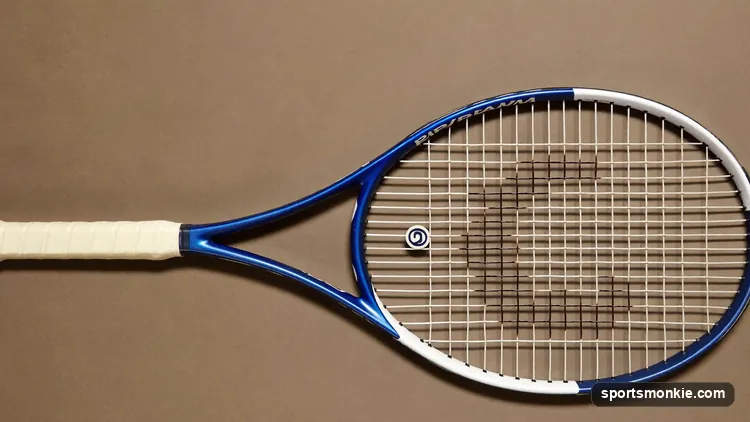
Parts of a Tennis Racket: Every Component and Spec Explained
The parts of a tennis racket are the head, strings, grommets, throat, shaft, beam, handle, grip, butt cap, and bumper guard. Full guide with specs.
How Much Do Tennis Courts Cost to Build? (2023 Guide)
Building a private tennis court typically costs $25,000 to $100,000+ depending on surface, site prep, fencing, and lighting. Hard courts are the cheapest.

Tennis Shoes for Teens: What to Look For and Why It Matters
The right tennis shoes for teens match sole type to court surface, support growing feet, and offer durability that keeps up with heavy practice schedules.
Stefan Milicevic Banned for 24 Years After Running a Match-Fixing Network
Serbia's Stefan Milicevic, a former world No. 1,338, has been banned until 2050 and fined $70,000 after the ITIA found he fixed six matches and recruited other players.