
Tennis Grip Size Guide: How to Measure and Choose (US Sizes)
On this page7
Tennis grip size is the circumference of your racket handle, measured in inches on the US L0–L5 scale (4 to 4-5/8 in). To find yours, hold the racket and check the gap between your ring-finger tip and your palm: it should fit exactly one index finger. Most adults land at 4-1/4 in (L2) or 4-3/8 in (L3). When you fall between two sizes, pick the smaller one — you can always add an overgrip to build it up, but a handle that is too big can never be shaved down.
What tennis grip size means
Grip size is the distance around the racket’s handle, not its length or weight. Handles are eight-sided (octagonal), and each flat face is a bevel; the size number is the circumference across all eight bevels. Getting it right matters because your hand has to both hold the racket securely and release the wrist freely to generate spin and serve speed. A handle that is off by even one size changes how your wrist rolls through a tennis forehand and how cleanly you can switch grips at the net.
The size is set by the manufacturer and molded into the handle, so it is not something you adjust with string tension or racket weight. It is the one racket spec fitted to your body rather than your playing style, which is why it deserves its own measurement rather than a guess. If you are buying your first frame, read this alongside our full guide to how to choose a tennis racket, where grip size is one of four core fit decisions.
US grip sizes chart (L0–L5)
The industry uses two parallel scales: a US measurement in inches and a European “L” number. They map directly onto each other. This table is the one to screenshot before you shop.
| US size (inches) | Euro “L” size | Circumference | Typical player |
|---|---|---|---|
| 4 in | L0 | 4 inches | Juniors, small-handed women |
| 4-1/8 in | L1 | 4.125 inches | Many women, teens |
| 4-1/4 in | L2 | 4.25 inches | Women, smaller-handed men |
| 4-3/8 in | L3 | 4.375 inches | Most adult men |
| 4-1/2 in | L4 | 4.5 inches | Larger-handed men |
| 4-5/8 in | L5 | 4.625 inches | Very large hands (rare) |
Each step up the scale adds 1/8 in (0.125 in) to the circumference. That gap is small in numbers but obvious in the hand, so the two sizes on either side of yours will feel clearly wrong once you know your baseline. Junior frames go smaller still — 3-1/2 in to 3-7/8 in (L000–L0) — but those grips are usually fixed to the racket and not chosen separately.
How to measure your grip size: two tests
There are two reliable ways to find your size at home, and doing both takes under a minute. Neither needs a store.
The index-finger test (most accurate)
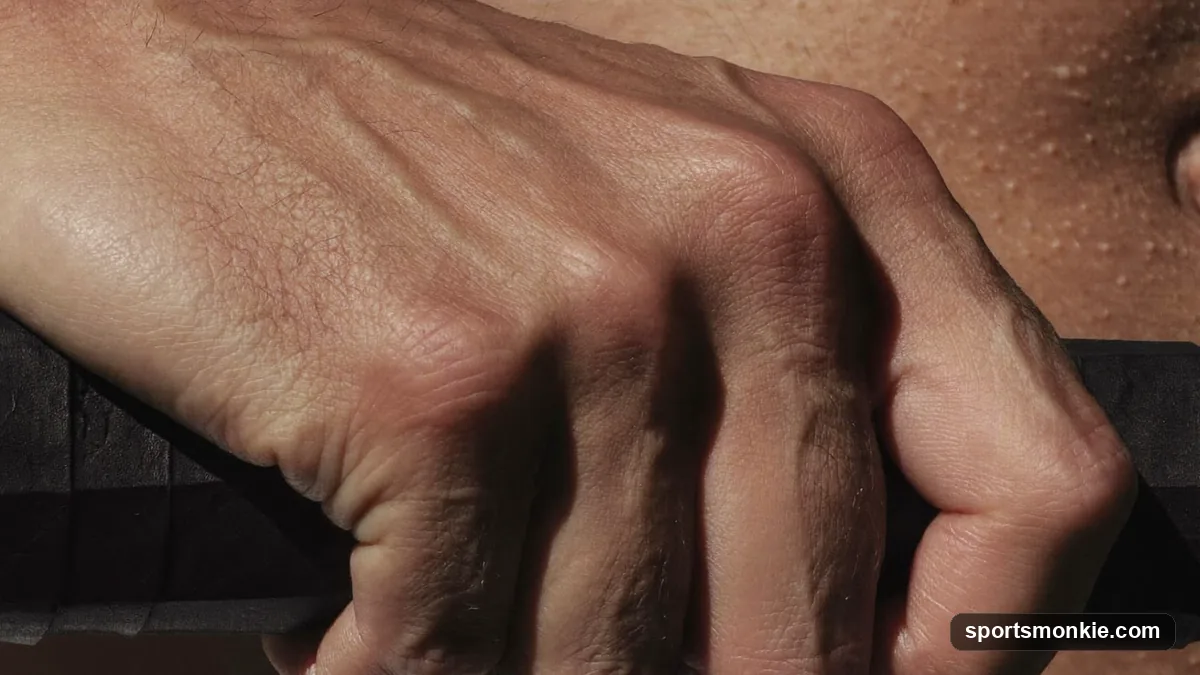
Hold a racket you already own in an eastern forehand grip — palm flat against the back bevel, as if shaking hands with the handle. Now take the index finger of your non-hitting hand and slide it into the gap between the tip of your ring finger and the base of your palm (the fleshy pad below your thumb).
- If your index finger fits snugly in that gap, the grip size is correct.
- If there is no room and your fingers dig into your palm, the grip is too small.
- If your index finger swims with space to spare, the grip is too big.
This test works because it measures the handle against your actual grip, not just your hand at rest. It is the method most stringers and coaches use, and it is more trustworthy than the ruler method below because it accounts for how you really hold the racket. The same hand position is the foundation for how to hold a tennis racket correctly.
The ruler method (no racket needed)
If you do not have a racket to hold, measure your hand directly. Open your hitting hand flat, fingers together and extended. Find the middle crease that runs horizontally across your palm, then measure straight up to the tip of your ring finger with a ruler.
- 4 in → US L0 / 4-1/8 in
- 4-1/4 in → US L2
- 4-1/2 in → US L4
The number of inches you measure translates directly to your US grip size. Measure both hands and use your dominant one; hands are rarely identical. Treat the ruler result as a starting point and confirm it with the index-finger test whenever you can get your hand on a real handle.
Too big vs too small: which error to make
If you have to guess, guess small — this is the single most important rule in grip sizing. A grip that is slightly too small is a minor, fixable problem; a grip that is too big is a nagging one you cannot undo.
A grip that is too big forces you to squeeze harder just to keep the racket from twisting on off-center hits. That constant tension is the classic trigger for tennis elbow, and it also locks your wrist, which robs you of the snap you need for spin and for a kick serve. You lose the quick grip changes between forehand, backhand, and volleys because your fingers cannot wrap far enough around the handle.
A grip that is too small lets the racket twist a little on contact and can make you over-grip to compensate. But it is trivially corrected: one or two overgrips bring it back to spec, and the smaller base actually helps players who use a lot of wrist for topspin. Pros trend slightly small for exactly this reason, then build the handle back up with an overgrip and a customized shape.
How overgrips and sleeves change the size
An overgrip is the thin, replaceable wrap players add over the factory grip for sweat absorption and feel — and it quietly changes your effective grip size. A standard overgrip adds about 1/16 in to the circumference, which is half of one full grip size (remember, each size is 1/8 in apart).
So the math is simple: a 4-1/4 in (L2) handle with one overgrip plays like roughly 4-5/16 in, sitting halfway between L2 and L3. If you always use an overgrip, buy the base racket one half-size down from your measured size; if you layer two overgrips, drop a full size. This is why matching your naked measurement is only step one — factor in your wrapping habit before you commit. When your overgrip wears out, our guide on how to regrip a tennis racket walks through replacing it without changing the size you settled on.
To go the other way and increase size on a racket you already own, a stringer can fit a heat-shrink sleeve under the grip, which adds a full size or more. There is no clean way to make a molded handle smaller beyond stripping the stock grip for a thinner one, so sizing up is always the easier adjustment.
Grip sizes for kids and juniors
Children should be sized by hand, not by age, and almost always land between 3-1/2 in and 4 in (L00–L0). Run the index-finger test on the child’s own hand, and when it falls between sizes, go smaller — small hands lose control on an oversized handle far faster than adults do, and an overgrip is not a fix when the whole racket is already too heavy to swing.
The catch is that most junior rackets under 26 in ship with a fixed, non-adjustable grip matched to that frame’s length. So for young players the real decision is racket length first: a 6-year-old on a 23 in frame gets whatever small grip it comes with, and that is correct by design. Only once a junior moves up to a 26 in or full-size 27 in adult frame does grip size become a separate choice again. Getting the fundamentals grooved matters more than perfect gear at this stage, which is where our tennis drills for beginners do the heavy lifting.
Common grip-size mistakes to avoid
The most frequent error is buying the size that “felt fine” in the shop without the index-finger test — comfortable-at-rest and correct-under-load are different things, and a too-big grip often feels reassuringly solid until your elbow complains a month later. Verify with the gap test, not vibes.
The second mistake is ignoring the overgrip effect and ending up half a size large because you wrapped a fresh racket you already bought at your exact measured size. The third is assuming both your rackets match: grip sizes drift between brands and even between models, since bevel shape varies, so measure each frame rather than trusting the label alone. Nail the size and the rest of your fit — weight, balance, and your choice of a continental grip or semi-western grip for different shots — all get easier to dial in.
Frequently asked questions
How do I know my tennis grip size?+
Hold the racket in an eastern forehand grip and slide the index finger of your free hand into the gap between your ring fingertip and the base of your palm. If your finger fits snugly, the grip is right. No gap means it is too small; a loose gap means it is too big. Alternatively, measure from your palm's middle crease to your ring-finger tip with a ruler.
What is the most common tennis grip size?+
For adult men, 4-3/8 in (US L3) is the most common, and 4-1/4 in (US L2) is close behind. Most adult women and teenagers use 4-1/4 in (L2) or 4-1/8 in (L1). Sizes above 4-1/2 in (L4) are rare and mostly suit players with very large hands. Retail stock is heaviest around L2 and L3 for this reason.
Is it better to have a tennis grip too big or too small?+
Too small is the safer error. A grip that is slightly small can be built up with an overgrip or a heat-shrink sleeve to reach the exact feel you want. A grip that is too big cannot be reduced, forces you to squeeze harder, slows wrist action on serves and topspin, and raises the risk of tennis elbow. When between two sizes, choose the smaller.
Does an overgrip change your grip size?+
Yes. A standard overgrip adds roughly 1/16 in to the handle circumference, which is half of one full grip size (each size is 1/8 in apart). So a 4-1/4 in handle with one overgrip feels close to 4-5/16 in. If you always play with an overgrip, buy the base racket one half-size down, or one full size down if you layer two overgrips.
What grip size should a junior or child use?+
Most children use grip sizes from 3-1/2 in up to 4 in (US L00 to L0), scaled to hand size rather than age. Junior rackets under 26 in usually ship with a fixed small grip you cannot change, so pick the right racket length first. Use the index-finger test on the child directly; if in doubt, go smaller, since small hands lose control fast on an oversized handle.
Can I change the grip size of a racket I already own?+
You can only go up. Adding an overgrip raises the size about half a step, and a heat-shrink sleeve adds a full size or more. To go down, a stringer can remove the stock grip and fit a thinner replacement, but the handle's underlying bevel shape limits how far you can reduce it. It is easier to match size correctly at purchase.
Sources
Play & tools
Free browser games and tools — no account, no download.
- Play today's Sports Connections — Today's Sports Connections — daily hints, answers, and play the grid.
- Play Guess the NFL Player — A new mystery NFL player every day. Eight guesses, with a clue on each — plus free unlimited mode.
- Explore all our games →
Related tennis guides
View all →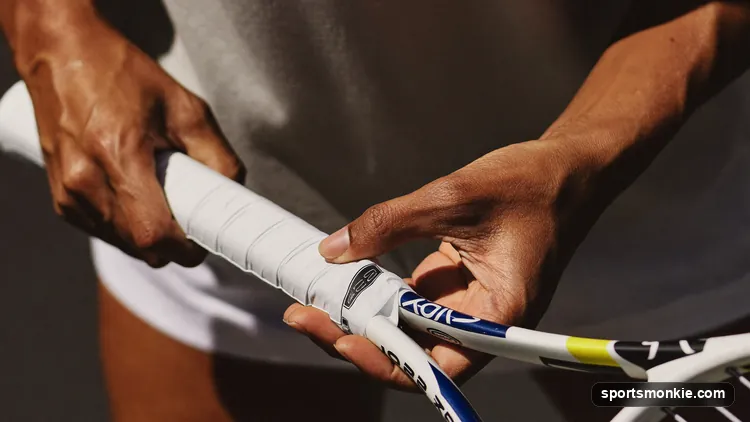
How to Regrip a Tennis Racket: A Step-by-Step Guide
How to regrip a tennis racket: peel the old grip, start at the butt cap, wrap upward at a slight angle with a small overlap, and finish with the tape. Full steps for both replacement grips and overgrips.
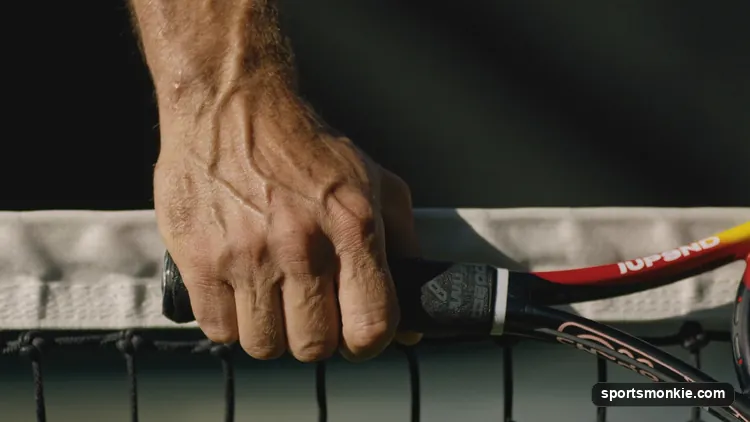
Continental Grip in Tennis: How to Hold It and When to Use It
The continental grip places the base knuckle of your index finger on bevel 2 of the racket handle. It is the grip for serves, volleys, slices, and overheads. Here is how to find it and drill it.
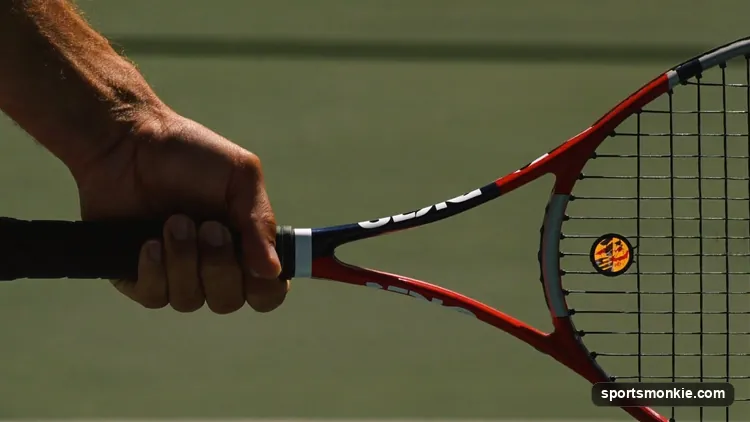
Eastern Grip in Tennis: The Bevel-3 Forehand Explained
The eastern grip in tennis places your index knuckle on bevel 3 for a flat, versatile forehand. Learn how to find it, its pros and cons, and who uses it.

How to Hit a Tennis Backhand: Grip, Turn, Contact, and Drills
To hit a tennis backhand, turn your shoulders early, load with an Eastern backhand or two-handed grip, swing low-to-high, and make contact out in front of your front hip.

How to Hit a Tennis Forehand: Grip, Swing, and Topspin
How to hit a tennis forehand: use a Semi-Western or Eastern grip, turn your shoulders early, drop the racket below the ball, and swing low-to-high to contact out front.

How to Hit Topspin in Tennis: The Low-to-High Swing, Grip, and Drills
To hit topspin in tennis, use a semi-western grip and swing low-to-high so the racket brushes up the back of the ball. Here is the grip, swing path, contact point, and drills that build heavy spin on both wings.