
Parts of a Tennis Racket: Every Component and Spec Explained
On this page10
- 01The Head (Hoop): Where the Strings Live
- 02The Strings and the Sweet Spot
- 03The Grommets
- 04The Throat
- 05The Shaft and the Beam
- 06The Handle, Grip, and Butt Cap
- 07The Bumper Guard
- 08Tennis Racket Parts and Specs at a Glance
- 09The Buyer’s Specs: Head Size, String Pattern, Weight, Balance, and Stiffness
- 10Why It All Matters on Court
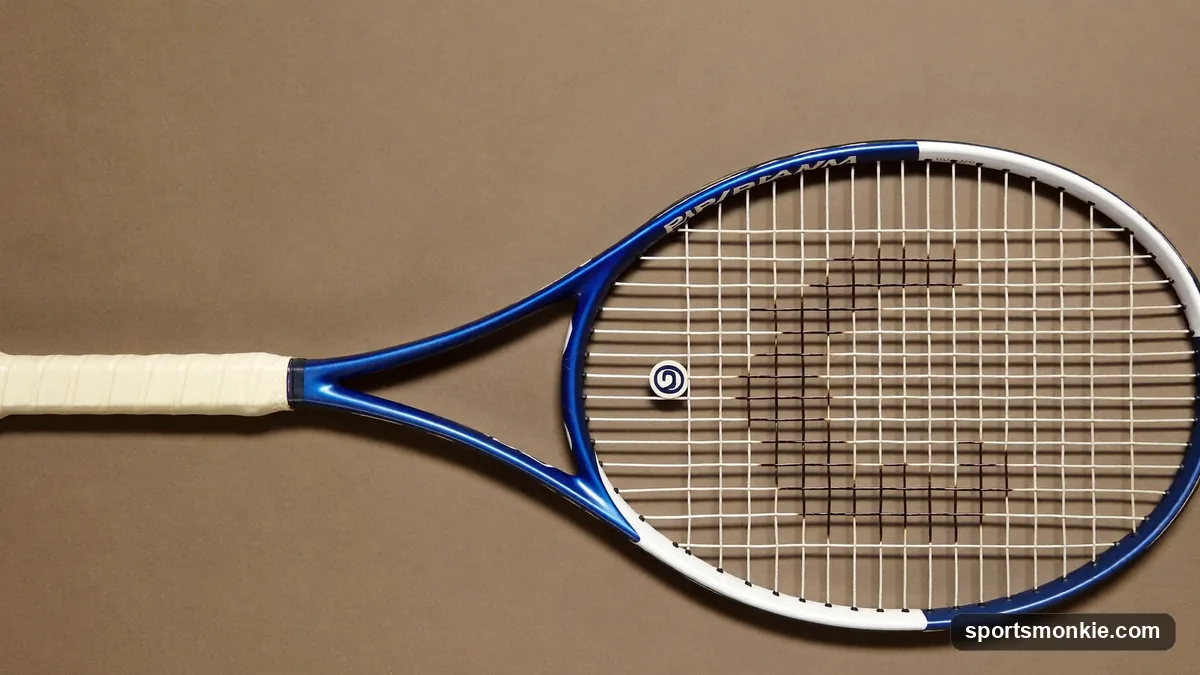
A tennis racket breaks down into nine core parts: the head, strings, grommets, throat, shaft, beam, handle, grip, and butt cap, plus the bumper guard that protects the frame’s edge. Under ITF Rule 4, a legal racket can’t exceed 73.7 cm (29.0 in) in overall length or 31.7 cm (12.5 in) in width, and the strung hitting surface is capped at 39.4 cm x 29.2 cm (15.5 in x 11.5 in). Everything else — head size, string pattern, weight, balance, and stiffness — is a manufacturer choice within those limits, and each one changes how the racket plays.
The Head (Hoop): Where the Strings Live
The head is the oval frame at the top of the racket that holds the string bed and makes contact with the ball. ITF Rule 4 sets the ceiling on how big a strung hitting surface can legally be — 39.4 cm (15.5 in) long by 29.2 cm (11.5 in) wide — but almost no racket on the market is built to that maximum.
In practice, adult head sizes cluster into three bands:
- Oversized: 105–115 sq in — biggest sweet spot, most forgiving on off-center hits, common for beginners.
- Mid-plus: 98–104 sq in — the standard for most intermediate and advanced club players.
- Mid: 85–97 sq in — smallest sweet spot, used mostly by advanced and tour players who want maximum control.
The Strings and the Sweet Spot
The strings crisscross the head in mains (running lengthwise, toward the handle) and crosses (running side to side). Where they cross, they’re woven or bonded together to form the string bed — the actual surface that contacts the ball. The sweet spot sits just above the string bed’s geometric center, where energy transfer is highest and shock is lowest.
String tension, not just the strings themselves, changes how that bed behaves — lower tension flexes more for extra power, higher tension holds firm for more control. That’s a deep enough topic on its own; see our guide to string tension in tennis for how to pick a number.
The Grommets
Grommets are the small plastic (sometimes rubber) sleeves lining every hole around the frame where a string passes through. They do two jobs: they stop the string from cutting into the graphite or rubbing against a raw edge, and they help distribute tension evenly around the hoop. A cracked or missing grommet is one of the most common reasons a string snaps prematurely at the frame rather than in the middle of the bed.
The Throat
The throat — also called the heart or the yoke — is the open triangular (or Y-shaped) section directly beneath the head, where two shafts converge before meeting the handle. Older wood and early composite rackets often had a closed throat with a bridge across it; virtually every modern racket leaves it open. An open throat cuts weight, reduces wind resistance through the swing, and lets the frame flex slightly for feel without sacrificing stiffness where it matters, at the head.
The Shaft and the Beam
The shaft is the straight section of frame running from the throat down to the handle. Beam width — the actual thickness of the frame, measured in millimeters — is what most directly separates a “power” racket from a “control” racket:
- 19–23mm beam: thinner, more flexible, less power on its own, more player-generated feel. Favored by advanced players.
- 24–30mm+ beam: thicker, stiffer, more inherent power with less swing effort. Common on beginner and “tweener” frames.
The Handle, Grip, and Butt Cap
The handle is the bottom section a player actually holds, built with an eight-sided (octagonal) cross-section so the racket doesn’t twist mid-swing. Two layers sit over that base:
- Grip: the factory-installed wrap, usually leather or a synthetic polymer, that gives the handle its texture and cushioning.
- Overgrip: a thin, tacky layer players add on top of the factory grip for extra feel and easy replacement — most players change overgrips far more often than the base grip underneath.
At the very bottom is the butt cap, a molded plastic piece that seals the end of the handle, stops the racket from sliding out of a sweaty hand mid-swing, and usually carries the brand logo and grip-size stamp.
The Bumper Guard
The bumper guard is the plastic strip that wraps around the top and sides of the head, sitting between the frame and the outer grommets. Every time a racket scrapes the court on a low slice or a mishit clips the frame, the bumper guard takes the damage instead of the graphite underneath. It’s a wear part by design — on well-used rackets, it’s usually the first thing to visibly scuff or crack.
Tennis Racket Parts and Specs at a Glance
| Part / Spec | What It Does | Typical Range |
|---|---|---|
| Head (hoop) | Holds strings, contacts ball | Max legal: 39.4 x 29.2 cm (15.5 x 11.5 in); typical head size 95–115 sq in |
| Strings | Generate spin, power, control | Tension 40–65 lbs (18–30 kg), player-dependent |
| Grommets | Protect strings from frame edge | Full-frame set, replaced with restringing |
| Throat | Connects head to shaft | Open on nearly all modern rackets |
| Shaft/Beam | Frame body and thickness | 19mm (control) to 30mm+ (power) |
| Handle | Gripping section | 8-sided (octagonal) cross-section |
| Grip/Overgrip | Comfort, tack, sizing | US 4”–4⅝” (Euro L1–L5) |
| Butt cap | Seals handle end, prevents slipping | Molded plastic, one piece |
| Bumper guard | Shields frame from scrapes | Plastic, wraps head’s leading edge |
| Overall racket | Full-frame legal limit | Max 73.7 x 31.7 cm (29.0 x 12.5 in) — ITF Rule 4 |
The Buyer’s Specs: Head Size, String Pattern, Weight, Balance, and Stiffness
These five specs decide how a legal racket actually plays, and they’re what most buying guides skip past too quickly.
- Head size controls sweet-spot size: bigger head, more forgiveness on off-center contact; smaller head, more precision but less room for error.
- String pattern is written as mains x crosses — 16x19 is open and spin-friendly, 18x20 is dense and control-oriented, holding tension longer.
- Weight ranges roughly 200–300g (7–10.6 oz) unstrung, up to about 360g (12.6 oz) strung on some tour frames. Heavier rackets absorb pace better; lighter rackets swing faster.
- Balance describes where the mass sits along the frame. A head-heavy racket carries more weight toward the hoop and adds pop on groundstrokes; a head-light racket shifts mass toward the handle for faster maneuverability at net.
- Stiffness, measured on an RA scale, tracks how much the frame flexes at contact. A stiffer frame returns more power with a shorter, more jarring feel; a more flexible frame gives up some pop for a softer, more controllable response.
Why It All Matters on Court
Every part above changes what happens when strings meet ball. A thicker beam and stiffer frame push power toward you automatically, which matters less if your types of tennis shots already generate pace on their own through technique. A denser string pattern holds up better on abrasive surfaces — worth factoring in alongside the different types of tennis courts you play on most, since clay chews through strings differently than a hard court does. And if you’re weighing a switch to squash, padel, or badminton, the same head-throat-shaft-handle anatomy carries over — see our broader look at racket sports for how the specs compare across games.
None of these parts work in isolation. A big head with a thin beam behaves differently than a big head with a thick one; a head-light balance on a heavy frame plays nothing like a head-light balance on a light one. Knowing the parts by name is step one — knowing how they interact is what actually improves your racket choice.
Frequently asked questions
What is the top part of a tennis racket called?+
It's called the head, or sometimes the hoop. It's the oval frame that holds the strings and does all the ball contact. Head sizes for adult rackets typically run 95–115 square inches (610–740 cm²), with most club players using something in the 98–108 sq in range.
What is the triangle-shaped part of a tennis racket called?+
That's the throat, sometimes called the heart or the yoke. It's the open V or Y-shaped section directly below the head where the shaft splits to meet the frame. Most modern rackets leave it open to cut weight and reduce air resistance through the swing.
What is the sweet spot on a tennis racket?+
The sweet spot is the small zone on the string bed, usually just above the racket's true center, where a shot transfers the most energy with the least vibration. Hits there feel solid and carry more pace; hits near the frame's edge feel jarring and lose power.
What is a normal beam width for a tennis racket?+
Most tennis rackets have a beam (frame thickness) between 19mm and 23mm on control-oriented frames, and 24mm to 30mm or more on power frames. A thicker beam is stiffer and generates more power with less swing effort; a thinner beam flexes more and rewards precise technique with better control.
What's the difference between a 16x19 and 18x20 string pattern?+
The numbers count main strings x cross strings. A 16x19 pattern is more open, so strings move more at contact, producing extra spin and power. An 18x20 pattern packs strings tighter for a flatter, more controlled response and typically lasts longer before breaking.
What does head-light mean on a tennis racket?+
Head-light means the racket's balance point sits closer to the handle than its physical midpoint, so more mass is in the grip end. That makes the racket feel quicker through the swing, which is why serve-and-volley and doubles players often prefer it over a head-heavy frame.
How much does a tennis racket weigh?+
Adult rackets generally weigh 200g to 300g (7 to 10.6 oz) unstrung, and up to about 360g (12.6 oz) strung for some tour-level frames. Beginners typically use lighter rackets around 250–280g strung, while advanced players often move up to 295–340g for extra stability and power.
What is the bumper guard on a tennis racket for?+
The bumper guard is the plastic strip running around the top and sides of the head. It absorbs scrapes from mishits and court contact so the frame itself doesn't crack or fray, and it also anchors the grommets that route the strings through the hoop.
Sources
Play & tools
Free browser games and tools — no account, no download.
- Play today's Sports Connections — Today's Sports Connections — daily hints, answers, and play the grid.
- Play Guess the NFL Player — A new mystery NFL player every day. Eight guesses, with a clue on each — plus free unlimited mode.
- Explore all our games →
Related tennis guides
View all →
How to Choose a Tennis Racket: A Buyer's Guide for All Levels
Choosing a tennis racket depends on your skill, style, and build. Beginners want larger heads and lighter frames; pros prefer control and heavier weight.
How to Hold a Tennis Racket: 5 Grips Every Player Should Know
How you hold a tennis racket shapes your swing, spin, and reach. The five main grips are Continental, Eastern, Semi-Western, Western, and two-handed.
How to Regrip a Tennis Racket: A Step-by-Step Guide
How to regrip a tennis racket: peel the old grip, start at the butt cap, wrap upward at a slight angle with a small overlap, and finish with the tape. Full steps for both replacement grips and overgrips.
Tennis Court Lines Explained: Every Line, Named and Defined
Tennis court lines explained: baseline, sidelines, service line, centre service line, centre mark and net — ITF dimensions, singles vs doubles, in/out rule.
Tennis String Tension: Full Guide to Power, Control, and What to Choose
Tennis string tension typically runs 40-65 lbs (18-30 kg). Lower tension adds power and comfort; higher tension adds control. Full guide by string type.
Types of Tennis Shots: The Complete Guide to Every Stroke
The main types of tennis shots are groundstrokes, the serve, volleys, and specialty shots like the slice, lob, smash, and drop shot.