
Tennis Net Height: Official ITF Measurements at Centre and Posts
On this page8
- 01Official Tennis Net Height at a Glance
- 02Why Is a Tennis Net Lower in the Middle? The Centre Strap Explained
- 03How to Measure Tennis Net Height (The Racket Trick)
- 04Where Are Tennis Net Posts Positioned?
- 05Singles Sticks: Raising a Doubles Net for Singles Play
- 06Why Net Height Matters Tactically
- 07Tennis Net Height Compared to Other Racket and Net Sports
- 08Bottom Line
A tennis net is 3 ft (0.914 m / 91.4 cm) high at the centre and 3 ft 6 in (1.07 m / 107 cm) high at the posts, per Rule 2 of the ITF Rules of Tennis.
That six-inch gap between centre and post isn’t a manufacturing tolerance, it’s built into the rule on purpose. A white centre strap clamps the net cord down to the exact 3 ft mark in the middle of the court, while the posts on either side hold the same net taut at the full 3 ft 6 in. Every net on a sanctioned court, from a public park to Arthur Ashe Stadium, is checked against these same two numbers before play.
Official Tennis Net Height at a Glance
| Measurement | Metric | Imperial |
|---|---|---|
| Net height at centre | 0.914 m (91.4 cm) | 3 ft (36 in) |
| Net height at posts | 1.07 m (107 cm) | 3 ft 6 in (42 in) |
| Difference, centre to post | 0.156 m (15.6 cm) | 6 in |
| Net post position | 0.914 m outside the doubles sideline | 3 ft outside the doubles sideline |
| Singles stick position | 0.914 m outside the singles sideline | 3 ft outside the singles sideline |
| Net width, post to post (doubles) | 12.80 m | 42 ft |
| Centre strap maximum width | 5 cm | 2 in |
Why Is a Tennis Net Lower in the Middle? The Centre Strap Explained
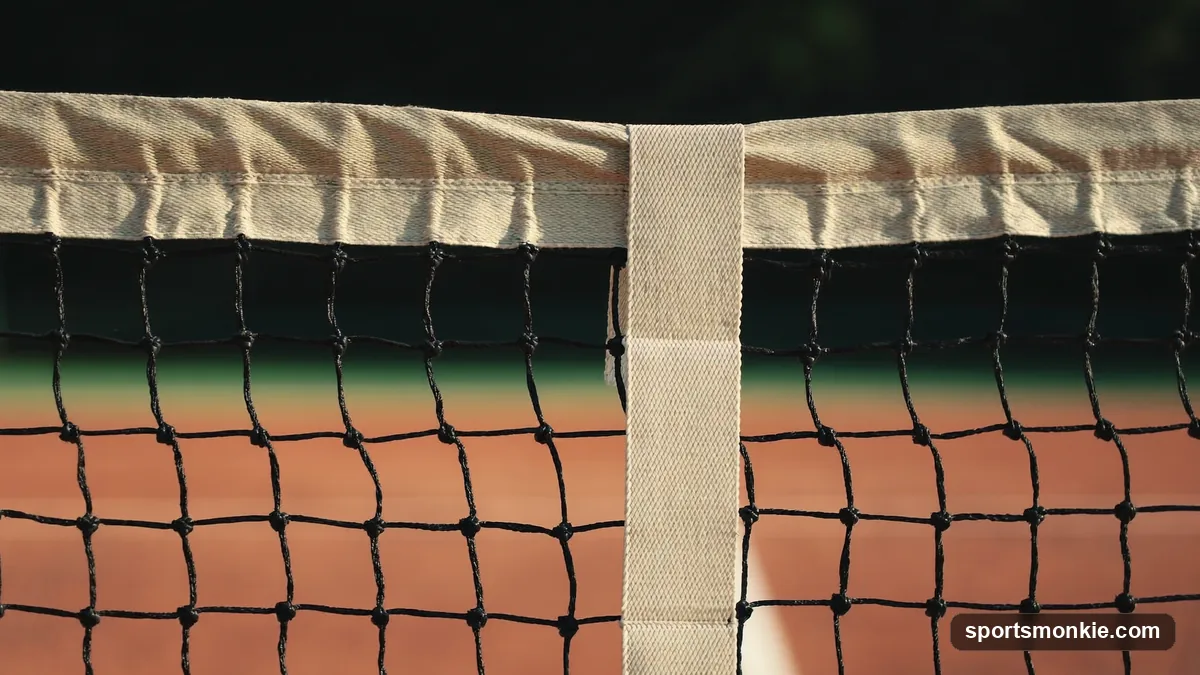
The net’s top cord runs the full width between the posts, and without help it would sag well below the required height under its own weight. A white centre strap, capped at 5 cm (2 in) wide by ITF rules, runs from the net’s midpoint down to an anchor in the court surface and pulls that section down to precisely 3 ft. It’s the only part of the net rig that gets tightened to a fixed measurement rather than a general tension, which is why umpires and club staff check it with a tape measure before matches rather than eyeballing it.
Without the strap, or with one that’s loosened or improperly clipped, the centre creeps upward toward post height, tightening the margin on every shot hit through the middle of the court. This is the single most common net fault at recreational clubs: the strap slips a few centimetres and nobody notices until rallies start clipping the tape more often than usual.
How to Measure Tennis Net Height (The Racket Trick)
You don’t need a court-specific measuring stick to check a net. A standard adult tennis racket measures 27 in (68.6 cm) from the butt cap to the tip of the frame, which is exactly 9 in short of the 36 in centre height. Stand the racket upright on its head at the centre strap, mark or hold a hand span (roughly 9 in for most adults) above the tip, and the top of that mark should meet the net cord at 3 ft. Repeat the same racket-length check at a post: 27 in plus 15 in gets you to the 42 in (3 ft 6 in) post height.
This is the same rough method used by club pros and referees when a proper net gauge isn’t on hand. It won’t replace an official calibrated tool for tournament play, where umpires use a fixed net-height stick, but it’s accurate enough to catch a net that’s badly out of tolerance before a casual match. Getting these numbers right matters for the rest of the court too, and lines up with the fixed dimensions covered in our guide to official tennis court dimensions.
Where Are Tennis Net Posts Positioned?
Net posts sit 3 ft (0.914 m) outside the doubles sideline on each side of the court, regardless of whether the match being played is singles or doubles. That placement matters because the 3 ft 6 in post height is measured at the post itself, well outside the singles court’s narrower boundary. A doubles net strung on doubles posts sags below 3 ft 6 in directly above the singles sidelines, since the cord isn’t held up at that point.
Posts must be between 10–15 cm (4–6 in) square or in diameter, strong enough to keep the net upright under tension without bowing inward. Their exact placement outside the sideline, rather than on it, is one of several fixed reference points that define the different types of tennis courts and how they’re marked out and built.
Singles Sticks: Raising a Doubles Net for Singles Play
Most club and public courts only own a single set of doubles posts, which creates a problem for singles matches: the net sags low right where singles players actually hit their angles, well inside the doubles posts’ span. The ITF-sanctioned fix is a pair of singles sticks, portable supports placed 3 ft outside each singles sideline, that prop the net back up to the correct 3 ft 6 in height at that narrower width.
Tournament venues increasingly install a second, separate set of dedicated singles posts instead, so the net can be fully restrung for singles rather than propped up mid-span. But wherever only doubles posts exist, which is the majority of courts worldwide, singles sticks remain the official workaround, and their exact position (3 ft outside the singles sideline, diagonally matching the doubles posts) is itself governed by the same rulebook that defines the sideline and court markings they sit against.
Why Net Height Matters Tactically
The 15.6 cm gap between centre and post height is small on paper but shapes real shot selection. A ball travelling down the middle of the court crosses the net at its lowest point, so it clears with more margin than the same shot hit at a sharp crosscourt angle toward the sidelines, where the net stands a full 6 in taller. That’s part of why coaches teach players to:
- Aim conservative rally shots and defensive lobs through the centre strap area under pressure, where the net offers the most forgiveness
- Treat angled passing shots and drop volleys near the posts as the highest-risk net clearance in the game, since the ball must clear 42 in rather than 36 in
- Recognise that a stretched net cable or a loosened centre strap changes these margins mid-match, which is why net height gets checked before, not during, competitive play
None of this is theoretical for anyone who has played on a net that’s even a centimetre off. A high centre strap turns routine rally shots into net-cord errors; a low one turns the middle of the court into a highway.
Tennis Net Height Compared to Other Racket and Net Sports
Net height isn’t a shared standard across racket sports, each governing body sets its own numbers, and the differences are bigger than most players expect.
| Sport | Net height (centre) | Net height (posts / sides) |
|---|---|---|
| Tennis | 0.914 m (3 ft) | 1.07 m (3 ft 6 in) |
| Pickleball | 0.86 m (34 in) | 0.914 m (36 in) |
| Badminton | 1.524 m (5 ft) | 1.55 m (5 ft 1 in) |
| Table tennis | 15.25 cm (6 in), uniform | 15.25 cm (6 in), uniform |
Tennis and pickleball share the same basic idea, a centre strap that dips the net slightly below the post height, but pickleball’s whole net sits well below tennis’s even at the posts. Badminton runs the opposite way, its net rising toward 5 ft, more than a foot taller than a tennis net at the same point. Anyone moving between these sports and other racket sports has to relearn net clearance almost from scratch, since none of the height numbers carry over.
Bottom Line
The net height numbers that matter, 3 ft at the centre and 3 ft 6 in at the posts, come straight from the ITF Rules of Tennis and don’t vary by surface, tournament, or level of play. What does vary in practice is how well a given net is set up: a slack centre strap or misplaced singles stick throws these figures off by just enough to change how a match plays, which is exactly why they’re checked with a tape measure rather than assumed.
Frequently asked questions
How high is a tennis net at the centre?+
A tennis net is 3 ft (0.914 m / 91.4 cm) high at the exact centre of the court. A white centre strap, no more than 5 cm wide, anchors the net cord down to this precise height so it cannot sag or bow above the legal mark before or during a match.
How high is a tennis net at the posts?+
At the net posts, on both sides of the court, the net stands 3 ft 6 in (1.07 m / 107 cm) high. That is 15.6 cm (6 in) taller than the centre. The posts hold the top cord under tension so the net stays taut across the full width of the court.
Why is a tennis net lower in the middle than at the posts?+
The dip is intentional, not sagging equipment. The centre strap pulls the net down to exactly 3 ft so that shots hit through the middle of the court, which is the shortest, most direct path over the net, have to clear a slightly lower barrier than sharp crosscourt or down-the-line shots that pass closer to the posts.
Where are tennis net posts positioned on the court?+
Net posts sit 3 ft (0.914 m) outside the doubles sideline on each side of the court, so they never intrude into playable space even during doubles. Because the net's 3 ft 6 in post height is measured there, well outside the singles lines, a plain doubles net sags below the correct height directly above the singles sidelines.
What are singles sticks and when do I need them?+
Singles sticks are portable supports placed 3 ft outside each singles sideline to prop a doubles net back up to the full 3 ft 6 in height for singles matches. They exist because a doubles net's posts are too far apart to hold the correct height above the narrower singles court; without sticks, the net sags low right where singles players hit their angles.
Does net height differ between singles and doubles play?+
No. The ITF specifies one net height for all match formats: 3 ft at the centre and 3 ft 6 in at the posts. What changes is only where the posts (or singles sticks) sit relative to the sidelines, not the actual height measurements themselves, which stay identical whether two or four players are on court.
How can I check if a net is the correct height without a measuring stick?+
Most adult rackets measure 27 in (68.6 cm) from butt cap to tip. Stand the racket on its head at the net's centre; mark 9 in above the strings using a hand span or tape, and that combined 36 in equals the official 3 ft centre height. Repeat at a post using the same racket plus 15 in to check the 42 in mark.
Does net height affect how tennis is played tactically?+
Yes. Because the middle of the net sits 6 in lower than the posts, shots down the centre of the court carry more margin for error than shots aimed at sharp angles near the sidelines. Coaches use this to teach players to bail out through the middle under pressure and to treat volleys near the posts, where the net is at its tallest, as the hardest to clear cleanly.
Sources
Play & tools
Free browser games and tools — no account, no download.
- Play today's Sports Connections — Today's Sports Connections — daily hints, answers, and play the grid.
- Play Guess the NFL Player — A new mystery NFL player every day. Eight guesses, with a clue on each — plus free unlimited mode.
- Explore all our games →
Related tennis guides
View all →
How Tall Is a Tennis Net? Official Height and Dimensions
A tennis net is 91.4 cm (3 ft) tall at the centre and 107 cm (3 ft 6 in) at the posts. These ITF measurements apply to all sanctioned tennis play.
What Is a Volley in Tennis? Grip, Technique, and When to Attack the Net
A volley in tennis is a shot hit before the ball bounces, usually at the net. Learn grip, punch technique, and forehand vs. backhand volley form.
What Is Deuce in Tennis? Score, Advantage, and Tiebreaks
Deuce in tennis means both players have reached 40, so one player must win two straight points to take the game.
What Is Hawk-Eye in Tennis? How Electronic Line Calling Works
Hawk-Eye uses multiple cameras and ball-tracking software to judge whether a tennis shot landed in or out.
Walkover vs Retirement in Tennis: What Is the Difference?
A walkover happens before a match begins; a retirement happens after play starts. The distinction affects results, records and tournament administration.
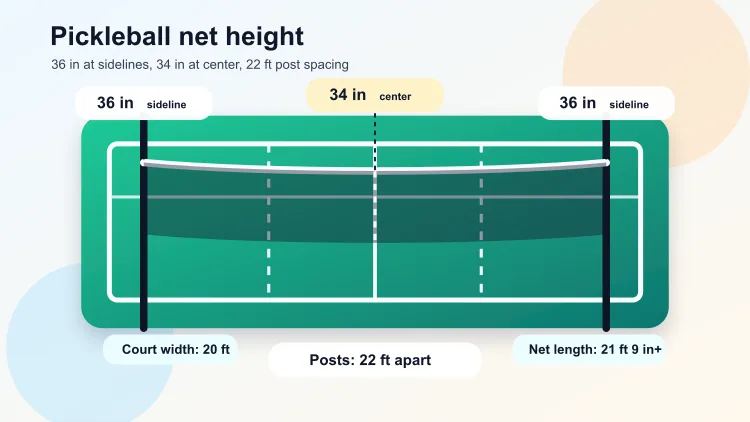
Pickleball Net Height: Official 36/34 Inch Setup
Official pickleball net height is 36 inches at the sidelines and 34 inches at the center. Check post spacing, net length, center sag and tennis-net conversions.