
How Tall Is a Tennis Net? Official Height and Dimensions
On this page6
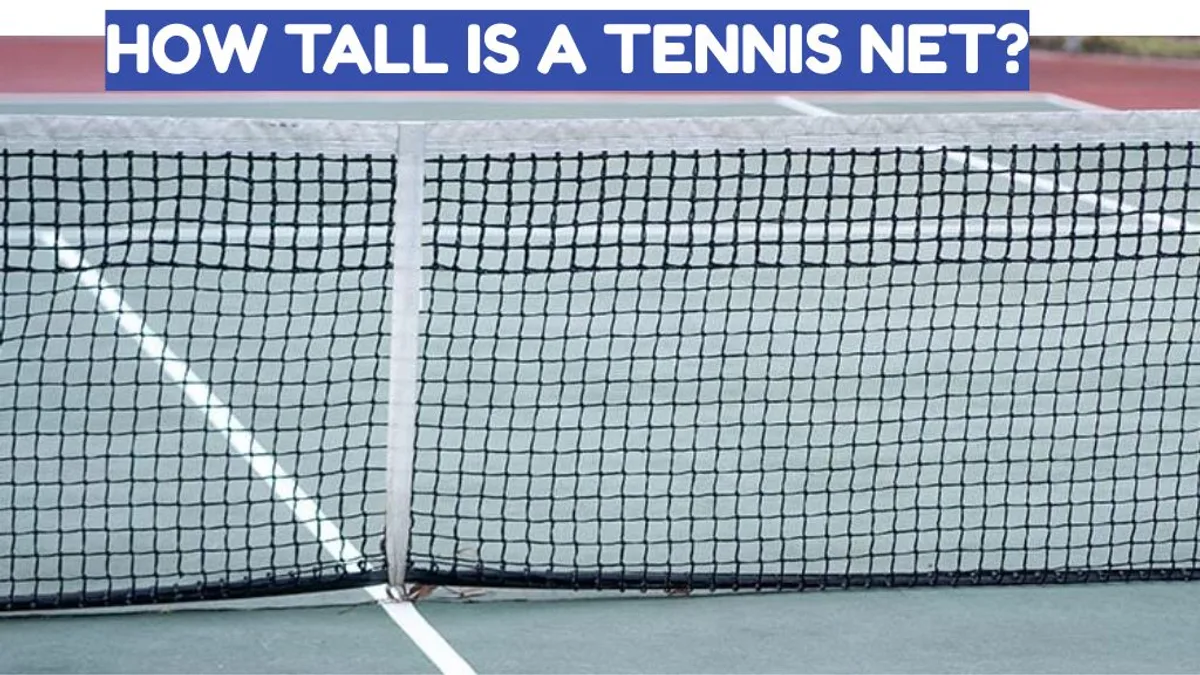
Grab a tape measure and check a net at your local club and you’ll probably find it’s off by a centimeter or two. Umpires check this before every professional match for a reason: a few centimeters at the center changes how many balls clear the net on a flat, hard-hit crosscourt shot. The ITF sets the number at 91.4 cm at the center and 107 cm at the posts, and club nets drift out of tolerance more often than most players realize.
Official Tennis Net Dimensions
| Measurement | Height |
|---|---|
| Net height at centre | 91.4 cm (3 ft / 0.914 m) |
| Net height at posts | 107 cm (3 ft 6 in / 1.07 m) |
| Net posts position | 0.914 m outside the singles sideline |
| Net width (singles court) | 10.06 m (33 ft) |
| Net width (doubles court) | 12.8 m (42 ft) |
Why the Net Is Lower in the Middle
The dip at the center isn’t a manufacturing quirk. A ball hit down the middle of the court travels a shorter distance to the net than one hit crosscourt at a sharp angle, so the lower height there compensates by giving that shot a bit more room to clear. Go for a tight crosscourt angle instead, and the ball has to pass over a section of net that’s 15.6 cm higher. That gap between center and post height quietly shapes where players aim their serves and how they choose passing shots.
The Centre Strap
A white strap runs from the net’s midpoint down to the court surface, and it’s what holds the center at exactly 91.4 cm. Without it, the cable running through the top of the net would sag well below the required height under its own weight. ITF rules require the strap to be white and no wider than 5 cm.
Singles Sticks
Clubs that only own doubles posts still need a way to raise the net for singles matches. The fix is a pair of “singles sticks,” placed 0.914 m outside each singles sideline, which prop the net up to the full 107 cm at that point. Most tournament venues now install separate singles posts instead, but singles sticks remain the ITF-approved workaround wherever only doubles posts exist.
Net Construction Requirements
| Component | Specification |
|---|---|
| Mesh opening | Small enough that a ball cannot pass through |
| Top band | White tape, 5–6.35 cm (2–2.5 in) wide |
| Centre strap | White, maximum 5 cm (2 in) wide |
| Net cable / cord | Maximum 0.8 cm (1/3 in) diameter |
Does Net Height Affect Strategy?
It does. With the center sitting 15.6 cm lower than the posts, shots through the middle carry a built-in safety margin that angled shots don’t get. That’s part of why coaches teach players to:
- Favor the middle of the box on a first serve when the placement is in doubt
- Aim passing shots at the lowest point of the net rather than the corners
- Treat volleys hit near the posts as some of the toughest to execute cleanly, since the ball has to clear more net there
None of this is abstract for anyone who’s played at a net level that’s even slightly off. A sagging center strap or a stretched net cable changes these calculations in ways players feel before they can explain why.
Frequently asked questions
How high is a tennis net at the centre?+
The net at the centre of a tennis court must be exactly 91.4 cm (3 feet / 0.914 m) tall. A centre strap pulls the net down to this measurement.
How high is a tennis net at the posts?+
At the posts on each side of the court, the net stands 107 cm (3 feet 6 inches / 1.07 m) tall.
Is the net height the same for singles and doubles?+
The net height is the same. However, for singles play a 'singles stick' can be used to prop up the net to 107 cm at the singles sidelines when a doubles net is being used.
Sources
Play & tools
Free browser games and tools — no account, no download.
- Play today's Sports Connections — Today's Sports Connections — daily hints, answers, and play the grid.
- Play Guess the NFL Player — A new mystery NFL player every day. Eight guesses, with a clue on each — plus free unlimited mode.
- Explore all our games →
Related tennis guides
View all →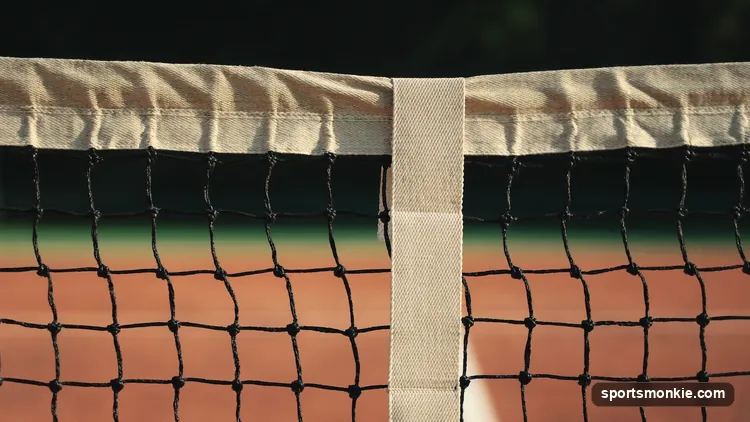
Tennis Net Height: Official ITF Measurements at Centre and Posts
A tennis net is 3 ft (0.914 m) high at the centre and 3 ft 6 in (1.07 m) at the posts, per the ITF Rules of Tennis. Full specs, measuring trick, and singles sticks.
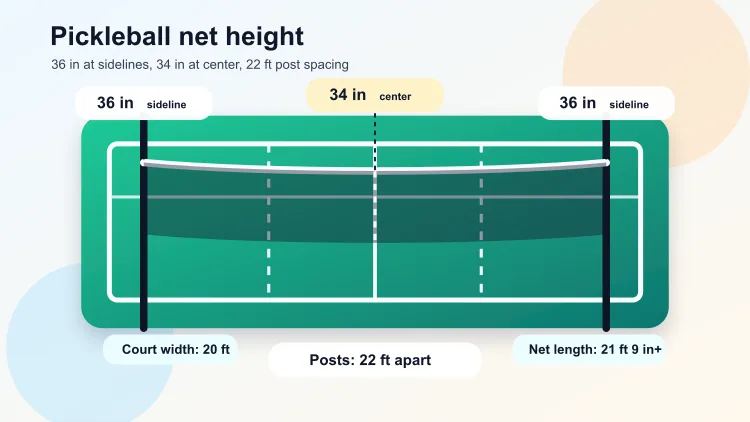
Pickleball Net Height: Official 36/34 Inch Setup
Official pickleball net height is 36 inches at the sidelines and 34 inches at the center. Check post spacing, net length, center sag and tennis-net conversions.

How Much Does a Tennis Ball Weigh? Official Specs Explained
A standard tennis ball must weigh 56.0 to 59.4 g (1.975-2.095 oz) under ITF rules, and meet strict diameter and bounce limits for approved pro play.
Why Do Tennis Players Change Ends?
Tennis players change ends to keep conditions fair when sun, wind, court wear and other environmental factors affect play.
Tennis Volley Technique: Grip, Punch, and Footwork to Win the Net
Master tennis volley technique with a continental grip, a short punch instead of a swing, a split-step, and contact out in front. Step-by-step form plus drills.
What Is a Volley in Tennis? Grip, Technique, and When to Attack the Net
A volley in tennis is a shot hit before the ball bounces, usually at the net. Learn grip, punch technique, and forehand vs. backhand volley form.