
Why Do Tennis Balls Have Fuzz? The Real Aerodynamic Reason
On this page7
- 01Why Do Tennis Balls Have Fuzz? The Aerodynamics Explained
- 02How Fuzz Helps Players Grip, Spin, and Control the Ball
- 03Why Are Tennis Balls Yellow, Not White?
- 04Official ITF Tennis Ball Specifications
- 05Why Do Pros Change Tennis Balls Every 7, Then 9 Games?
- 06What Happens When the Fuzz Wears Down?
- 07The Bottom Line
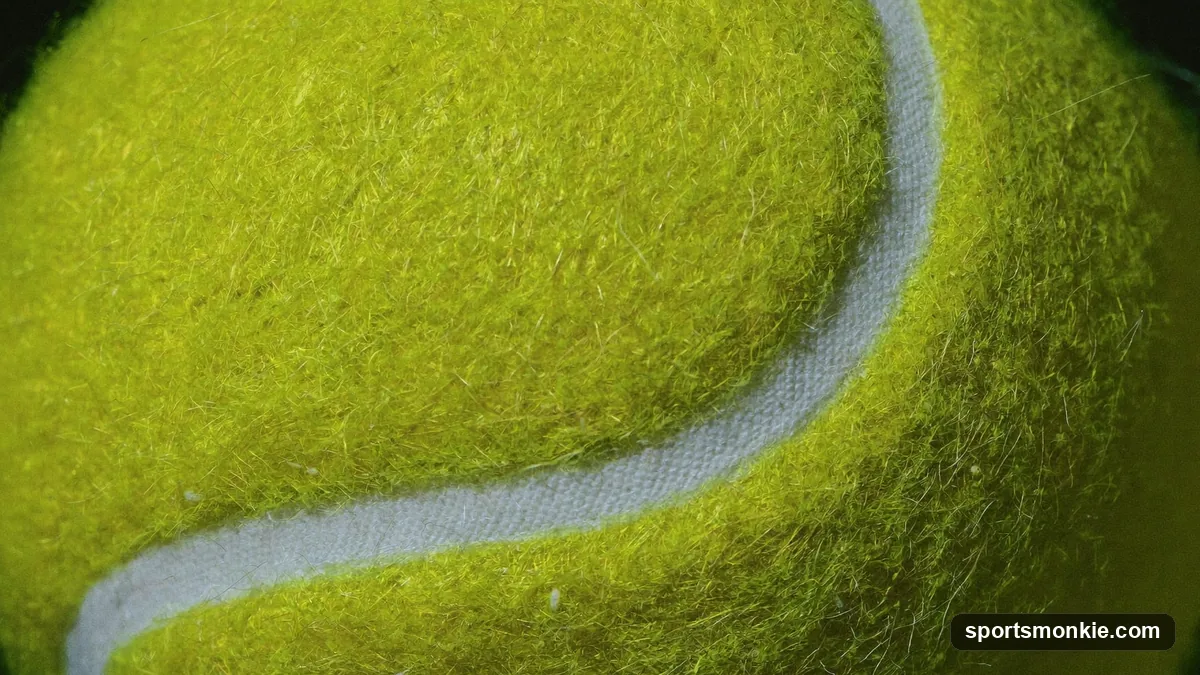
Tennis balls have fuzz because the raised felt covering — called the nap — roughly doubles the ball’s aerodynamic drag, slowing its flight and stabilizing its trajectory so the game is controllable, while also letting the strings grip the ball to generate spin. Strip the fuzz off and the same rubber core would rocket off the racket far faster and far more erratically. The nap is one of the most quietly engineered pieces of equipment in sport, and its exact size, weight, and bounce are locked down by the International Tennis Federation (ITF) down to the millimeter and the gram.
Why Do Tennis Balls Have Fuzz? The Aerodynamics Explained
The core function of the nap is drag. A bald rubber sphere hit at professional racket-head speed would experience very little air resistance and would streak toward the opponent at a velocity far beyond what’s playable or safe. The raised fibers of the felt disturb the thin layer of air right at the ball’s surface — what aerodynamicists call the boundary layer — delaying flow separation and roughly doubling drag compared to a smooth ball of the same size. That extra drag bleeds off speed as the ball travels, which is why a serve that leaves the racket at over 130 mph (209 km/h) has slowed to a returnable speed by the time it crosses the net and bounces. Without the nap, tennis as a rally-based sport wouldn’t really work — every shot would look more like a bald handball smash than a controlled groundstroke.
How Fuzz Helps Players Grip, Spin, and Control the Ball
Drag isn’t the only job the nap does. At the moment of contact, the felt’s texture lightly grips the strings for a few milliseconds longer than smooth rubber would, and that extra contact time is what lets players brush up or across the ball to impart topspin, slice, or kick spin. This is central to how modern players construct rallies — heavy topspin lets a player hit hard while still clearing the net safely, and slice depends on the strings catching the nap at an angle. The same fuzz-generated turbulence also explains why a heavily topspun ball dips sharply and a backspun slice floats: the spinning nap grabs passing air unevenly, adding lift or drop on top of gravity. Players developing these shots (see our breakdown of the main types of tennis shots) are really exploiting the aerodynamic interaction between spin and felt, not just swing technique.
Why Are Tennis Balls Yellow, Not White?
Tennis balls were traditionally white or black well into the 20th century. That changed in 1972, when the ITF officially added “optic yellow” as an approved ball color after research found it was significantly easier to track on color television than a white ball, which tended to wash out against white court markings and light backgrounds. BBC broadcast executive David Attenborough is widely credited with pushing for the switch ahead of televised Wimbledon coverage. Optic yellow remains the standard at essentially every professional and recreational level today — color and fuzz work together, since the felt’s texture also scatters light in a way that keeps the ball visible under stadium lighting and against different playing surfaces described in our guide to the types of tennis courts.
Official ITF Tennis Ball Specifications
Every ball approved for sanctioned play must satisfy the measurements set out in Appendix I of the ITF Rules of Tennis. These figures apply regardless of which of the three ITF speed types (Type 1 Fast, Type 2 Medium, Type 3 Slow) a ball is, aside from Type 3’s larger diameter used for slower, high-altitude play.
| Specification | Imperial | Metric |
|---|---|---|
| Diameter (Type 1 & 2) | 2.57 – 2.70 in | 6.54 – 6.86 cm |
| Diameter (Type 3, slow) | 2.76 – 2.87 in | 7.00 – 7.30 cm |
| Mass | 1.98 – 2.10 oz | 56.0 – 59.4 g |
| Bounce drop height | 100 in | 254 cm |
| Bounce rebound height | 53 – 58 in | 135 – 147 cm |
| Internal pressure | ~12 psi above ambient | pressurized nitrogen/oxygen mix |
The bounce test is performed by dropping a ball from 254 cm (100 in) onto a rigid concrete surface at sea level, 20°C (68°F), and 60% relative humidity — it must rebound between 135 and 147 cm (53 and 58 in) to pass. That tight rebound window, combined with the mass and diameter limits, is why a ball’s bounce feels remarkably consistent whether you’re playing on a hard court, clay, or grass — the surfaces you’ll find broken down in our tennis court dimensions guide change the bounce angle and pace, not the ball’s core legality.
Why Do Pros Change Tennis Balls Every 7, Then 9 Games?
Tour-level matches follow a standard ball-change schedule: the first change happens after 7 games, and every change after that comes every 9 games. The reason the opening interval is shorter isn’t arbitrary — it accounts for the pre-match warm-up knock-up, during which the balls are already being struck repeatedly before a single point is played. That warm-up wear is treated as roughly equivalent to two games of competitive hitting, so counting from ball-in-play at 7 games actually keeps the felt’s condition consistent with every later 9-game cycle. As the nap flattens and thins with use, drag drops and the ball speeds up while losing spin-grip, which is exactly why servers often push harder in the game right after a ball change and returners brace for it.
What Happens When the Fuzz Wears Down?
A new ball has a dense, springy, evenly-brushed nap. After even a few hard groundstrokes, fibers start matting down, and after a full set the felt can look visibly balder and fluffier at the seams. That worn felt has less surface texture to disturb airflow, so the drag effect weakens — worn balls fly faster in a straight line but are noticeably harder to load with heavy topspin or slice, since the strings can’t grip a flattened nap the way they grip fresh fuzz. This is also why tennis balls are a genuinely different piece of equipment from other racket sports balls and shuttles — badminton shuttlecocks and squash balls solve the drag-and-control problem with completely different physics, but tennis’s solution has stayed remarkably unchanged since vulcanized rubber balls were first felt-covered in the 1870s.
The Bottom Line
The fuzz on a tennis ball is not decorative — it is precision-engineered aerodynamics. The wool-nylon nap roughly doubles drag to keep rally speeds human, grips the strings to make spin possible, and its optic-yellow dye keeps the ball visible to players and cameras alike. All of it sits on top of an ITF spec sheet — 6.54–6.86 cm diameter, 56.0–59.4 g mass, and a 135–147 cm rebound from a 254 cm drop — that has kept the sport’s most basic piece of equipment fair and consistent for over half a century.
Frequently asked questions
What is tennis ball fuzz actually called?+
It's called the nap. The nap is the felt covering — typically a wool and nylon blend — that's glued and stitched onto the pressurized rubber core of every tennis ball. Manufacturers brush and cut the nap to a specific pile height, since even small variations change how much drag and spin the ball produces.
What is tennis ball fuzz made of?+
Tennis ball felt is a blend of wool and nylon (some cotton is sometimes added for durability), wrapped around a hollow, pressurized rubber core. Wool gives the springy, grippy texture players feel at contact, while nylon adds abrasion resistance so the nap survives thousands of racket strikes and hard-court scuffs.
Why are tennis balls fuzzy instead of smooth?+
A smooth rubber ball would fly far faster and far less predictably because it has much lower aerodynamic drag. The raised fibers of the nap roughly double that drag, slowing the ball's flight speed and making its trajectory consistent — which is what lets players react, rally, and control shots instead of just reacting to a blur.
Why are tennis balls yellow and not white?+
The ITF added optic yellow as an official tennis ball color in 1972 after research showed it was far easier to see on color television broadcasts than the traditional white ball, which disappeared against white court lines and spectator backgrounds. Optic yellow is still the standard color used at every professional tournament today.
How often do professional tennis balls get changed during a match?+
Under ITF-based tour rules, balls are changed for the first time after 7 games, then every 9 games afterward. The first change comes two games early because the warm-up knock-up already wears the felt roughly as much as two full games of competitive play, so the balls are effectively older than the game count suggests.
What is the official ITF size and weight of a tennis ball?+
Per the ITF Rules of Tennis, a standard ball must measure 6.54-6.86 cm (2.57-2.70 in) in diameter and weigh 56.0-59.4 g (1.98-2.10 oz). It must also rebound 135-147 cm (53-58 in) when dropped from 254 cm (100 in) onto a concrete surface, ensuring consistent bounce across every approved ball.
Does old, worn-down fuzz change how a tennis ball plays?+
Yes. As the nap wears down and flattens from repeated impacts, aerodynamic drag decreases, so worn balls fly faster through the air but grip the strings less, making them harder to spin and control. That's the main practical reason tour matches replace balls on a fixed game schedule rather than playing them until they visibly bald.
Would a tennis ball without fuzz still bounce normally?+
A bald rubber ball would still compress and rebound off the court in a similar way, since the ITF bounce test measures the rubber core's elasticity. But it would fly through the air far faster and more erratically because it lacks the drag-generating nap, making it dangerous to return and nearly impossible to control with spin.
Sources
Play & tools
Free browser games and tools — no account, no download.
- Play today's Sports Connections — Today's Sports Connections — daily hints, answers, and play the grid.
- Play Guess the NFL Player — A new mystery NFL player every day. Eight guesses, with a clue on each — plus free unlimited mode.
- Explore all our games →
Related tennis guides
View all →
Why Are Tennis Balls Pressurized? The Science Explained
Tennis balls are pressurized with air or nitrogen to give them their bounce and feel. The pressure keeps the rubber core firm so the ball rebounds fast.
Tennis Court Dimensions and Space Needed
Official tennis court dimensions: 78 ft long, 36 ft wide for doubles, 27 ft for singles, plus total space needed, net height, lines and run-off.
What Is Deuce in Tennis? Score, Advantage, and Tiebreaks
Deuce in tennis means both players have reached 40, so one player must win two straight points to take the game.
What Is Hawk-Eye in Tennis? How Electronic Line Calling Works
Hawk-Eye uses multiple cameras and ball-tracking software to judge whether a tennis shot landed in or out.
Walkover vs Retirement in Tennis: What Is the Difference?
A walkover happens before a match begins; a retirement happens after play starts. The distinction affects results, records and tournament administration.
Clay Court Tennis: Surface, Rules, and Why It Plays So Slow
Clay court tennis is the slowest surface with the highest bounce. See red vs. green clay, sliding, ball marks, upkeep, and why Nadal owns it.