
Baseball Terminology Glossary: Every Key Term Explained

On this page7
Baseball terminology is the official and slang vocabulary fans, players, and broadcasters use to describe every part of the game — from pitches and hits to outs, positions, and stats. Whether you’re new to baseball or just want a refresher, this glossary organizes the essential terms by category so you can follow any broadcast, scorecard, or conversation without missing a beat.
Baseball has one of the richest vocabularies in sports, built up over more than 150 years of play. Some terms are official rule language straight from the MLB rulebook; others are dugout slang that stuck around because they’re colorful and useful. Below, we break the language of baseball into digestible categories: game structure, hitting, pitching, fielding, baserunning, and scoring.
Game Structure Terms
These are the basic building blocks of how a baseball game is organized and played.
- Inning — A segment of the game split into a top half (visiting team bats) and bottom half (home team bats). Learn the full rule at how many innings are in a baseball game.
- At-bat — A batter’s turn facing the pitcher, ending in a hit, out, or other resolved outcome (walks and hit-by-pitches don’t count as official at-bats).
- Count — The number of balls and strikes a batter currently has, always stated balls-first (e.g., “2-1”). When it reaches three balls and two strikes, it’s called a full count.
- Strike zone — The rectangular area over home plate, roughly from the midpoint of the torso to just below the kneecap, that determines whether a pitch is a called strike. See the strike zone in baseball for a full breakdown.
- Out — Any of several ways a batter or runner is retired; three outs end a half-inning.
- Extra innings — Additional innings played beyond the standard nine when the score is tied after regulation.
Hitting and Offense Terms
Offensive terminology describes what happens when the ball is put in play.
- Single, double, triple — Hits that advance the batter to first, second, or third base, respectively.
- Home run — A hit that allows the batter to round all four bases and score, usually by clearing the outfield fence.
- Grand slam — A home run hit with the bases loaded, scoring four runs at once. Full details at what is a grand slam in baseball.
- Bunt — A softly tapped ball made by holding the bat still rather than swinging, often used to advance a runner. See what is a bunt in baseball for the different types.
- Sacrifice fly — A fly ball caught for an out that still allows a runner to score after tagging up. Explained fully in what is a sacrifice fly in baseball.
- Walk (base on balls) — When a batter takes four pitches outside the strike zone and is awarded first base.
- Strikeout — When a batter accumulates three strikes in a single at-bat and is out.
- RBI (run batted in) — Credit given to a batter whose action directly drives in a run.
- Can of corn — Old-school slang for an easy, routine fly-ball out. Full origin story at what is a can of corn in baseball.
Pitching Terms
Pitching has its own dense vocabulary describing pitch types and outcomes.
- Fastball — The most common pitch, thrown for maximum velocity with minimal break.
- Curveball — A breaking pitch that dips sharply downward due to topspin.
- Slider — A pitch that breaks laterally and down, faster than a curveball but with more movement than a fastball.
- Changeup — A slower pitch thrown with the same arm action as a fastball to disrupt a hitter’s timing.
- Earned run — A run that scores without the help of a defensive error, charged against the pitcher’s ERA.
- Walk-off — Any play that immediately ends the game because the home team scores the winning run in the bottom of the final inning.
Fielding and Defense Terms
Defensive terminology covers how fielders record outs and positions on the diamond.
- Force out — An out recorded by tagging a base a runner is forced to advance to, without needing to tag the runner directly. Full mechanics at what is a force out in baseball.
- Double play — A single defensive sequence that records two outs on one batted ball. See what is a double play in baseball for common variations like the 6-4-3.
- Putout — Credit given to the fielder who physically records an out (catching a fly ball, tagging a base or runner).
- Error — A fielding mistake that allows a batter or runner to reach or advance base safely when a competent play should have prevented it.
- Tools of ignorance — Nickname for the catcher’s protective equipment, referencing how demanding the position is.
The nine defensive positions each carry a standard scorecard number, from the pitcher (1) to the right fielder (9). See the full breakdown at baseball positions by number.
| Position Number | Position Name |
|---|---|
| 1 | Pitcher |
| 2 | Catcher |
| 3 | First Baseman |
| 4 | Second Baseman |
| 5 | Third Baseman |
| 6 | Shortstop |
| 7 | Left Fielder |
| 8 | Center Fielder |
| 9 | Right Fielder |
Baserunning Terms
Baserunning has its own set of rules and terms distinct from hitting or fielding.
- Tagging up — A rule requiring a runner to touch (or remain on) their base until a caught fly ball is first touched by a fielder, before advancing. Full rule at what is tagging up in baseball.
- Stolen base — When a runner advances to the next base during a pitch without the ball being hit.
- Pickoff — A throw from the pitcher (or catcher) to a base attempting to catch a runner off guard.
- Lead-off — The short distance a runner takes off a base before a pitch, positioning for a potential steal.
- Caught stealing — When a runner attempting to steal a base is tagged out before reaching it safely.
Scoring and Stats Terms
Understanding a box score requires knowing these common statistical terms.
| Abbreviation | Meaning |
|---|---|
| AB | At-bats |
| H | Hits |
| HR | Home runs |
| RBI | Runs batted in |
| BB | Walks (base on balls) |
| SO / K | Strikeouts |
| ERA | Earned run average |
| AVG | Batting average |
| OBP | On-base percentage |
Knowing these terms turns a box score from a wall of numbers into a story of the game — and if you want to go line by line, see our guide on how to read a baseball box score.
Why Learning Baseball Terminology Matters
Baseball’s terminology is denser than most sports because so much of the game is discrete, countable, and rule-driven — every pitch, at-bat, and out has a name. Once you know the vocabulary in this glossary, watching a broadcast, reading a box score, or following play-by-play commentary becomes far more intuitive. For a broader look at the sport, visit the baseball and MLB hub, where you’ll find deeper explainers on rules, records, and strategy across every part of the game.
Frequently asked questions
What is baseball terminology?+
Baseball terminology is the collection of official rule words and everyday slang fans, players, and broadcasters use to describe the game, including terms for pitches, hits, outs, positions, and statistics.
What is the most confusing baseball term for beginners?+
The 'full count' and 'strike zone' confuse many new fans because both depend on the umpire's real-time judgment rather than a fixed number on the field, unlike innings or outs which are simple counts.
What does 'tools of ignorance' mean in baseball?+
It's a nickname for the catcher's protective gear (mask, chest protector, shin guards), a term that pokes fun at how physically demanding and injury-prone the catching position is.
What is a 'can of corn' in baseball?+
A can of corn is old-fashioned slang for an easy, routine fly ball that a fielder catches without difficulty, with roots in old-time grocers using a pole to knock canned goods off high shelves.
What is the difference between an error and a hit?+
A hit is credited when a batter reaches base safely on a well-struck ball; an error is charged to a fielder when a routine defensive play is misplayed and the batter or runner advances because of the mistake.
What does RBI stand for in baseball?+
RBI stands for 'runs batted in,' a stat credited to a batter whose hit, walk, sacrifice, or fielder's choice directly causes a run to score.
What is a 'walk-off' in baseball?+
A walk-off is any play that immediately ends the game because the home team takes the lead in the bottom of the final inning, such as a walk-off home run or walk-off hit.
Sources
Play & tools
Free browser games and tools — no account, no download.
- Play 162-0 — Draft nine and see if your roster can survive a flawless 162-game MLB season.
- Explore all our games →
- Analyze a trade — Compare both sides of a fantasy baseball trade before you accept.
- Run the MLB predictor — Simulate the MLB postseason bracket down to a World Series champion.
- Open the ERA calculator — Work out earned run average from earned runs and innings pitched — handles the .1/.2 thirds convention.
- Explore all our free sports tools →
Related baseball guides
View all →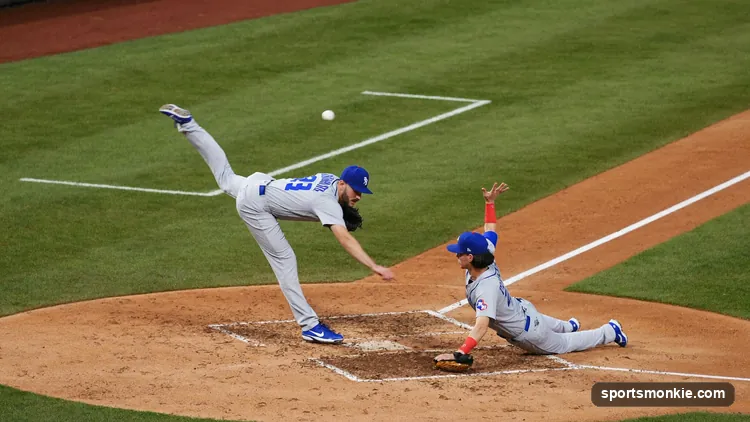
What Is a Sacrifice Fly in Baseball? Rule, Scoring, RBI Explained
A sacrifice fly in baseball is a fly out that scores a runner from third base. Learn the official rule, scoring, RBI, and how it differs from a sac bunt.
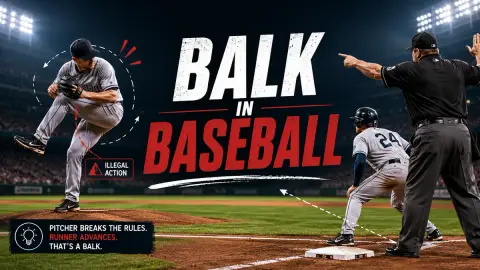
What Is a Balk in Baseball? Rules, Types, and Penalty
A balk is an illegal pitching motion with runners on base, and the penalty advances every runner one base. Here are the common types and the reasons.

The Infield Fly Rule in Baseball, Explained Simply
The infield fly rule calls the batter out on an easy pop-up with runners on first and second (or bases loaded) and fewer than two outs. Here is why it exists.

What Is a Walk-Off in Baseball?
A walk-off is when the home team scores the winning run in the bottom of the final inning, ending the game instantly. Here is how it works and the types.

Baseball Positions by Number: The Complete 1-9 Guide
Baseball positions by number run 1-9: pitcher, catcher, first base, second, third, shortstop, left, center, right field. Full scorekeeping guide.

What Is a Can of Corn in Baseball? Meaning, Origin & Examples
A can of corn in baseball is an easy, high fly ball a fielder catches without moving much. Learn the term's grocery-store origin and how it's used.