
What Is a Full Count in Baseball? 3-2 Count Rules Explained
On this page6
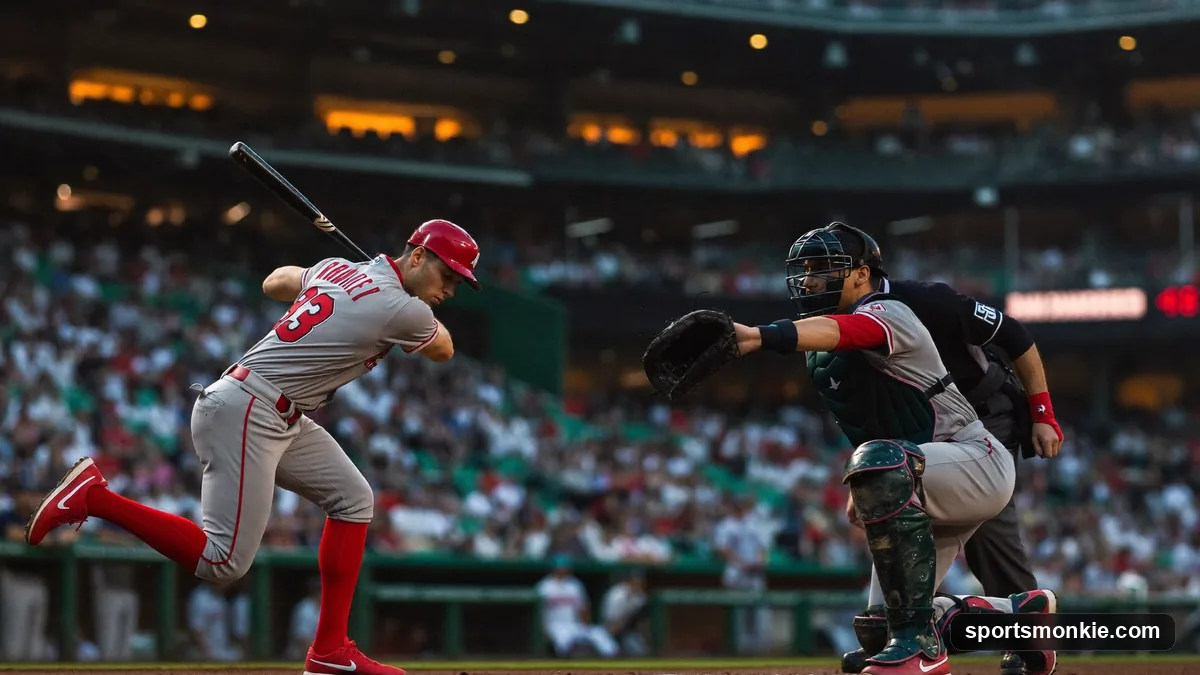
A full count in baseball is a 3-ball, 2-strike count on the batter — the maximum number of balls and strikes a hitter can have before the at-bat must be resolved. From here, the next pitch either ends the plate appearance outright or, if fouled off, resets to another full-count pitch. It’s one of the most tense moments in the sport because the pitcher, the batter, and every runner on base are all one pitch away from a decision.
How the count works
Every plate appearance tracks two numbers: balls and strikes, always said in that order (“two and one,” “three and two”). A batter reaches base on a walk after four balls, and is out on a strikeout after three strikes. Since the maximum before something has to give is three balls and two strikes, “full count” simply describes the count maxing out on both sides at once — 3-2.
You’ll also hear a full count called “three and two” by announcers, and it’s written as 3-2 in scorebooks and pitch-tracking charts. It can happen in any at-bat, at any point in a game, once the pitcher has missed the strike zone three times and the batter has taken or swung through two strikes.
What happens on the next pitch
Once the count reaches 3-2, the next pitch almost always decides the at-bat:
- Ball — the batter draws a walk (base on balls) and takes first base.
- Strike (called or swinging) — the batter strikes out.
- Ball put in play — the play unfolds as normal (a hit, an out, a fielder’s choice, etc.).
- Foul ball — the at-bat continues and the count stays 3-2, since a foul ball with two strikes cannot be recorded as the third strike (bunts are the one exception — a foul bunt with two strikes is an out).
Because that next pitch so often settles the entire plate appearance, it has a nickname of its own: the payoff pitch. A single mistake by either player — the pitcher grooving one down the middle, or the batter chasing something out of the zone — typically ends things immediately.
Why full counts can go on forever
Because a foul ball on a full count doesn’t end the at-bat, a batter with good bat control can, in theory, foul off 3-2 pitches indefinitely and keep the plate appearance alive. This is legal at every level of baseball. MLB has seen full-count battles that stretch well past a dozen pitches before the hitter finally walks, strikes out, or puts a ball in play. It’s one of the reasons a single at-bat can take several minutes and several trips back to the dugout for both benches.
Some slow-pitch softball leagues use a different rule, treating a foul ball with two strikes as an out rather than letting it extend the at-bat — but standard baseball and fast-pitch softball both let it play out indefinitely.
Hitter’s count, pitcher’s count, or neither?
Most counts lean one way or the other:
| Count | Who it favors | Why |
|---|---|---|
| 3-0, 3-1, 2-0 | Hitter | Pitcher must throw a strike or risk a walk, so pitches are more predictable and in the zone |
| 0-2, 1-2 | Pitcher | Pitcher can waste pitches out of the zone to bait a chase, with no walk risk yet |
| 3-2 (full count) | Close to neutral | Pitcher still must throw a strike-zone pitch (walk risk), but the batter must also protect against strikeout |
A full count sits in between. The pitcher can’t nibble at the edges the way he can on 0-2, because ball four ends things in the batter’s favor. But the batter can’t sit back and wait, either, because a called third strike ends things in the pitcher’s favor. That mutual pressure is what makes the 3-2 pitch so tightly contested — both sides are typically playing it as straight as they can.
Full count strategy for pitchers and hitters
Pitchers on a full count usually go to their most reliable, most-controlled pitch rather than their nastiest one, because a walk is often just as costly as a hit. Many pitchers lean on a fastball they can locate for a strike, or a well-commanded breaking ball if they trust it in the zone.
Hitters, meanwhile, tend to shorten their swing and simply try to make contact — fouling off marginal pitches to survive rather than chasing a big hit. On a 3-2 count with runners on base, those runners are often already moving as the pitch is thrown (since a walk, strikeout, or ball in play is coming regardless), which adds another layer of strategy for both the defense and the offense.
Full count in context
A full count is just one entry in baseball’s broader count vocabulary — it sits alongside terms like the strike zone that defines balls from strikes, and it can theoretically occur in any of the nine innings of a baseball game. For a complete rundown of counts, pitches, and other baseball vocabulary, see the full baseball terminology glossary, and browse more explainers in SportsMonkie’s baseball and MLB hub.
Whether you’re watching a Little League game or a tied playoff game in the ninth, the same rule applies: once the count reaches 3-2, everyone in the ballpark knows the next non-foul pitch is likely to decide the at-bat.
Frequently asked questions
What is a full count in baseball?+
A full count in baseball is a 3-ball, 2-strike count on the batter — the maximum a hitter can accumulate before the at-bat must be decided. The next pitch either ends the plate appearance or, if fouled off, keeps the count at 3-2.
What happens after a full count pitch?+
If the pitch is a ball, the batter draws a walk (base on balls). If it's a called or swinging strike, the batter is struck out. If the batter hits it foul, the at-bat continues and the count stays 3-2, since a foul ball cannot be the third strike once a batter already has two strikes.
Why is the pitch on a full count called the 'payoff pitch'?+
It's nicknamed the payoff pitch because it typically settles, or 'pays off,' the entire at-bat — a mistake by either the pitcher or the batter usually ends the plate appearance immediately, unlike earlier counts where both sides still have room to work.
Can a full count at-bat go on forever?+
Yes. As long as the batter keeps fouling off 3-2 pitches, the at-bat continues indefinitely. MLB has seen full-count battles run well past 10 foul balls before the plate appearance is finally decided by a ball, a strike, or a ball in play.
Is a full count good for the hitter or the pitcher?+
It's considered close to neutral, unlike most two-strike counts (which heavily favor the pitcher). Because a fourth ball walks the batter, the pitcher generally has to throw a strike-zone pitch on 3-2, which gives the hitter a more hittable pitch to look for than on counts like 0-2 or 1-2.
How is a full count announced or written?+
Announcers say 'full count' or 'three and two' (balls always stated first). In scorebooks and pitch-tracking data, it's written as 3-2.
Does a full count exist in softball or Little League?+
Yes, the same 3-2 definition applies across baseball and softball at every level, from Little League through MLB, though some slow-pitch softball leagues rule that a foul ball with two strikes is an out rather than allowing it to extend the at-bat.
Sources
Play & tools
Free browser games and tools — no account, no download.
- Play 162-0 — Draft nine and see if your roster can survive a flawless 162-game MLB season.
- Explore all our games →
- Analyze a trade — Compare both sides of a fantasy baseball trade before you accept.
- Run the MLB predictor — Simulate the MLB postseason bracket down to a World Series champion.
- Open the ERA calculator — Work out earned run average from earned runs and innings pitched — handles the .1/.2 thirds convention.
- Explore all our free sports tools →
Related baseball guides
View all →
Baseball Positions by Number: The Complete 1-9 Guide
Baseball positions by number run 1-9: pitcher, catcher, first base, second, third, shortstop, left, center, right field. Full scorekeeping guide.
What Is a Double Play in Baseball? Rules, Types & Scoring Explained
A double play in baseball is when the defense records two outs on one continuous play. Learn every type, how it's scored, and the slide rule that protects it.
What Is a Force Out in Baseball? Force Play Rules Explained
A force out in baseball happens when a runner must advance to an open base and is put out there before or without a tag. Full rules and examples.
What Is the Strike Zone in Baseball? Rules, Dimensions & 2026 ABS Explained
The strike zone in baseball is the area over home plate a pitch must cross for a strike. Learn its exact dimensions, history, and MLB's ABS challenge rules.
What Is a Balk in Baseball? Rules, Types, and Penalty
A balk is an illegal pitching motion with runners on base, and the penalty advances every runner one base. Here are the common types and the reasons.

The Infield Fly Rule in Baseball, Explained Simply
The infield fly rule calls the batter out on an easy pop-up with runners on first and second (or bases loaded) and fewer than two outs. Here is why it exists.