
What Is a Balk in Baseball? Rules, Types, and Penalty
On this page4
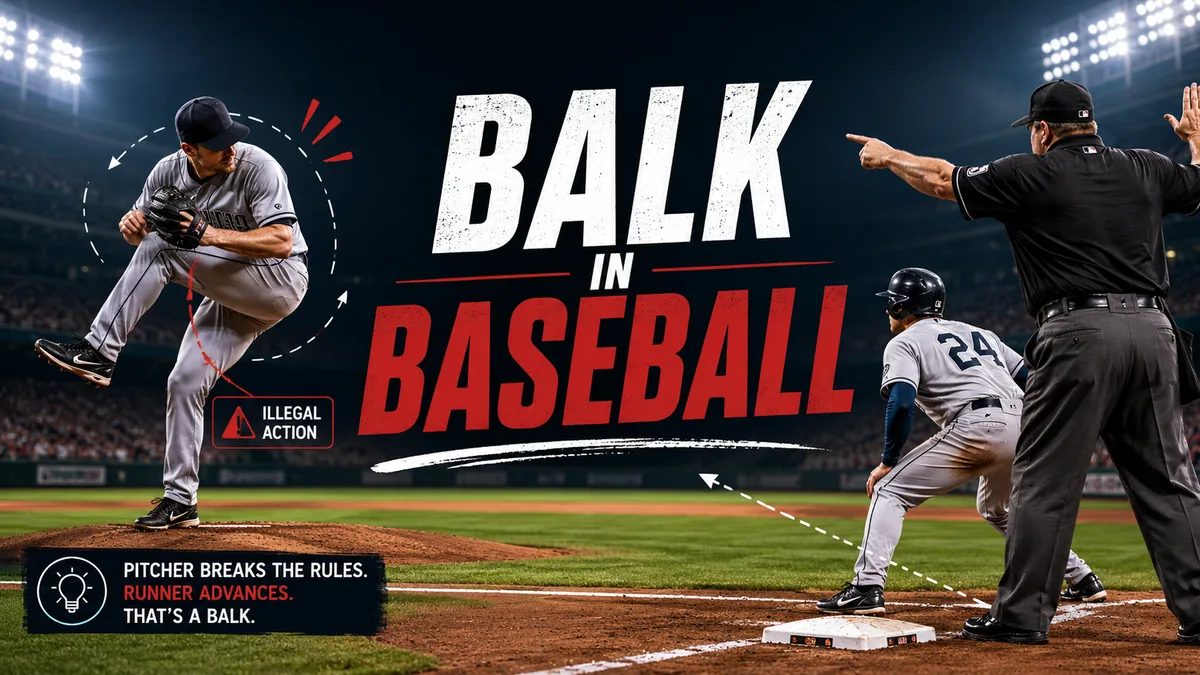
A pitcher shuffles his feet on the mound, twitches toward first base, and suddenly the umpire is pointing and every runner trots up a base. No pitch was thrown, no ball was hit, yet the offense just gained ground. That is a balk, and it is one of the few rules in baseball that punishes a fake rather than an action. Like the dropped third strike, it is a situational rule that catches casual fans off guard.
What a balk actually is
A balk is an illegal motion by the pitcher when there is at least one runner on base. The rule exists for one reason: to stop the pitcher from deceiving baserunners about whether he is going to pitch or throw over to a base. Runners are entitled to react to a genuine pitch or a genuine pickoff attempt. If the pitcher blurs that line with a deceptive move, the umpire evens things up by awarding the runners a base.
The key detail people miss: a balk can only be charged with a runner on base. With the bases empty, the same illegal move is just called a ball on the batter.
The penalty
When a balk is called, the ball is dead and each runner advances exactly one base. A runner on first goes to second, a runner on third scores, and so on.
There is one modern wrinkle. If the pitcher balks but still delivers the pitch, and the batter then reaches base safely and every runner advances at least one base on the play, the balk can be ignored and the result of the play stands. In practice, though, most balks stop everything immediately.
Common types of balk
Balk calls almost always come from one of a handful of moves:
| Balk situation | What the pitcher did wrong |
|---|---|
| No complete stop | Delivered from the set position without coming to a full, visible stop |
| Fake to first | Faked a throw to first base (a throw there must be a real attempt) |
| Starting and stopping | Began the pitching motion and did not finish it |
| Foot off the rubber issues | Threw to a base without stepping toward it, or stepped off improperly |
| Quick pitch | Pitched before the batter was reasonably set |
| Dropping the ball | Let the ball slip while on the rubber |
| Not facing the batter | Delivered while not properly set toward home plate |
Note that a pitcher can legally fake a throw to second or third base under most rulesets, but faking a throw to first base is a balk.
Why the rule feels so fussy
The balk is deliberately strict because a fraction of a second of deception can be the difference between a runner stealing a base or being thrown out. Pitchers with runners on are essentially in a staring contest with the runner, and the balk rule keeps that contest honest. Umpires are trained to watch the pitcher’s stop, hands, and lead foot closely, which is why balks sometimes look invisible to fans but obvious from behind the plate.
For pitchers, the fix is simple in theory: a clean, consistent motion every time. In tight games, though, when a pitcher tries to hold a fast runner close, that is exactly when a balk is most likely to slip out.
Frequently asked questions
What happens when a balk is called in baseball?+
Every baserunner advances one base. If there are no runners on base, a balk cannot be charged; instead the pitch is simply called a ball.
Can you balk with no runners on base?+
No. A balk requires at least one runner on base, because the rule exists to stop pitchers from deceiving runners. With the bases empty, an illegal motion is just called a ball.
What is the most common type of balk?+
Failing to come to a complete, discernible stop before delivering from the set position is the most frequently called balk, along with starting the pitching motion and then not completing it.
Sources
Play & tools
Free browser games and tools — no account, no download.
- Play 162-0 — Draft nine and see if your roster can survive a flawless 162-game MLB season.
- Explore all our games →
- Analyze a trade — Compare both sides of a fantasy baseball trade before you accept.
- Run the MLB predictor — Simulate the MLB postseason bracket down to a World Series champion.
- Open the ERA calculator — Work out earned run average from earned runs and innings pitched — handles the .1/.2 thirds convention.
- Explore all our free sports tools →
Related baseball guides
View all →
The Infield Fly Rule in Baseball, Explained Simply
The infield fly rule calls the batter out on an easy pop-up with runners on first and second (or bases loaded) and fewer than two outs. Here is why it exists.
What Is a Double Play in Baseball? Rules, Types & Scoring Explained
A double play in baseball is when the defense records two outs on one continuous play. Learn every type, how it's scored, and the slide rule that protects it.
Baseball Positions by Number: The Complete 1-9 Guide
Baseball positions by number run 1-9: pitcher, catcher, first base, second, third, shortstop, left, center, right field. Full scorekeeping guide.
What Is a Force Out in Baseball? Force Play Rules Explained
A force out in baseball happens when a runner must advance to an open base and is put out there before or without a tag. Full rules and examples.
What Is a Full Count in Baseball? 3-2 Count Rules Explained
A full count in baseball is a 3-ball, 2-strike count on the batter, where the next non-foul pitch usually ends the at-bat. Here's how it works.
What Is a Sacrifice Fly in Baseball? Rule, Scoring, RBI Explained
A sacrifice fly in baseball is a fly out that scores a runner from third base. Learn the official rule, scoring, RBI, and how it differs from a sac bunt.