
Baseball Positions by Number: The Complete 1-9 Guide
On this page8
- 01The Full List: Baseball Position Numbers 1-9
- 02Why the Numbers Go in This Order
- 03How Scorekeepers Use Position Numbers
- 04Position Numbers vs. Jersey Numbers
- 05Is There a Position 10? The Designated Hitter Question
- 06Position Numbers Across Levels of Play
- 07Quick Reference: Common Scorebook Plays
- 08Why This System Still Matters
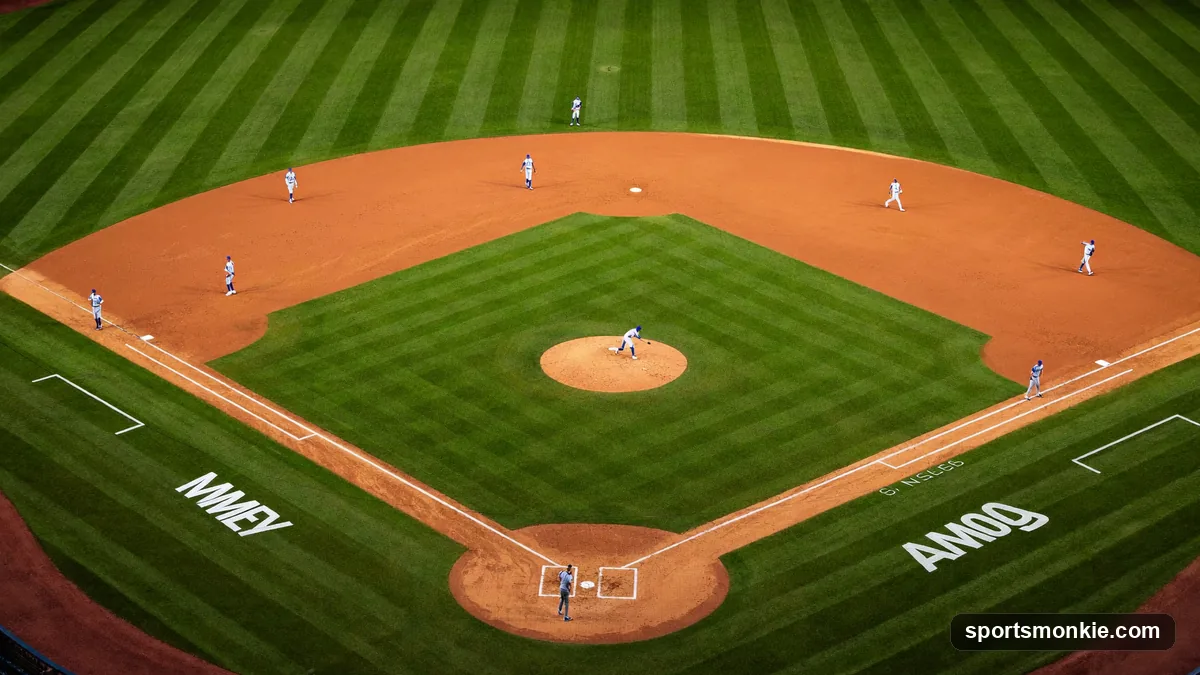
Baseball positions by number run from 1 to 9: pitcher (1), catcher (2), first baseman (3), second baseman (4), third baseman (5), shortstop (6), left fielder (7), center fielder (8), and right fielder (9). Every official scorer, coach, and stat sheet uses these nine numbers instead of position names because they’re faster to write and universally understood across every level of the sport, from Little League to the MLB.
The Full List: Baseball Position Numbers 1-9
Here’s the complete reference chart. Memorize this order and scorebook notation stops looking like a secret code.
| Number | Position | Abbreviation | General Area |
|---|---|---|---|
| 1 | Pitcher | P | Pitcher’s mound |
| 2 | Catcher | C | Behind home plate |
| 3 | First Baseman | 1B | Right side of infield |
| 4 | Second Baseman | 2B | Right-center infield |
| 5 | Third Baseman | 3B | Left side of infield |
| 6 | Shortstop | SS | Left-center infield |
| 7 | Left Fielder | LF | Left outfield |
| 8 | Center Fielder | CF | Deep center outfield |
| 9 | Right Fielder | RF | Right outfield |
Notice that the numbers don’t follow a strict left-to-right or clockwise path around the field. They follow a historical scorekeeping convention that groups the battery first, then the infield, then the outfield.
Why the Numbers Go in This Order
The 1-9 system isn’t random, but it also isn’t purely geographic. It breaks into three logical groups:
- The battery (1-2): Pitcher and catcher get the first two numbers because they’re involved in literally every pitch. Together they’re called the “battery.”
- The infield (3-6): First base (3), second base (4), third base (5), and shortstop (6) follow. This is the part that trips people up — the shortstop plays between second and third but is numbered last in the infield group. That’s simply the order 19th-century scorers settled on, and it stuck.
- The outfield (7-9): Left field (7), center field (8), and right field (9) close out the numbering, moving from the third-base side to the first-base side.
This system was standardized in the early days of organized baseball scorekeeping and hasn’t changed since, which is part of why it still works as a universal language between old box scores and today’s stat sheets.
How Scorekeepers Use Position Numbers
Scorekeepers write plays as number sequences instead of spelling out names. A few common examples:
- 6-3: Shortstop fields a ground ball and throws to first base for the out.
- 4-3: Second baseman fields the ball and throws to first base.
- 6-4-3: A classic double play — shortstop to second baseman (forcing the runner) to first baseman (completing the double play).
- 5-4-3: Third baseman starts a double play, throwing to second, then relayed to first.
- K: Strikeout (not a position number, but appears alongside them in scorebooks).
If you’re trying to visualize how a double play actually develops on the field, our double play in baseball explainer breaks down the full mechanics play by play.
Position Numbers vs. Jersey Numbers
A common point of confusion for new fans: position numbers (1-9) have nothing to do with the number on a player’s jersey. A shortstop is always “6” in scorekeeping shorthand no matter whether his uniform says #2 or #24. Position numbers exist purely for scorekeeping notation; jersey numbers are a separate identifier chosen by the player or team.
Is There a Position 10? The Designated Hitter Question
The designated hitter (DH) bats in place of the pitcher in the American League and, since 2022, throughout MLB, but doesn’t play defense. Because the 1-9 system only numbers defensive positions, the DH has no official number. Some informal scoresheets and youth leagues use “10” as shorthand for the DH or for an extra short fielder used in T-ball and coach-pitch formats, but neither is part of the sport’s official numbering standard.
Position Numbers Across Levels of Play
The 1-9 numbering system is consistent from Little League through the majors — a 6-4-3 double play means the same thing whether it happens in a high school game or a World Series. The only variations show up in entry-level youth formats (like T-ball), where a coach may station an extra “short fielder” in shallow outfield for beginners still learning to track fly balls. That extra defender is a teaching tool, not a change to the standard nine positions used everywhere else in the sport.
Quick Reference: Common Scorebook Plays
| Notation | What Happened |
|---|---|
| 1-3 | Pitcher fields a comebacker, throws to first |
| 2-6 | Catcher throws out a runner stealing second (shortstop covers) |
| 8 | Fly out to center field |
| 4-6-3 | Double play started by the second baseman |
| 9-3 | Right fielder throws behind a runner to first for the out |
For the broader vocabulary that surrounds these plays — force outs, sacrifice flies, full counts, and more — the baseball terminology glossary collects every term new fans need in one place, and our guide to the strike zone covers the rule that governs most of what a pitcher (1) and catcher (2) do on every pitch.
Why This System Still Matters
Even with modern tracking data and advanced analytics, MLB teams, official scorers, and broadcasters still rely on the same 1-9 numbering that’s been standard for over a century. It’s compact, unambiguous, and works the same way in every ballpark and every country that plays the game. Learning it is one of the fastest ways to actually read a scorebook or box score rather than just watch the final score.
Want the bigger picture of how a game is structured around these nine defenders? Start with how many innings are in a baseball game, or head back to the baseball hub for the full library of MLB rules, terms, and explainers.
Frequently asked questions
What are the baseball positions by number?+
Baseball positions by number run from 1 to 9: pitcher (1), catcher (2), first baseman (3), second baseman (4), third baseman (5), shortstop (6), left fielder (7), center fielder (8), and right fielder (9). Every defensive player on the field is assigned one of these nine numbers for scorekeeping purposes.
Why is the shortstop number 6 instead of 5?+
The numbering follows the general path a ball travels around the infield rather than the order players stand in. After the battery (pitcher 1, catcher 2), the system moves first base (3), second base (4), third base (5), then shortstop (6), even though the shortstop plays between second and third. This order dates back to 19th-century scorekeeping conventions and has stayed consistent ever since.
What does 6-4-3 mean in baseball?+
A 6-4-3 is a classic double play: the shortstop (6) fields a ground ball, throws to the second baseman (4) to force out the runner, and the second baseman relays to the first baseman (3) to complete the double play. Scorers write out the number sequence to show the exact path the ball took.
Is the designated hitter given a number?+
No. The designated hitter (DH) bats in place of the pitcher but does not play defense, so it has no number in the standard 1-9 fielding system. Some scorebooks and stat sheets informally use "DH" or the number 10 as a roster shorthand, but it is not part of the official defensive numbering.
Do position numbers change between youth baseball and MLB?+
No, the core 1-9 numbering is the same from Little League through MLB. Some youth formats like T-ball or coach-pitch add an extra "short fielder" in shallow outfield, sometimes labeled 10, but that is a league-specific addition rather than a change to the standard system.
What is the difference between a position number and a jersey number?+
A position number (1-9) identifies where a player lines up on defense and is used only in scorekeeping notation. A jersey number is the number on a player's uniform and has no connection to which position they play; a shortstop can wear jersey #6 or #24 with no rule requiring a match.
Why do scorers use numbers instead of position names?+
Numbers are faster to write in real time and create a compact, universal shorthand that any trained scorer can read regardless of language. "6-4-3 DP" fits in a small scorebook box; spelling out "shortstop to second baseman to first baseman, double play" does not.
Sources
Play & tools
Free browser games and tools — no account, no download.
- Play 162-0 — Draft nine and see if your roster can survive a flawless 162-game MLB season.
- Explore all our games →
- Analyze a trade — Compare both sides of a fantasy baseball trade before you accept.
- Run the MLB predictor — Simulate the MLB postseason bracket down to a World Series champion.
- Open the ERA calculator — Work out earned run average from earned runs and innings pitched — handles the .1/.2 thirds convention.
- Explore all our free sports tools →
Related baseball guides
View all →
What Is a Double Play in Baseball? Rules, Types & Scoring Explained
A double play in baseball is when the defense records two outs on one continuous play. Learn every type, how it's scored, and the slide rule that protects it.
What Is a Force Out in Baseball? Force Play Rules Explained
A force out in baseball happens when a runner must advance to an open base and is put out there before or without a tag. Full rules and examples.
What Is a Full Count in Baseball? 3-2 Count Rules Explained
A full count in baseball is a 3-ball, 2-strike count on the batter, where the next non-foul pitch usually ends the at-bat. Here's how it works.
What Is the Strike Zone in Baseball? Rules, Dimensions & 2026 ABS Explained
The strike zone in baseball is the area over home plate a pitch must cross for a strike. Learn its exact dimensions, history, and MLB's ABS challenge rules.
What Is a Balk in Baseball? Rules, Types, and Penalty
A balk is an illegal pitching motion with runners on base, and the penalty advances every runner one base. Here are the common types and the reasons.

The Infield Fly Rule in Baseball, Explained Simply
The infield fly rule calls the batter out on an easy pop-up with runners on first and second (or bases loaded) and fewer than two outs. Here is why it exists.