
What Is a Sacrifice Fly in Baseball? Rule, Scoring, RBI Explained
On this page6
A sacrifice fly in baseball is a fly ball hit deep enough to be caught for an out while a runner, almost always from third base, tags up and scores after the catch. It is the rare out a batter wants to make: it counts as a run batted in, but it does not count against his batting average.
Announcers shorten it to “sac fly,” and box scores mark it with the abbreviation SF. Understanding why this one specific type of out gets special treatment explains a lot about how baseball’s scoring rules reward productive outs. Here is the full rule, how it is scored, and how it compares to the sport’s other sacrifice play.
The official rule for a sacrifice fly
Major League Baseball’s Official Rule 9.08(d) defines it precisely. A sacrifice fly is scored when, with fewer than two outs, the batter hits a fly ball in fair or foul territory that is handled by an outfielder (or an infielder running into the outfield) and:
- The ball is caught, and a runner scores after tagging up, or
- The ball is dropped, and a runner scores, if in the official scorer’s judgment that runner would have scored anyway had the fly ball been caught cleanly.
The key phrase is “fewer than two outs.” A fly out with two outs already on the board ends the half-inning the instant it is caught, so no runner can legally score on the play, which means a sacrifice fly is mathematically impossible with two outs.
Why it does not hurt the batter’s average
This is the detail that makes the sacrifice fly unique. Under Rule 9.02(a), a sacrifice fly is one of the handful of outcomes excluded from a player’s official at-bats, alongside walks, hit-by-pitches, and sacrifice bunts.
Since batting average is calculated as hits divided by at-bats, removing the at-bat means a sac fly cannot lower it. At the same time, the run that scores is credited to the batter as an RBI. The result: a hitter can fail to reach base, technically make an out, and still walk away with a better stat line than if the at-bat had never happened.
| Outcome | Counts as an at-bat? | Counts as an RBI? | Affects batting average? |
|---|---|---|---|
| Sacrifice fly | No | Yes | No |
| Sacrifice bunt | No | No | No |
| Regular fly out | Yes | Only if a run scores | Yes (lowers it) |
| Base hit | Yes | If a run scores | Yes (raises it) |
| Walk | No | No (unless bases loaded) | No |
How the play typically unfolds
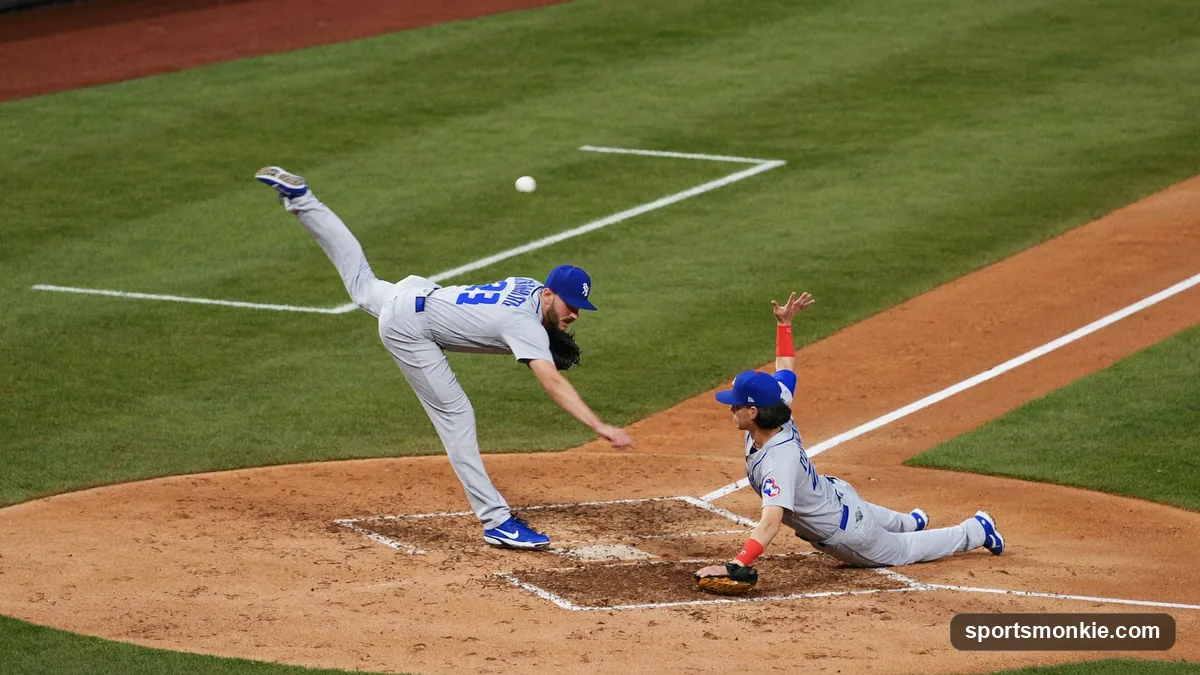
The classic sacrifice fly situation is a runner on third base with fewer than two outs. The batter lifts a fly ball deep enough to the outfield that, once it is caught, the runner can tag up and beat the throw home.
- The batter hits a fly ball caught by an outfielder (or a shallow infielder running into outfield territory).
- The runner on third must legally tag up, meaning they touch third base at or after the moment of the catch, before advancing.
- The runner sprints home and beats (or ties) the throw to the plate.
- The umpire rules the runner safe, and the official scorer logs a sacrifice fly and an RBI for the batter.
If the runner leaves third base too early and the defense appeals correctly, the runner can be called out for leaving early, but under Rule 9.08(d) the batter still keeps credit for the sacrifice fly as long as a run scored before the appeal out became the third out of the inning.
Sacrifice fly vs. sacrifice bunt
Baseball groups sacrifice flies and sacrifice bunts under the same broad “sacrifice” umbrella because both plays intentionally trade an out for team advancement, and both are excluded from at-bats. The mechanics and the reward are different, though.
- Sacrifice fly: a fly ball caught in the air, scores a runner from third, and is credited as an RBI.
- Sacrifice bunt (sac hit): a bunted ground ball that advances a runner (typically from first to second, or second to third) without necessarily scoring anyone, and it does not earn an RBI.
Both plays are examples of what fans generally call a “productive out,” a batting result that helps the team even though the hitter is retired. For more on how baseball’s less obvious plays and calls are officially defined, see the baseball terminology glossary.
Sacrifice fly leaders and situational value
Sacrifice flies are most common with a runner on third and one out, since a runner on third with zero outs already scores on far more play types, and with two outs the play is impossible by rule. Teams that hit the ball with authority to the outfield, rather than relying on ground balls, tend to rack up more sacrifice flies over a season simply because they generate more deep fly-ball contact with a runner in scoring position.
The situational skill involved, lifting a pitch just deep enough without popping it up or striking out, is closely related to other contact-based run-producing plays like the grand slam at the opposite extreme of power, or the sacrifice bunt at the opposite extreme of small-ball strategy. All three sit on the same spectrum of manufacturing runs in different ways.
Quick recap
A sacrifice fly is a fly out that:
- Occurs with fewer than two outs
- Is caught (or misplayed in a way that still would have allowed the run)
- Allows a runner to tag up and score
- Is not counted as an at-bat
- Is counted as an RBI
It rewards a hitter for productive contact even in defeat, which is why coaches and broadcasters treat it as a genuinely good outcome rather than a failed at-bat. To see how this fits into the sport’s larger rulebook of scoring and situational plays, browse more explainers on the baseball and MLB hub.
Frequently asked questions
What is a sacrifice fly in baseball?+
A sacrifice fly is a batted fly ball that is caught for an out but allows a runner, usually from third base, to tag up and score after the catch. Official scorers record it with the notation SF, and it counts as an RBI for the batter.
Does a sacrifice fly count as an at-bat?+
No. Under MLB Rule 9.02(a) and 9.08(d), a sacrifice fly is excluded from at-bats, the same way a walk or a sacrifice bunt is excluded. This means a sacrifice fly cannot lower a batter's batting average, even though the batter technically made an out.
Does a sacrifice fly count as an RBI?+
Yes. Any run that scores on a sacrifice fly is credited to the batter as a run batted in, exactly as if the batter had gotten a hit. The batter gets the offensive credit without the at-bat penalty.
Do you need a runner on third for a sacrifice fly?+
Almost always, since the runner has to tag the base after the catch and still beat the throw home. In rare cases a runner from second can score on a very deep fly ball plus an error or a weak relay throw, and that can still be scored a sacrifice fly if a run crosses the plate.
Can a sacrifice fly happen with two outs?+
No. A sacrifice fly can only be scored with fewer than two outs, because a fly out with two outs ends the half-inning immediately and no runner can legally score on the play.
What is the difference between a sacrifice fly and a sacrifice bunt?+
A sacrifice fly is a fly ball caught in the air that scores a runner from third, and it is credited as an RBI. A sacrifice bunt, or sac hit, is a bunted ground ball that advances a runner without scoring one, and it does not count as an RBI. Both are excluded from at-bats, but only the sacrifice fly rewards the batter with a run batted in.
What happens if the fielder drops the fly ball?+
If a fielder drops a catchable fly ball and a runner scores, the official scorer can still credit a sacrifice fly, but only if they judge the runner would have scored anyway had the ball been caught cleanly. If the drop is what created the scoring chance, it is typically ruled an error instead.
Does a sacrifice fly hurt a batter's stats?+
It has almost no downside for rate stats. Because it is not an at-bat, it cannot lower batting average, on-base percentage, or slugging percentage, while it still adds a run batted in to the counting stats. It is one of the few outs in baseball a hitter is happy to make.
Sources
Play & tools
Free browser games and tools — no account, no download.
- Play 162-0 — Draft nine and see if your roster can survive a flawless 162-game MLB season.
- Explore all our games →
- Analyze a trade — Compare both sides of a fantasy baseball trade before you accept.
- Run the MLB predictor — Simulate the MLB postseason bracket down to a World Series champion.
- Open the ERA calculator — Work out earned run average from earned runs and innings pitched — handles the .1/.2 thirds convention.
- Explore all our free sports tools →
Related baseball guides
View all →
The Infield Fly Rule in Baseball, Explained Simply
The infield fly rule calls the batter out on an easy pop-up with runners on first and second (or bases loaded) and fewer than two outs. Here is why it exists.

What Is Tagging Up in Baseball?
Tagging up is when a baserunner waits on his base until a fly ball is caught, then advances. He must be touching the base at the moment of the catch.
What Is a Balk in Baseball? Rules, Types, and Penalty
A balk is an illegal pitching motion with runners on base, and the penalty advances every runner one base. Here are the common types and the reasons.

Baseball Terminology Glossary: Every Key Term Explained
A complete baseball terminology glossary covering hitting, pitching, fielding, baserunning, and scoring terms every fan needs to know.

What Is a Walk-Off in Baseball?
A walk-off is when the home team scores the winning run in the bottom of the final inning, ending the game instantly. Here is how it works and the types.
What Is a Double Play in Baseball? Rules, Types & Scoring Explained
A double play in baseball is when the defense records two outs on one continuous play. Learn every type, how it's scored, and the slide rule that protects it.