
Breaststroke Kick Technique: Whip Kick, Faults & Drills
On this page7
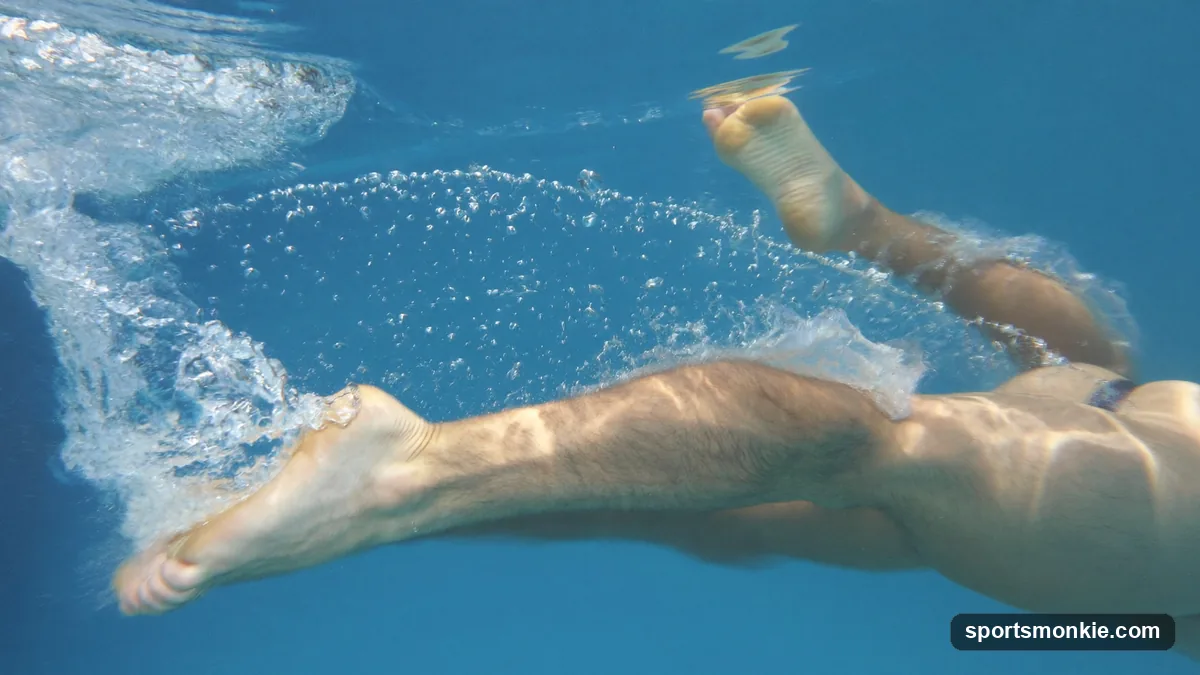
The breaststroke kick is a whip kick: you draw your heels toward your seat, turn both feet outward with flexed ankles, then whip them back and around in a fast circular sweep until they snap together in a streamline. All the propulsion comes from the soles and insoles of your feet pressing against the water, so pointed toes kill the kick instantly. Get the ankle turn and the timing right and the legs become the strongest engine in the whole stroke.
How the Breaststroke Kick Actually Works
Unlike the flutter kick in freestyle technique, the breaststroke kick is a single, powerful, symmetrical action rather than a continuous flutter. Both legs move together and mirror each other exactly, which is why it is sometimes called the frog kick. Propulsion is generated on the back half of the movement, when your feet are flexed and sweeping backward and inward against the water.
Think of the kick as a three-phase loop:
- Recovery (loading): heels draw up toward the seat with minimal knee drop.
- Outsweep and catch: feet turn out, ankles flex, insoles find the water.
- Insweep and snap: feet whip back and around, then slam together straight.
The whole cycle should feel like a fast, circular whip rather than a slow squeeze. This is the same propulsion-then-glide rhythm you build in the full swim technique guide, where every stroke pairs a power phase with a streamlined recovery.
Step-by-Step Whip Kick Sequence
Break the kick into deliberate steps and drill each one until the sequence feels automatic.
- Start streamlined. Legs straight and together, toes pointed, body long on the surface.
- Draw the heels up. Bend the knees and pull your heels toward your glutes. Keep your knees close, roughly shoulder-width, and let them drop only slightly. Do not pull your thighs far forward under your body, which creates drag.
- Turn the feet out and flex. As the heels arrive near your seat, rotate both feet outward and dorsiflex hard, so the soles face out and slightly back. This is the catch position. Your feet should be wider than your knees now.
- Whip back and around. Drive the feet backward and in a circular arc, pressing the insoles and soles against the water. This is where all the power lives. Accelerate through the sweep.
- Snap together and glide. Finish with the legs fully extended and the feet snapping together in a streamline. Hold the glide for a beat before the next kick.
The single biggest speed cue is to accelerate through phases 4 and 5. A lazy insweep leaks propulsion. If you want more end-of-stroke speed across every stroke, our guide on how to swim faster breaks down why finishing each power phase with acceleration matters most.
Whip Kick vs Frog Kick
The terms are often used interchangeably, but coaches distinguish them by width and ankle action. The table below shows what changes.
| Feature | Whip kick (modern) | Frog kick (classic) |
|---|---|---|
| Knee width | Narrow, ~shoulder-width | Wide, splayed out |
| Foot path | Tight circular whip | Wide, rounded sweep |
| Ankle turn | Sharp, aggressive dorsiflexion | Moderate |
| Speed | Fast, snappy | Slower, more relaxed |
| Drag | Lower | Higher |
| Best for | Racing, efficiency | Casual swimming, learning |
Beginners often learn a frog kick first because the wider motion is easier to feel. As control improves, narrowing the knees and sharpening the ankle turn converts it into a faster whip kick. Neither is wrong for recreational swimming, but the whip kick is what you want if speed and efficiency are the goal.
Ankle Flexion: The Hidden Key
Ankle flexion is the single element that separates a strong kick from a weak one. When you draw your heels up, both ankles must cock into dorsiflexion, toes pulled toward the shins and turned outward. That flexed position exposes the large surface of your soles to the water. Point your toes at the wrong moment and the tops of your feet knife through, producing almost nothing.
Two things limit ankle turn:
- Mobility. Tight ankles simply cannot rotate the feet out far enough. Regular calf and ankle stretching, plus seated foot-eversion work, expands your range over weeks.
- Timing. Even mobile swimmers lose power if they flex too late. The feet must already be turned out and flexed before the insweep begins, not during it.
A quick land check: sit on the floor, extend your legs, and see whether you can turn your soles to face outward. If you cannot, that limited range is showing up in the pool as lost propulsion.
Common Breaststroke Kick Faults and Fixes
Most kick problems come down to a handful of repeatable errors. Match your symptom to the fix.
| Fault | What it looks like | Fix |
|---|---|---|
| Pointed toes | Feet slide, no push | Dorsiflex hard before the insweep; think “toes to shins” |
| Knees too wide | Big frontal drag, stalled glide | Keep knees shoulder-width; let feet go wider than knees |
| Thighs pulled forward | Body pikes, hips sink | Draw heels up, not knees down |
| Scissor kick | Legs asymmetrical | Kick against a wall or board to feel both feet mirror |
| No glide | Rushed, choppy rhythm | Hold streamline one beat after the snap |
| Feet finish apart | Weak, incomplete snap | Consciously clap the feet together at the end |
The asymmetrical scissor kick is worth extra attention because it is both slow and, in competition, illegal. Under World Aquatics rules the kick must be simultaneous and symmetrical, so any alternating movement risks disqualification. Practicing a clean, even whip builds the right habit regardless of whether you race.
Drills That Build a Powerful Kick
Isolation drills let you feel the kick without the distraction of the arms. Add these to any session, and pair them with the beginner-friendly progressions in our swimming drills for beginners roundup.
- Kick on your back: Float on your back, hands at your sides or in streamline, and perform the whip kick. Because your face stays up you can breathe freely and watch that your knees stay narrow and your feet snap together.
- Vertical kicking: In deep water, hold a vertical position and kick continuously to stay afloat. This exposes weak ankle flexion fast, because a pointed-toe kick sinks you.
- Board kick with a pause: Hold a kickboard, do one kick, then glide and count “one-one-thousand” before the next. This ingrains the propulsion-then-glide rhythm.
- Wall heel-draw: Stand in the shallow end, place both hands on the wall, and slowly rehearse the heel draw, foot turn, and whip on dry-ish land to groove the shape.
- Two-kick, one-pull: Swim breaststroke but take two kicks for every arm pull. This forces you to rely on and refine the legs.
For newer swimmers, these fit naturally alongside the water-confidence and body-position work in our guide on how to swim for beginners. Once the kick is reliable, it slots straight into the timing of the full stroke covered in our dedicated breaststroke technique breakdown, where the pull, breath, and kick sequence together as pull, breathe, kick, glide.
Putting It All Together
A great breaststroke kick is narrow, flexed, and fast. Draw the heels up without dragging the thighs forward, turn the feet out and dorsiflex before you sweep, whip the legs back and around with accelerating power, then snap the feet together and glide. Fix pointed toes first, because that one change unlocks more propulsion than anything else. Drill the movement in isolation until the whip fires automatically, and your legs will become the most powerful part of your stroke.
Frequently asked questions
What is the difference between a whip kick and a frog kick?+
Both are breaststroke kicks, but the whip kick is narrower, faster, and more efficient. In a whip kick you keep your knees closer together, turn the feet sharply outward with flexed ankles, and whip them back in a tight circular path. A classic frog kick spreads the knees wide like a frog and sweeps the legs in a slower, rounder arc. Nearly all competitive swimmers use the whip kick because it reduces drag and produces sharper propulsion.
Why is my breaststroke kick so slow and weak?+
The most common cause is pointed toes. If your ankles stay plantarflexed, the tops of your feet slide through the water and generate almost no push. You must dorsiflex, turning the toes toward your shins and out to the sides so the insoles and soles catch the water. Other culprits are pulling the knees too far under your body, recovering the heels too slowly, and finishing with the feet apart instead of snapping them together.
How wide should my knees be in the breaststroke kick?+
Aim to keep your knees roughly shoulder-width or slightly narrower at the widest point of the recovery. Wide knees create frontal drag and stall your glide. Instead, let the feet travel wider than the knees during the outsweep. A useful cue is to think knees in, heels out, feet out. This keeps your body streamlined while still loading the large muscle groups that drive the whip.
What does ankle flexion have to do with the kick?+
Ankle flexion, or dorsiflexion, is what turns your feet into paddles. When you draw your heels up you must cock both ankles so the soles face outward and slightly backward. As the feet whip around and back, that flexed position presses a large surface against the water. Swimmers with limited ankle mobility lose propulsion because their feet cannot turn out far enough. Regular ankle stretching and evertor strengthening noticeably improve kick power.
Should I glide after every breaststroke kick?+
Yes, a brief glide is part of the stroke. After the feet snap together, hold a tight streamline for a beat and let the propulsion carry you forward before the next pull begins. In distance and recreational swimming the glide is longer to save energy; in sprint breaststroke it is shortened but never fully eliminated. Skipping the glide entirely spikes your stroke rate, wastes the push you just created, and tires you quickly.
Is a dolphin kick legal in breaststroke?+
Under World Aquatics rules, breaststroke requires a simultaneous, symmetrical kick with no alternating or downward dolphin movement, except for a single downward dolphin kick permitted during the start and each turn while submerged. During normal swimming any dolphin kick will be disqualified. If you swim recreationally the rule does not matter, but training a clean, symmetrical whip kick builds better habits and is far more efficient anyway.
Sources
Play & tools
Free browser games and tools — no account, no download.
- Play today's Sports Connections — Today's Sports Connections — daily hints, answers, and play the grid.
- Play Guess the NFL Player — A new mystery NFL player every day. Eight guesses, with a clue on each — plus free unlimited mode.
- Explore all our games →
Related guides
Breaststroke Swimming: Technique, Timing, and Drills Explained
Breaststroke swimming is the slowest competitive stroke, built on a pull-breathe-kick-glide rhythm and a whip kick. Learn the timing, pull-out, and fixes.
Breaststroke Technique: Pull, Breathe, Kick, Glide Timing
Master breaststroke technique with the pull-breathe-kick-glide sequence, body undulation, and timing cues that fix common mistakes and make you faster.
Butterfly Stroke: Technique, Kick Timing, and Drills Explained
The butterfly stroke pairs a simultaneous over-water arm recovery with two dolphin kicks per cycle, making it swimming's hardest, second-fastest stroke.

Dolphin Kick Swimming: Technique, the 15-Meter Rule, and Drills
The dolphin kick swimming technique explained: core-driven undulation, streamline, the 15-meter underwater rule, and drills to build a faster fifth stroke.

Heptathlon Technique Guide: Hurdles, Jumps, Throws and 800m
A heptathlon technique guide for all seven events, including hurdles, high jump, shot put, 200m, long jump, javelin and 800m pacing.
How to Do the Butterfly Stroke: Technique Guide
Learn how to do the butterfly stroke with dolphin kick drills, two-kick timing, arm recovery cues, and breathing tips to swim fly smoothly and without exhaustion.