
7-on-7 Flag Football: Rules, Positions and Plays
On this page11
- 017-on-7 flag football at a glance
- 027v7 format checker
- 03What makes 7-on-7 different from 5-on-5?
- 04Common 7-on-7 offensive positions
- 05Common 7-on-7 defensive positions
- 06Rules that vary most in 7v7
- 07Best beginner 7v7 formations
- 08Simple 7-on-7 plays to install first
- 09How many players should a 7v7 team carry?
- 10How to start a 7-on-7 flag football team
- 117v7 vs tackle football
7-on-7 flag football is flag football with seven players per side. It keeps the basic idea of stopping the ball carrier by pulling a flag instead of tackling, then adds two more bodies than 5v5. That extra space changes the game: offenses can use more receivers, defenses can play fuller coverage, and some leagues add a running back or non-contact protector.
The catch is that 7v7 is not one universal rulebook. Youth, adult rec, high-school girls flag and college flag can all use different details. Start with the format below, then confirm your local rule sheet before you teach blocking, quarterback runs, rush rules or field dimensions.
7-on-7 flag football at a glance
| Question | Practical answer |
|---|---|
| Players on field | Seven per team |
| Common offense | Quarterback, center and five eligible receivers or receiver-running-back roles |
| Common defense | One rusher plus defensive backs, linebackers or safeties |
| Tackling | No tackling. The play ends on a clean flag pull |
| Blocking | No blocking in many youth formats. Some 7v7 leagues allow limited non-contact protection, so check the rulebook |
| Best use | Youth leagues, adult rec leagues, high-school girls flag, college flag and passing development |
| Main difference from 5v5 | Two extra players create more route combinations and more complete defensive coverage |
If you are choosing between formats, read this alongside our guides to flag football positions and 5-on-5 flag football plays. The roles and plays make more sense once you see what the extra two players do.
7v7 format checker
Use this quick selector before you write a lineup. It does not replace the rulebook. It helps you ask the right question before practice starts.
What makes 7-on-7 different from 5-on-5?
7-on-7 gives each team two more players than 5v5, and that changes the geometry. The offense can put more threats into routes. The defense can cover short, middle and deep space without leaving one defender stranded.
In most 5v5 formats, the game is stripped down: quarterback, center, three receiving threats, one rusher and coverage players. In 7v7, coaches can add slot receivers, a running back, an extra safety, a linebacker or, in some leagues, a non-contact protector. NFL FLAG’s own guidance says 7v7 is often found in adult competitive, regional recreation and co-ed leagues, while USA Football publishes a 7v7 rulebook for organizers who want more players involved.
The mistake is treating 7v7 like tackle football just because more players are on the field. If your league bans blocking, those extra players are route and coverage players, not linemen. If your league allows limited protection, teach the legal technique from the rule sheet and do not let it drift into contact.
Common 7-on-7 offensive positions
A simple 7v7 offense starts with one passer, one snapper and five receiving threats. Some teams label one of those threats as a running back or slot receiver because that player starts near the quarterback and handles handoffs, screens or swing routes.
| Offensive role | Count | Job |
|---|---|---|
| Quarterback | 1 | Takes the snap, reads coverage and throws, hands off or runs only when rules allow it |
| Center | 1 | Snaps the ball, then releases as an eligible receiver in many no-contact formats |
| Outside receivers | 2 | Stretch the field and attack sidelines, corners and deep space |
| Slot receivers | 2 | Work short and middle routes, option routes, crossers and seams |
| Running back or motion receiver | 1 | Handles handoffs, screens, swings, fake motion and short-yardage touches |
That is the cleanest youth-friendly structure. Adult or school leagues may use a protector instead of the fifth receiving role, but only if the rulebook allows it. Our flag football rules page explains why blocking and rushing language changes the whole playbook.
Common 7-on-7 defensive positions
7v7 defense is about matching all those extra routes without losing flag-pull discipline. A simple defense uses one rusher and six coverage players.
| Defensive role | Count | Job |
|---|---|---|
| Rusher | 1 | Pressures the quarterback from the legal rush distance or rulebook mechanic |
| Cornerbacks | 2 | Handle outside receivers and protect sideline throws |
| Linebackers or short-zone defenders | 2 | Read crossers, handoffs, screens and underneath routes |
| Safeties | 1 to 2 | Protect deep throws, rotate coverage and clean up breakaways |
For younger teams, zone coverage is the easier base. Players can see the quarterback, keep receivers in front and react to the throw. Man coverage becomes useful once defenders can communicate switches and recover after crossing routes.
The practical coaching point comes from flag-pulling more than scheme. Public coach discussions often circle back to the same problem: young defenders reach at flags while running beside the ball carrier. They need to get in front, widen their body, shuffle, track the hips and pull under control. A clean flag pull beats a fancy coverage call that nobody can finish.
Rules that vary most in 7v7
Most 7-on-7 rule disputes come from assuming another league’s version applies. Before you build the season plan, confirm these five items:
| Rule area | Why it matters |
|---|---|
| Blocking or screening | No-contact leagues ban it. Some adult or larger-sided leagues allow limited protection, which changes the offense |
| Quarterback running | Some 7v7 formats allow more QB movement. Others keep the passer restricted like 5v5 |
| Rusher mechanic | The rush may start from a set distance, a count, or a declared-rusher rule |
| No-run zones | These decide when handoffs, sneaks or QB runs disappear from the call sheet |
| Field and game timing | High-school, college, tournament and rec formats may use different field sizes, quarters, halves and timeouts |
NFHS now has a dedicated flag-football rules track for high schools, and USA Football lists 7v7 as its own rulebook option. That is good for standardization, but it does not make every local league identical. Ask for the actual rule sheet, then write the playbook.
Best beginner 7v7 formations
Start with formations that players can line up in quickly. A slower team that knows where to stand usually beats a faster team arguing at the line.
| Formation | Layout | Best use |
|---|---|---|
| Balanced spread | Receivers split across both sides with a back or slot near the quarterback | Base offense, spacing, beginner route teaching |
| Trips | Three receiving threats to one side | Floods, overloads, short-side isolation |
| Bunch | Three players tight to one side | Quick releases, short-yardage, legal spacing against man |
| Empty | No back next to the quarterback, all threats spread | Passing-only downs and quick rhythm throws |
| Single-back | One back or motion player near the quarterback | Handoffs, swings, screens and play-action looks where legal |
Keep the call sheet small. A youth 7v7 team can live on spread, trips and bunch for weeks if the players know the route depth and the quarterback knows the first read.
Simple 7-on-7 plays to install first
The best starter playbook is a group of concepts, not a stack of trick plays. Install one answer for each common defensive problem.
| Situation | Play concept | Quarterback read |
|---|---|---|
| Defense plays man | Mesh or shallow cross | Hit the crosser who wins cleanly, with no deliberate pick |
| Defense sits in zone | Flood | Read one side deep to short |
| Defense protects deep | Hitch-flat or stick | Take the short throw before the rusher arrives |
| Defense overplays short | Four verticals with checkdown | Throw the seam if it opens, otherwise take the outlet |
| Rusher wins too quickly | Screen or swing | Let pressure come, then throw behind it |
| Need short yardage | Center release, quick out or legal handoff | Choose the shortest throw that gets past the line to gain |
Use 5-on-5 flag football plays as the base, then add a second slot, back or safety valve. The concepts transfer. The spacing changes.
How many players should a 7v7 team carry?
Seven players start, but seven is not a roster. A youth or adult rec team is safer with 10 to 14 players if the league allows it. That gives you a quarterback option, enough receivers, at least one reliable snapper, multiple defenders and a rusher who can rest.
For high-school and college teams, roster planning depends on the season structure, travel rules and substitution rules. Do not copy an NFL FLAG roster number into a school program without checking the governing body. If your team plays both ways heavily, condition for repeat sprints and build substitutions around defensive workload. Tired defenders miss flags.
How to start a 7-on-7 flag football team
Starting a 7v7 team is mostly an organization job:
- Get the local rulebook before you recruit for positions.
- Recruit enough players for seven starters plus substitutions.
- Confirm the field size, ball size, flag-belt rules, uniform rules and whether pockets, jewelry, metal cleats or soft-shell helmets are allowed.
- Pick a base offense and defense before designing trick plays.
- Practice flag pulling, route spacing, snaps and substitutions every week.
- Add one new concept at a time only after the base calls run cleanly.
USA Football’s flag resources are useful for organizers because they separate 5v5 and 7v7 rulebooks. NFL FLAG’s rules and formation guides are useful for coaches because they explain the no-contact foundation and how 5v5 concepts can expand into 7v7.
7v7 vs tackle football
7v7 flag can sharpen football skills, but it is not just tackle football without pads. There is no tackling, contact rules differ, and many leagues remove normal blocking. The passing game gets the spotlight because quarterbacks, receivers, rushers and defensive backs are making decisions every snap.
That is why 7v7 is useful for development. Players get repeated throws, catches, coverage reps and open-field flag pulls. It is also why coaches should avoid importing tackle habits that do not fit the rulebook. A route that works because someone illegally screens a defender is not a good flag-football play.
For the broader comparison, see flag football vs tackle football. For field layout, use our flag football field dimensions guide before you paint lines or set cones.
Sources and verification notes
This page treats the official or governing-body sources as factual authority. Competitor pages and public coach discussions were used only to understand reader questions and practical pain points. The recurring audience theme was simple: coaches and parents are confused because 7v7 rules vary by league, and beginners need clear lineup, defense and play-call examples before they need a giant playbook.
Frequently asked questions
What is 7-on-7 flag football?+
7-on-7 flag football is a version of flag football with seven players on the field for each team. It usually keeps the no-tackle format, but the exact rules vary by league. Youth 7v7 often looks like expanded 5v5, while high-school, college and adult leagues may use their own rules for blocking, rushing and quarterback runs.
How many players are on a 7-on-7 flag football team?+
Seven players from each team are on the field at once. A practical roster is larger, often 10 to 14 players for youth or rec teams, because players need rest and most athletes play offense and defense. College and high-school programs may use deeper rosters under their own rulebooks.
What positions are used in 7v7 flag football?+
A simple 7v7 offense uses a quarterback, a center and five eligible receivers or receiver-running-back roles. Some leagues add a non-contact protector or lineman. On defense, teams usually use one rusher plus defensive backs, linebackers and safeties, depending on whether they play man, zone or a mixed coverage.
Is 7-on-7 flag football contact or no-contact?+
Many youth 7v7 leagues are no-contact, but not every 7v7 rulebook is identical. NFL FLAG warns that some 7v7 leagues allow limited forms of contact around the line, while youth leagues often stay closer to no-contact flag rules. Check your organizer's rulebook before teaching blocking or pass protection.
Can the quarterback run in 7-on-7 flag football?+
It depends on the league. NFL FLAG notes that 7v7 can create more quarterback-running opportunities, but youth no-contact leagues may still restrict direct quarterback runs. If your rulebook uses NFL FLAG-style quarterback language, build the offense around quick passes, handoffs and laterals instead of automatic QB keepers.
What defense works best in 7v7 flag football?+
A simple zone with one rusher is the safest starting defense for most youth teams because it keeps eyes on the quarterback and protects deep space. As players improve, add man calls, a safety rotation and pressure looks. The best defense is the one your players can line up in without confusion.
Sources
Play & tools
Free browser games and tools — no account, no download.
- Play 17-0 — Draft nine and chase a flawless NFL regular season — the perfect 17-0 run, no playoffs.
- Play 20-0 — Draft nine and chase a perfect NFL season — regular season and playoffs, undefeated.
- Play 16-0 — Draft nine and chase a perfect 16-0 — the classic 16-game NFL regular season, no playoffs.
- Play Flawless Six — Draft five players and a head coach, then chase a perfect NFL season with the right chemistry.
- Play Guess the NFL Player — A new mystery NFL player every day. Eight guesses, with a clue on each — plus free unlimited mode.
- Play NFL Wordle — A Wordle for football — guess the daily NFL player in eight tries, with green-amber-grey feedback on every clue.
- Play NFL Connections — Sort sixteen football tiles into four hidden groups of four. A new daily puzzle, four mistakes allowed, plus unlimited mode.
- Explore all our games →
- Open the schedule simulator — Pick every 2026 NFL game and watch the standings and playoff seeds update live.
- Open the squares generator — Generate a randomized, printable Super Bowl squares grid for your party — free, no sign-up.
- Open the trade calculator — Weigh any fantasy football trade instantly — clear winner and value gap.
- Run the NFL predictor — Simulate the NFL bracket and see who your picks send to the Super Bowl.
- Open the passer rating calculator — Calculate the official NFL passer rating (0–158.3) from any passing line, with the formula shown.
- Explore all our free sports tools →
Related nfl guides
View all →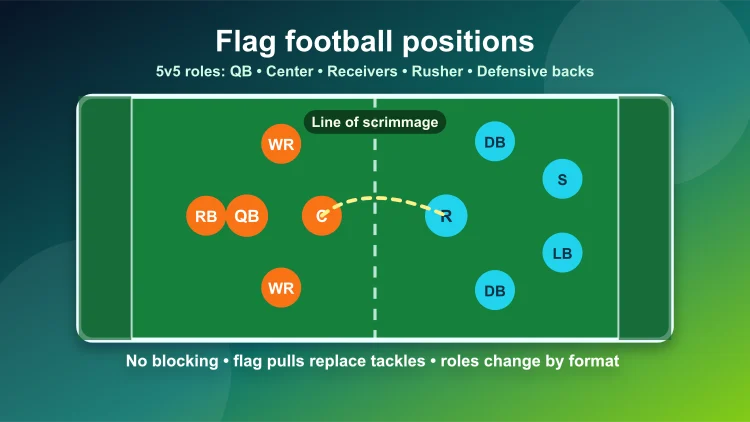
Flag Football Positions Explained: 5v5 and 7v7 Roles
Flag football positions explained for 5v5 and 7v7: quarterback, center, receiver, running back, rusher, defensive back, safety and beginner role fit.
Flag Football Rules Explained: 5v5, 7v7 and Olympic Format
Flag football rules explained with no tackling, no blocking, flag guarding, no-run zones, 7-second passing, 7-yard rush, 5v5, 7v7 and Olympic format.
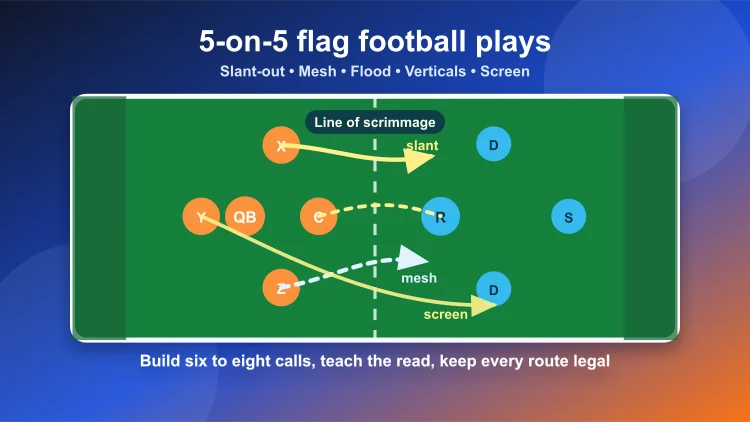
5-on-5 Flag Football Plays: Simple Routes, Reads and Formations
5-on-5 flag football plays for beginners and coaches: slant-out, mesh, flood, verticals, screen, bunch, trips, spread, play-calling reads and mistakes.
Defensive Positions in Football Explained
Defensive positions in football fall into three groups: the defensive line (ends, tackles, nose tackle), linebackers, and the secondary (corners, safeties).
Offensive Positions in Football Explained: Every Role on the Unit
Offensive positions in football explained: QB, RB/FB, WR, TE, and the five offensive line spots (LT, LG, C, RG, RT) with duties and alignment.
Football Positions Explained: Every Offense, Defense & Special Teams Role
Football positions explained: every offense, defense, and special teams role in American football, what each one does, and how they fit together.