
Flag Football Rules Explained: 5v5, 7v7 and Olympic Format

On this page12
- 01Flag football rules at a glance
- 02Legal or illegal play checker
- 03How a flag football game starts
- 04Pulling the flag ends the play
- 05Blocking and screening are not allowed in non-contact flag
- 06Can the quarterback run?
- 07The 7-second passing rule
- 08The 7-yard rush rule
- 09No-run zones
- 10Flag guarding and other common penalties
- 115v5, 7v7 and Olympic flag football
- 12What equipment do players need?
Flag football is American football without tackling. A defender stops the ball carrier by pulling a flag from the runner’s belt. In common non-contact rulebooks, players also cannot block, screen or tackle, so the game is built around space, quick passing, legal handoffs and clean flag pulls.
The rules below match the common NFL FLAG and USA Football style, but local leagues can change details. Before a tournament or school season, check the organizer’s sheet for player count, field size, quarterback running, rush distance, no-run zones and scoring.
Flag football rules at a glance
| Rule | Common version | What it means in a game |
|---|---|---|
| Stop the play | Pull a flag from the ball carrier’s belt | No tackling or bringing a player to the ground |
| Blocking | Not allowed in common non-contact formats | Offensive players must avoid screening or impeding defenders |
| Downs | Often four downs to midfield, then four to score | Turnover if the offense fails to reach the line-to-gain or end zone |
| Quarterback running | The snap receiver usually cannot run directly across the line in 5v5 | The QB must pass, hand off or pitch backward unless local rules allow more |
| Passing clock | Quarterback commonly has seven seconds to release the ball | The play dies if the passer holds it too long |
| Rushing | Rusher starts from the legal rush distance, often seven yards | A declared rusher pressures the quarterback without contact |
| No-run zones | Usually near the goal line and sometimes midfield | The offense must use a pass play in those zones |
| Flag guarding | Illegal | Ball carriers cannot shield, slap away hands or protect flags with the ball |
For the field layouts behind these rules, use our flag football field dimensions guide. For who lines up where, start with flag football positions.
Legal or illegal play checker
Use this as a quick coaching check. It follows common NFL FLAG-style non-contact rules, so use your league sheet when a rule differs.
How a flag football game starts
Most youth and rec games begin with a possession, not a traditional tackle-football kickoff. The offense starts at a set spot and has a limited number of downs to advance. In many 5v5 formats, the offense gets four plays to cross midfield. If it succeeds, it gets four more plays to score.
That structure keeps the game moving and removes high-contact kickoff returns. It also explains why midfield matters so much. The line-to-gain is not just a random stripe. It decides whether the offense keeps the ball.
Pulling the flag ends the play
A legal flag pull is the basic defensive tackle in flag football. The defender reaches for one of the flags on the ball carrier’s belt and removes it cleanly. Once the flag is pulled, the play ends at that spot.
A defender should not grab clothing, hold the runner, shove, trip or make body contact to force a stop. If a flag falls off by itself, if the runner steps out of bounds, or if the ball carrier goes down, the rulebook will define where the play is dead. The NFL Play Football glossary is useful here because it lists common dead-ball situations in plain language.
Blocking and screening are not allowed in non-contact flag
USA Football describes flag football as a non-contact game with no linemen or blocking. That changes nearly everything. The center snaps the ball and becomes a receiver. Receivers run routes, not picks. Teammates near the ball carrier must avoid obstructing defenders.
This is the rule beginners break without meaning to. In tackle football, helping the runner by getting in a defender’s way is normal. In flag football, that can become illegal screening or blocking. Teach players to clear space after the catch, not escort the runner like a blocker.
For the full position effect, see flag football vs tackle football.
Can the quarterback run?
In common NFL FLAG-style 5v5 rules, the player who receives the snap cannot simply run across the line of scrimmage. The quarterback can pass, hand off or pitch the ball backward. After a legal handoff or backward pass, another player may run when the play is not inside a no-run zone.
This rule balances the game. Without tackling or normal pass rush, a fast quarterback would be too hard to stop if every play could become a keeper. Some 7v7, adult or local leagues allow more quarterback movement, which is why the rule sheet matters before you design the offense.
If you are coaching plays, pair this page with 5-on-5 flag football plays and 7-on-7 flag football.
The 7-second passing rule
In NFL FLAG’s public rules, the quarterback has seven seconds from receiving the snap to release the ball. If the quarterback still has the ball after the count, the play is dead. NFL FLAG also notes that once a backward handoff, pass or lateral happens, the seven-second rule no longer applies in that same way.
For coaches, this rule is the playbook filter. Long-developing routes are risky unless the defense gives the quarterback time. Quick outs, hitches, slants, mesh routes, screens and center releases usually fit youth flag better than slow double moves.
The 7-yard rush rule
Many youth flag formats use a seven-yard rush line. A legal rusher starts from that distance behind the line of scrimmage and, in NFL FLAG’s public rules, identifies by raising a hand until the snap. Once the ball is handed off or pitched backward, other defenders may be able to cross the line depending on the rulebook.
The rusher still cannot crash into the passer. Good rushing is controlled speed: close the space, break down, get hands ready and pull the flag if the quarterback becomes a legal runner.
No-run zones
No-run zones are areas where the offense must use a pass play. NFL FLAG’s public glossary describes no-run zones before each goal line and at midfield. USA Football’s current public rules language emphasizes the five-yard area before each end zone. Because those details can differ, field setup and play calling should follow the specific rulebook.
No-run zones exist to reduce contact in tight spaces. Near the goal line, a simple power run would tempt players to lower shoulders, block or crowd the ball carrier. A required pass play spreads the field and keeps the game closer to its non-contact purpose.
Flag guarding and other common penalties
Flag guarding is one of the easiest calls to understand and one of the hardest habits for new runners to break. The ball carrier cannot protect the flag with a hand, arm, ball or body move that blocks the defender’s reach.
Common penalties include:
- flag guarding
- illegal contact
- illegal blocking or screening
- illegal rush
- offside or false start
- delay of game or holding the ball past the pass clock
- unsportsmanlike conduct
The exact yardage depends on the league. Teach the concept first: make people miss with space and cuts, not by shielding the flag.
5v5, 7v7 and Olympic flag football
5v5 is the best-known modern format because NFL FLAG centers much of its youth game there and the Olympic debut at LA28 is planned as 5v5. The NFL’s LA28 announcement says the Olympic competition will use five players on the field and 10-player rosters.
7v7 is also common, especially when organizers want more players involved or want a format closer to a full passing game. USA Football separates 5v5 and 7v7 rulebook options, and NFHS has its own high-school flag football rules track. Those formats can look similar on TV or from the sideline, but the rulebook details may not match.
| Format | Typical use | Watch first |
|---|---|---|
| 5v5 | NFL FLAG-style youth play, international/Olympic style | QB run rules, seven-second count, rusher rules, no-run zones |
| 7v7 | Youth, adult rec, school and passing-style leagues | Contact rules, blocking language, field size and roster rules |
| High school | State association and NFHS-based competition | Local adoption, field option, timing, equipment and school-specific policies |
| Olympic | LA28 international competition | 5v5 format, 10-player rosters and IFAF/Olympic qualification details |
What equipment do players need?
A basic flag football player needs a football, a flag belt, flags, athletic clothes and shoes suitable for the surface. Most non-contact leagues do not require pads. Some school or adult leagues restrict pockets, jewelry, metal cleats or certain headgear because those items can interfere with flag pulls or safety.
For a team, add cones, a field diagram, spare flags, a pump, first-aid supplies and a printed rule sheet. If you are setting up the field yourself, confirm the layout before practice with our flag football field dimensions guide.
Sources and verification notes
This page uses NFL FLAG, USA Football, NFHS, LA28 and NFL Olympic information as factual sources. Public comments and community discussions were used only to identify recurring reader confusion: quarterback runs, no-run zones, seven-second counts, legal rushing and whether 7v7 rules match 5v5 rules. They are not treated as rule authority.
Frequently asked questions
What are the basic rules of flag football?+
The basic rules are simple: stop the runner by pulling a flag, do not tackle, do not block in non-contact formats, and move the ball with passes, handoffs and legal runs. Many 5v5 rulebooks give the offense four downs to reach midfield, then four more to score.
Can the quarterback run in flag football?+
In many NFL FLAG-style 5v5 rules, the player who receives the snap cannot run directly across the line of scrimmage. The quarterback can hand off or pitch backward, and the ball carrier may run if the play is legal and not inside a no-run zone. Some 7v7 and adult leagues differ.
What is the 7-second rule in flag football?+
The 7-second rule means the quarterback has seven seconds from the snap to release the ball. If the quarterback still has the ball when the count expires, the play is dead. NFL FLAG also notes that once a backward handoff, pass or lateral happens, the seven-second passing count can go away under its rules.
What is the 7-yard rush rule in flag football?+
The 7-yard rush rule requires a designated rusher to start at least seven yards from the line of scrimmage before rushing the quarterback. NFL FLAG's public rules also require rushers to identify themselves by raising a hand until the snap.
What is flag guarding?+
Flag guarding is using a hand, arm, ball or body movement to stop a defender from reaching your flags. It is illegal because the whole defensive action is the flag pull. Referees usually penalize it from the spot of the foul.
Is Olympic flag football 5v5 or 7v7?+
The LA28 Olympic flag football tournament is planned as 5v5. LA28 lists men's and women's six-team tournaments, and the NFL's Olympic participation announcement says Olympic rosters will have 10 players per team with five players on the field.
Sources
Play & tools
Free browser games and tools — no account, no download.
- Play today's Sports Connections — Today's Sports Connections — daily hints, answers, and play the grid.
- Play Guess the NFL Player — A new mystery NFL player every day. Eight guesses, with a clue on each — plus free unlimited mode.
- Explore all our games →
Related guides
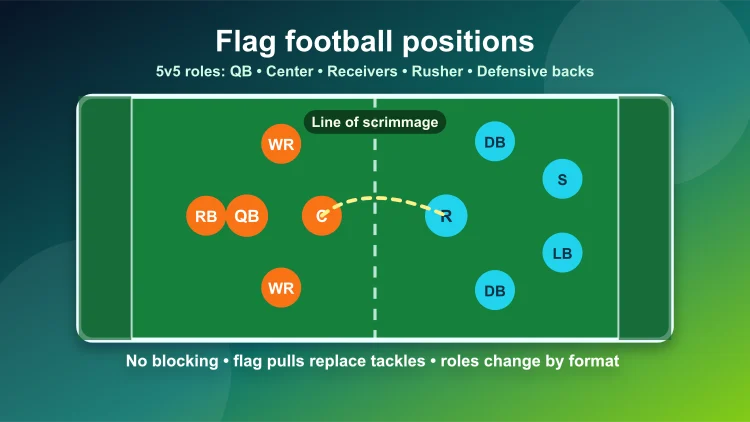
Flag Football Positions Explained: 5v5 and 7v7 Roles
Flag football positions explained for 5v5 and 7v7: quarterback, center, receiver, running back, rusher, defensive back, safety and beginner role fit.
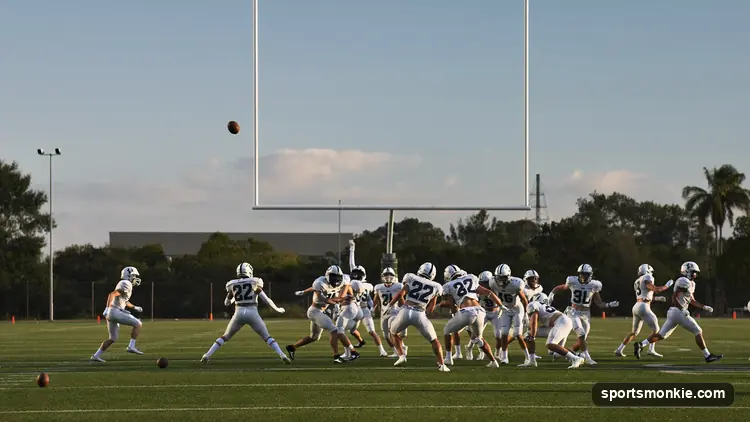
7-on-7 Flag Football: Rules, Positions and Plays
7-on-7 flag football rules, positions, formations, team size and simple plays, with youth, high-school, college and adult format differences.
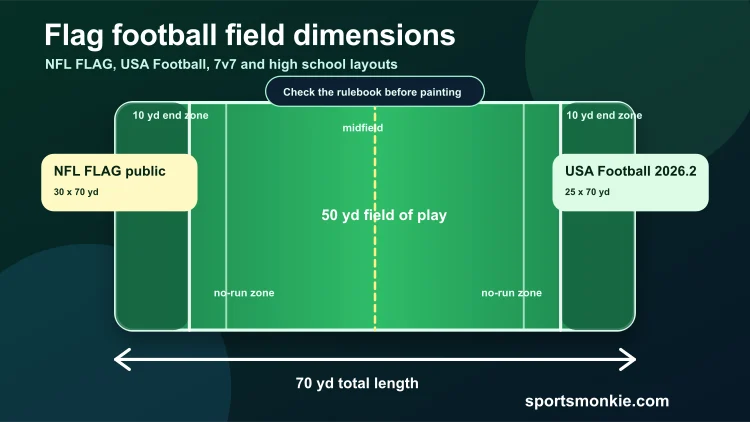
Flag Football Field Dimensions: 5v5, 7v7, NFL FLAG and High School
Flag football field dimensions by ruleset: NFL FLAG 30 x 70 yd, USA Football 25 x 70 yd, 7v7 variations, high school NFHS options and setup calculator.
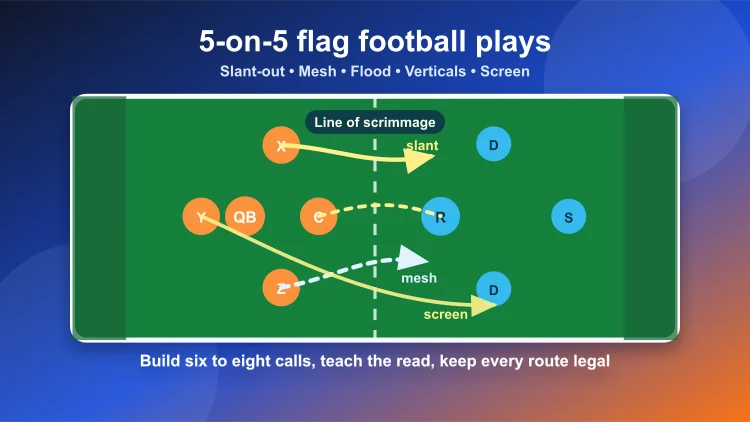
5-on-5 Flag Football Plays: Simple Routes, Reads and Formations
5-on-5 flag football plays for beginners and coaches: slant-out, mesh, flood, verticals, screen, bunch, trips, spread, play-calling reads and mistakes.
Flag Football vs Tackle Football
Flag football replaces tackling with pulling a flag and drops pads; tackle football is the full-contact game. Rules, safety and skills compared.

What Is a Challenge Flag in Football? NFL Replay Rules
A challenge flag is the red flag an NFL coach throws to request an instant-replay review. Teams get two challenges, a third if both succeed, and lose a timeout if wrong.