
5-on-5 Flag Football Plays: Simple Routes, Reads and Formations

On this page16
- 015-on-5 flag football plays at a glance
- 025v5 play picker
- 03Start with a small play sheet
- 04Formation 1: spread
- 05Formation 2: bunch
- 06Formation 3: trips
- 07Formation 4: single-back
- 08Slant-out
- 09Mesh
- 10Flood
- 11Verticals
- 12Screen
- 13Center release
- 14Rules that affect every play
- 15Beginner playbook example
- 16Common 5v5 play-calling mistakes
The best 5-on-5 flag football plays are not magic trick plays. They are simple route combinations that force one defender to choose between two bad options. A slant-out punishes leverage. Mesh beats man coverage. Flood stretches a zone. Verticals back defenders up. A screen slows down a rusher who is winning too quickly.
That matters because 5v5 flag has no normal offensive line. In NFL FLAG-style youth rules, the quarterback usually cannot run directly after the snap, all players can catch a pass, handoffs happen behind the line, and blocking is not part of the game. Your plays need quick reads, clean spacing and legal routes.
5-on-5 flag football plays at a glance
| Play concept | Best against | Quarterback read | Beginner warning |
|---|---|---|---|
| Slant-out | Fast rush or loose man coverage | Throw away from the defender’s leverage | Do not let both routes drift into the same space |
| Mesh | Man coverage | Hit the crosser who wins cleanly | Crossing routes cannot become deliberate picks |
| Flood | Zone coverage | Read deep, middle, short on one side | Spacing matters more than speed |
| Verticals | Soft coverage or a defense sitting short | Throw deep if won, check down if defenders bail | Do not force the deep ball into a safety |
| Screen | Aggressive rusher | Let pressure come, then throw behind it | Receiver must turn upfield quickly |
| Center release | Defense ignores the snapper | Throw as the center clears traffic | Center must snap cleanly first |
| Motion handoff | No-run-zone not active and league allows it | Give if the edge is light | Handoffs must follow local rulebook language |
Teach the read with the play. If the quarterback only memorizes “throw to X,” the play dies as soon as the defense lines up differently.
5v5 play picker
Use this quick selector when you are choosing a call for a youth or beginner team. It assumes a non-contact NFL FLAG-style game, so confirm your local league’s quarterback, handoff, rush and no-run-zone rules first.
Start with a small play sheet
NFL FLAG’s coaching resources recommend starting with the basics before adding more complex plays. That is the right instinct. A beginner 5v5 team does not need 30 wristband calls. It needs six to eight plays that players can run at real speed.
Build the sheet around situations:
| Situation | Carry this answer |
|---|---|
| Rush is fast | Slant-out, quick out or center release |
| Defense plays man | Mesh or shallow cross |
| Defense plays zone | Flood or high-low |
| Need short yardage | Hitch, quick out or center option |
| Defense jumps short routes | Verticals or post-corner |
| Rusher over-pursues | Screen |
Once those calls work, change formations before changing the concept. The same slant-out from spread, bunch and trips feels like three plays to the defense, even if the quarterback read stays simple.
Formation 1: spread
Spread puts two eligible players on each side of the quarterback. It is the cleanest beginner formation because the defense has to cover the full width of the field.
Best spread calls:
- Slant-out: one receiver breaks inside, the outside receiver breaks to the sideline.
- Double hitches: both sides stop quickly, useful when defenders play too deep.
- Verticals with checkdown: two receivers go deep while the center or inside receiver stays available.
Spread is also the easiest formation for teaching spacing. If young players keep running into each other, go back to spread for a few drives. It gives everyone room to breathe.
Formation 2: bunch
Bunch places three receivers close together on one side. It helps beginners release from defenders, but it can become illegal if players turn the bunch into blocking.
Best bunch calls:
- Bunch quick out: the outside player breaks flat to the sideline.
- Bunch flood: one short, one intermediate and one deep route attack the same side.
- Bunch return: one receiver starts across the field, then returns to the open side.
The coaching point is order. Decide which receiver releases first so players do not collide. The routes must be real routes, not moving screens.
Formation 3: trips
Trips puts three receiving threats on one side and one on the other. It is a good way to attack a weaker defensive side or force zone coverage to slide.
Best trips calls:
- Trips flood: deep corner, middle out and short flat.
- Trips clearout: two routes pull defenders deep while the short route settles underneath.
- Backside slant: if everyone chases trips, throw quickly to the single receiver.
Trips works best when the quarterback knows where the emergency throw lives. Without a backside answer, the whole play can feel trapped on one sideline.
Formation 4: single-back
Single-back gives the quarterback one player behind or near them, with receivers spread wider. Use it when your league allows handoffs behind the line of scrimmage and your team has a runner who can make one defender miss.
Best single-back calls:
- Motion handoff: receiver or back crosses behind the quarterback for a quick handoff.
- Play-action slant: fake the handoff, then hit the receiver behind the frozen defender.
- Running-back screen: let the rusher come, then throw to the back in space.
Do not build the whole offense around the handoff. In many 5v5 games, no-run zones and pass clocks make the passing game the safer foundation.
Slant-out
Slant-out is the first 5v5 concept to teach. Put two receivers on the same side. The outside receiver runs a quick out. The inside receiver runs a slant. The quarterback reads the defender’s leverage.
If the defender sits inside, throw the out. If the defender widens, throw the slant. If both are covered, reset to the center or backside receiver.
This play is boring in the best possible way. It gets the ball out before the rush wins and teaches the quarterback to throw to grass, not to a pre-decided name.
Mesh
Mesh sends two receivers on shallow crossing routes over the middle. It is strongest against man coverage because defenders have to chase through traffic. The traffic must be natural, not a deliberate pick.
For beginners, keep it shallow and simple: two crossers, one deeper sit route and one safety valve. The quarterback watches which crosser wins first. If the defense drops into zone, the sit route behind the crossers may become the cleaner throw.
Flood
Flood overloads one side with three depths: short, middle and deep. Against zone, one defender cannot cover every level.
A simple flood uses:
- short flat route
- 8 to 12-yard out or corner
- deeper go, post or corner
The quarterback reads high to low. If the deep route wins, take it. If the deep defender bails, throw the middle. If the middle closes, take the short completion and let the receiver run.
Verticals
Verticals keep a defense honest. Send two or three receivers downfield, then give the quarterback a short checkdown.
The mistake is treating verticals as “throw deep no matter what.” In 5v5, the deep routes often win by opening space underneath. If the safety retreats and the rusher is arriving, the checkdown may be the correct throw.
For a last-play deep shot, our Hail Mary in football guide explains the wider football idea. In normal 5v5 flag, though, verticals should still have a safe answer.
Screen
A screen is the counterpunch to an aggressive rusher. The quarterback invites pressure, then throws to a receiver or back in the space the rusher left.
Keep the throw soft and quick. The receiver should catch, turn upfield and attack open grass. Screens die when the receiver drifts sideways or waits for blocking that is not legal in non-contact flag football.
Center release
The center is easy to forget. That is why the center release works.
After the snap, the center delays for a beat, then releases into open space. If the defense chases the outside receivers, the center becomes the free short option. This is also a useful short-yardage answer when everyone expects a throw to the sideline.
Our flag football positions guide explains why the center is a real receiving role, not just the player who starts the play.
Rules that affect every play
Before you copy any playbook, check these rules:
| Rule | Why it changes play calls |
|---|---|
| Quarterback running | If the QB cannot run directly, every call needs a fast pass or legal handoff option |
| Handoffs | Many rules require handoffs behind the line of scrimmage |
| No-run zones | Near the goal line or midfield, run calls may be unavailable |
| Rusher distance | A seven-yard rush gives a different timing window than a shorter local rush |
| Blocking and picks | Most non-contact rules forbid deliberate screens, blocks and rubs |
| Center sneak | NFL FLAG coaching guidance warns against center-sneak style plays |
| All-player eligibility | Centers and quarterbacks can become receiving threats when the rule set allows it |
Use flag football rules and flag football field dimensions alongside this page. The best play on paper becomes a bad call if the field, no-run zone or local QB rule makes it illegal.
Beginner playbook example
Here is a clean six-play starting sheet:
| Call | Formation | First read | Backup |
|---|---|---|---|
| Orange 1 | Spread | Slant-out to the wide side | Center release |
| Orange 2 | Spread | Double hitches | Backside out |
| Green 1 | Bunch | Quick out | Short sit |
| Green 2 | Bunch | Mesh crosser | Deep sit |
| Blue 1 | Trips | Flood middle route | Flat route |
| Blue 2 | Single-back | Screen | Backside slant |
Give each call a color or one-word name players can remember. Wristbands help, but only if players understand the first read and the backup.
Common 5v5 play-calling mistakes
| Mistake | Better habit |
|---|---|
| Carrying too many plays | Start with six to eight and run them well |
| Calling deep shots on every third down | Use short routes to stay ahead of the rush |
| Letting routes bunch together | Assign depths and landmarks |
| Designing illegal rubs | Cross naturally, but do not block defenders |
| Forgetting the center | Build one center release into each drive |
| Ignoring no-run zones | Know when the rulebook requires a pass |
| Copying 7v7 spacing | 5v5 has fewer bodies and different timing |
For the broader role and format context, connect this play sheet with 7-on-7 flag football and flag football vs tackle football. The more clearly players understand the format, the easier the plays become.
Sources
Frequently asked questions
What are the best 5-on-5 flag football plays?+
Start with slant-out, mesh, flood, verticals, screen and a quick center-release play. Those six concepts give you answers for a hard rush, man coverage, zone coverage, soft coverage, over-pursuit and short-yardage situations.
What formation should a 5-on-5 flag football team use?+
Spread is the safest base because it gives the quarterback both sides of the field. Bunch and trips are useful for younger teams because they create quick releases and simple reads. Single-back looks are good when your league allows handoffs behind the line.
Can the quarterback run in 5-on-5 flag football?+
In NFL FLAG-style youth rules, the quarterback usually cannot directly run with the ball after the snap. They can pass or hand off, and after a legal handoff the quarterback may be eligible to receive a pass depending on the rule set. Always check your league sheet.
Are pick plays legal in flag football?+
Deliberate picks, rubs and blocking are not legal in most non-contact flag rulesets. Crossing routes are fine when players run real routes and do not intentionally screen defenders.
How many plays should a beginner flag football team have?+
Six to eight plays are enough for most beginner 5v5 teams. Run them from two or three formations and teach the read, not just the route drawing. A small playbook executed well beats a large one nobody remembers.
What is the easiest 5-on-5 flag football play?+
A slant-out concept from spread is usually the easiest. One receiver breaks inside, one breaks outside, and the quarterback throws away from the defender's leverage.
Sources
Play & tools
Free browser games and tools — no account, no download.
- Play 17-0 — Draft nine and chase a flawless NFL regular season — the perfect 17-0 run, no playoffs.
- Play 20-0 — Draft nine and chase a perfect NFL season — regular season and playoffs, undefeated.
- Play 16-0 — Draft nine and chase a perfect 16-0 — the classic 16-game NFL regular season, no playoffs.
- Play Flawless Six — Draft five players and a head coach, then chase a perfect NFL season with the right chemistry.
- Play Guess the NFL Player — A new mystery NFL player every day. Eight guesses, with a clue on each — plus free unlimited mode.
- Play NFL Wordle — A Wordle for football — guess the daily NFL player in eight tries, with green-amber-grey feedback on every clue.
- Play NFL Connections — Sort sixteen football tiles into four hidden groups of four. A new daily puzzle, four mistakes allowed, plus unlimited mode.
- Explore all our games →
- Open the schedule simulator — Pick every 2026 NFL game and watch the standings and playoff seeds update live.
- Open the squares generator — Generate a randomized, printable Super Bowl squares grid for your party — free, no sign-up.
- Open the trade calculator — Weigh any fantasy football trade instantly — clear winner and value gap.
- Run the NFL predictor — Simulate the NFL bracket and see who your picks send to the Super Bowl.
- Open the passer rating calculator — Calculate the official NFL passer rating (0–158.3) from any passing line, with the formula shown.
- Explore all our free sports tools →
Related nfl guides
View all →
7-on-7 Flag Football: Rules, Positions and Plays
7-on-7 flag football rules, positions, formations, team size and simple plays, with youth, high-school, college and adult format differences.
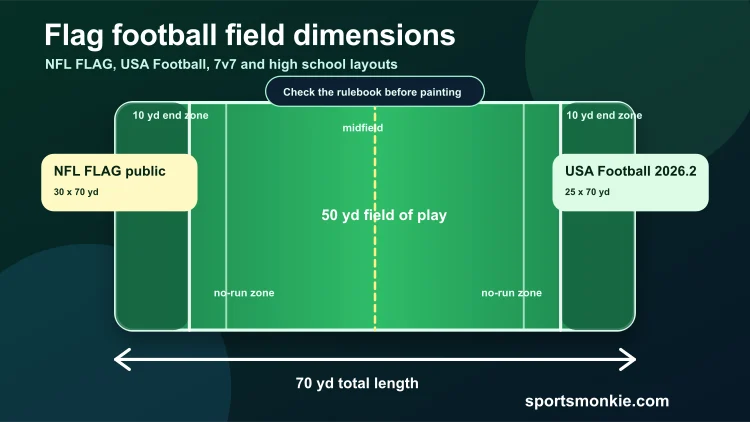
Flag Football Field Dimensions: 5v5, 7v7, NFL FLAG and High School
Flag football field dimensions by ruleset: NFL FLAG 30 x 70 yd, USA Football 25 x 70 yd, 7v7 variations, high school NFHS options and setup calculator.
Flag Football vs Tackle Football
Flag football replaces tackling with pulling a flag and drops pads; tackle football is the full-contact game. Rules, safety and skills compared.
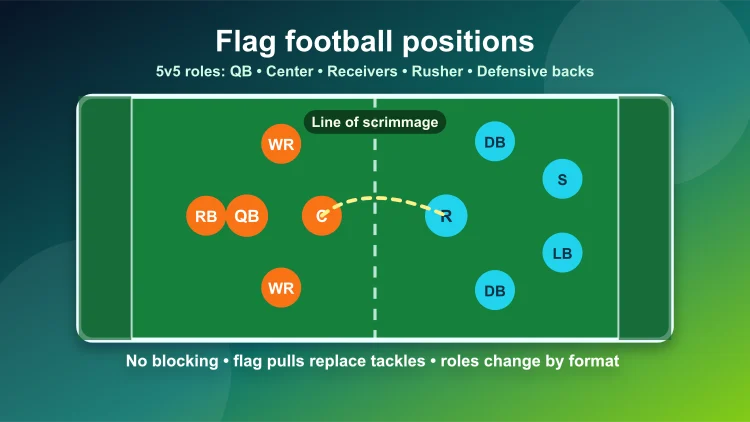
Flag Football Positions Explained: 5v5 and 7v7 Roles
Flag football positions explained for 5v5 and 7v7: quarterback, center, receiver, running back, rusher, defensive back, safety and beginner role fit.

Flag Football Rules Explained: 5v5, 7v7 and Olympic Format
Flag football rules explained with no tackling, no blocking, flag guarding, no-run zones, 7-second passing, 7-yard rush, 5v5, 7v7 and Olympic format.
Football Formations and Coverages Explained: The Complete NFL Guide
Football formations and coverages explained: how NFL offenses line up, how defenses answer with zone and man coverage, and why each matchup wins or loses.