
Flag Football Positions Explained: 5v5 and 7v7 Roles
On this page11
Flag football positions look familiar if you know tackle football, but they do not work the same way. The missing piece is the line. In most 5v5 flag football, there are no blocking guards, tackles or defensive linemen. The center snaps the ball, releases into a route, and every offensive player can become part of the play.
That makes flag football less about size and more about space. Quarterbacks need fast decisions. Receivers need separation. Rushers need controlled speed. Defensive backs need clean flag pulls without crashing through the ball-carrier.
Flag football positions at a glance
| Position | Side | Main job | Best fit |
|---|---|---|---|
| Quarterback | Offense | Takes the snap, reads coverage, throws or hands off | Calm passer with quick decisions |
| Center | Offense | Snaps the ball, then runs a route | Reliable hands and timing |
| Wide receiver | Offense | Runs routes and catches passes | Speed, cuts and catching |
| Slot receiver | Offense | Works short and middle routes | Quick change of direction |
| Running back | Offense | Takes handoffs, catches screens and may throw after a handoff | Burst and open-field vision |
| Rusher | Defense | Starts from the legal rush distance and pressures the quarterback | Fast first step and body control |
| Defensive back | Defense | Covers receivers and pulls flags | Footwork, angles and patience |
| Safety | Defense | Protects deep space and stops breakaways | Range and field awareness |
| Linebacker | Defense | Reads short routes, handoffs and middle space | Versatility and quick reactions |
The exact names change by league, but the jobs do not: throw, snap, get open, rush, cover and pull flags.
5v5 flag football positions
NFL FLAG centers its youth game around 5v5, and that is also the format most new players meet first. A clean 5v5 offense usually looks like this:
| Offensive role | What the player does |
|---|---|
| Quarterback | Receives the snap, then passes or hands off. In many youth rulesets, the QB cannot directly run past the line after the snap |
| Center | Snaps the ball and immediately becomes eligible as a receiver |
| Outside receivers | Stretch the field, run sideline routes, slants, hooks and deep patterns |
| Slot receiver or running back | Works motion, handoffs, screens, short routes and option-style looks |
On defense, most 5v5 teams use one rusher and four coverage players. The rusher pressures the quarterback from the required rush distance, while defensive backs cover receivers in man or zone. Some teams call the deepest defender a safety, even in 5v5, but that player is still usually part of the coverage group.
Because there are only five players, nobody gets to hide. The center must catch. Receivers may take handoffs. Defensive backs have to tackle by pulling flags, not by waiting for help.
7v7 flag football positions
7v7 adds two players, and those extra bodies change the game. Coaches can use more specialized roles:
| 7v7 role | How it changes the game |
|---|---|
| Extra receiver | Opens four-receiver route combinations and more spacing stress |
| Running back | Makes handoffs, swings, screens and option passes more believable |
| Slot receiver | Gives the quarterback a quick middle-field target |
| Non-contact lineman or protector | Appears in some leagues, but blocking rules must be checked first |
| Linebacker | Helps defense read handoffs, short routes and crossing patterns |
| Second safety | Lets defense split deep coverage instead of leaving one player alone |
The trap is assuming every 7v7 league uses the same rules. Some allow more contact near the line. Some do not. Some use a dedicated rusher. Some rotate rushers by play call. Before you assign positions, read the local rule sheet for blocking, rushing, quarterback running, motion and pass-clock rules.
For the related formats, see our guides to 7-on-7 flag football and 5-on-5 flag football plays. The roles make more sense once you see the formations they create.
Flag football position finder
Use this quick selector to match a beginner with a starting role. It is not a scouting report, just a helpful way to stop everyone from defaulting to quarterback.
Quarterback
The quarterback receives the snap and starts the play. In many youth 5v5 rulesets, the quarterback cannot simply take the snap and run past the line. They usually need to pass or hand the ball off, although local leagues can modify that rule.
A good flag quarterback is not always the player with the biggest arm. The job is to read the rusher, know the no-run zone, throw before the pass clock becomes a problem and choose the easy completion when the highlight throw is not there.
Center
The center is much more important in flag than many new players expect. The snap must be clean, then the center becomes a receiver. That release can punish defenses that forget the snapper is eligible.
Centers are useful for short routes, quick outs, shovel-style looks where legal, and late releases when the defense overplays the wide receivers. If a beginner has reliable hands but is not the fastest player yet, center can be a smart first role.
Receivers and running backs
Receivers win by creating separation. In 5v5, that often means quick slants, outs, hooks, corners and motion routes. In 7v7, teams can spread the field with outside receivers and slot receivers, which creates more layered reads for the quarterback.
Running back is more format-dependent. Some 5v5 teams use one receiver as a handoff player. In 7v7, a dedicated running back is more common because there is enough space and enough bodies to make run-pass looks believable.
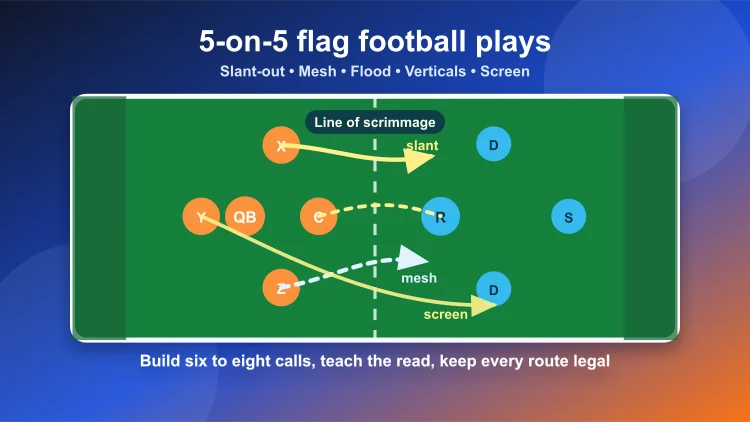
For route examples, use 5-on-5 flag football plays. For the full rule context, read flag football rules.
Rusher
The rusher pressures the quarterback, usually from a set distance behind the line of scrimmage. NFL FLAG and USA Football guidance commonly use a seven-yard rush distance in youth 5v5 contexts, but local rules decide the exact mechanic.
Speed helps, but control matters more. A rusher who flies past the quarterback or crashes into the passer gives the offense free yards. The best rushers close fast, break down under control and pull the flag cleanly.
Defensive backs, linebackers and safeties
Defensive backs cover receivers and pull flags. They may play man coverage, where each defender follows one player, or zone coverage, where each defender protects an area.
Linebacker and safety labels appear more often in 7v7. A linebacker reads short routes and handoffs. A safety protects deep space and stops breakaways. In 5v5, those jobs still exist, but coaches may simply call every coverage player a defensive back.
If you are comparing flag with tackle, our flag football vs tackle football guide explains why no blocking changes almost every position. Our flag football field dimensions guide also shows why spacing changes by format.
What position should a beginner play?
For most beginners, receiver, defensive back and center are the easiest entry points. They teach the core skills without putting the whole play on one person:
| Beginner trait | Best first role |
|---|---|
| Throws accurately and stays calm | Quarterback |
| Catches well and likes running routes | Receiver |
| Reliable hands, good timing, comfortable in traffic | Center |
| Fast first step, good body control | Rusher |
| Patient, quick feet, likes reacting | Defensive back |
| Good vision with the ball | Running back or motion receiver |
Rotate early. A child who starts at center may become a very good receiver once the snap is automatic. A receiver who learns defensive back usually runs better routes because they understand what coverage hates.
Common position mistakes
| Mistake | Better approach |
|---|---|
| Treating flag like tackle without pads | Remove blocking and tackling from the mental model |
| Giving the best athlete only one role | Rotate players so they learn offense and defense |
| Forgetting the center after the snap | Use the center as a real receiving option |
| Sending every fast player deep | Keep short routes and resets available |
| Letting the rusher run out of control | Teach speed, then teach braking and flag-pull angle |
| Copying a 7v7 playbook into 5v5 | Adjust spacing because fewer players means fewer layers |
| Ignoring the local rule sheet | Confirm QB runs, rushing distance, no-run zones and blocking rules |
Flag football rewards adaptable players. The sooner a team stops treating positions as tiny boxes, the faster everyone improves.
Sources
Frequently asked questions
What are the positions in 5v5 flag football?+
A simple 5v5 offense uses a quarterback, a center and three receiving threats. One of those receivers may work as a running back if the play uses handoffs. On defense, teams usually use one rusher and four coverage players, often cornerbacks, defensive backs or a safety depending on the call.
What are the positions in 7v7 flag football?+
A 7v7 offense usually keeps the quarterback and center, then adds more receivers, a running back, slot receiver or non-contact lineman depending on league rules. The defense can use a rusher, cornerbacks, linebackers and one or two safeties because the extra players allow more defined coverage roles.
Can the quarterback run in flag football?+
In many youth 5v5 rulesets, including NFL FLAG guidance, the quarterback cannot directly run with the ball after the snap. They usually must pass or hand off. Some 7v7, adult or local leagues allow different quarterback-run rules, so check the league sheet before building plays around QB runs.
Does flag football have linemen?+
Most 5v5 flag football has no traditional linemen because there is no blocking. The center snaps the ball and becomes a receiver. Some 7v7 or larger formats may use a non-contact lineman or protector, but blocking rules vary heavily by league.
What is the hardest position in flag football?+
Quarterback is usually the hardest offensive position because the passer must read coverage and throw before the pass clock or rusher wins. On defense, rusher is demanding because it requires speed, control and clean flag-pulling without contact.
What flag football position should a beginner play?+
Receiver, defensive back and center are friendly starting points. They teach route running, spacing, catching, coverage and flag pulling without putting the whole play call on one player. A beginner with a good arm and calm decision-making can also try quarterback.
Sources
Play & tools
Free browser games and tools — no account, no download.
- Play today's Sports Connections — Today's Sports Connections — daily hints, answers, and play the grid.
- Play Guess the NFL Player — A new mystery NFL player every day. Eight guesses, with a clue on each — plus free unlimited mode.
- Explore all our games →
Related guides
Flag Football Rules Explained: 5v5, 7v7 and Olympic Format
Flag football rules explained with no tackling, no blocking, flag guarding, no-run zones, 7-second passing, 7-yard rush, 5v5, 7v7 and Olympic format.
7-on-7 Flag Football: Rules, Positions and Plays
7-on-7 flag football rules, positions, formations, team size and simple plays, with youth, high-school, college and adult format differences.
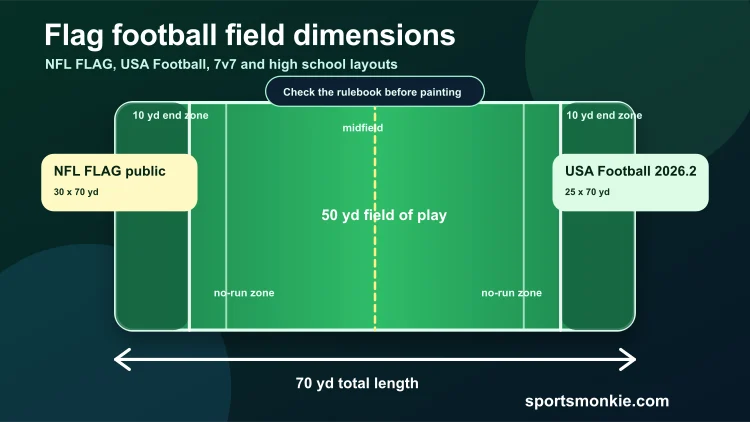
Flag Football Field Dimensions: 5v5, 7v7, NFL FLAG and High School
Flag football field dimensions by ruleset: NFL FLAG 30 x 70 yd, USA Football 25 x 70 yd, 7v7 variations, high school NFHS options and setup calculator.
Flag Football vs Tackle Football
Flag football replaces tackling with pulling a flag and drops pads; tackle football is the full-contact game. Rules, safety and skills compared.
5-on-5 Flag Football Plays: Simple Routes, Reads and Formations
5-on-5 flag football plays for beginners and coaches: slant-out, mesh, flood, verticals, screen, bunch, trips, spread, play-calling reads and mistakes.
Women's Lacrosse Positions Explained: All 12 Roles
Women's lacrosse fields 12 players a side. Here are all 12 positions — attack, midfield, defense and goalie — with each role and field zone explained.