
Figure Skating Jumps Explained: All 6 Types
On this page5
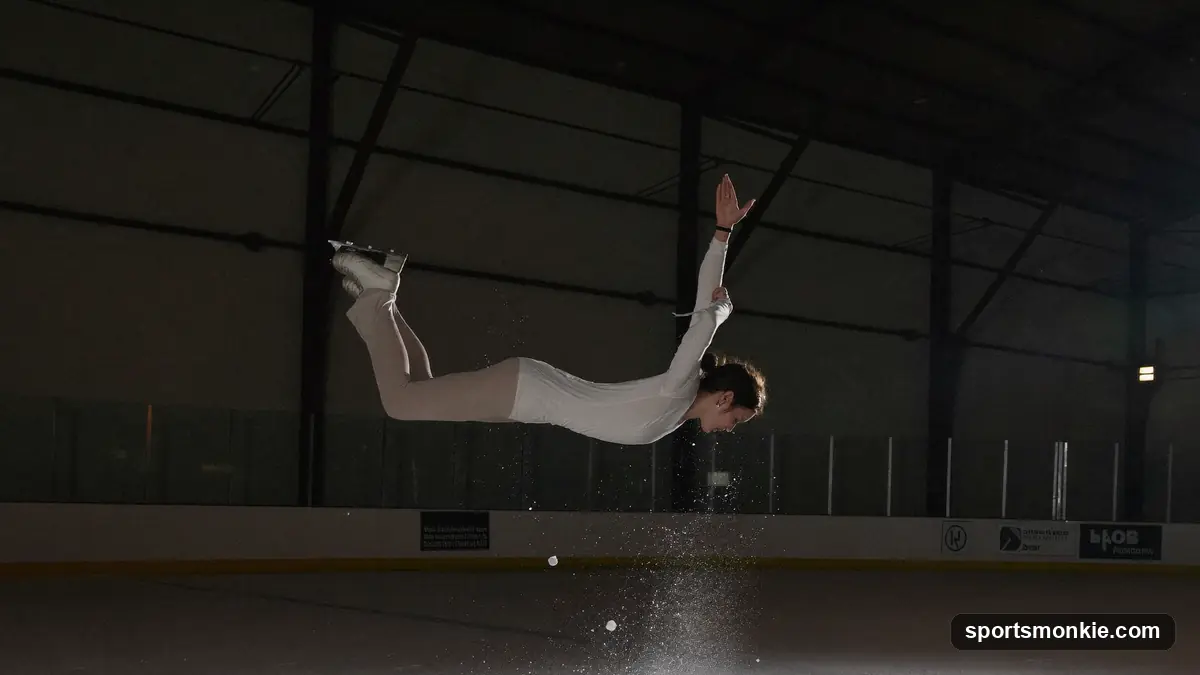
There are six figure skating jumps, and they split into two families based on how the skater leaves the ice: three edge jumps (the salchow, loop and axel) that launch straight off the blade’s edge, and three toe jumps (the toe loop, flip and lutz) that use the toe pick of the free leg to vault into the air. Ordered roughly from easiest to hardest, they run toe loop, salchow, loop, flip, lutz and axel, with the axel standing alone as the toughest because it is the only jump that takes off facing forward.
All six jumps, and the points each is worth, are defined by the International Skating Union (ISU), the sport’s world governing body. Once you know the two takeoff families and the small detail that separates each jump, you can tell them apart in real time, which is exactly what judges do at high speed. Here is each jump explained.
The two families: edge jumps and toe jumps
Every standard jump lands backward on one foot, gliding on a back outside edge. What differs is the launch.
- Edge jumps spring directly off the edge of the skating blade, with no help from the toe pick. The salchow, loop and axel are edge jumps.
- Toe jumps use the toe pick, the serrated teeth at the front of the blade, of the free leg, which the skater stabs into the ice to pole-vault upward. The toe loop, flip and lutz are toe jumps.
That single distinction, edge versus toe pick, is the first thing to look for, and it immediately narrows any jump down to one of three options.
The six jumps, easiest to hardest
| Jump | Family | Takeoff | Relative difficulty |
|---|---|---|---|
| Toe loop | Toe jump | Back outside edge + toe pick | Easiest |
| Salchow | Edge jump | Back inside edge | Easy |
| Loop | Edge jump | Back outside edge | Moderate |
| Flip | Toe jump | Back inside edge + toe pick | Harder |
| Lutz | Toe jump | Back outside edge + toe pick | Very hard |
| Axel | Edge jump | Forward outside edge | Hardest |
Toe loop. The simplest jump. The skater glides backward, reaches back with the free leg to plant the toe pick, and rotates. It is the most common jump to attach in combinations because of how naturally it flows out of a landing.
Salchow. An edge jump that takes off from a back inside edge, with the free leg swinging around to help generate rotation. It is often one of the first multi-rotation jumps a skater learns.
Loop. An edge jump launched from a back outside edge with the feet crossed, no toe assist. Because it takes off and lands on essentially the same edge, it is a common building block and a frequent second jump in combinations.
Flip. A toe jump from a back inside edge, using the toe pick to vault. It looks similar to the lutz, which is what makes the two the trickiest pair for casual viewers to tell apart.
Lutz. A toe jump from a back outside edge, and one of the hardest because that outside-edge entry runs “against” the natural direction of rotation. A skater who accidentally rolls onto the inside edge on takeoff is committing the well-known “flutz” error, a lutz that is really a flip.
Axel. The signature difficulty of the sport. It is the only jump with a forward takeoff, which means the skater has to rotate an extra half-turn to land backward like every other jump. So a “single” axel is one and a half rotations, a double is two and a half, and a triple axel is three and a half rotations, which is why it is the highest-scoring and most feared of the six.
Why the axel is the hardest
The forward takeoff is everything. Because all jumps land backward, the axel’s forward launch bakes in that extra half-rotation, so a skater must generate more rotational speed and hang in the air longer than for any other jump of the same “number.” This is why the triple axel is a landmark achievement and why the quad axel, four and a half rotations, sat at the outer edge of what is humanly possible for so long. The ISU’s scoring reflects this, awarding the axel the highest base value of the six jump types.
How judges tell them apart
Judges and technical panels distinguish jumps by watching the takeoff edge and whether the toe pick is used, all in a fraction of a second. Getting the entry wrong, such as the “flutz,” leads to deductions or a downgraded element, because the jump attempted is not the jump credited. It is a level of precision that rewards years of edge work, the same edge control that underpins the careers profiled in our features on the greatest female figure skaters and the greatest male figure skaters.
Putting it together
Figure skating jumps are less mysterious once you know the framework: two families defined by edge or toe pick, six jumps that stack in difficulty from the toe loop up to the axel, and one jump, the axel, made uniquely hard by its forward takeoff. Add more rotations (doubles, triples, quads) and combine them in sequences, and you have the technical spine of a modern program. For a sense of how much this difficulty has shaped Olympic history, our look at U.S. figure skaters who never won an Olympic medal shows how fine the margins can be at the top of the sport.
The short version: the six figure skating jumps are the toe loop, salchow, loop, flip, lutz and axel; they divide into toe jumps and edge jumps by how the skater launches; difficulty rises across that list; and the axel is hardest because its forward takeoff forces an extra half-rotation, all as defined by the ISU.
Frequently asked questions
What are the 6 figure skating jumps?+
The six jumps are the toe loop, salchow, loop, flip, lutz and axel. They divide into two groups by takeoff: edge jumps (salchow, loop, axel) that launch off the blade edge, and toe jumps (toe loop, flip, lutz) that use the toe pick of the free leg to vault upward. The axel stands apart because it is the only one that takes off facing forward. All six are defined and scored by the International Skating Union.
What is the hardest type of jump in figure skating?+
The axel is considered the hardest of the standard jumps because it is the only one with a forward takeoff. Landing backward like every other jump means the skater must rotate an extra half-turn, so a 'single' axel is actually one and a half rotations and a triple axel is three and a half. That extra half-rotation makes it the most technically demanding and the highest-scoring of the six under ISU rules.
What is the difference between the jumps in figure skating?+
The differences come down to takeoff edge, whether a toe pick is used, and the direction of the entry. Edge jumps (salchow, loop, axel) spring directly from the blade edge, while toe jumps (toe loop, flip, lutz) plant the free-leg toe pick to launch. Within each group, the specific edge (inside or outside) and the entry vary, which is how judges distinguish, say, a flip from a lutz even though both look similar in the air.
What is the forbidden move in figure skating?+
The backflip has historically been banned in ISU competition, largely for safety reasons, since it involves landing on two feet and carries injury risk on the ice. It is not one of the six standard jumps and is a separate acrobatic move rather than a scored jump. Rules on such elements are set by the ISU and have evolved over time, so the governing body is the authority on what is currently permitted in competition.
Sources
Play & tools
Free browser games and tools — no account, no download.
- Play today's Sports Connections — Today's Sports Connections — daily hints, answers, and play the grid.
- Play Guess the NFL Player — A new mystery NFL player every day. Eight guesses, with a clue on each — plus free unlimited mode.
- Explore all our games →
Related guides
How Does Figure Skating Scoring Work?
Figure skating scoring adds a technical element score and a program components score. Base values, GOE, deductions and how a total skate score is built, explained.
Types of Swimming Strokes: Freestyle, Backstroke, Breaststroke & More
The main types of swimming strokes are freestyle, backstroke, breaststroke, butterfly, sidestroke, and elementary backstroke — each built for a different job.

What Is a False Start in Track? Rules and Disqualification
A false start happens when a sprinter begins before the legal starting signal or reacts early enough to violate the competition’s reaction-time rule.
What Is the Individual Medley in Swimming? Order and Rules
The individual medley combines butterfly, backstroke, breaststroke, and freestyle in one race, in that order.

What Is a Faceoff in Lacrosse? Restart and Possession Rules
A lacrosse faceoff starts each quarter and follows goals, with two players competing for the ball while teammates stay outside the restraining area.

Sports Calendar: Upcoming Events and Confirmed Dates
Find upcoming sporting events by sport, month and host. Check confirmed dates, schedule status, short event overviews and official organiser links.