
Flag Football vs Tackle Football
On this page6
Flag football replaces tackling with pulling a flag from a belt worn by the ball carrier, removes most blocking, and is usually played without pads on smaller teams and fields. Tackle football is the full-contact version, played with helmets and pads under standard 11-on-11 rules that include blocking, tackling and line play. The core difference is contact: flag takes it out, tackle is built on it.
For a lot of families, the real question is which one a child should play, or whether flag is only a warm-up for the “real” game. Here is how the two compare on rules, safety, skills and cost, and why flag increasingly stands on its own.
The fundamental rule difference
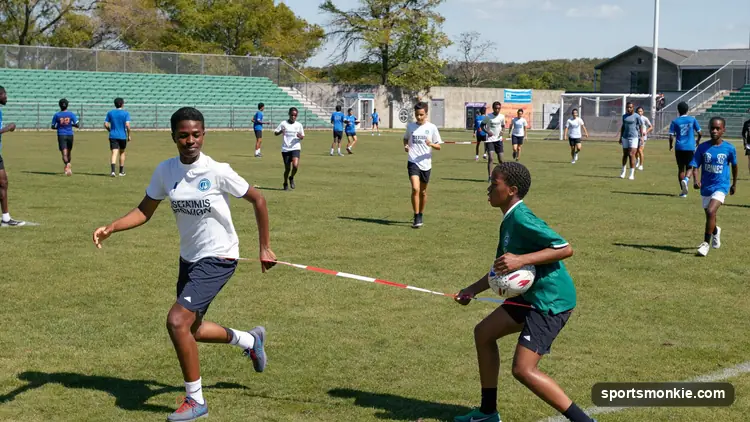
In tackle football, a play ends when the ball carrier is brought to the ground or forced out of bounds, and both offense and defense use blocking to open or shut down running and passing lanes. In flag football, a play ends the moment a defender pulls a flag from the belt around the ball carrier’s waist. There is no tackling, and in most rulebooks little or no blocking.
That single change ripples through everything. Without tackling and blocking, flag needs fewer players, less space and almost no protective equipment, and it becomes a game of evasion and pursuit rather than collision.
Flag vs tackle at a glance
| Feature | Flag football | Tackle football |
|---|---|---|
| Ending a play | Pull a flag from the belt | Tackle to the ground |
| Blocking | Limited or none | Central to the game |
| Equipment | Flags, belt, ball; no pads | Helmet, pads, mouthguard, cleats |
| Players per side | Often 5 or 7 | 11 |
| Field size | Smaller | Full gridiron |
| Contact | Minimal | Full contact |
| Injury risk | Lower | Higher |
| Cost | Low | High (gear, insurance) |
The table makes the trade clear: flag is smaller, cheaper and safer, while tackle is bigger, more physical and more equipment-intensive. Our guide to flag football rules covers the flag game’s specifics, and flag football field dimensions shows how much smaller the playing area is.
Safety: the biggest difference
Safety is the reason flag football exists in its modern form and the main driver of its growth. By removing tackling, blocking and most high-speed collisions, flag dramatically reduces the impact injuries, including head impacts, associated with the tackle game. No sport is risk-free, players still sprain ankles and occasionally collide, but the absence of deliberate contact makes flag markedly safer.
This is why many parents now start children in flag and why some choose it as a permanent alternative rather than a stepping stone. It is also central to the sport’s appeal for older recreational and co-ed players who want the game without the pounding.
Different skills, not lesser skills
A common misconception is that flag is just “easy tackle.” In reality the two reward different skill sets. Flag football, with no pads and no blocking to hide behind, puts a premium on speed, agility, precise route-running, accurate passing and open-field evasion, both to pull a flag and to avoid having yours pulled. Tackle football adds the physical and technical arts of blocking, tackling and line play, along with more complex schemes and personnel.
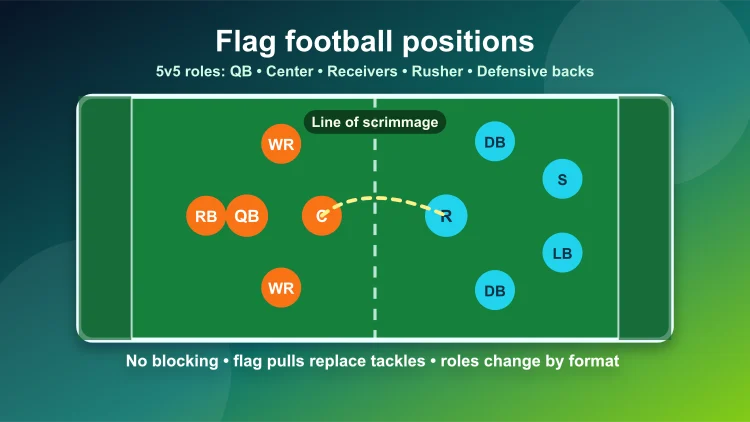
Because flag is so pass- and space-oriented, it is an excellent developmental environment for quarterbacks, receivers and defensive backs, which is part of why formats like 7-on-7 flag football are used as skill-building circuits even by players who also play tackle. The positions in flag football map loosely onto the tackle game’s skill positions, minus the linemen.
Cost and accessibility
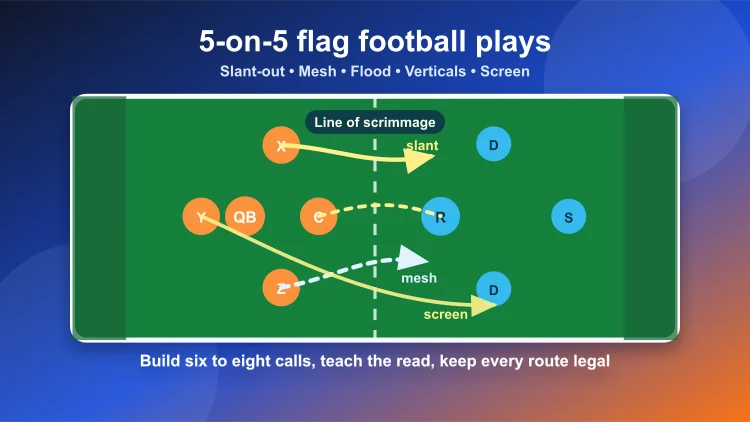
Cost is another practical divide. Tackle football requires a helmet, shoulder pads, a mouthguard and other protective gear per player, plus the insurance and infrastructure that full-contact leagues carry. Flag football needs little more than a belt with flags and a ball, and it can be played on any open field with as few as ten total players. That low barrier makes flag one of the most accessible team sports, and a natural fit for schools, parks programs and co-ed recreational leagues, as our look at 5-on-5 flag football plays illustrates with a smaller-sided setup.
Flag football’s rising status
Flag is no longer just a youth or backyard game. It is one of the fastest-growing forms of football, run at scale by programs such as NFL FLAG, and it will appear at the 2028 Olympic Games, a milestone that has elevated its prestige and drawn interest from high-profile athletes. That trajectory has changed the conversation: for a growing number of players and families, flag is a legitimate destination sport, not merely a safer rehearsal for tackle.
The short version: flag football swaps tackling for pulling a flag, removes most blocking and pads, and is played on smaller teams and fields, making it safer, cheaper and more accessible; tackle football is the full-contact 11-on-11 game with blocking, tackling and heavy equipment. They develop different skills rather than one being simply harder, and with Olympic inclusion and booming youth participation, flag increasingly stands as a sport in its own right.
Frequently asked questions
Is flag football harder than tackle?+
Neither is simply harder; they test different skills. Flag football emphasizes speed, agility, precise route-running, accurate passing and the quickness to pull or evade a flag, so it can be more demanding athletically in open space. Tackle football adds the physical and technical challenges of blocking, tackling, and line play, plus reading more complex schemes. Many players find flag mentally and athletically fast-paced, while tackle is more physically punishing, so 'harder' depends on which skills you mean.
Why is tackling not allowed in flag football?+
Flag football removes tackling by design to make the game safer and more accessible. Instead of bringing a ball carrier to the ground, a defender ends the play by pulling a flag from the carrier's belt. Eliminating tackling, and usually blocking, sharply reduces collisions and the injury risk that comes with full contact, which is why flag is popular for youth, recreational and co-ed play and needs far less equipment than the tackle game.
Is flag football safer than tackle football?+
Yes. By removing tackling, blocking and most high-speed collisions, flag football carries a substantially lower risk of the impact injuries, including head impacts, associated with tackle football. No contact sport is completely risk-free, sprains, and collisions between players still happen, but the absence of deliberate contact makes flag markedly safer. This safety profile is a major reason youth participation in flag has grown and why many parents choose it first.
Are NFL players allowed to play flag football?+
NFL players can and do play flag football in exhibitions and offseason events, and flag's rising profile, including its addition to the 2028 Olympics, has drawn interest from professional athletes. During the regular NFL season, players are bound by their contracts and league rules that restrict risky offseason activities, so participation in outside games is governed by those agreements. But there is no blanket ban on the sport itself, and flag's growth has made star involvement more visible.
Sources
Play & tools
Free browser games and tools — no account, no download.
- Play 17-0 — Draft nine and chase a flawless NFL regular season — the perfect 17-0 run, no playoffs.
- Play 20-0 — Draft nine and chase a perfect NFL season — regular season and playoffs, undefeated.
- Play 16-0 — Draft nine and chase a perfect 16-0 — the classic 16-game NFL regular season, no playoffs.
- Play Flawless Six — Draft five players and a head coach, then chase a perfect NFL season with the right chemistry.
- Play Guess the NFL Player — A new mystery NFL player every day. Eight guesses, with a clue on each — plus free unlimited mode.
- Play NFL Wordle — A Wordle for football — guess the daily NFL player in eight tries, with green-amber-grey feedback on every clue.
- Play NFL Connections — Sort sixteen football tiles into four hidden groups of four. A new daily puzzle, four mistakes allowed, plus unlimited mode.
- Explore all our games →
- Open the schedule simulator — Pick every 2026 NFL game and watch the standings and playoff seeds update live.
- Open the squares generator — Generate a randomized, printable Super Bowl squares grid for your party — free, no sign-up.
- Open the trade calculator — Weigh any fantasy football trade instantly — clear winner and value gap.
- Run the NFL predictor — Simulate the NFL bracket and see who your picks send to the Super Bowl.
- Open the passer rating calculator — Calculate the official NFL passer rating (0–158.3) from any passing line, with the formula shown.
- Explore all our free sports tools →
Related nfl guides
View all →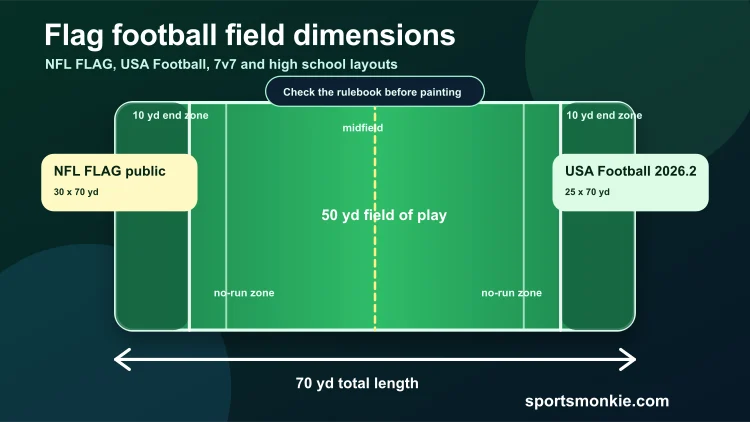
Flag Football Field Dimensions: 5v5, 7v7, NFL FLAG and High School
Flag football field dimensions by ruleset: NFL FLAG 30 x 70 yd, USA Football 25 x 70 yd, 7v7 variations, high school NFHS options and setup calculator.
5-on-5 Flag Football Plays: Simple Routes, Reads and Formations
5-on-5 flag football plays for beginners and coaches: slant-out, mesh, flood, verticals, screen, bunch, trips, spread, play-calling reads and mistakes.
Flag Football Positions Explained: 5v5 and 7v7 Roles
Flag football positions explained for 5v5 and 7v7: quarterback, center, receiver, running back, rusher, defensive back, safety and beginner role fit.
Flag Football Rules Explained: 5v5, 7v7 and Olympic Format
Flag football rules explained with no tackling, no blocking, flag guarding, no-run zones, 7-second passing, 7-yard rush, 5v5, 7v7 and Olympic format.
7-on-7 Flag Football: Rules, Positions and Plays
7-on-7 flag football rules, positions, formations, team size and simple plays, with youth, high-school, college and adult format differences.

New Olympic Sports for LA 2028
LA 2028 adds five sports: flag football, cricket (T20), lacrosse (sixes), squash and baseball/softball. What's new, what's returning and why, explained.