
Flag Football Field Dimensions: 5v5, 7v7, NFL FLAG and High School

On this page10
- 01Flag football field dimensions at a glance
- 02Flag football field size calculator
- 03Why the numbers conflict
- 04NFL FLAG 5v5 field layout
- 05USA Football 5s and 7s field layout
- 067v7 flag football field dimensions
- 07High school and NFHS flag football fields
- 08No-run zones, line-to-gain and rush line
- 09How to mark a 5v5 field with cones
- 10Flag football vs tackle football field size
A flag football field is not one fixed size across the sport. The answer depends on the rulebook.
For NFL FLAG 5v5, the public rules page describes a 30-yard wide by 70-yard long field, built from a 50-yard field of play and two 10-yard end zones. USA Football’s current USA FLAG 5s and 7s rulebooks list 25 x 70 yards in total, also with a 50-yard field of play and two 10-yard end zones. High school flag football follows NFHS rules and state-association field options.
That difference is exactly why generic diagrams can be risky. If you are setting cones for a weekend clinic, a small variation is manageable. If you are painting a school field, ordering turf covers or running a tournament, use the named rulebook for that season.
Flag football field dimensions at a glance
| Ruleset or format | Total field size | Field of play | End zones | Notes |
|---|---|---|---|---|
| NFL FLAG public 5v5 guidance | 30 x 70 yd | 30 x 50 yd | two 10 yd end zones | Midfield line-to-gain; public rules also describe no-run zones at midfield and before goal lines |
| USA Football USA FLAG 5s 2026.2 | 25 x 70 yd | 25 x 50 yd | two 10 yd end zones | Rulebook says smaller fields may be used where space is limited |
| USA Football USA FLAG 7s 2026.2 | 25 x 70 yd | 25 x 50 yd | two 10 yd end zones | Same field dimensions listed in the current 7s rulebook, despite the extra players |
| Independent 7v7 leagues | varies | varies | usually 7 to 10 yd | Some use 60 to 80 yd total length and 30 to 40 yd width, but the league document controls |
| NFHS high school flag football | varies by option and state adoption | varies | usually 10 yd | NFHS publishes high school rules and field diagrams, with state associations choosing or adapting options |
| NFL tackle football comparison | 53 1/3 x 120 yd | 53 1/3 x 100 yd | two 10 yd end zones | Much larger than small-sided flag football |
The safest answer is not “30 x 70” or “25 x 70” in isolation. The safest answer is: name the ruleset, then name the measurement.
Flag football field size calculator
Use this for a quick layout check. It calculates the basic rectangle and square yardage. It does not replace a league field diagram, local field-safety review or school association rulebook.
The calculator includes a common 40 x 80 yard 7v7 estimate because many leagues use something in that neighborhood. It is not a universal rule. If your 7v7 league says 30 x 70, 25 x 70 or a full football-field layout, that league document wins.
Why the numbers conflict
Flag football grew through youth leagues, adult rec leagues, school programs, NFL FLAG, USA Football, IFAF and local tournament operators. Those groups do not all use one field diagram.
The conflict is especially visible in 5v5:
| Source | Width | Total length | What to do with it |
|---|---|---|---|
| NFL FLAG public rules page | 30 yd | 70 yd | Use for NFL FLAG-style public 5v5 unless your league provides a different rulebook |
| USA Football USA FLAG 5s 2026.2 rulebook | 25 yd | 70 yd | Use when your league or tournament says it follows USA Football USA FLAG 5s |
| USA Football USA FLAG 7s 2026.2 rulebook | 25 yd | 70 yd | Use when your 7s event uses this specific USA Football rulebook |
The shared part is the length structure: 50 yards between goal lines plus two 10-yard end zones. The width is where many search results and diagrams blur the rulebooks together.
NFL FLAG 5v5 field layout
NFL FLAG’s public rules page describes a compact field:
| Element | NFL FLAG public guidance |
|---|---|
| Total length | 70 yd |
| Width | 30 yd |
| Field of play | 50 yd |
| End zones | 10 yd each |
| First down / line-to-gain | midfield |
| Rush line | 7 yd from the line of scrimmage |
| No-run zones | before each goal line and at midfield in the public rules explanation |
This smaller field supports the 5v5 game. There are no traditional linemen, everyone can become part of the passing game, and crossing midfield creates the new set of downs. For the rest of the rule structure, see flag football rules and flag football positions.
USA Football 5s and 7s field layout
USA Football’s rules hub links to current USA FLAG 5s and 7s rulebooks. In the 2026.2 versions checked on September 5, 2026, both list:
| Element | USA Football 5s and 7s 2026.2 |
|---|---|
| Total length | 70 yd |
| Width | 25 yd |
| Field of play | 50 yd |
| End zones | 10 yd each |
| Starting spot after most possession changes | own 5-yard line |
| No-run zones | 5 yd before the goal line |
| Smaller field allowance | permitted where space requires it |
The surprising part is that the 7s book lists the same field dimensions as the 5s book. That is not how every independent 7v7 league plays, but it is what the USA Football 7s rulebook states. If your event says USA Football 7s, do not assume a larger 40-yard wide field without checking the tournament packet.
7v7 flag football field dimensions
7v7 has more variation than 5v5. Some leagues use a compact USA Football-style field. Others use wider or longer fields to give two extra players per side enough space. A common recreational estimate is around 40 x 80 yards total, with a 60-yard field of play and two 10-yard end zones, but that is an example, not a national law.
| 7v7 layout type | Common total size | Best use |
|---|---|---|
| USA Football 7s rulebook | 25 x 70 yd | Events using USA Football USA FLAG 7s |
| Compact rec league | 30 x 70 yd | Limited fields, youth or fast passing leagues |
| Wider rec/tournament layout | about 40 x 80 yd | More route spacing and defensive width |
| Full-field school option | up to standard football-field width and length | High school or state-association use |
If you are a league organizer, publish the exact field diagram before the season. If you are a parent or player, ask for the rulebook rather than trusting a generic “7v7 field size” graphic.
High school and NFHS flag football fields
NFHS now maintains flag football rules resources for high school programs, including rulebooks, officials signals and field diagrams. The 2026-27 rule-change notice says a new fourth field option was added for flag football.
That matters because high school flag football is adopted through state associations. One state may use a compact layout. Another may mark flag football on an existing football field. A school can also be constrained by turf lines, soccer overlays, goal posts and existing safety zones.
For athletic directors and field crews, the workflow should be:
- Confirm the state association and season.
- Get the current NFHS rulebook or state adoption document.
- Use that field diagram for total length, width, end zones and line-to-gain.
- Mark flag-specific lines clearly so they do not get confused with tackle football, soccer or lacrosse lines.
- Recheck goal posts, walls, benches, runoff and spectator areas before play.
No-run zones, line-to-gain and rush line
The field rectangle is only half the layout. The interior markings decide how the game works.
| Marking | Common purpose | Ruleset warning |
|---|---|---|
| Goal line | Start of each end zone | Stable concept across formats |
| End line | Back of the end zone | End-zone depth can vary |
| Midfield line-to-gain | First-down target in many 5v5 formats | Some formats use different zone lines |
| No-run zone | Forces pass plays near scoring or first-down areas | NFL FLAG public guidance and USA Football rulebooks do not describe the zones identically |
| Rush line | Where a legal blitzer must start | Often 7 yards from the line of scrimmage |
| Sidelines | Boundary lines | Width changes by ruleset |
The no-run zone is the detail most likely to surprise new players. In one rulebook, midfield may be part of the no-run logic. In another, only the area before the goal line is listed. Paint what your league actually uses.
How to mark a 5v5 field with cones
For a temporary NFL FLAG-style 30 x 70 yard setup:
- Measure the 50-yard field of play first.
- Add one 10-yard end zone at each end.
- Measure 30 yards across for the width.
- Square the corners by checking both diagonals.
- Mark midfield at 25 yards from each goal line.
- Mark no-run zones according to your ruleset.
- Place cones or pylons at end-zone corners, midfield and line-to-gain points.
- Keep spectators, bags, coolers and younger siblings out of the end-zone and sideline areas.
For a USA Football 25 x 70 layout, keep the same length steps and change the width to 25 yards.
Flag football vs tackle football field size
The standard NFL tackle field is 100 yards between goal lines, plus two 10-yard end zones, and 53 1/3 yards wide. A 30 x 70 yard NFL FLAG-style field is much smaller.
| Field | Total dimensions | Total area |
|---|---|---|
| NFL FLAG public 5v5 | 30 x 70 yd | 2,100 sq yd |
| USA Football 5s/7s | 25 x 70 yd | 1,750 sq yd |
| NFL tackle field | 53 1/3 x 120 yd | about 6,400 sq yd |
That size difference changes the sport. Flag football has less collision space, faster passing windows and more compressed route spacing. It also means a single full football field can sometimes hold more than one temporary flag field if safety buffers and local rules allow it.
If you are here because football season has you in an NFL mood, the field-size rabbit hole pairs nicely with our NFL playoff predictor, NFL schedule simulator and Guess the NFL Player. Different kind of nerdy, same family of fun.
Sources
Frequently asked questions
What are the dimensions of a flag football field?+
It depends on the ruleset. NFL FLAG's public 5v5 guidance describes a 30 x 70 yard field. USA Football's current USA FLAG 5s rulebook lists 25 x 70 yards in total, with a 50-yard field of play and two 10-yard end zones. School and 7v7 leagues can use different layouts.
How big is an NFL FLAG field?+
NFL FLAG's public rules page describes a 30-yard wide by 70-yard long 5v5 field, with two 10-yard end zones and a midfield line-to-gain. Some official or affiliated rulebook formats use 25 yards of width, so confirm the exact document for your league or tournament.
What size is a USA Football 5v5 flag field?+
USA Football's USA FLAG 5s 2026.2 rulebook lists field dimensions of 25 x 70 yards in total, with two 10-yard end zones and a 50-yard field of play. It also says smaller fields may be used where space requires it.
What size is a 7v7 flag football field?+
There is no universal 7v7 size. USA Football's 2026.2 7s rulebook uses the same listed 25 x 70 yard total field as its 5s book, while many independent 7v7 and school leagues use wider or longer fields. Always check the league or state rulebook before painting lines.
Where are the no-run zones in flag football?+
In USA Football's current 5s and 7s rulebooks, no-run zones are the 5-yard zones before the goal lines. NFL FLAG's public rules page also describes no-run zones before each goal line and at midfield. That difference is another reason to check the specific rulebook.
Is a flag football field the same size as an NFL field?+
No. A 5v5 flag football field is much smaller. NFL FLAG's public 30 x 70 yard layout is 2,100 square yards including end zones, while a regulation NFL field is 120 x 53 1/3 yards including end zones, about 6,400 square yards.
Sources
Play & tools
Free browser games and tools — no account, no download.
- Play 17-0 — Draft nine and chase a flawless NFL regular season — the perfect 17-0 run, no playoffs.
- Play 20-0 — Draft nine and chase a perfect NFL season — regular season and playoffs, undefeated.
- Play 16-0 — Draft nine and chase a perfect 16-0 — the classic 16-game NFL regular season, no playoffs.
- Play Flawless Six — Draft five players and a head coach, then chase a perfect NFL season with the right chemistry.
- Play Guess the NFL Player — A new mystery NFL player every day. Eight guesses, with a clue on each — plus free unlimited mode.
- Play NFL Wordle — A Wordle for football — guess the daily NFL player in eight tries, with green-amber-grey feedback on every clue.
- Play NFL Connections — Sort sixteen football tiles into four hidden groups of four. A new daily puzzle, four mistakes allowed, plus unlimited mode.
- Explore all our games →
- Open the schedule simulator — Pick every 2026 NFL game and watch the standings and playoff seeds update live.
- Open the squares generator — Generate a randomized, printable Super Bowl squares grid for your party — free, no sign-up.
- Open the trade calculator — Weigh any fantasy football trade instantly — clear winner and value gap.
- Run the NFL predictor — Simulate the NFL bracket and see who your picks send to the Super Bowl.
- Open the passer rating calculator — Calculate the official NFL passer rating (0–158.3) from any passing line, with the formula shown.
- Explore all our free sports tools →
Related nfl guides
View all →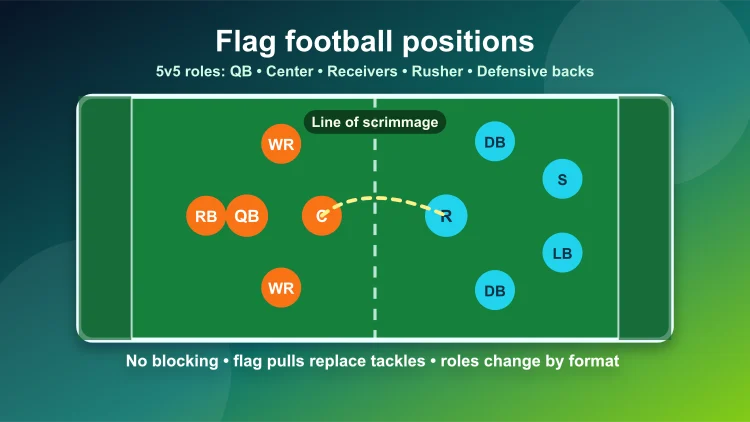
Flag Football Positions Explained: 5v5 and 7v7 Roles
Flag football positions explained for 5v5 and 7v7: quarterback, center, receiver, running back, rusher, defensive back, safety and beginner role fit.

Flag Football Rules Explained: 5v5, 7v7 and Olympic Format
Flag football rules explained with no tackling, no blocking, flag guarding, no-run zones, 7-second passing, 7-yard rush, 5v5, 7v7 and Olympic format.

Flag Football vs Tackle Football
Flag football replaces tackling with pulling a flag and drops pads; tackle football is the full-contact game. Rules, safety and skills compared.
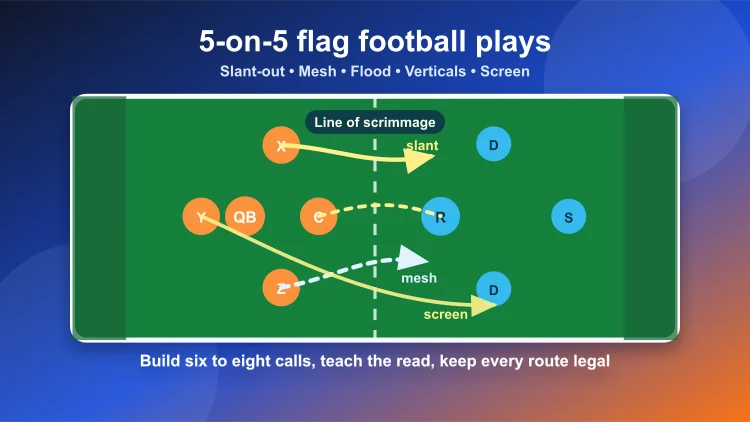
5-on-5 Flag Football Plays: Simple Routes, Reads and Formations
5-on-5 flag football plays for beginners and coaches: slant-out, mesh, flood, verticals, screen, bunch, trips, spread, play-calling reads and mistakes.
Football Referee Signals: The Complete NFL Hand Signal Chart
Football referee signals explained: touchdown, first down, holding, false start, pass interference, and every hand signal NFL officials use on the field.
Football Formations and Coverages Explained: The Complete NFL Guide
Football formations and coverages explained: how NFL offenses line up, how defenses answer with zone and man coverage, and why each matchup wins or loses.