
Cover 4 Defense (Quarters Coverage) in Football: Rules and Weaknesses
On this page6
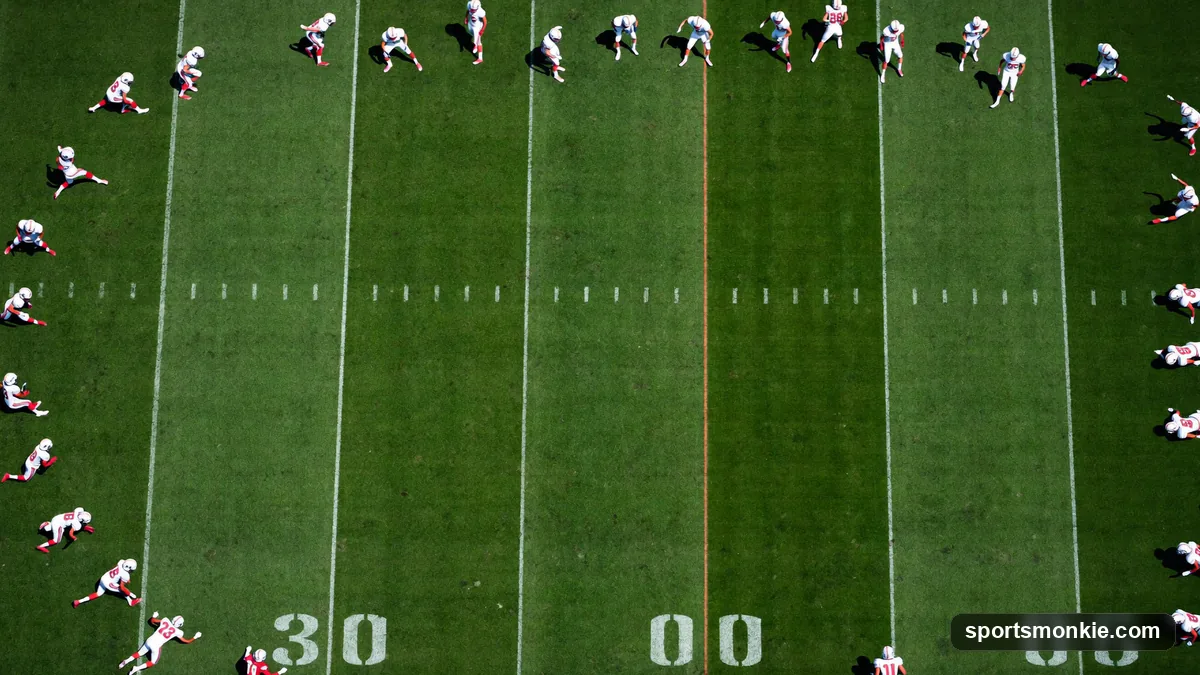
Cover 4 defense, also called quarters coverage, is a zone scheme in which four defenders — usually both cornerbacks and both safeties — each guard one quarter of the deep field while three linebackers hold underneath zones. It’s built to shut down explosive plays over the top while still keeping the safeties close enough to the line to help against the run, which is why it has become one of the most widely used base coverages in both college and NFL defenses over the last two decades.
How Cover 4 Is Structured
Cover 4 splits the field into a “four-deep, three-under” shell. The deep part of the field, from sideline to sideline, is divided evenly into four vertical lanes:
- Two cornerbacks align at five to seven yards off the line of scrimmage and own the outside quarters, primarily responsible for the number one receiver on their side running vertically.
- Two safeties line up 10-15 yards deep and own the inside quarters, keying the number two receiver (usually a slot receiver or tight end) and reading whether he threatens deep, breaks inside, or blocks for the run.
Underneath, three linebackers split the field into thirds, covering the hook/curl and flat zones from the line of scrimmage out to roughly 10 yards. The defensive line rushes the passer or fills run gaps as it would in most base fronts. For a wider look at how this shell fits alongside other coverage calls a defense might use on a given snap, see this breakdown of nfl formations and coverages explained.
Because every deep defender is responsible for a limited vertical lane rather than half or a third of the field, Cover 4 is often described as the coverage with the fewest deep “seams” for an offense to attack — at least in theory. In practice, most of Cover 4’s real value comes from how it’s taught to react, not just where players line up.
Pattern-Match Rules: How Cover 4 Reads Routes
Almost no team plays true “spot drop” Cover 4 anymore. Modern defenses run pattern-match quarters, sometimes called Match Cover 4, which starts as a zone shell and converts individual defenders into man coverage once a route declares. The core reads:
- Corners play the number one receiver vertically. If he runs a go route or post, the corner stays on him in man coverage. If he breaks off into a short or intermediate route, the corner passes him off to an underneath defender and looks inside for another receiver entering his deep zone.
- Safeties read the number two receiver. If he releases vertically past a certain depth (often around six to eight yards), the safety treats it like man coverage and carries him deep. If the number two receiver breaks inside, blocks, or runs a shallow route, the safety is freed to drive downhill — either to support the run or to jump an underneath route.
- Linebackers handle the number two and number three receivers underneath, often with a “collision” or “banjo” rule that lets them pass receivers off to each other as routes cross.
This is the mechanism behind Cover 4’s biggest selling point: because safeties don’t have to commit deep until the number two receiver’s route declares, they can act almost like an eighth run defender against inside runs, then bail into coverage the instant the offense shows pass. That flexibility is a major reason quarters coverage has spread from college spread-option defenses into the modern NFL.
Strengths of Cover 4 Defense
Cover 4’s biggest strength is that it blankets the deep part of the field better than almost any other base coverage. With four defenders splitting the field into quarters instead of halves or thirds, there’s no single deep defender who has to cover as much ground, which makes explosive plays over the top much harder to complete.
Other strengths include:
- Run support from the deep secondary. Because safeties key the number two receiver rather than committing to deep coverage on every snap, they can trigger downhill against the run almost like an extra linebacker when their read tells them it’s a run play.
- Disguise value. Cover 4 looks similar pre-snap to other two-safety shells, including some Cover 2 and man-coverage looks, which makes it harder for a quarterback to diagnose before the ball is snapped.
- Flexibility across fronts. Cover 4 works with both 4-3 and 3-4 defensive fronts and doesn’t require a specific personnel package, so a defense can stay in its base grouping and still get quarters principles.
- Fewer deep seams. Splitting the field into four lanes instead of two or three means there’s less real estate for any single deep defender to cover, which limits the effectiveness of simple vertical stretches.
Weaknesses of Cover 4 Defense
The trade-off for all that deep coverage is what’s left underneath and in the box. With only three linebackers working short and intermediate zones — rather than four in Cover 3 or five in Cover 2 — Cover 4 has fewer bodies to squeeze quick, high-percentage throws.
- Light box against the run. Even with safeties reading run, Cover 4 starts with fewer defenders in the immediate box than a run-heavy front, which physical rushing teams can exploit before the safeties get a chance to trigger.
- Underneath windows. Slants, stick routes, shallow crossers, and quick outs can find soft spots in the three-under zone before defenders settle into position, especially against fast tempo or quick-game passing concepts.
- Vulnerable to double moves and double posts. Because safeties are reading rather than always playing strictly deep, a well-timed double move or two receivers running post routes into the same safety’s zone can manipulate that safety out of position and create a big play.
- Communication-dependent. Pattern-match rules require the secondary to communicate route combinations in real time; a busted read or miscommunication between a corner and safety can turn quarters coverage into a coverage bust.
Cover 4 vs. Cover 3 vs. Cover 2: How It Lines Up
The three coverages differ mainly in how many defenders play deep versus underneath, and that trade-off shapes what each is good and bad at.
| Feature | Cover 2 | Cover 3 | Cover 4 |
|---|---|---|---|
| Deep defenders | 2 (both safeties) | 3 (usually 2 safeties + 1 cornerback) | 4 (both cornerbacks + both safeties) |
| Underneath defenders | 5 | 4 | 3 |
| Deep field divided into | Two halves | Three thirds | Four quarters |
| Deep coverage strength | Strong sidelines, weak middle | Strong middle, weaker sidelines | Strong everywhere deep |
| Run support from secondary | Limited | Moderate | Strong (safety read-and-trigger) |
| Underneath coverage | Very strong (5 defenders) | Strong (4 defenders) | Lighter (3 defenders) |
| Common vulnerability | Seam routes, four verticals | Deep out/corner routes | Quick underneath routes, inside run |
In short, cover 2 defense in football stacks defenders underneath at the cost of a deep-middle seam, cover 3 defense in football sits in between with a dedicated deep-middle defender, and Cover 4 pushes the most defenders deep of the three, trading underneath numbers for a coverage shell that’s difficult to beat over the top. Defensive coordinators pick between them based on the offense’s personnel, down and distance, and whether the bigger threat that game is the run or the deep pass.
Why Cover 4 Has Become So Popular
Quarters coverage started as a college answer to spread and option offenses, where safeties needed to be able to both defend four verticals and still show up in the run fit against read-option and zone-read plays. Its blend of deep protection and disguised run support made it a natural fit as spread concepts and run-pass options spread into the NFL, and it’s now a staple call for defenses built around versatile, rangy safeties rather than pure man-cover cornerbacks.
Cover 4 is rarely a defense’s only call; it’s typically mixed with Cover 1, Cover 2, Cover 3, and man-coverage packages depending on formation and situation. Understanding how quarters coverage fits into that broader menu is a useful step toward reading NFL defenses like a coach — for the full picture of how these coverages interact with front-seven alignments, see the guide to american football and the NFL along with the broader breakdown of nfl formations and coverages explained.
Frequently asked questions
What is Cover 4 defense in football?+
Cover 4 is a zone coverage scheme in which four defenders — typically both cornerbacks and both safeties — line up deep and each takes responsibility for one quarter of the field. Three linebackers work underneath zones, creating a four-deep, three-under shell that's built to prevent explosive plays over the top.
Why is Cover 4 called quarters coverage?+
It's called quarters coverage because the deep part of the field, from sideline to sideline, is split evenly into four sections — quarters — with one defender assigned to each. That's different from Cover 2 (deep field split into halves) and Cover 3 (deep field split into thirds).
What is the main weakness of Cover 4 defense?+
Cover 4's main weakness is the running game and the shallow passing game. With four defenders committed deep and only three underneath, the box can be light against inside runs, and there are natural gaps in the short-to-intermediate zones that quick outs, curls, and stick routes can exploit before the coverage settles.
How does pattern-match Cover 4 work?+
Pattern-match Cover 4 lets defenders read the receivers' routes at the snap and convert from zone rules into man coverage once a route declares. Corners typically play the number one receiver deep unless he breaks off short, in which case they pass him off and look for another receiver entering their zone. Safeties read the number two receiver — if he runs vertically they carry him deep, and if he breaks inside or out they can drive downhill to support the run or jump underneath routes.
Is Cover 4 a zone or man defense?+
Base Cover 4 is a zone defense, with each of the four deep defenders responsible for an area rather than a specific player. Most modern NFL and college defenses run a pattern-match version, however, which starts as zone and converts individual defenders into man coverage once the route pattern in their zone becomes clear.
How is Cover 4 different from Cover 3?+
Cover 4 uses four deep defenders splitting the field into quarters and three underneath defenders, while Cover 3 uses three deep defenders splitting the field into thirds and four underneath defenders. Cover 4 provides more help on deep passes and more support for run defense from the safeties, while Cover 3 keeps an extra body underneath for short and intermediate throws.
How is Cover 4 different from Cover 2?+
Cover 4 has four deep defenders and three underneath, while Cover 2 has two deep defenders and five underneath. Cover 4 is stronger against deep vertical routes and can still get safeties involved in run support, while Cover 2 packs more bodies into short and intermediate zones but leaves a well-known seam in the deep middle between its two safeties.
What beats Cover 4 defense?+
Cover 4 is most commonly attacked with double moves and double post concepts that stress a single safety, with quick underneath routes like slants, stick, and shallow crossers that exploit the light three-under zone, and with inside run plays that attack the coverage before the safeties can trigger downhill.
Sources
Play & tools
Free browser games and tools — no account, no download.
- Play 17-0 — Draft nine and chase a flawless NFL regular season — the perfect 17-0 run, no playoffs.
- Play 20-0 — Draft nine and chase a perfect NFL season — regular season and playoffs, undefeated.
- Play 16-0 — Draft nine and chase a perfect 16-0 — the classic 16-game NFL regular season, no playoffs.
- Play Flawless Six — Draft five players and a head coach, then chase a perfect NFL season with the right chemistry.
- Play Guess the NFL Player — A new mystery NFL player every day. Eight guesses, with a clue on each — plus free unlimited mode.
- Play NFL Wordle — A Wordle for football — guess the daily NFL player in eight tries, with green-amber-grey feedback on every clue.
- Play NFL Connections — Sort sixteen football tiles into four hidden groups of four. A new daily puzzle, four mistakes allowed, plus unlimited mode.
- Explore all our games →
- Open the schedule simulator — Pick every 2026 NFL game and watch the standings and playoff seeds update live.
- Open the squares generator — Generate a randomized, printable Super Bowl squares grid for your party — free, no sign-up.
- Open the trade calculator — Weigh any fantasy football trade instantly — clear winner and value gap.
- Run the NFL predictor — Simulate the NFL bracket and see who your picks send to the Super Bowl.
- Open the passer rating calculator — Calculate the official NFL passer rating (0–158.3) from any passing line, with the formula shown.
- Explore all our free sports tools →
Related nfl guides
View all →
Cover 2 Defense in Football: Rules, Alignment, and Weaknesses Explained
Cover 2 defense explained: two deep safeties split the field, five underneath defenders, strengths vs. deep passes, weaknesses in the middle, and the Tampa 2 twist.
Cover 3 Defense in Football: How It Works, Strengths & Weaknesses
Cover 3 defense explained: three deep defenders split the field into thirds while four underneath defenders play zone. Strengths, weaknesses, and how to beat it.
Tampa 2 Defense Explained: How the Cover 2 Variation Works
The Tampa 2 defense explained: how it modifies Cover 2 by dropping the middle linebacker deep, why Tony Dungy and Monte Kiffin built it, and its strengths and weaknesses.
Match Coverage in Football: How Pattern-Match Defense Works
Match coverage is a zone/man hybrid where defenders read receiver routes and lock on man-to-man within zone rules. Full breakdown of pattern matching.
Zone Coverage in Football: How It Works, Shells, and Weaknesses
Zone coverage in football explained: defenders guard areas instead of players. Learn Cover 2, Cover 3, Cover 4, strengths, and soft-spot weaknesses.
Press Coverage in Football: How Corners Jam Receivers at the Line
Press coverage in football is when a corner lines up at the line of scrimmage and jams the receiver at the snap to disrupt route timing.