
Match Coverage in Football: How Pattern-Match Defense Works
On this page7
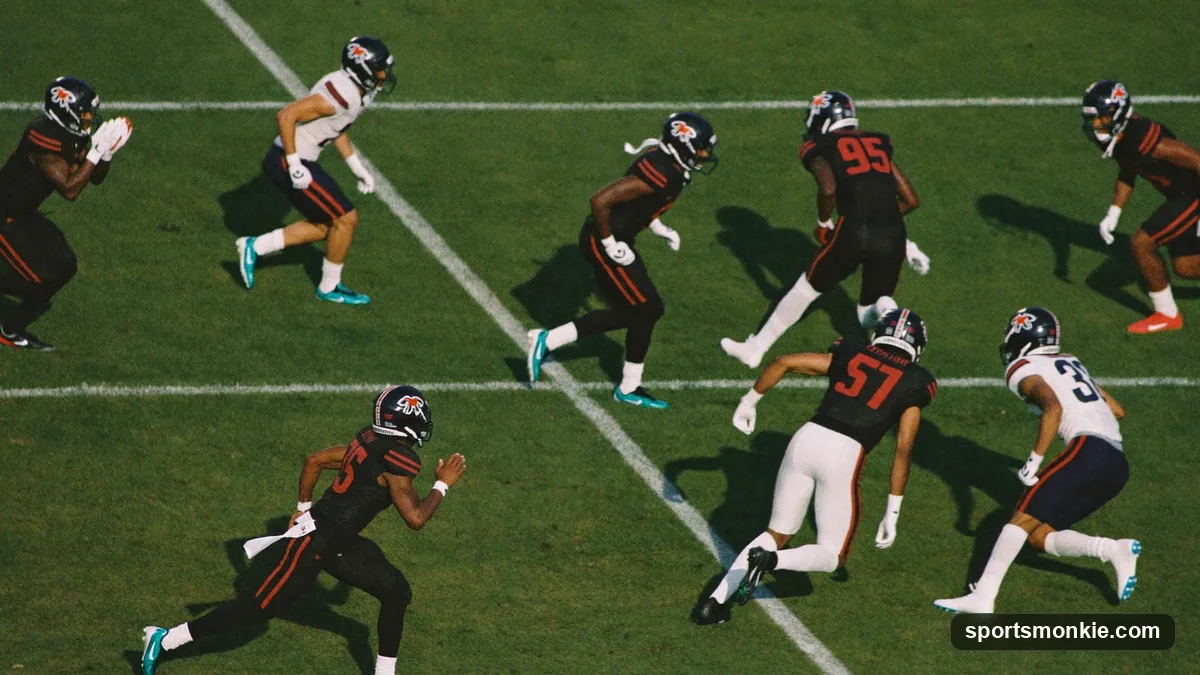
Match coverage is a hybrid defense in which defenders line up and drop like a zone, then convert to man-to-man coverage on a specific receiver once his route “declares” inside their area. It’s often called pattern-match or zone-match coverage, and it’s now the default way most college and NFL defenses teach Cover 3 and Cover 4 rather than old-school spot-drop zone. This guide breaks down how it works, why it exists, and the terminology you’ll hear announcers and coaches use.
What Is Match Coverage?
Match coverage sits in the space between pure man and pure zone. In a traditional spot-drop zone, a defender runs to a landmark on the field — say, the deep third or the flat — and reacts to whichever receiver shows up in that area while keeping his eyes on the quarterback. That’s simple to teach, but it leaves predictable windows: route combinations designed to put two receivers in one defender’s zone (a “high-low” or “flood” concept) can stretch a spot-dropper past his ability to cover both.
Pattern matching fixes that by teaching defenders to read the release and route stem of the receiver(s) threatening their zone before they decide how to drop. Once a receiver’s route is identified, the defender matches him man-to-man — mirroring his hips, staying on top of vertical routes, and carrying him through the defender’s area and sometimes beyond it, passing him off only by rule. The defense still shows a zone shell before the snap (which is part of why it disguises coverage so well against quarterbacks), but it plays like man once the ball is out.
This is the same conceptual family covered in our broader breakdown of NFL formations and coverages explained, and it’s worth reviewing zone coverage in football first if you want the baseline that match coverage builds on.
Why Defenses Use Match Coverage: Best of Both Worlds
Coaches gravitate to pattern matching because it solves the classic trade-off between man and zone:
- Zone coverage keeps defenders’ eyes on the quarterback, helps against the run, and gives safety help over the top — but it can be schemed against with route combinations that overload a single zone.
- Man coverage locks defenders onto receivers wherever they go, closing off scheme-based windows — but it isolates defensive backs on islands, is vulnerable to natural pick plays and rub routes, and gives up easy vision of the quarterback and ball-carriers.
Match coverage borrows the structural discipline and disguise of zone with the receiver-erasing tightness of man. A cornerback playing match Cover 3 reads the receiver’s release: if he runs vertical, the corner matches him like it’s man coverage; if he runs a shallow route, the corner can pass him off to an underneath defender and settle back into a zone drop, staying available to help elsewhere. That flexibility is what makes pattern matching so hard for offensive coordinators to identify pre-snap and attack with a single beater route.
How Match Coverage Rules Work
Every pattern-match defense is built on route-distribution rules taught during install and drilled in practice. Common rule triggers include:
- Vertical releases — if a receiver pushes vertically past a certain depth (often 8-12 yards), the nearest defender matches him man-to-man up the field.
- Route combinations by number — defenders are taught to react based on how many receivers release to their side and in what order (the “#1, #2, #3 receiver” reads used across zone-match systems).
- Pass-off rules — if a receiver’s route takes him out of a defender’s area (a shallow crosser, for example), that defender passes him to the next defender by rule rather than following him indefinitely.
- MEG calls (man everywhere he goes) — some pattern-match calls put a specific defender in true man coverage on a specific receiver regardless of route, layered inside an otherwise zone-match shell.
This is why match coverage is considered a “coverage shell” concept as much as a single coverage — it’s frequently married to Cover 3 defense in football (three deep-third defenders) and to Cover 4/quarters shells, with match rules governing what the underneath and deep defenders do once the ball is snapped.
Rip/Liz and the Saban Cover 7 System
The terminology most associated with modern match coverage traces back to Nick Saban’s coaching tree, where pattern-match theory was systematized into what’s commonly called Cover 7. Within that system, calls like Rip and Liz tell the secondary which side the coverage rotates and matches toward — Rip rotates help to the right, Liz to the left — while the defense still shows a quarters (two-high safety) look before the snap. Cover 7 layers in additional calls (poach rules for a robber-style safety, MEG assignments, and specific answers for 2x2 and 3x1 formations) so the defense has a built-in answer for almost any route combination a spread offense presents. This system has since spread widely through college football and into NFL coaching staffs, becoming the backbone of how many defensive coordinators teach match coverage at every level.
Match Coverage vs. Traditional Zone: How It Lines Up
| Feature | Traditional Spot-Drop Zone | Match (Pattern-Match) Coverage |
|---|---|---|
| Pre-snap look | Zone shell | Zone shell (often identical look) |
| Post-snap technique | Drop to landmark, react to QB/area | Read route, convert to man on matched receiver |
| Eyes | Quarterback | Receiver first, then quarterback once matched |
| Vulnerable to | Route combos that flood one zone | Missed reads, rub/pick routes, busted communication |
| Disguise value | Moderate | High — looks like zone, plays tighter than zone |
| Teaching complexity | Lower | Higher — requires extensive rules and reps |
| Common shells | Cover 2, Cover 3 | Match Cover 3, Cover 4/quarters, Cover 7 |
Strengths and Weaknesses of Match Coverage
Strengths:
- Cuts down on busted zones and easy completion windows created by combination routes
- Keeps the safety help, run support, and eyes-on-QB advantages of zone
- Disguises coverage well since the pre-snap picture resembles standard zone
- Adapts to modern spread and motion-heavy offenses better than rigid spot-drop zone
Weaknesses:
- Far more complex to teach and execute — defenders must process route reads at full speed, not just run to a spot
- Communication breakdowns on bunch/stack formations or pre-snap motion can still create busts
- Man-matched defenders can lose track of a scrambling quarterback since their eyes shift to the receiver
- Requires disciplined, athletic defensive backs who can both zone-read and man-cover in the same rep
Match Coverage Within the Broader Coverage Picture
Match coverage isn’t a standalone call so much as a technique layered onto existing shells — most often Cover 3 and Cover 4, and increasingly Cover 2 variations as well. If you’re building out a full picture of how NFL and college defenses disguise and rotate coverage, start with American football (NFL) coverage fundamentals, then work through zone coverage in football and Cover 3 defense in football before circling back to match rules — pattern matching only makes sense once the underlying zone shell it’s built on is clear.
Match coverage has become the default teaching method for zone coverage at nearly every competitive level of football, from major college programs to NFL defenses, precisely because pure spot-drop zone is too easy to attack with modern route concepts. Understanding the difference between “playing a zone” and “matching a zone” is one of the clearest ways to read a defense’s sophistication when you’re watching film or a live broadcast.
Frequently asked questions
What is match coverage in football?+
Match coverage, also called pattern-match or zone-match coverage, is a defensive scheme where defenders start in zone drops but convert to man-to-man coverage on a receiver once his route pattern is read within their zone. It blends zone structure with man-to-man technique.
Is match coverage zone or man?+
It's both. Match coverage uses zone alignment and zone rules pre-snap and at the snap, but the actual coverage technique that follows — mirroring a receiver's hips, hands, and cuts — is man-to-man once a defender 'matches' onto that receiver.
What is the difference between match coverage and zone coverage?+
Traditional spot-drop zone coverage has defenders drop to a landmark and read the quarterback, playing whoever enters their area. Match coverage still uses zone landmarks, but defenders read receiver releases and routes first, then match up man-to-man on the receivers that threaten their zone, closing the passing windows spot-drop zone leaves open.
Why do defenses use pattern-match coverage instead of straight man or zone?+
Pattern matching gives defenses the best of both worlds: the deep safety help, run support, and eyes-on-quarterback advantages of zone, combined with the tight route coverage of man-to-man. It also builds in rules for handling route combinations (like two receivers running into the same zone) that break simple spot-drop zones.
What is Rip/Liz coverage?+
Rip and Liz are match-coverage rotation calls, most associated with Nick Saban's coaching tree, that tell the secondary which side the single-high safety rotates to and how the corners and safeties match routes on each side. 'Rip' rotates the coverage help to the right, 'Liz' to the left, within a quarters- or Cover 3-based match shell.
What is Cover 7 in football?+
Cover 7 is Nick Saban's umbrella term for a pattern-match coverage system built off quarters (Cover 4) principles, with built-in rules (like Rip/Liz, MEG, and poach calls) that let the defense match receivers man-to-man out of a two-high safety shell depending on the formation and routes it sees.
Does match coverage eliminate coverage busts?+
It reduces them significantly by giving defenders clear rules for who to match and when to pass a receiver off, but it doesn't eliminate busts entirely. Match coverage is more complex to teach and play than simple spot-drop zone, so communication errors on motion, stacks, and bunch formations can still create explosive-play windows.
Which NFL and college coaches are known for match coverage?+
Nick Saban popularized modern pattern-match theory with Cover 7 at LSU and Alabama, and it has spread throughout the coaching tree into the NFL. Many current NFL defensive coordinators run pattern-match variations of Cover 3 and Cover 4 as their base coverage rather than pure spot-drop zone.
Sources
Play & tools
Free browser games and tools — no account, no download.
- Play 17-0 — Draft nine and chase a flawless NFL regular season — the perfect 17-0 run, no playoffs.
- Play 20-0 — Draft nine and chase a perfect NFL season — regular season and playoffs, undefeated.
- Play 16-0 — Draft nine and chase a perfect 16-0 — the classic 16-game NFL regular season, no playoffs.
- Play Flawless Six — Draft five players and a head coach, then chase a perfect NFL season with the right chemistry.
- Play Guess the NFL Player — A new mystery NFL player every day. Eight guesses, with a clue on each — plus free unlimited mode.
- Play NFL Wordle — A Wordle for football — guess the daily NFL player in eight tries, with green-amber-grey feedback on every clue.
- Play NFL Connections — Sort sixteen football tiles into four hidden groups of four. A new daily puzzle, four mistakes allowed, plus unlimited mode.
- Explore all our games →
- Open the schedule simulator — Pick every 2026 NFL game and watch the standings and playoff seeds update live.
- Open the squares generator — Generate a randomized, printable Super Bowl squares grid for your party — free, no sign-up.
- Open the trade calculator — Weigh any fantasy football trade instantly — clear winner and value gap.
- Run the NFL predictor — Simulate the NFL bracket and see who your picks send to the Super Bowl.
- Open the passer rating calculator — Calculate the official NFL passer rating (0–158.3) from any passing line, with the formula shown.
- Explore all our free sports tools →
Related nfl guides
View all →
Cover 3 Defense in Football: How It Works, Strengths & Weaknesses
Cover 3 defense explained: three deep defenders split the field into thirds while four underneath defenders play zone. Strengths, weaknesses, and how to beat it.
Zone Coverage in Football: How It Works, Shells, and Weaknesses
Zone coverage in football explained: defenders guard areas instead of players. Learn Cover 2, Cover 3, Cover 4, strengths, and soft-spot weaknesses.
Cover 2 Defense in Football: Rules, Alignment, and Weaknesses Explained
Cover 2 defense explained: two deep safeties split the field, five underneath defenders, strengths vs. deep passes, weaknesses in the middle, and the Tampa 2 twist.
Tampa 2 Defense Explained: How the Cover 2 Variation Works
The Tampa 2 defense explained: how it modifies Cover 2 by dropping the middle linebacker deep, why Tony Dungy and Monte Kiffin built it, and its strengths and weaknesses.
Cover 4 Defense (Quarters Coverage) in Football: Rules and Weaknesses
Cover 4 defense explained: four deep defenders split the field into quarters, pattern-match rules, run strengths, and how it differs from Cover 2/Cover 3.
Press Coverage in Football: How Corners Jam Receivers at the Line
Press coverage in football is when a corner lines up at the line of scrimmage and jams the receiver at the snap to disrupt route timing.