
Zone Coverage in Football: How It Works, Shells, and Weaknesses
On this page7
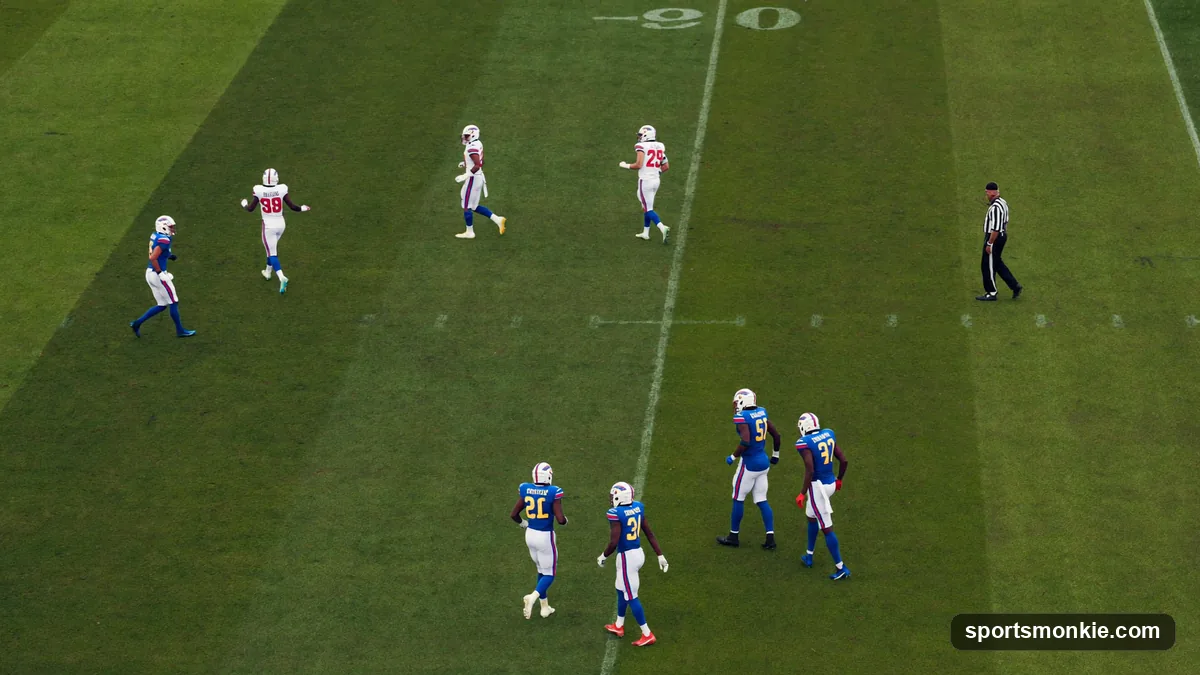
Zone coverage is a football defense in which each defender guards a specific area of the field rather than tracking one assigned receiver, reading the quarterback and reacting to whoever runs into that space. It’s one of the two foundational coverage philosophies in football, alongside man coverage, and it forms the backbone of shells like Cover 2, Cover 3, and Cover 4 that NFL defensive coordinators call on nearly every series.
How Zone Coverage Works
In zone coverage, the field is carved into sections, and each defensive back or linebacker owns one of those sections for the duration of the play. Instead of memorizing which receiver to chase, the defender’s job is to:
- Drop to a landmark (a specific depth and width on the field) at the snap
- Keep his eyes on the quarterback rather than a single receiver
- React to routes as they enter his zone, “collision” or reroute receivers passing through, and pass them off to the next defender
- Break on the ball the instant the quarterback commits to a throw
This is the core distinction from man coverage, where a defender is locked onto one receiver from snap to whistle no matter where the route takes him. Because zone defenders are watching the quarterback’s shoulders and eyes instead of mirroring footwork, they typically get a better jump on underthrown or tipped passes — one reason zone-heavy defenses tend to generate more interceptions over a season. For a broader look at how these two families of coverage differ play by play, see our breakdown of man coverage in football.
The Common Zone Shells
Every zone call is built around how many defenders drop deep versus how many stay underneath. The math (deep defenders + underneath defenders) always totals seven, since four pass rushers are typically up front in a standard four-man rush.
Cover 2
Cover 2 uses two deep safeties, each responsible for one half of the field, with five defenders underneath. It’s a bend-but-don’t-break shell: short and intermediate routes are conceded to protect against anything over the top. The classic weak point is the deep middle, where a tight end or slot receiver can split the two safeties before either arrives. The “Tampa 2” variant patches that hole by sending the middle linebacker deep down the pipe to close the gap.
Cover 3
Cover 3 splits the deep field into thirds, generally with both cornerbacks and the free safety each owning a third, while four defenders play underneath zones. Because it only commits three defenders deep, Cover 3 keeps more bodies near the line of scrimmage, making it one of the better zone shells against the run. Its signature weakness is the flat/curl seam — a single cornerback covering an entire third of the field can be stressed by a deep out or a well-timed comeback route. See our dedicated guide to Cover 3 defense in football for a full breakdown of alignment and technique.
Cover 4 (Quarters)
Cover 4 divides the deep field into four quarters, with each safety and cornerback owning a vertical stripe rather than a wide zone. It’s the most conservative shell against explosive deep plays because no single defender is ever isolated over the top. The tradeoff is that underneath routes — quick outs, slants, and screens — have more room to operate before help arrives, so Cover 4 is often paired with “pattern-match” rules that let defenders switch to man principles once a route declares itself short.
Cover 6
Cover 6 is a hybrid: one side of the field plays Cover 4 principles while the other plays Cover 2. It lets a coordinator tilt coverage toward a stronger receiver or formation strength without fully committing to one shell across the whole field.
Zone Shells at a Glance
| Shell | Deep defenders | Underneath defenders | Best against | Common soft spot |
|---|---|---|---|---|
| Cover 2 | 2 (safeties, halves) | 5 | Balanced run/pass, short routes | Deep middle seam between safeties |
| Cover 3 | 3 (2 corners + 1 safety, thirds) | 4 | The run, keeping 8 in the box | Flat/curl area, deep outside third |
| Cover 4 (Quarters) | 4 (quarters) | 3 | Explosive deep plays | Underneath routes (slants, outs, screens) |
| Cover 6 | Mixed (2 one side, 4 other) | Mixed | Formation-specific matchups | Whichever half is playing Cover 2 |
Strengths of Zone Coverage
Zone coverage’s biggest advantages come from where defenders point their eyes and how many bodies converge on the ball:
- Eyes on the quarterback: Defenders read the passer instead of mirroring a receiver’s release, reacting to the throw rather than the route.
- Gang tackling: Multiple defenders often have overlapping vision on the same area, so more players converge on the ball carrier, limiting yards after the catch.
- Ball-hawking and takeaways: Watching the quarterback’s eyes makes it easier to jump underneath routes and turn tipped or late passes into interceptions.
- Built-in help against double moves: A fooled zone defender still has a defender in the next zone ready to pick up the route, unlike man coverage where a beaten defender is often left with no help.
- Better run support in certain shells: Cover 3 keeps extra defenders closer to the box, giving zone-heavy defenses an edge against the run.
Weaknesses of Zone Coverage
The tradeoff for all that structure is space that no single defender fully owns:
- Soft spots between zones: The seams where one defender’s zone ends and another’s begins are the classic zone-beater. A quarterback who diagnoses the shell pre-snap can throw to a spot just before the next defender rotates over.
- Predictability: Zone landmarks are relatively fixed, so an experienced passer who recognizes the shell can attack the exact seam it’s known to concede.
- Underneath windows in deep-heavy shells: Cover 4’s commitment to four deep defenders opens up quick underneath throws before help can close.
- Isolated defenders in certain calls: Cover 3’s single deep-middle safety or an outside cornerback covering an entire third can be stressed one-on-one on a vertical route.
- Communication breakdowns: Because responsibility shifts as receivers cross zones, a busted handoff between two defenders can leave a receiver wide open — a risk man coverage doesn’t carry the same way.
Zone Coverage vs. Man Coverage
The two philosophies aren’t mutually exclusive — most NFL defenses mix both from snap to snap. The fundamental tradeoff:
| Factor | Zone Coverage | Man Coverage |
|---|---|---|
| Defender’s focus | Area of the field | One specific receiver |
| Eyes | Quarterback | Assigned receiver |
| Help on busted plays | Built-in, next zone over | Minimal without a safety over the top |
| Run support | Often stronger (Cover 3) | Varies, corners can be isolated |
| Vulnerability | Soft spots between zones | One-on-one mismatches, double moves |
| Best against | Route combinations designed to attack space | Isolated receivers, timing routes |
Understanding which shell a defense is in — and how it interacts with man principles — is one of the fastest ways to read football like a coach. For the full picture of how these coverages fit into a defense’s broader scheme, see our guide to NFL formations and coverages explained, and for the bigger-picture context of how coverage schemes fit into the sport overall, visit our American football / NFL hub.
Why It Matters for Watching the Game
Once you can identify whether a defense dropped into a two-deep, three-deep, or four-deep shell, you start seeing the game the way a quarterback does. A receiver breaking open “for no reason” 15 yards downfield is usually finding the exact seam his route was designed to exploit. Zone coverage is less about individual matchups and more about geometry: whichever side solves the spacing problem fastest usually wins the down.
Frequently asked questions
What is zone coverage in football?+
Zone coverage is a defensive scheme where each defender guards a designated area of the field instead of a specific offensive player. Defenders keep their eyes on the quarterback, read route combinations developing in front of them, and pass receivers off to the next zone as those receivers cross into another defender's area.
What is the difference between zone coverage and man coverage?+
In zone coverage, defenders are assigned to spaces on the field and cover whoever enters that space. In man coverage, each defender is locked onto one specific receiver for the entire play, following that player wherever he goes regardless of which zone he runs into.
What are the main types of zone coverage?+
The most common zone shells in the NFL are Cover 2 (two deep safeties splitting the field into halves, five underneath defenders), Cover 3 (three deep defenders splitting the field into thirds, four underneath), and Cover 4/Quarters (four deep defenders each covering a quarter of the field). Hybrid shells like Cover 6 and Tampa 2 combine elements of these.
What is the weakness of zone coverage?+
Zone coverage's main weakness is the soft spots that form between zones, especially in the intermediate area 10-20 yards downfield and along the seams near the hash marks. Quarterbacks who diagnose the coverage before the snap can throw into these gaps just before a defender fully rotates into position.
Is zone coverage better than man coverage?+
Neither is universally better; they solve different problems. Zone coverage gives defenders better run support, easier interceptions off tipped or underthrown balls, and less risk of one-on-one blowups against elite receivers. Man coverage applies tighter pressure on receivers but leaves defenders more exposed to double moves and lacks extra eyes on the quarterback.
What is Cover 3 in football?+
Cover 3 is a zone coverage that divides the deep part of the field into three equal thirds, typically covered by two cornerbacks and one deep safety, while four other defenders (usually linebackers and a nickel corner or safety) cover underneath zones. It is popular because it keeps eight defenders near the box to stop the run while still protecting against deep passes.
Why do NFL defenses use zone coverage?+
NFL defenses use zone coverage because it keeps defenders' eyes on the quarterback, makes it easier to react to the ball for interceptions, provides built-in help against double moves, and allows gang tackling since multiple defenders often converge on the same area rather than each being isolated on an island.
Can zone coverage stop the run?+
Yes, certain zone shells like Cover 3 are considered strong run defenses because they keep more defenders (often eight) close to the line of scrimmage compared to some man coverages, letting linebackers and safeties fill running lanes quickly while still maintaining deep pass protection.
Sources
Play & tools
Free browser games and tools — no account, no download.
- Play 17-0 — Draft nine and chase a flawless NFL regular season — the perfect 17-0 run, no playoffs.
- Play 20-0 — Draft nine and chase a perfect NFL season — regular season and playoffs, undefeated.
- Play 16-0 — Draft nine and chase a perfect 16-0 — the classic 16-game NFL regular season, no playoffs.
- Play Flawless Six — Draft five players and a head coach, then chase a perfect NFL season with the right chemistry.
- Play Guess the NFL Player — A new mystery NFL player every day. Eight guesses, with a clue on each — plus free unlimited mode.
- Play NFL Wordle — A Wordle for football — guess the daily NFL player in eight tries, with green-amber-grey feedback on every clue.
- Play NFL Connections — Sort sixteen football tiles into four hidden groups of four. A new daily puzzle, four mistakes allowed, plus unlimited mode.
- Explore all our games →
- Open the schedule simulator — Pick every 2026 NFL game and watch the standings and playoff seeds update live.
- Open the squares generator — Generate a randomized, printable Super Bowl squares grid for your party — free, no sign-up.
- Open the trade calculator — Weigh any fantasy football trade instantly — clear winner and value gap.
- Run the NFL predictor — Simulate the NFL bracket and see who your picks send to the Super Bowl.
- Open the passer rating calculator — Calculate the official NFL passer rating (0–158.3) from any passing line, with the formula shown.
- Explore all our free sports tools →
Related nfl guides
View all →
Cover 3 Defense in Football: How It Works, Strengths & Weaknesses
Cover 3 defense explained: three deep defenders split the field into thirds while four underneath defenders play zone. Strengths, weaknesses, and how to beat it.
Match Coverage in Football: How Pattern-Match Defense Works
Match coverage is a zone/man hybrid where defenders read receiver routes and lock on man-to-man within zone rules. Full breakdown of pattern matching.
Tampa 2 Defense Explained: How the Cover 2 Variation Works
The Tampa 2 defense explained: how it modifies Cover 2 by dropping the middle linebacker deep, why Tony Dungy and Monte Kiffin built it, and its strengths and weaknesses.
Cover 2 Defense in Football: Rules, Alignment, and Weaknesses Explained
Cover 2 defense explained: two deep safeties split the field, five underneath defenders, strengths vs. deep passes, weaknesses in the middle, and the Tampa 2 twist.
Press Coverage in Football: How Corners Jam Receivers at the Line
Press coverage in football is when a corner lines up at the line of scrimmage and jams the receiver at the snap to disrupt route timing.
Cover 4 Defense (Quarters Coverage) in Football: Rules and Weaknesses
Cover 4 defense explained: four deep defenders split the field into quarters, pattern-match rules, run strengths, and how it differs from Cover 2/Cover 3.