
Wildcat Formation in Football: What It Is and How It Works
On this page7
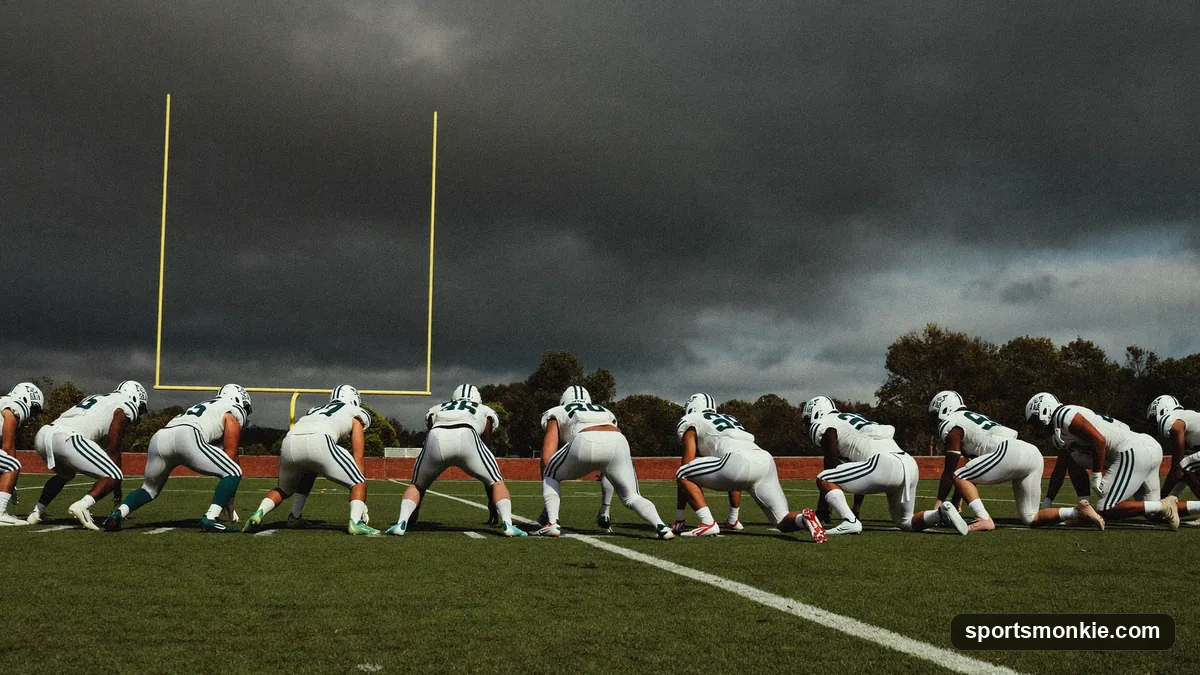
The wildcat formation is a direct-snap offense in which the ball goes straight from center to a non-quarterback, usually a running back, while the true quarterback lines up split out as a receiver. It trades a live passing threat for an extra blocker and a numbers advantage in the run game, and it became a nationwide NFL trend in 2008 when the Miami Dolphins used it to upset the unbeaten New England Patriots.
How the Wildcat Formation Lines Up
The wildcat starts from a shotgun-style shape, but with a twist: the player receiving the snap is not the quarterback. A running back, and occasionally a receiver or a backup quarterback used as a runner, sets up four to five yards behind center in the spot the quarterback would normally occupy. The actual quarterback is removed from the play entirely, split out wide as a receiver so the defense has to account for him downfield even though he almost never gets the ball.
A second skill player, often a wide receiver or a second running back, goes in motion across the formation just before the snap. That man-in-motion is the key detail: he sprints laterally as the ball is snapped, giving the “wildcat quarterback” the option to hand off on a jet sweep, keep the ball himself, or, in some packages, throw off a play-action fake. The offensive line is frequently unbalanced, with an extra lineman shifted to one side to overload the point of attack.
Because none of this looks like a standard shotgun snap to a passer, the defense has to diagnose the play late, which is exactly the point. For a side-by-side comparison of the wildcat with the sets it borrows from and replaces, see our breakdown of NFL formations and coverages explained.
Wildcat Formation at a Glance
| Element | Wildcat Formation | Standard Shotgun/Pro Set |
|---|---|---|
| Who takes the snap | A running back (occasionally WR/backup QB) | The starting quarterback |
| Where the real QB lines up | Split out wide as a decoy receiver | Under center or in shotgun |
| Primary threat | Inside/outside run, with a rare pass | Balanced run-pass, real passing threat |
| Blocking numbers | 11-on-11 (QB isn’t “wasted” as a passer) | Effectively 10-on-11 in protection |
| Best used | Short yardage, goal line, change-of-pace | Every down, full-game offense |
| Biggest weakness | Passing game is limited and predictable | Requires a competent starting QB |
The Strengths of the Wildcat
The formation’s central advantage is blocking math. In a normal offense, the quarterback stands in the backfield to throw or hand off, which means he isn’t physically blocking anyone. In the wildcat, the quarterback is removed from the backfield and used as a decoy receiver, so every other eligible player on the field, including him as a route-runner drawing coverage away, is working to spring the runner. That gives the offense a full 11-on-11 look in the run game instead of the 10-on-11 disadvantage a normal running play faces.
The man-in-motion adds a second layer of deception. Defenses have to respect an immediate jet-sweep threat to the perimeter, which can pull defenders out of the box before the ball-carrier ever decides whether to keep it, hand it off, or, on rare occasions, pull up and throw. Against a defense seeing it for the first time, that hesitation is worth several extra yards a play, which is exactly what happened to Miami’s 2008 opponents before film study caught up with the trend.
The Weaknesses of the Wildcat
The tradeoff is obvious: the wildcat mostly takes the pass away. A running back under center is not a threat to throw the way a real quarterback is, so once a defense recognizes the personnel and the split-out quarterback, it can load the box, sell out on run support, and dare the offense to try a low-percentage pass. Defensive coordinators quickly build a specific “wildcat card” of run-blitzes and edge-contain rules once they see the tendency on tape.
The formation is also telegraphed by its own personnel. Substituting in a running back at the snap position, motioning a receiver across, and pulling the quarterback out wide are all visual cues a disciplined defense can key on before the ball is even snapped. New England’s own defense proved this later in that 2008 season, holding Miami’s wildcat to a fraction of its early-season production once they adjusted. That is the core reason most teams treat the wildcat as a situational wrinkle rather than a base package. For a look at the sets built specifically around real passing concepts by comparison, see our explainer on the shotgun formation.
The 2008 Miami Dolphins Revival
The wildcat is not a modern invention, it descends from Pop Warner’s single-wing offense of the 1920s and was revived at the high school and college level by coaches like Hugh Wyatt in the late 1990s and Bill Snyder’s Kansas State program in the years that followed. But the play that made it a household term in the NFL came on September 21, 2008, when Miami Dolphins offensive coordinator Dan Henning, under head coach Tony Sparano, unveiled it against the previously unbeaten New England Patriots.
Running backs Ronnie Brown and Ricky Williams ran the wildcat package six times that afternoon and produced five touchdowns, four rushing and one passing off a Brown pass, in a 38-13 upset. The formation spread across the NFL within weeks as other coaching staffs installed their own versions, and college programs like Arkansas, which had already been running a similar look with Darren McFadden and Felix Jones under the nickname “wild hog,” saw renewed national attention for it too.
Why the Wildcat Faded, and Where It Survives Today
By the back half of that same 2008 season, defenses had adjusted. New England itself held Miami’s wildcat to a fraction of its early-season output once opposing coordinators built specific run-fits and contain rules for it. As NFL rosters kept trending toward mobile, dual-threat starting quarterbacks who don’t need to be replaced by a running back to create a run-pass threat, the wildcat’s usefulness as an every-down offense shrank fast.
It hasn’t disappeared, though. Most NFL teams still keep a direct-snap package in the bag for short-yardage and goal-line situations, and it remains a common change-up in college and high school football, where teams often have a dual-threat back or receiver but not necessarily a passer capable of running a full-time spread attack. It’s also a useful contrast point when studying how run-heavy formations differ from pro-style sets like the I-formation, which relies on a true fullback and tailback rather than a decoy quarterback. For the bigger picture of how all these run and pass concepts fit into an NFL playbook, see our American football and NFL hub.
Bottom Line
The wildcat formation earns its keep by turning the quarterback into a decoy and giving the run game an extra blocker, which is a genuine schematic edge for a play or two. But that same design strips out a real passing threat, and once a defense has seen it on film, the surprise, which is most of the formation’s value, evaporates. That’s why it lives on today less as a full-time offense and more as a situational trick play: a callback to single-wing football that still shows up on third-and-short more than 15 years after Miami turned it into a national talking point.
Frequently asked questions
What is the wildcat formation in football?+
The wildcat formation is an offensive scheme in which the center snaps the ball directly to a player who normally isn't the quarterback, most often a running back, while the actual quarterback lines up split out wide as a receiver. The ball-carrier at the snap can run, hand off on a jet sweep, or throw, which forces the defense to respect multiple options before the play even develops.
Who invented the wildcat formation?+
The wildcat traces back to single-wing football from the 1920s popularized by coaches like Pop Warner. The modern version is credited to high school coaches Hugh Wyatt and Timothy Skipper in the late 1990s, and it was refined at the college level by Kansas State under Bill Snyder and later spread through programs like Arkansas and Florida.
Why did the Miami Dolphins run the wildcat in 2008?+
Offensive coordinator Dan Henning installed the wildcat under head coach Tony Sparano to squeeze more production out of running backs Ronnie Brown and Ricky Williams. On September 21, 2008, the Dolphins unveiled it against the previously unbeaten New England Patriots, running the package six times for five touchdowns in a 38-13 upset that made the formation an NFL trend almost overnight.
What is the main advantage of the wildcat formation?+
The wildcat's biggest edge is the extra blocker. Because the quarterback is split out as a receiver instead of standing under center or in the backfield, the offense effectively blocks for the runner with every eligible player who would otherwise be needed to protect a traditional passer, creating an 11-on-11 blocking situation for the defense to handle.
What is the biggest weakness of the wildcat formation?+
The wildcat's weakness is the passing game. With a running back or receiver at the controls instead of a trained passer, defenses can load the box, sell out against the run, and dare the offense to throw. Once opponents scout the formation's tendencies, the play calls become predictable and easier to shut down.
Is the wildcat formation still used in the NFL?+
Yes, but sparingly. Most NFL teams now use wildcat-style direct snaps as a situational wrinkle, typically in short-yardage or goal-line packages, rather than as a core offense. College and high school programs, where dual-threat backs and receivers are more common, still lean on it more heavily.
How is the wildcat different from the shotgun formation?+
In the shotgun formation, the quarterback still takes the direct snap from a few yards back, keeping the passing game fully live. In the wildcat, the ball goes to a non-quarterback instead, and the real quarterback is removed from the backfield entirely, which trades passing threat for a heavier, more deceptive running attack.
Which running backs are most associated with the wildcat formation?+
Ronnie Brown and Ricky Williams of the 2008 Miami Dolphins are the players most credited with popularizing the wildcat in the NFL. Arkansas' Darren McFadden and Felix Jones ran a college version of it under the name 'wild hog' in the mid-2000s, and it later showed up in Carolina, Philadelphia, and other NFL playbooks in various forms.
Sources
Play & tools
Free browser games and tools — no account, no download.
- Play 17-0 — Draft nine and chase a flawless NFL regular season — the perfect 17-0 run, no playoffs.
- Play 20-0 — Draft nine and chase a perfect NFL season — regular season and playoffs, undefeated.
- Play 16-0 — Draft nine and chase a perfect 16-0 — the classic 16-game NFL regular season, no playoffs.
- Play Flawless Six — Draft five players and a head coach, then chase a perfect NFL season with the right chemistry.
- Play Guess the NFL Player — A new mystery NFL player every day. Eight guesses, with a clue on each — plus free unlimited mode.
- Play NFL Wordle — A Wordle for football — guess the daily NFL player in eight tries, with green-amber-grey feedback on every clue.
- Play NFL Connections — Sort sixteen football tiles into four hidden groups of four. A new daily puzzle, four mistakes allowed, plus unlimited mode.
- Explore all our games →
- Open the schedule simulator — Pick every 2026 NFL game and watch the standings and playoff seeds update live.
- Open the squares generator — Generate a randomized, printable Super Bowl squares grid for your party — free, no sign-up.
- Open the trade calculator — Weigh any fantasy football trade instantly — clear winner and value gap.
- Run the NFL predictor — Simulate the NFL bracket and see who your picks send to the Super Bowl.
- Open the passer rating calculator — Calculate the official NFL passer rating (0–158.3) from any passing line, with the formula shown.
- Explore all our free sports tools →
Related nfl guides
View all →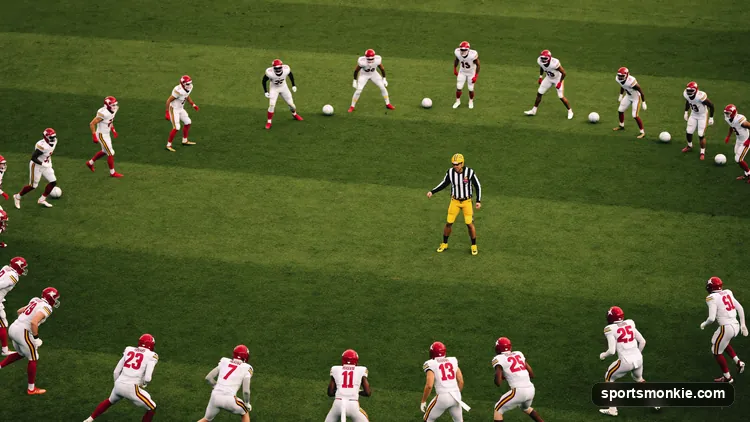
Shotgun Formation in Football: How It Works, Why Teams Use It
The shotgun formation lines the QB 5-7 yards back for a snapped pass. Learn its alignment, personnel, strengths, weaknesses, and history.
Singleback Formation in Football: How the Ace Set Works
The singleback formation lines up one running back behind a QB under center, no fullback, for balanced run-pass disguise. Full breakdown here.
Spread Offense in Football: Definition, Principles & History
The spread offense spreads receivers wide from shotgun to stretch defenses horizontally. Learn its principles, strengths, weaknesses, and NFL history.
3-4-3 Formation Explained: Roles, Strengths & Weaknesses
The 3-4-3 formation explained: how the back three, midfield four, and front three line up, plus its strengths, weaknesses, and top managers.
4-3-3 Formation Explained: Roles, Strengths & Weaknesses
The 4-3-3 formation explained: back four, midfield three, front three roles, why it works, its weaknesses, and the managers who made it famous.
What Is a False Nine in Football?
A false nine starts as a central striker but drops into midfield, pulling defenders out and opening lanes for teammates.