
Shotgun Formation in Football: How It Works, Why Teams Use It
On this page8
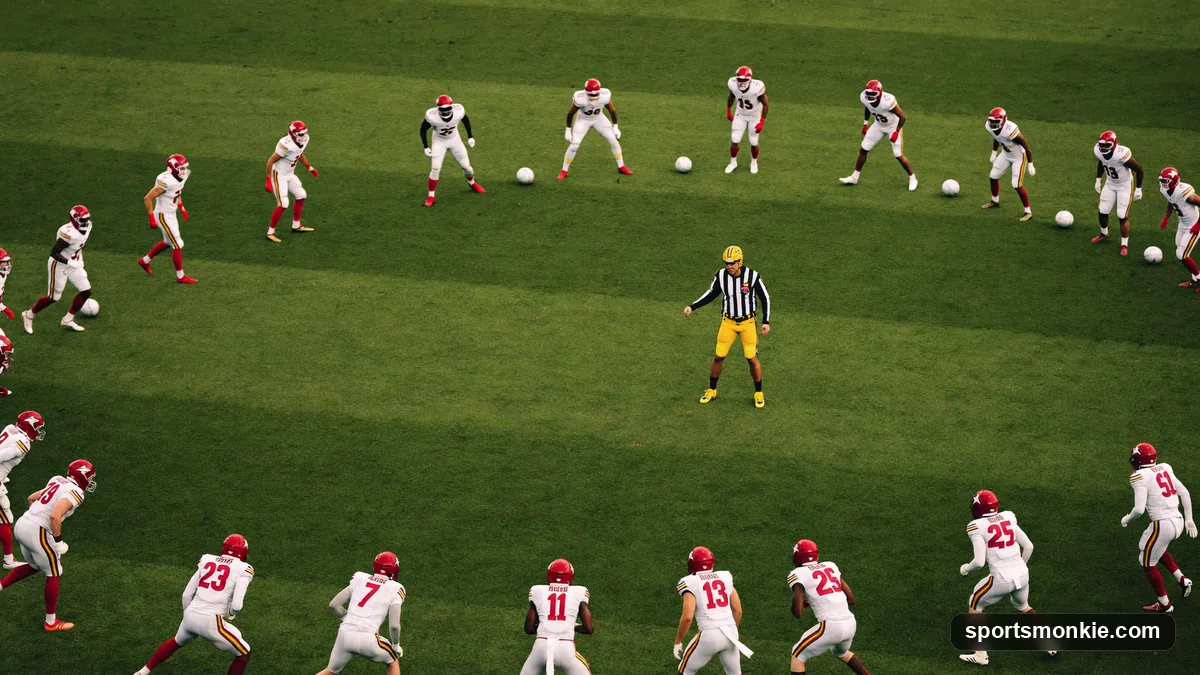
The shotgun formation is an offensive alignment in which the quarterback lines up roughly 5 to 7 yards behind the center and takes the snap through the air rather than directly under him, giving him an immediate look at the defense and a head start on his drop. It is the most common pre-snap alignment in modern American football / NFL, used on the majority of passing downs and, increasingly, as a full-time base formation.
What the Shotgun Formation Looks Like
Picture a standard offensive set, but instead of the quarterback crouched with his hands under the center’s rear end, he’s standing upright several yards deep in the backfield. The center snaps the ball backward and through the air, and the quarterback catches it in stride, already facing forward with both hands free.
Everything else around him can vary. A single running back might set up just to his left or right, offset a step or two off the line. Some snaps go empty, with the quarterback the only player in the backfield and everyone else split out as receivers. Two-back shotgun sets, popular in short-yardage and play-action packages, put a lead blocker or second ball-carrier next to the QB as well. The formation is less about a fixed skill-position map, laid out in NFL formations and coverages explained, and more about where the quarterback stands relative to the line.
Why Teams Line Up in Shotgun
The core appeal is time and vision. A quarterback under center has to catch the snap, turn, and drop three, five, or seven steps before he’s ready to throw. From shotgun, he skips that footwork entirely — the ball arrives with him already squared to the defense, which shaves a critical fraction of a second off the process and lets him get the ball out before a rush closes in.
That extra half-second matters more than it sounds. It gives quarterbacks more time to read coverage, identify blitzes, and go through progressions, and it’s part of why shotgun became the default answer to modern pass rushes covered in what is a blitz in football. The alignment also naturally spreads protection: with no need to retreat, offensive linemen can set a shallower, tighter pocket instead of one stretched out by a long quarterback drop.
Shotgun also suits mobile, dual-threat quarterbacks. Standing in the backfield already, a QB in shotgun can pull the ball on a zone-read keeper, scramble through a lane, or improvise outside the pocket far more easily than one starting from directly behind the center.
Personnel and Alignment Variations
| Element | Typical Shotgun Setup | Notes |
|---|---|---|
| QB depth | 5-7 yards behind center | Deeper than pistol (~4 yards) |
| Snap type | Long, airborne snap from center | Requires timing and accuracy |
| Running back | Offset beside QB, or absent (empty) | Angle changes run-blocking scheme |
| Line splits | Often wider to spread the rush | Aids passing lanes, thins run gaps |
| Common down/distance | 2nd/3rd-and-long historically; now base offense for many teams | Signals pass less than it once did |
Because the running back sets up beside the quarterback rather than directly behind him, shotgun run plays typically use zone-blocking schemes — inside zone, outside zone, or read-option looks — rather than the north-south dive plays associated with older formations like the I-formation in football, where the back gets a full head of steam before touching the ball.
Strengths of the Shotgun
- Faster release: no drop-back footwork means quicker throws, which helps against pressure.
- Better pre-snap and post-snap vision: the QB sees the entire defensive front from the moment he lines up, making it easier to diagnose coverage and blitzes.
- Cleaner pocket: linemen block a shorter, more compact area instead of a deep drop-back pocket.
- Built-in run/pass versatility: the same alignment threatens zone-read runs, quick game, and vertical shots without tipping intent as clearly as it once did.
- Friendlier to mobile quarterbacks: scrambles and designed QB runs are easier to execute starting from depth.
Weaknesses of the Shotgun
- Weaker downhill run threat: a running back taking a handoff beside the QB loses the momentum and angle a traditional under-center dive provides, making short-yardage and goal-line power runs harder to execute.
- Snap risk: the longer, airborne exchange between center and quarterback is more prone to a bad snap than a direct under-center handoff, particularly in wet or windy conditions.
- Historically signaled pass: for decades, shotgun alignment all but announced a passing play, letting defenses pin their ears back. Modern offenses have blurred this by running far more often out of shotgun, but the tendency lingers in some playbooks.
- Less deception at the goal line: with the QB standing back and away from the line, disguising quick-hitting run concepts near the end zone is tougher than from under center.
History and Evolution of the Shotgun
The shotgun formation traces to 1960, when San Francisco 49ers head coach Red Hickey introduced it to try to slow down opposing pass rushes, running it with quarterbacks John Brodie and Y.A. Tittle. It faded from regular use for a stretch before the Dallas Cowboys, led by Roger Staubach under head coach Tom Landry, revived it as a full-time weapon through the 1970s, cementing its place as a legitimate NFL formation rather than a gadget look.
Through the 1980s and 1990s, shotgun remained mostly a passing-down and two-minute-drill tool. That began shifting in the 2000s and 2010s as college spread concepts, zone-read running, and dual-threat quarterbacks pushed shotgun into every-down use. New England under Tom Brady, and later a wave of offenses built around mobile passers, helped normalize shotgun as a base formation rather than an obvious pass tell. Today, many NFL teams snap from shotgun or its close cousin, the pistol formation in football, on the majority of their offensive snaps — a total reversal from the exclusively under-center game that defined the sport’s first several decades.
Shotgun vs. Under Center vs. Pistol
The three main quarterback alignments trade off differently. Under center keeps the QB tight to the line for the best run-blocking angles and play-action disguise, but costs time on drop-backs. Shotgun trades that downhill run power for vision and quicker passing. The pistol formation splits the difference, standing the quarterback about 4 yards back — closer than shotgun — with the running back aligned directly behind him, which restores a truer downhill handoff angle while still giving the QB a forward-facing pre-snap view. Coaches choose among the three, and often mix all three in a single game plan, based on down, distance, personnel, and how mobile their quarterback is.
Bottom Line
The shotgun formation earned its place as the NFL’s most-used alignment by solving a simple problem: it buys the quarterback time and sight lines that under-center football can’t match. That trade comes at the cost of some run-game punch and a slightly riskier snap, which is why teams still lean on other looks in short-yardage and goal-line situations. But for an era defined by faster pass rushes and more mobile quarterbacks, shotgun’s advantages have outweighed its drawbacks for the majority of offensive snaps league-wide.
Frequently asked questions
What is the shotgun formation in football?+
The shotgun formation is an offensive setup where the quarterback lines up about 5-7 yards behind the center instead of directly under him. The center snaps the ball through the air to the QB, who is already positioned to survey the defense, hand off, or throw without first dropping back.
Why is it called the shotgun formation?+
The name comes from the spread of the ball leaving the center's hands like pellets scattering from a shotgun barrel toward the quarterback standing several yards downfield, a visual the term has carried since the formation's earliest coverage in the 1960s.
Who invented the shotgun formation?+
49ers head coach Red Hickey is credited with introducing the shotgun to the NFL in 1960, using quarterbacks John Brodie and Y.A. Tittle to run it. The Dallas Cowboys under Roger Staubach later popularized it as a full-time weapon through the 1970s.
How far back does the QB stand in shotgun?+
Most NFL quarterbacks set up 5 to 7 yards behind the line of scrimmage in shotgun, deep enough to see the whole defensive front and have a beat of extra time before the rush arrives, but close enough to still hand the ball off on run plays.
What is the difference between shotgun and pistol formation?+
In shotgun, the quarterback stands 5-7 yards back with any running back typically offset to his side. In the pistol formation, the QB is only about 4 yards back with the running back aligned directly behind him, which restores a more traditional downhill running angle. Read more in our pistol formation guide.
What are the main weaknesses of the shotgun formation?+
Shotgun signals pass on early downs, letting defenses tee off with blitzes, and it strips away the downhill momentum a running back gets from an under-center handoff. It also adds a longer, more difficult snap that raises the risk of a fumbled exchange, especially in bad weather.
Do teams run the ball out of shotgun?+
Yes. Nearly every modern NFL offense runs zone-read, inside zone, and outside zone plays from shotgun, and some teams use it as their base formation for run and pass alike. It just changes the running back's launch angle instead of eliminating the run game.
How often does the NFL use shotgun today?+
Shotgun has become the default alignment for most NFL offenses, with many teams snapping from shotgun or its pistol variant on the large majority of their offensive plays, a sharp shift from the exclusively under-center game of the 1970s and 1980s.
Sources
Play & tools
Free browser games and tools — no account, no download.
- Play 17-0 — Draft nine and chase a flawless NFL regular season — the perfect 17-0 run, no playoffs.
- Play 20-0 — Draft nine and chase a perfect NFL season — regular season and playoffs, undefeated.
- Play 16-0 — Draft nine and chase a perfect 16-0 — the classic 16-game NFL regular season, no playoffs.
- Play Flawless Six — Draft five players and a head coach, then chase a perfect NFL season with the right chemistry.
- Play Guess the NFL Player — A new mystery NFL player every day. Eight guesses, with a clue on each — plus free unlimited mode.
- Play NFL Wordle — A Wordle for football — guess the daily NFL player in eight tries, with green-amber-grey feedback on every clue.
- Play NFL Connections — Sort sixteen football tiles into four hidden groups of four. A new daily puzzle, four mistakes allowed, plus unlimited mode.
- Explore all our games →
- Open the schedule simulator — Pick every 2026 NFL game and watch the standings and playoff seeds update live.
- Open the squares generator — Generate a randomized, printable Super Bowl squares grid for your party — free, no sign-up.
- Open the trade calculator — Weigh any fantasy football trade instantly — clear winner and value gap.
- Run the NFL predictor — Simulate the NFL bracket and see who your picks send to the Super Bowl.
- Open the passer rating calculator — Calculate the official NFL passer rating (0–158.3) from any passing line, with the formula shown.
- Explore all our free sports tools →
Related nfl guides
View all →
Singleback Formation in Football: How the Ace Set Works
The singleback formation lines up one running back behind a QB under center, no fullback, for balanced run-pass disguise. Full breakdown here.
Wildcat Formation in Football: What It Is and How It Works
The wildcat formation snaps the ball to a non-QB, usually a running back, while the QB splits out wide. Learn its rules, strengths, weaknesses, and history.
Pistol Formation in Football: What It Is and Why NFL Teams Use It
The pistol formation lines the QB ~4 yards behind center with the RB directly behind him, blending shotgun passing with a hidden run threat.
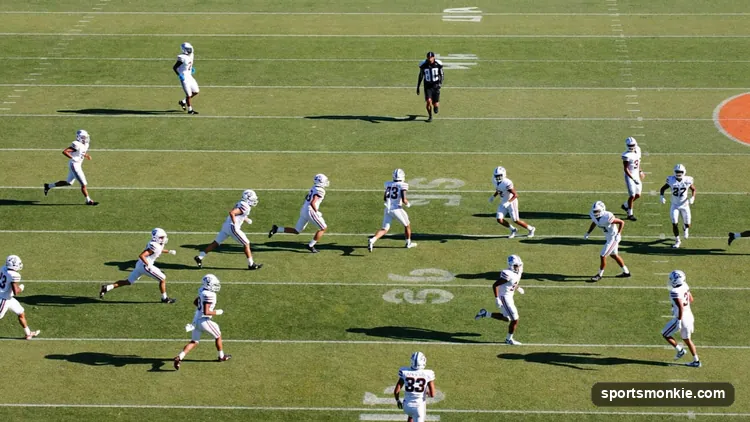
Spread Offense in Football: Definition, Principles & History
The spread offense spreads receivers wide from shotgun to stretch defenses horizontally. Learn its principles, strengths, weaknesses, and NFL history.
3-4-3 Formation Explained: Roles, Strengths & Weaknesses
The 3-4-3 formation explained: how the back three, midfield four, and front three line up, plus its strengths, weaknesses, and top managers.
4-3-3 Formation Explained: Roles, Strengths & Weaknesses
The 4-3-3 formation explained: back four, midfield three, front three roles, why it works, its weaknesses, and the managers who made it famous.