
4-3-3 Formation Explained: Roles, Strengths & Weaknesses
On this page7
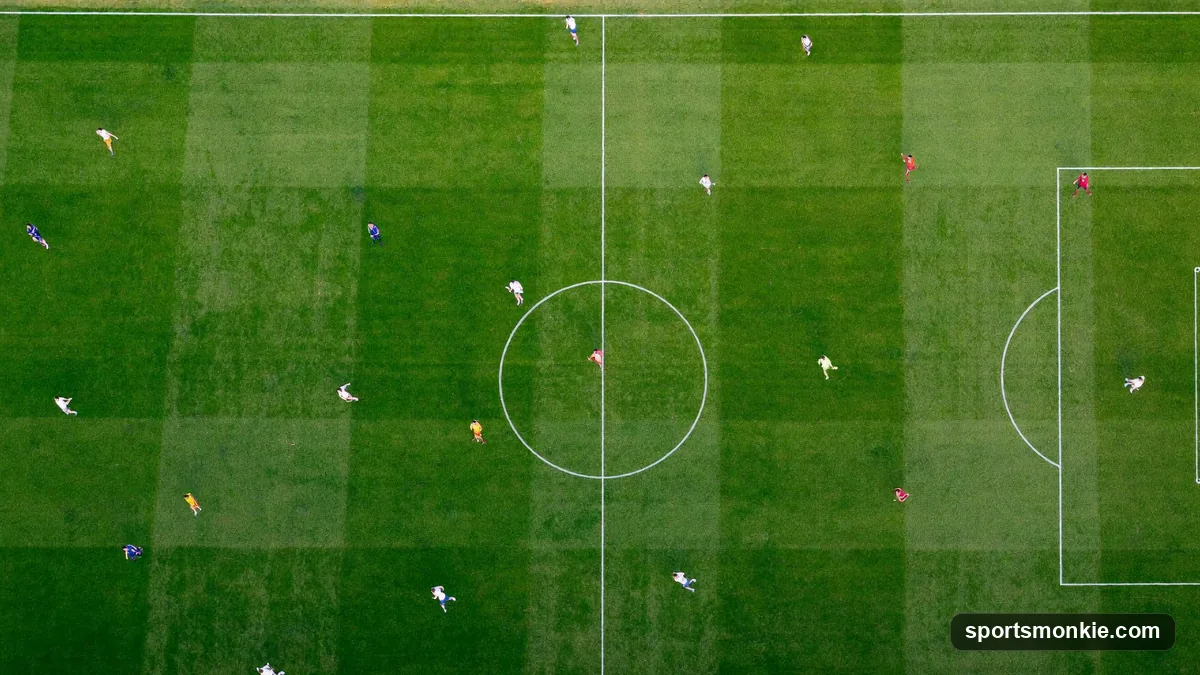
The 4-3-3 formation lines up four defenders, three midfielders, and three forwards ahead of the goalkeeper, built around a single holding midfielder, two shuttling central midfielders, and wingers who stay high and wide to stretch the opposition. It is one of the most widely used shapes in modern football because it balances defensive numbers with attacking width, and it remains the base system behind some of the sport’s most celebrated possession and pressing teams. For a broader look at how it stacks up against other systems, see our guide to soccer formations explained.
How the 4-3-3 lines up
Picture the eleven outfield players split into three clean bands in front of the goalkeeper.
- Back four: Two center backs sit centrally, defending the box and starting attacks with passes into midfield. Two full backs occupy the wide defensive channels, tucking in when the ball is on the far side and pushing high up the touchline to support attacks when the wingers cut infield.
- Midfield three: One defensive midfielder (the “6”) sits just in front of the back four, screening passing lanes and recycling possession. Two central midfielders (the “8s”) play slightly higher and wider than the 6, covering ground box to box, joining attacks, and tracking back to help defend.
- Front three: Two wingers hug the touchlines high up the pitch, aiming to isolate opposing full backs, before either crossing early or cutting inside onto their stronger foot. A single central striker leads the line, holding up play, making runs in behind, and finishing chances created by the wide players.
In defense the front three often becomes the first line of pressure, with the striker cutting off the passing lane to the opposition’s defensive midfielder while the wingers press the full backs.
Roles and responsibilities by position
| Position | Core job | What it demands |
|---|---|---|
| Center backs (2) | Defend centrally, start attacks | Composure on the ball, aerial strength |
| Full backs (2) | Defend wide, overlap in attack | Stamina, crossing, recovery pace |
| Defensive midfielder (1) | Screen the back four, dictate tempo | Positioning, passing range, discipline |
| Central midfielders (2) | Link defense to attack, box-to-box running | Work rate, dribbling, late runs into the box |
| Wingers (2) | Provide width, beat defenders 1v1 | Pace, dribbling, end product |
| Striker (1) | Score, hold up play, lead the press | Finishing, movement, physicality |
Single pivot vs double pivot
The traditional 4-3-3 runs on a single pivot: one defensive midfielder covers the space in front of the back four while both number 8s push forward to support attacks. This gives the formation an extra attacking body but can leave the lone pivot isolated if both 8s advance at once, opening the central channel for a counter-attack.
Many modern coaches soften that risk with a double pivot variant, dropping one of the number 8s alongside the 6 to form a flatter two-man screen. This trades a little attacking thrust for defensive stability and, in possession, often morphs the shape into something closer to a 4-2-3-1, with one advanced central midfielder effectively playing as a number 10 behind the striker.
Strengths of the 4-3-3
- Genuine width without sacrificing central numbers. Wingers stretch the pitch horizontally while the midfield three still outnumbers a flat two-man midfield, so the team keeps control centrally and attacks wide simultaneously.
- Strong pressing triggers. The front three and advanced 8s can box in opposition defenders, using the touchline as an extra defender and forcing turnovers high up the pitch.
- Passing triangles everywhere. Full back, winger, and central midfielder form a natural triangle on each flank, making it easier to work the ball through pressure and combine in tight areas.
- Flexible defensive shape. Out of possession the front three can drop into a line to form a 4-5-1, giving the team a compact defensive block without changing personnel.
- Rewards technical, possession-based play. Because it creates so many short passing options, the 4-3-3 suits teams built to dominate the ball rather than sit deep and counter.
Weaknesses of the 4-3-3
- Vulnerable central midfield. Three midfielders against a rival’s midfield four can be outnumbered, and if the pivot is bypassed the back four is exposed to direct passes into space.
- Full back exposure. When both full backs push forward to support wide attacks, the space behind them becomes a highway for opposition counters, especially if a winger doesn’t track back.
- Heavy reliance on winger quality. The formation lives or dies on having wingers capable of beating a defender one-on-one; without that, the front three becomes narrow and predictable.
- Isolated pivot risk. With a single holding midfielder, one well-timed opposition run through the middle can force the back four into uncomfortable one-on-one duels.
- Tough against deep, packed defenses. Against a team sitting in a low block, the lack of a dedicated number 10 can make it harder to unlock the final third compared with systems built around a playmaker.
Famous exponents of the 4-3-3
The 4-3-3’s modern roots trace back to Rinus Michels’ Ajax and the Netherlands national team of the 1970s, where Johan Cruyff’s Total Football used the shape’s width and interchangeable roles to devastating effect. Pep Guardiola’s Barcelona later refined it into a possession machine, with Sergio Busquets as the lone pivot and Xavi, Andres Iniesta, and Lionel Messi rotating through midfield and attack. Jurgen Klopp’s Liverpool ran a more direct, high-pressing 4-3-3 built around Roberto Firmino as a false nine flanked by Mohamed Salah and Sadio Mane, using the front three’s pressing to trigger quick transitions. Unlike the 4-4-2, which keeps two strikers central at the cost of midfield numbers, the 4-3-3 has long been the preferred base for teams that want to control matches through midfield superiority and wide attacking threat. To see how it fits into a club’s broader tactical identity, browse more soccer tactical systems explained or catch up on the latest from football and soccer coverage.
Final word
The 4-3-3 remains a cornerstone formation because it solves two problems at once: it provides midfield control through its three-man engine room and attacking width through committed wingers. Its risks — an isolated pivot, exposed full backs, and dependence on winger quality — are well known, which is exactly why so many coaches build a defensive game plan specifically to exploit them.
Frequently asked questions
What is the 4-3-3 formation?+
The 4-3-3 is a football formation that uses four defenders, three midfielders, and three forwards in front of the goalkeeper. It splits into a back four (two center backs, two full backs), a midfield three built around a defensive pivot, and a front three of two wingers plus a central striker.
What is the weakness of the 4-3-3 formation?+
The biggest weakness is the space that opens beside the lone defensive midfielder and behind advancing full backs. Because the midfield three is often outnumbered by a rival's midfield four, the 4-3-3 is vulnerable to fast transitions and counter-attacks if the ball is lost in midfield or wingers fail to track back.
Does the 4-3-3 use a single or double pivot?+
Classically the 4-3-3 uses a single pivot: one holding midfielder (the number 6) screens the back four while two more advanced central midfielders (the number 8s) shuttle box to box. Some modern variants drop one number 8 deeper to form a double pivot for extra defensive cover, effectively shifting toward a 4-2-3-1 shape in possession.
What positions make up a 4-3-3?+
A 4-3-3 fields a goalkeeper, two center backs, two full backs, a defensive midfielder, two central midfielders, two wingers, and a center forward. Full backs push high to provide width when the wingers cut inside, while the wide forwards stay high and wide to stretch the opposition defense.
Which teams and managers are famous for the 4-3-3?+
Ajax and the Netherlands popularized the 4-3-3 through Total Football in the 1970s under Rinus Michels and Johan Cruyff. Pep Guardiola's Barcelona used it to dominate possession with Xavi, Iniesta, and Messi, and Jurgen Klopp's Liverpool ran a high-pressing 4-3-3 built around Firmino, Salah, and Mane.
Is the 4-3-3 a good formation for attacking football?+
Yes. The 4-3-3 is one of the most attack-minded base shapes in football because it commits two wide forwards and a central striker permanently high up the pitch, supported by advancing full backs and box-to-box midfielders, which is why possession-heavy, pressing teams favor it.
How does the 4-3-3 compare to the 4-4-2?+
The 4-3-3 trades a second striker for a third midfielder and pushes two wide players higher up as true wingers rather than midfielders, giving it more central control but a lower goal-scoring presence than a [4-4-2](/4-4-2-formation-explained/), which keeps two strikers central but has less midfield numbers.
What players suit the 4-3-3 formation best?+
The 4-3-3 needs mobile, disciplined central midfielders, a defensive midfielder comfortable receiving under pressure, quick and technical wingers who can beat a full back one-on-one, and center backs happy defending in open space left by advancing full backs.
Sources
Play & tools
Free browser games and tools — no account, no download.
- Play 38-0 — Sign a 4-4-2 of all-time football legends and chase a perfect 38-0 league season — perfect, not just unbeaten.
- Explore all our games →
Related football guides
View all →
3-4-3 Formation Explained: Roles, Strengths & Weaknesses
The 3-4-3 formation explained: how the back three, midfield four, and front three line up, plus its strengths, weaknesses, and top managers.
3-5-2 Formation Explained: Roles, Strengths and Weaknesses
The 3-5-2 formation uses three center-backs, two attacking wing-backs, a midfield three and two strikers for a compact, wide-covering shape.
4-4-2 Formation Explained: Roles, Strengths and Weaknesses
The 4-4-2 formation lines up two banks of four plus two strikers. Learn the roles, strengths, weaknesses, and famous teams who made it work.
What Is a False Nine in Football?
A false nine starts as a central striker but drops into midfield, pulling defenders out and opening lanes for teammates.
4-1-4-1 Formation Explained: Structure, Roles, Strengths & Weaknesses
The 4-1-4-1 formation explained: a lone holding midfielder screens the back four behind a midfield band of four and one striker. Roles, pros, cons.
4-2-3-1 Formation Explained: Roles, Strengths & Weaknesses
The 4-2-3-1 formation explained: double pivot, attacking-midfield trio, lone striker, key strengths, weaknesses, and the managers who made it famous.