
4-1-4-1 Formation Explained: Structure, Roles, Strengths & Weaknesses
On this page7
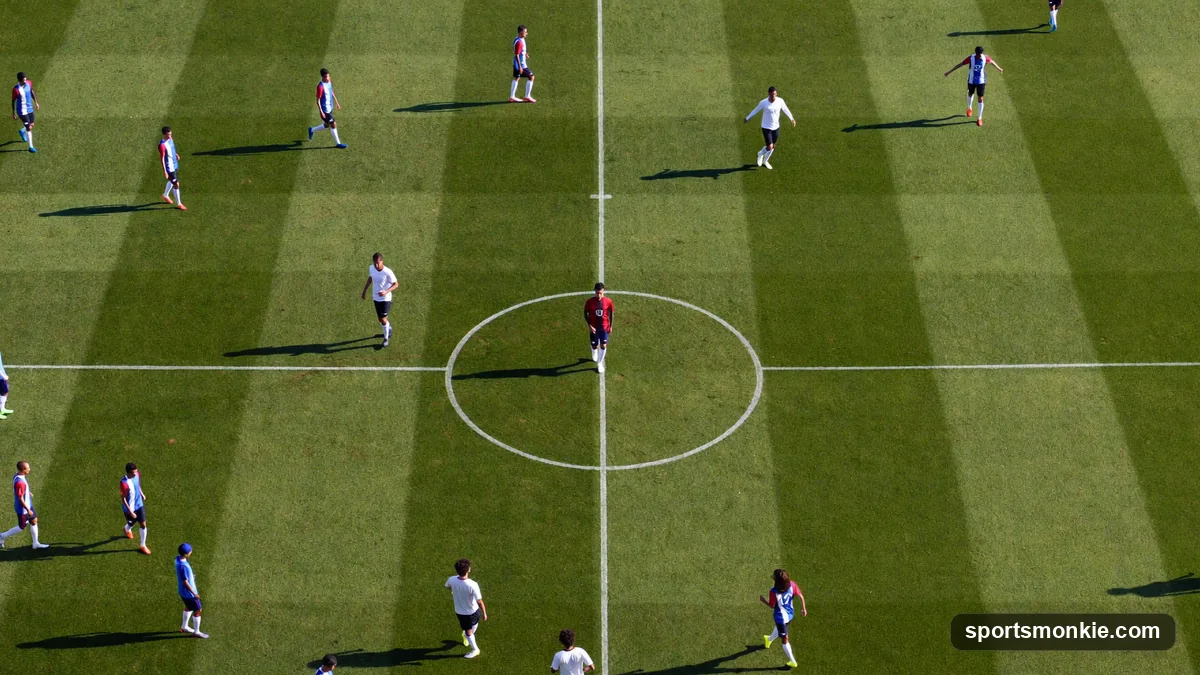
The 4-1-4-1 formation lines up a back four, a single holding midfielder screening that back line, a band of four midfielders ahead of him, and one lone striker at the top of the shape. It is one of football’s most defensively compact systems, prized by coaches who want central control without sacrificing the option to attack with numbers once possession is won. Unlike the flatter 4-2-3-1, which uses two holding midfielders, the 4-1-4-1 asks a single elite pivot to do that defensive screening job alone.
What Is the 4-1-4-1 Formation?
The 4-1-4-1 is a numerical description of how eleven outfield players are arranged from back to front: four defenders, one defensive midfielder, four midfielders, and one striker. The name itself tells the story — the lone “1” between the back four and the midfield four is the entire point of the system. That player, usually called the pivot, the anchor, or the number six, sits just in front of the center-backs and cuts off the central passing lanes that opponents want to use to attack.
Above him, the midfield band of four typically splits into two central midfielders and two wide midfielders (or inverted wingers), who provide both defensive cover on the flanks and the creative link to the striker. It sits within the broader family of soccer tactical systems built around a back four, alongside shapes like the 4-3-3 and 4-2-3-1.
How It Lines Up: Player Positions Explained
Picture the pitch from the goalkeeper forward:
- Back four: two center-backs in the middle, flanked by a right-back and left-back who can push into the space the pivot’s screening creates.
- The pivot (single “1”): one defensive midfielder positioned centrally, just ahead of the two center-backs. His job is to intercept passes into the space between the lines, break up counter-attacks early, and recycle possession to start attacks.
- Midfield four: two central midfielders sit either side of and slightly ahead of the pivot, linking defense to attack, while two wide midfielders operate in the half-spaces and touchline areas, tucking in more than a traditional winger would.
- Lone striker (final “1”): one central forward at the tip of the formation, responsible for holding up the ball, pressing the opposition’s first line, and finishing chances created by the midfield four.
This is the same basic personnel used in a 4-3-3 formation, but the wide players sit noticeably deeper here, which is why many teams treat the two shapes as interchangeable depending on the phase of play.
Strengths of the 4-1-4-1
- Defensive screen in front of the back four. The single pivot occupies the exact zone strikers and attacking midfielders love to exploit, making the team much harder to break down through the middle.
- Central numbers. With three central midfielders plus the pivot effectively working the middle of the pitch, teams using the 4-1-4-1 can dominate central possession and control tempo.
- Fluid transitions. Because the shape already contains the personnel for a 4-3-3 or a 4-5-1, teams can shift between those systems in-game without making a substitution — pushing the wide midfielders higher turns it into a 4-3-3 in attack, and dropping them deeper turns it into a 4-5-1 out of possession.
- Freedom for full-backs. With the pivot covering the space in front of the defense, both full-backs can overlap or push forward more aggressively than they could in a flatter back-four system.
Weaknesses of the 4-1-4-1
- An isolated striker. One forward against two or three center-backs is a tough matchup, and the lone striker often has to win the ball in the air, hold off defenders, and wait for late support from midfield runners.
- Single point of failure at the pivot. The entire defensive structure depends on one player. If he is pressed out of the game, dribbled past, or simply having an off night, the space in front of the back four opens up immediately.
- Overload risk. Opponents who commit two or three players to the zone around the pivot can outnumber him and progress the ball centrally before the rest of the midfield four can recover.
- High physical demand. The pivot, the striker, and the wide midfielders all cover significant ground every match, which can be a problem for squads without elite conditioning or strong squad depth.
4-1-4-1 vs 4-3-3 vs 4-5-1
| Formation | Midfield shape | Defensive solidity | Attacking width | Best for |
|---|---|---|---|---|
| 4-1-4-1 | 1 pivot + flat 4 | High | Moderate (wide mids tuck in) | Balanced control, transitioning shapes |
| 4-3-3 | Flatter 3 (or 1 pivot + 2) | Moderate | High (true wingers) | Possession-heavy, attacking teams |
| 4-5-1 | Flat/level 5 | Very high | Low | Protecting a lead, facing stronger opposition |
Teams and Managers Who Use It
The single-pivot idea behind the 4-1-4-1 became mainstream in the mid-2000s, when Jose Mourinho’s Chelsea sides built their defensive identity around a deep-lying screen in front of the back four. The concept has since become a staple of elite coaching: Pep Guardiola has used a lone pivot — first Sergio Busquets at Barcelona, later Rodri at Manchester City — to control games centrally while attacking midfielders like Kevin De Bruyne roam freely ahead of him. Mikel Arteta’s Arsenal has run a similar structure with Declan Rice screening the back four behind Martin Odegaard and the rest of the midfield four. These examples show why the formation remains popular at the highest level of the sport, distinct from the broader family of soccer formations built around a back four.
When to Use the 4-1-4-1
Coaches reach for the 4-1-4-1 when they want defensive security without giving up central control of the game — against stronger opposition, when protecting a lead, or when a squad has one standout defensive midfielder capable of covering the pivot role alone. It rewards teams with a disciplined anchor, box-to-box central midfielders willing to make late runs into the box, and a striker comfortable working in isolation. Coaches building out a full tactics unit within football/soccer coverage often teach the 4-1-4-1 alongside the 4-2-3-1 and 4-3-3 as the three core back-four systems every modern side draws from.
Frequently asked questions
What is the 4-1-4-1 formation?+
The 4-1-4-1 is a football formation built from a back four, a single holding midfielder (the pivot) positioned just in front of the defense, a band of four midfielders (two central, two wide) ahead of him, and one lone striker up top. It is one of the most defensively secure shapes in modern football because the pivot screens the space directly in front of the back line.
What is the difference between 4-1-4-1 and 4-3-3?+
Both use a back four and a single defensive-midfield pivot, but the 4-1-4-1's wide players sit deeper and closer to the midfield band than the wingers in a 4-3-3, who push higher and hug the touchline near the striker. In practice, many teams use the 4-1-4-1 as their defensive base shape and morph into a 4-3-3 once they win possession and advance the ball.
What is the difference between 4-1-4-1 and 4-5-1?+
The 4-5-1 is essentially a flatter, more conservative version of the same personnel: five midfielders in a relatively level line with one holding player dropping only slightly deeper. The 4-1-4-1 deliberately separates that holding player from the other four, creating a visible extra layer between the defense and midfield that gives the shape more defensive structure and more room for the front four to rotate.
Who plays the pivot role in a 4-1-4-1?+
The pivot is a defensive midfielder with strong positional discipline, tackling range, and the composure to receive the ball under pressure and start attacks. Players associated with the role include Sergio Busquets at Barcelona, Rodri at Manchester City, and Declan Rice at Arsenal, all deployed as the deep-lying shield in front of the back four.
Why is the striker isolated in a 4-1-4-1?+
With only one central forward and no natural strike partner, the lone striker often has to work the channels alone, hold up play under multiple defenders, and time late runs from midfielders to have anyone to combine with. Teams counter this by using a mobile, pressing forward and asking the two central midfielders to make forward runs to support the striker.
Is the 4-1-4-1 a defensive or attacking formation?+
It is fundamentally a balanced, defense-first formation, but it is flexible in attack. The single pivot and back four give it strong defensive cover, while the midfield four can push forward, overload the middle, or provide width, letting the shape flex into more attacking structures like the 4-3-3 once the team has the ball.
Which teams have used the 4-1-4-1 formation?+
Jose Mourinho's Chelsea used a defensive-midfield pivot (Claude Makelele) as the foundation of this style of shape, and more recent sides built around a deep pivot include Pep Guardiola's Manchester City with Rodri, and Mikel Arteta's Arsenal with Declan Rice screening the back four.
What are the main weaknesses of the 4-1-4-1?+
The biggest weaknesses are an isolated lone striker who can be outnumbered by two or three center-backs, and heavy reliance on the single pivot: if that player is overloaded, dragged out of position, or has an off day, the space in front of the back four opens up for the opposition to exploit.
Sources
Play & tools
Free browser games and tools — no account, no download.
- Play 38-0 — Sign a 4-4-2 of all-time football legends and chase a perfect 38-0 league season — perfect, not just unbeaten.
- Explore all our games →
Related football guides
View all →
3-5-2 Formation Explained: Roles, Strengths and Weaknesses
The 3-5-2 formation uses three center-backs, two attacking wing-backs, a midfield three and two strikers for a compact, wide-covering shape.
4-2-3-1 Formation Explained: Roles, Strengths & Weaknesses
The 4-2-3-1 formation explained: double pivot, attacking-midfield trio, lone striker, key strengths, weaknesses, and the managers who made it famous.
4-4-2 Formation Explained: Roles, Strengths and Weaknesses
The 4-4-2 formation lines up two banks of four plus two strikers. Learn the roles, strengths, weaknesses, and famous teams who made it work.
4-2-2-2 Formation Explained: The 'Magic Box' Football Tactic
The 4-2-2-2 formation explained: how the 'magic box' double pivot and two number 10s create central overloads, plus its strengths, weaknesses and famous users.
Formation in Soccer Explained: How to Read Every Shape
A formation in soccer is the numeric shorthand for how a team's outfield players line up by line: defenders, midfielders, forwards.
11v11 Soccer Formations: The Full-Sided Guide to Every Shape
11v11 soccer formations explained: how full-sided lineups work, the most common shapes (4-4-2, 4-3-3, 4-2-3-1, 3-5-2, 5-3-2), and how to pick one.