
Spread Offense in Football: Definition, Principles & History
On this page6
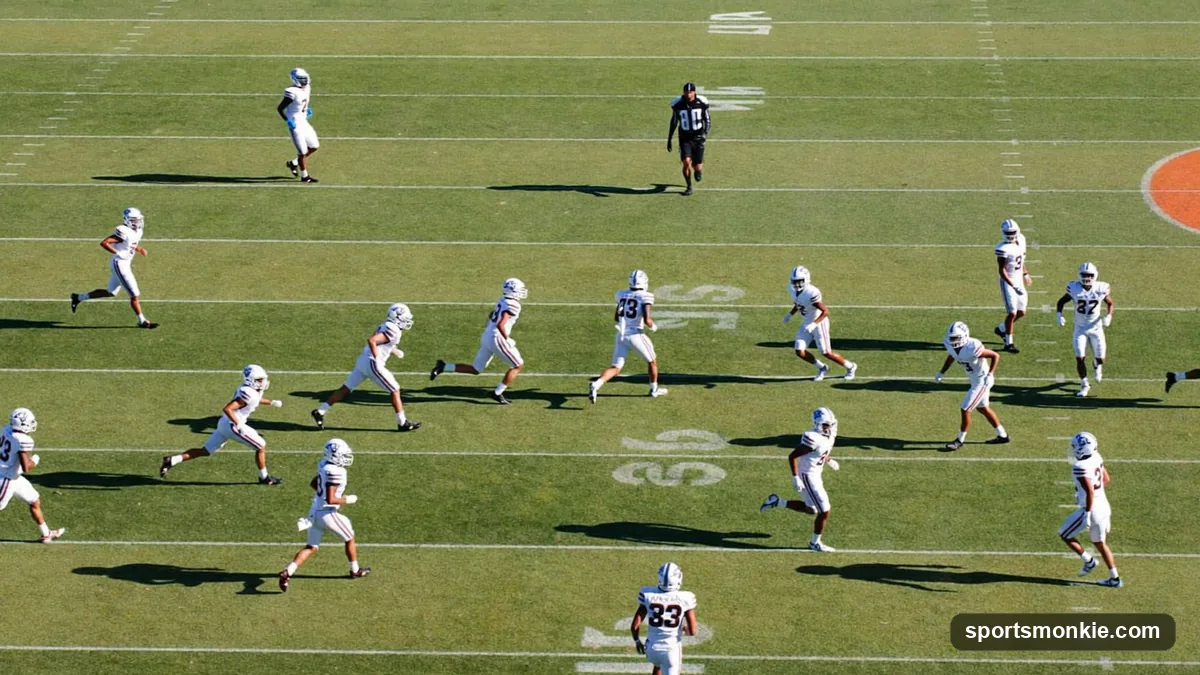
The spread offense is a scheme that lines up three, four, or even five receivers across the width of the field, almost always with the quarterback in shotgun or pistol, to stretch a defense horizontally and create isolated matchups for the run and pass game. Instead of stacking tight ends and running backs near the formation, spread teams pull players out wide, forcing defenders to declare their intentions before the snap and opening driving lanes for both throws and hand-offs. It is now the base offense for most of college football and has reshaped how the American football is called at every level, including the NFL.
What Is the Spread Offense?
At its core, the spread offense is about geometry. By splitting receivers to both sidelines and removing extra blockers from the formation, an offense forces the defense to cover more grass with the same eleven players. That horizontal stretch creates natural voids — inside the numbers, in the seams, and between the tackles — that a quarterback and playcaller can attack based on how the defense reacts before and after the snap.
The scheme almost always starts from the shotgun formation, which gives the quarterback a clean pre-snap view of the defense and extra time to read coverage compared to lining up under center. Some spread teams instead use the pistol formation, which keeps the running back directly behind the quarterback rather than offset, blending shotgun spacing with more traditional downhill running angles.
Core Principles of the Spread
Every spread system, whether pass-heavy or run-heavy, tends to share the same building blocks:
- Horizontal spacing — receivers and the formation itself are spread from numbers to numbers, widening the field defenders must patrol.
- Simple pre- and post-snap reads — the quarterback is coached to identify one or two defenders (often the safety or a “conflict” defender at the line) and let that read dictate the play.
- Tempo — many spread teams operate no-huddle, snapping the ball quickly to prevent defensive substitutions and force base personnel to defend every look.
- Run-pass options (RPOs) — a single play call that lets the quarterback hand off, keep, or throw based on how an unblocked defender reacts after the snap.
- Space over size — spread offenses prioritize athletes who can win in open space over sheer physical mass, since the scheme is designed to get skill players matched up on linebackers or safeties instead of stacked behind blockers.
Because so much of the scheme depends on formation and leverage, understanding spread principles goes hand in hand with understanding NFL formations and coverages — the spread is, in large part, an attempt to manipulate whatever coverage shell a defense shows before the snap.
How the Spread Offense Works
Not every spread offense looks the same. Programs and NFL playcallers borrow from a few well-established branches, each with a different balance of run and pass.
| Spread Variation | Primary Alignment | Emphasis | Associated Coaches/Teams |
|---|---|---|---|
| Air Raid | Shotgun, 4-5 receivers | Pass-first, quick and intermediate throws | Hal Mumme, Mike Leach, Kentucky/Texas Tech |
| Spread option (zone read) | Shotgun, 1 back + receivers | Run-first, dual-threat quarterback | Rich Rodriguez, Urban Meyer |
| Pistol spread | Pistol, back aligned behind QB | Balanced run/pass with downhill angles | Chris Ault, Nevada; adopted league-wide |
| Modern NFL spread/RPO hybrid | Shotgun/pistol, 11 or 10 personnel | Blend of RPOs, play-action, and pro protections | Kansas City Chiefs, Cincinnati Bengals |
In practice, a spread play develops in stages: the formation spreads the defense pre-snap, the quarterback identifies a conflict defender, and the offense either exploits a numbers advantage in the run game or takes the matchup the defense gives up in the passing game. That single-read simplicity is what made the spread so easy to install at every level, from high school programs up through the pros.
Strengths of the Spread Offense
The spread’s biggest advantage is that it isolates defenders in space and hands the offense a numbers advantage almost anywhere on the field. Spreading the formation removes extra defenders from the box, which opens running lanes even for offenses that do not have dominant offensive linemen. It also simplifies decision-making for the quarterback, since RPOs and pre-snap reads reduce a complex defensive picture to a single key. Tempo compounds all of this: a fast-paced spread offense limits a defense’s ability to substitute specialized personnel or disguise coverage, and it wears down a pass rush over the course of a game.
Weaknesses and Limitations
The trade-offs are real, especially at the NFL level. Spreading receivers out means fewer blockers stay in to protect the quarterback, so protection schemes are thinner against complex pressures and blitzes. A spread offense that leans too heavily on the pass can also become one-dimensional if a defense sells out to stop the RPO run, effectively taking away the play’s simplest option. Perhaps the biggest concern in the NFL is quarterback health — zone-read and RPO concepts ask the quarterback to carry the ball more often, and professional defenders are bigger, faster, and more disciplined than what a spread quarterback typically saw in college, closing passing windows more quickly and punishing exposed carries.
From College Innovation to NFL Staple
The spread’s roots trace back nearly a century, but the version recognized today largely comes from Jack Neumeier, who built a shotgun, receiver-heavy system at a California high school in 1970 that he nicknamed “basketball on grass.” The offense spread through college football over the following decades, with Hal Mumme’s Air Raid at Kentucky and Rich Rodriguez’s zone-read attacks in the late 1990s and 2000s turning it into the sport’s dominant offensive philosophy. Urban Meyer’s national championship teams at Florida and Ohio State, along with Chris Ault’s pistol at Nevada, further spread the scheme’s influence nationally.
The NFL was slower to adopt it, wary of exposing quarterbacks to more hits and skeptical that college-style reads would hold up against faster professional defenses. That changed as spread-raised quarterbacks such as Patrick Mahomes, Joe Burrow, and others entered the league and brought RPOs, shotgun spacing, and tempo concepts with them. Today’s NFL offenses rarely run a pure college spread, but the shotgun-based, receiver-heavy, RPO-infused approach that defines modern pro football is a direct descendant of what started on high school and college fields decades ago.
Frequently asked questions
What is a spread offense in football?+
A spread offense is a scheme that spaces out three to five receivers across the width of the field, usually with the quarterback in shotgun or pistol, to stretch the defense horizontally, simplify reads, and create favorable one-on-one matchups for the passing and running game.
Why is it called the spread offense?+
It is called the spread offense because it spreads offensive personnel — primarily receivers — from sideline to sideline instead of stacking them near the formation's center, forcing defenders to spread out in coverage and leave fewer defenders in the running-game box.
Who invented the spread offense?+
Jack Neumeier is widely credited with creating the modern spread offense in 1970 at Granada Hills High School in California, blending shotgun snaps, receiver spacing, and motion into a system he called basketball on grass; Hal Mumme and Mike Leach later popularized the pass-heavy Air Raid branch of it.
What is the difference between the spread offense and the pro-style offense?+
A traditional pro-style offense typically uses two backs or a tight end near the formation and a mix of under-center and shotgun snaps, while the spread offense removes players from the core, uses more receivers, and operates almost exclusively from shotgun or pistol to widen passing and running lanes.
What is an RPO in a spread offense?+
A run-pass option, or RPO, is a single play call in which the quarterback reads an unblocked defender after the snap and decides in real time whether to hand off, keep the ball, or throw a quick pass, a staple concept borrowed by spread offenses at every level, including the NFL.
Do NFL teams use the spread offense?+
Yes, most NFL offenses now borrow heavily from the spread, using shotgun and pistol formations, wide receiver splits, and RPOs, though pro defenses are faster and more disciplined than college defenses, so NFL teams typically blend spread concepts with pro-style protections rather than running a pure college spread.
What are the weaknesses of the spread offense?+
The spread offense's main weaknesses are thinner pass protection because fewer blockers stay in to protect, a running game that can be limited when defenses sell out against the pass, and added physical risk for a quarterback who carries the ball more often on zone-read and RPO plays.
What is the difference between the Air Raid and the spread option?+
The Air Raid is a pass-first branch of the spread built around quick, high-percentage throws out of four- and five-receiver sets, while the spread option is a run-oriented branch, popularized by Rich Rodriguez, built around the zone-read and a dual-threat quarterback keeping the ball based on a defender's reaction.
Sources
Play & tools
Free browser games and tools — no account, no download.
- Play 17-0 — Draft nine and chase a flawless NFL regular season — the perfect 17-0 run, no playoffs.
- Play 20-0 — Draft nine and chase a perfect NFL season — regular season and playoffs, undefeated.
- Play 16-0 — Draft nine and chase a perfect 16-0 — the classic 16-game NFL regular season, no playoffs.
- Play Flawless Six — Draft five players and a head coach, then chase a perfect NFL season with the right chemistry.
- Play Guess the NFL Player — A new mystery NFL player every day. Eight guesses, with a clue on each — plus free unlimited mode.
- Play NFL Wordle — A Wordle for football — guess the daily NFL player in eight tries, with green-amber-grey feedback on every clue.
- Play NFL Connections — Sort sixteen football tiles into four hidden groups of four. A new daily puzzle, four mistakes allowed, plus unlimited mode.
- Explore all our games →
- Open the schedule simulator — Pick every 2026 NFL game and watch the standings and playoff seeds update live.
- Open the squares generator — Generate a randomized, printable Super Bowl squares grid for your party — free, no sign-up.
- Open the trade calculator — Weigh any fantasy football trade instantly — clear winner and value gap.
- Run the NFL predictor — Simulate the NFL bracket and see who your picks send to the Super Bowl.
- Open the passer rating calculator — Calculate the official NFL passer rating (0–158.3) from any passing line, with the formula shown.
- Explore all our free sports tools →
Related nfl guides
View all →
Shotgun Formation in Football: How It Works, Why Teams Use It
The shotgun formation lines the QB 5-7 yards back for a snapped pass. Learn its alignment, personnel, strengths, weaknesses, and history.
Pistol Formation in Football: What It Is and Why NFL Teams Use It
The pistol formation lines the QB ~4 yards behind center with the RB directly behind him, blending shotgun passing with a hidden run threat.
Singleback Formation in Football: How the Ace Set Works
The singleback formation lines up one running back behind a QB under center, no fullback, for balanced run-pass disguise. Full breakdown here.
Wildcat Formation in Football: What It Is and How It Works
The wildcat formation snaps the ball to a non-QB, usually a running back, while the QB splits out wide. Learn its rules, strengths, weaknesses, and history.
What Is an RPO in Football? Run-Pass Option
An RPO is a run-pass option: one play where the QB reads a defender after the snap and decides to hand off or throw. How it works, explained.
Highest-Paid NCAA Football Coaches: Reported Pay
Kirby Smart and Ryan Day top college football coaching pay at a reported $13M+ a year. Full table, plus why public-school salaries are actually verifiable.