
I-Formation in Football: Alignment, Strengths, and Modern Use
On this page8
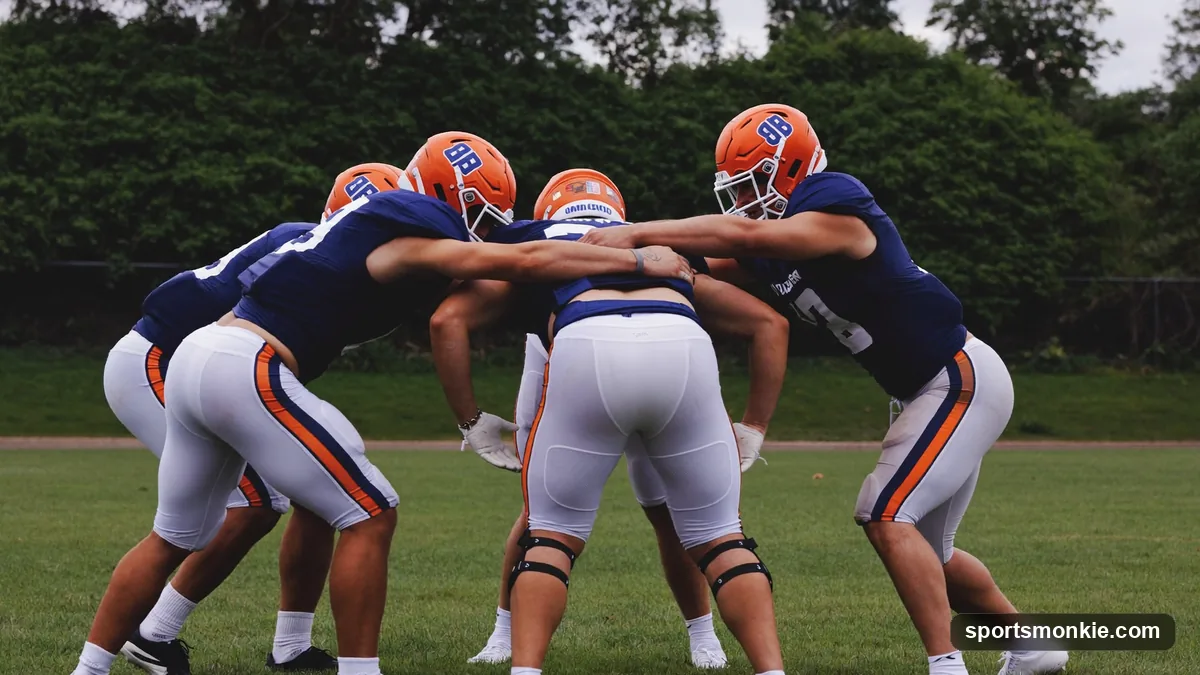
The I-formation lines up the quarterback under center with a fullback directly behind him and a tailback stacked behind the fullback, forming a vertical “I” shape built for downhill power running and play-action passing. It is one of the oldest and most influential offensive structures in American football, and understanding it is the fastest way to understand where every modern running formation came from.
How the I-Formation Lines Up
The I-formation starts with a standard five-man offensive line: two tackles, two guards, and a center. The quarterback lines up under center, taking a direct snap rather than working from shotgun. Directly behind the quarterback stands the fullback, usually two to three yards deep. Behind the fullback, six to eight yards off the ball, stands the tailback (running back) in an upright stance, giving him a clear view of the defensive front before the snap.
A tight end typically lines up on the line next to a tackle, with two wide receivers split out. That base personnel grouping (one running back, one fullback, one tight end, two receivers, commonly labeled 21 personnel) is what most people picture when they hear “I-formation,” but the alignment itself refers specifically to the backfield stack, not the receiver split.
Because the fullback and tailback are stacked directly in line with the quarterback rather than side by side, the formation reads as a straight vertical column when viewed from the press box, which is where the name comes from.
Where the I-Formation Came From
The I-formation’s exact inventor is debated, with early versions traced to Northwestern’s Charles Hollister around 1900 and Bob Zuppke in the 1910s. The formation most football historians credit as the modern I is usually tied to Tom Nugent, who developed it at Virginia Military Institute around 1950 as a successor to the single-wing attack. Don Coryell helped popularize it through college coaching, and it reached national prominence when John McKay’s USC teams built championship offenses around it in the 1960s. Tom Osborne later made the I-formation the backbone of Nebraska’s powerhouse rushing attacks starting in the early 1970s, cementing it as college football’s dominant run scheme for a generation.
Strengths: Why the I-Formation Worked for Decades
- A dedicated lead blocker. The fullback steps into the hole ahead of the tailback and takes on a linebacker or defensive back, clearing a running lane before the ball carrier arrives. This is the foundation of “ISO” (isolation) runs, the signature play out of the I.
- Downhill, north-south running. With the tailback deep and squared to the line, he can hit the hole at full speed and choose a cutback lane based on how the defense reacts, rather than having to build up speed laterally first.
- Strong play-action. Because the I-formation signals run so convincingly, a fake handoff followed by the fullback and tailback both selling run blocks freezes linebackers and safeties, opening up throwing lanes for a play-fake pass.
- Balanced pass protection. When the offense does drop back to pass, the fullback can stay in as an extra blocker, giving the quarterback more protection than most spread sets provide.
- Clock and possession control. A team that can consistently run behind a lead blocker can chew clock, shorten the game, and protect a lead, which is why the I-formation remains a staple in short-yardage and end-of-game situations.
Weaknesses: Why Offenses Moved Away From It
The I-formation’s biggest problem is predictability. Stacking two backs in the backfield instead of spreading a third or fourth receiver tells the defense a run is far more likely than a pass, letting defensive coordinators load the box with extra defenders. As passing rules opened up the game and defenses got faster, that trade-off stopped paying off as often.
It also depends on a specialized position, the true blocking fullback, that many programs no longer develop or roster. Modern NFL offenses generally prefer using that roster spot on a third wide receiver, a pass-catching tight end, or a hybrid H-back who can motion around the formation instead of parking in a stationary lead-blocker role. Compared with a formation like the shotgun, the I also puts the quarterback closer to the line with less time to read the defense before deciding where to go with the ball.
I-Formation vs. Other Backfield Sets
| Formation | Backfield alignment | Best for | Passing view for QB |
|---|---|---|---|
| I-formation | FB and RB stacked directly behind QB, who is under center | Downhill power runs, play-action | Limited, QB is at the line |
| Pro-set | FB and RB side by side behind QB, under center | Balanced run/pass, quick-hitting runs | Limited, QB is at the line |
| Shotgun | QB lines up 5-7 yards back, RB usually offset to one side | Spread passing, quick reads | Best, QB sees the field pre-snap |
| Pistol | QB a few yards back, RB directly behind QB | Zone-read runs, hybrid run/pass | Moderate, closer look than under center |
For the full rundown of alignment differences with the side-by-side backfield version of this same run-first family, see our pro-set formation in football breakdown. For the deeper comparison with the pass-friendly setup that eventually replaced the I-formation as most teams’ base offense, read our shotgun formation in football guide.
Common I-Formation Plays
- ISO (Isolation): The signature I-formation run. The fullback attacks a specific linebacker one-on-one while the tailback follows him through the designated gap.
- Power: A guard pulls across the formation to add a second lead blocker alongside the fullback, stacking blockers in front of the tailback for a more physical, gap-scheme run.
- Off-tackle: The tailback runs behind the tackle and tight end, with the fullback kicking out an edge defender to seal the perimeter.
- Play-action pass: The quarterback fakes an ISO or power handoff, and the fullback either sells the block before releasing into the flat or stays in to protect while a receiver runs a route behind the linebackers who bit on the run fake.
Does the I-Formation Still Show Up in the NFL Today?
Rarely as a full-time base offense, but it has not disappeared. Most NFL teams built their passing attacks around shotgun and spread concepts long ago, and traditional fullback roster spots have shrunk league-wide. Where the I-formation survives is in situational football: short-yardage conversions, goal-line packages, and clock-control drives late in games with a lead. Teams that still carry a true blocking fullback, such as the San Francisco 49ers with longtime Pro Bowler Kyle Juszczyk, use I-formation looks as a change-of-pace package rather than a weekly base set, often blending the fullback into motion and multiple alignments rather than parking him in a static I every snap.
College football, particularly programs built around power-running or option-influenced schemes, and high school football still lean on the I-formation far more than the pros, since it remains one of the simplest ways to teach angle blocking, gap discipline, and downhill running to developing players.
The Bottom Line
The I-formation built the modern running game before the league moved on to faster, more spread-out football. Its core idea, put a blocker in front of the ball carrier and hit the hole downhill, still shows up inside power and ISO runs from shotgun and pistol sets today. Knowing the I-formation is really knowing where a huge share of current NFL run-game vocabulary started. For the wider picture of how formations and the coverages defenses run against them fit together, see our NFL formations and coverages explained guide.
Frequently asked questions
What is the I-formation in football?+
The I-formation is an offensive formation where the quarterback lines up under center, a fullback lines up directly behind the quarterback, and a tailback (running back) lines up behind the fullback, roughly six to eight yards deep. Viewed from above, the QB, fullback, and tailback form a vertical line that looks like the letter I, which gives the formation its name.
Why is it called the I-formation?+
The name comes from the visual shape created by the quarterback, fullback, and tailback stacked one behind the other in a straight vertical line behind center. That column resembles the letter I, especially when compared to the T-formation, where the backs are spread side to side instead of stacked.
What is the fullback's job in the I-formation?+
The fullback's main job is to lead block for the tailback, stepping into the hole first and taking on a linebacker or defensive back so the tailback can follow him through the gap. On play-action passes, the fullback often fakes the same blocking assignment before releasing or staying in to protect the quarterback.
Is the I-formation still used in the NFL?+
Yes, but sparingly. Most NFL teams have moved to shotgun and spread formations for their base offense, and true fullbacks are now rare roster spots. The I-formation still shows up in short-yardage and goal-line packages, and a handful of run-heavy teams use it as a change-of-pace look, but it is no longer a base offense for most franchises.
What is the difference between the I-formation and the pro-set formation?+
In the I-formation, the fullback and tailback are stacked directly behind each other in a single vertical line. In the pro-set formation, the two backs line up side by side behind the quarterback instead of stacked, which spreads blocking angles differently and changes how quickly the running back can hit the hole. See our full breakdown of the pro-set formation in football for the alignment details.
What is the difference between the I-formation and the shotgun formation?+
The I-formation puts the quarterback under center, close to the offensive line, with backs stacked behind him for downhill runs. The shotgun formation moves the quarterback several yards back before the snap, giving him a better view of the defense and more time to pass, but it removes the classic under-center power-running mechanics. Read our shotgun formation in football guide for a full comparison.
What are the main weaknesses of the I-formation?+
The I-formation is fairly predictable because it signals run far more often than pass, and having two backs in the backfield instead of extra receivers limits how many pass-catching threats an offense can spread across the field. It also depends on a true blocking fullback, a specialist role that many modern offenses have phased out.
Which teams and levels of football still use the I-formation most?+
College and high school programs that lean on power-running or triple-option-adjacent schemes use the I-formation more than the NFL does. In the pros, it mainly appears in short-yardage, goal-line, and two-minute clock-control situations, run by teams that still carry a traditional fullback on the roster.
Sources
Play & tools
Free browser games and tools — no account, no download.
- Play 17-0 — Draft nine and chase a flawless NFL regular season — the perfect 17-0 run, no playoffs.
- Play 20-0 — Draft nine and chase a perfect NFL season — regular season and playoffs, undefeated.
- Play 16-0 — Draft nine and chase a perfect 16-0 — the classic 16-game NFL regular season, no playoffs.
- Play Flawless Six — Draft five players and a head coach, then chase a perfect NFL season with the right chemistry.
- Play Guess the NFL Player — A new mystery NFL player every day. Eight guesses, with a clue on each — plus free unlimited mode.
- Play NFL Wordle — A Wordle for football — guess the daily NFL player in eight tries, with green-amber-grey feedback on every clue.
- Play NFL Connections — Sort sixteen football tiles into four hidden groups of four. A new daily puzzle, four mistakes allowed, plus unlimited mode.
- Explore all our games →
- Open the schedule simulator — Pick every 2026 NFL game and watch the standings and playoff seeds update live.
- Open the squares generator — Generate a randomized, printable Super Bowl squares grid for your party — free, no sign-up.
- Open the trade calculator — Weigh any fantasy football trade instantly — clear winner and value gap.
- Run the NFL predictor — Simulate the NFL bracket and see who your picks send to the Super Bowl.
- Open the passer rating calculator — Calculate the official NFL passer rating (0–158.3) from any passing line, with the formula shown.
- Explore all our free sports tools →
Related nfl guides
View all →
Pistol Formation in Football: What It Is and Why NFL Teams Use It
The pistol formation lines the QB ~4 yards behind center with the RB directly behind him, blending shotgun passing with a hidden run threat.
Running Back Position in Football: Role, Skills & Types Explained
The running back position carries the ball, catches passes, and pass-blocks. Learn the halfback vs. fullback split, key skills, and top RB examples.
Pro Set Formation in Football Explained: Alignment, Uses, and Fade
The pro set formation lines up the QB under center with a halfback and fullback side by side, two WRs, and a TE. Here's how it works and why it faded.
Shotgun Formation in Football: How It Works, Why Teams Use It
The shotgun formation lines the QB 5-7 yards back for a snapped pass. Learn its alignment, personnel, strengths, weaknesses, and history.
Cover 2 Defense in Football: Rules, Alignment, and Weaknesses Explained
Cover 2 defense explained: two deep safeties split the field, five underneath defenders, strengths vs. deep passes, weaknesses in the middle, and the Tampa 2 twist.
Cover 3 Defense in Football: How It Works, Strengths & Weaknesses
Cover 3 defense explained: three deep defenders split the field into thirds while four underneath defenders play zone. Strengths, weaknesses, and how to beat it.