
Pro Set Formation in Football Explained: Alignment, Uses, and Fade
On this page6
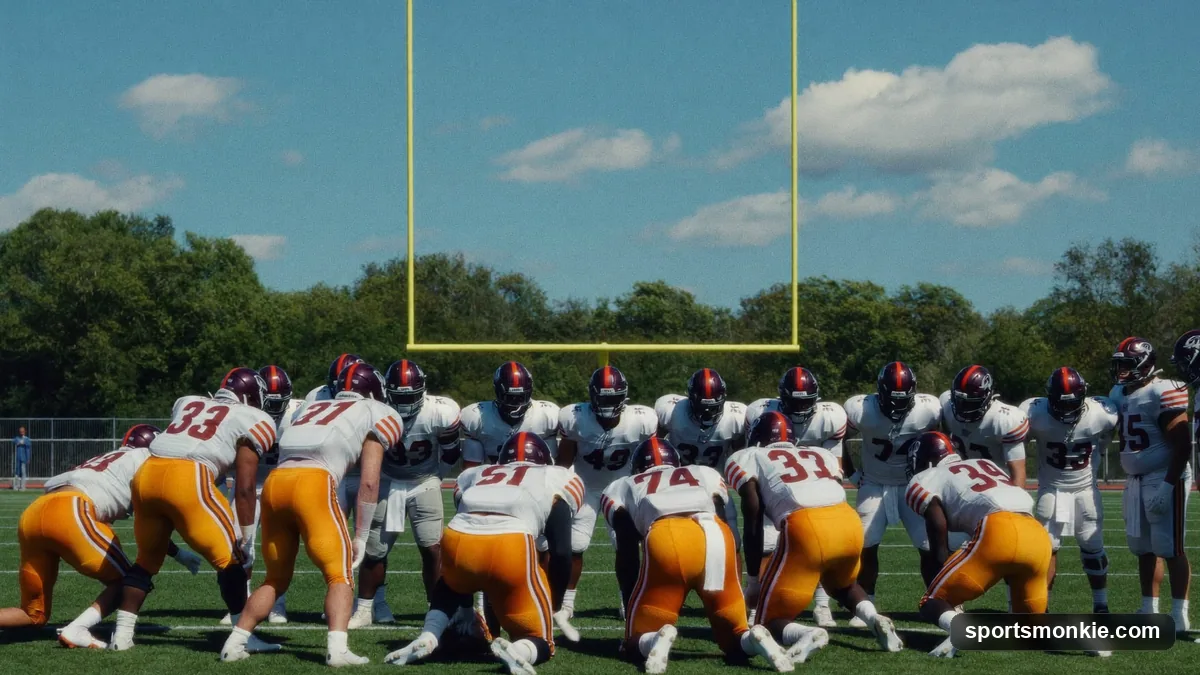
The pro set formation lines up the quarterback under center with a halfback and fullback split side by side in the backfield, two wide receivers split out, and a tight end on the line — the classic “balanced” base offense built to run or pass from the exact same look. For decades it was the default first-and-ten formation across pro and college football before shotgun and spread concepts pushed it into a situational role.
How the pro set formation lines up
Start with the quarterback under center, hands on the center’s backside, taking a straight three-, five-, or seven-step drop instead of catching a shotgun snap. Behind him, the halfback and fullback split to either side of the backfield, usually four to five yards deep and stationed just outside the guards rather than stacked one behind the other. That side-by-side alignment is the detail that separates the pro set from the I-formation in football, where the fullback lines up directly in front of the halfback in a single-file stack.
Up front, a tight end attaches to one end of the offensive line, and two wide receivers split out — one to each side, or occasionally both to one side (a “twins” look) with the tight end serving as an extra blocker or checkdown target on the other. In personnel terms, that’s a standard 21 grouping: two backs, one tight end, two receivers. Because the backs are interchangeable athletically, coaches can flip which one is called the “halfback” or “fullback” depending on where they split, and either back can be the runner, the lead blocker, or a receiving option on the same play call.
Why the pro set became the standard NFL base offense
The pro set descended directly from the T-formation, the three-back backfield that dominated football through the 1940s and 1950s. As passing offenses evolved, teams realized they got more value turning that third running back into a full-time receiver split wide, which is exactly what created the modern flanker position. What was left behind — quarterback under center, two backs split evenly, a receiver on each side — became the “pro” set because it was the version NFL teams standardized on, distinct from the I-formation and wing-T looks that stayed more common in college and high school ball.
By the 1970s the pro set was everywhere. Tom Landry’s Dallas Cowboys built much of their offense around it, and it became the launching pad for misdirection concepts like counters, reverses, and play-action bootlegs, since a defense couldn’t key on which back would touch the ball. Bill Walsh’s 49ers carried the pro set into the 1980s as the backbone of the West Coast offense, pairing it with quick, timing-based passing that used both backs as check-down options. It stayed a base formation into the 2000s-era Philadelphia Eagles offense before falling out of first-down usage almost entirely as the NFL shifted toward shotgun formation snaps and spread personnel.
Strengths: balance and disguise
The pro set’s core selling point is balance. Because both backs can run, pass-block, or release as receivers from an identical pre-snap look, a defense genuinely cannot tell whether a play is a run or a pass until well after the snap. That symmetry is what makes play-action so effective out of the pro set — either back can fake a handoff while the other releases, and the quarterback still has a clean pocket look with two blockers available if the rush comes free. It’s also a strong protection formation: with two backs in the backfield instead of one, quarterbacks get extra blitz insurance on money downs, something single-back and empty sets can’t offer.
The formation is flexible, too. Swap the tight end for a third receiver and it becomes a 20-personnel spread-lite look; add a second tight end and it becomes 22-personnel power football. That range let pro-set teams adjust to whatever defense they were facing without abandoning the fundamental alignment.
Weaknesses: dated against modern spread defenses
The tradeoff is that the pro set’s default two-receiver look doesn’t stress a defense built around the pass the way modern 10- or 11-personnel spread sets do. Nickel and dime packages, which are now a defense’s base personnel on early downs in most NFL games, are specifically designed to blanket two-receiver formations while stacking the box against the run. The pro set simply doesn’t create the horizontal space that trips up modern zone and man coverage the way three- and four-receiver sets do.
It’s also weaker in short-yardage power situations than a true stacked backfield. Because the fullback isn’t directly in front of the halfback, the pro set doesn’t generate the same downhill, lead-blocker punch as the I-formation on third-and-one or at the goal line. That’s a big part of why, even in its heyday, teams still shifted into the I-formation or a heavier goal-line package when they needed to grind out a yard.
Pro set vs. other base formations
| Formation | Backfield alignment | Best for | Common weakness |
|---|---|---|---|
| Pro set | Halfback + fullback split side by side | Balance, play-action, pass protection | Limited receiver spacing vs. nickel/dime |
| I-formation | Fullback stacked in front of halfback | Downhill power running, short yardage | Telegraphs run more easily |
| Shotgun / spread | QB 5–7 yards back, backs offset or single | Passing spacing, RPOs, tempo | Less physical run/protection punch |
| Singleback | One back, no fullback, 3+ receivers | Route variety, matchup creation | Weaker in-line run blocking |
Where the pro set fits in today’s NFL
The pro set formation hasn’t disappeared, it’s just been demoted from a first-down staple to a specialty package. Teams still bring it out in short-yardage and goal-line situations, where the extra back adds a blocking or misdirection wrinkle that spread sets can’t replicate, and some offenses use it for a change-up play-action shot after a game full of shotgun snaps. It remains the backbone of most high school offenses, where simpler, more balanced concepts are easier to teach than the complex route combinations that make spread passing games work.
For a broader look at how the pro set compares to every other alignment defenses have to prepare for — including how coverages are built to attack or defend it — see our full breakdown of NFL formations and coverages. And if you’re still building a foundation in the sport’s terminology and structure, our American football / NFL guide is the place to start.
The pro set’s legacy is really about what came after it. Nearly every modern personnel grouping, from 11-personnel spread to pistol looks, is either a direct evolution of the pro set’s split-back principle or a deliberate reaction against it. Understanding the pro set is understanding where the NFL’s passing revolution started pulling away from.
Frequently asked questions
What is the pro set formation in football?+
The pro set formation is an offensive alignment with the quarterback under center, a halfback and fullback split side by side in the backfield (instead of stacked as in the I-formation), two wide receivers, and one tight end. It's also called the split-back formation and was the standard base offense for most NFL teams from the 1960s through the 1990s.
Why is it called the pro set?+
It's called the pro set because it became the dominant professional base offense once NFL teams converted the T-formation's third running back into a full-time flanker (wide receiver), separating pro-style attacks from the college-heavy I-formation and single-wing looks that were still common at other levels.
What's the difference between the pro set and the I-formation?+
In the pro set, the halfback and fullback line up side by side, roughly even with each other. In the I-formation, they stack in a line directly behind the quarterback, with the fullback in front of the halfback. The I-formation is built to load blockers ahead of one runner; the pro set spreads two backs across the field for more balance and better protection variety.
What are the strengths of the pro set formation?+
The pro set disguises run and pass equally well because both backs can carry, block, or release as receivers from the same alignment. It gives quarterbacks max protection with two backs available to pick up blitzers, supports play-action and misdirection since either back can fake the handoff, and adapts easily to different personnel by swapping in a third receiver or second tight end.
What are the weaknesses of the pro set formation?+
The pro set only puts two wide receivers on the field by default, so it struggles to stress modern nickel and dime defenses built to stop the pass. It also lacks a true lead blocker stacked in front of the ball carrier the way the I-formation does, which limits its punch in short-yardage and goal-line power runs compared to heavier, more vertical backfield sets.
Is the pro set formation still used in the NFL?+
Yes, but rarely as a base offense anymore. Most NFL teams now build around shotgun and spread formations for early downs. The pro set survives as a situational package for short yardage, goal-line snaps, and play-action shots, and it remains a common base formation in high school football.
Which teams were known for running the pro set?+
The pro set formation was a signature look for the 1970s Dallas Cowboys and the 1980s San Francisco 49ers under Bill Walsh, whose West Coast offense leaned on split backs for short, timing-based passing. It also remained a Philadelphia Eagles staple into the mid-2000s before spread concepts took over league-wide.
How is personnel labeled in the pro set formation?+
A standard pro set uses 21 personnel: two running backs, one tight end, and two wide receivers. Teams can shift the label by swapping pieces, running 20 personnel (no tight end, three receivers) or 22 personnel (two tight ends, one receiver) from the same split-back alignment.
Sources
Play & tools
Free browser games and tools — no account, no download.
- Play 17-0 — Draft nine and chase a flawless NFL regular season — the perfect 17-0 run, no playoffs.
- Play 20-0 — Draft nine and chase a perfect NFL season — regular season and playoffs, undefeated.
- Play 16-0 — Draft nine and chase a perfect 16-0 — the classic 16-game NFL regular season, no playoffs.
- Play Flawless Six — Draft five players and a head coach, then chase a perfect NFL season with the right chemistry.
- Play Guess the NFL Player — A new mystery NFL player every day. Eight guesses, with a clue on each — plus free unlimited mode.
- Play NFL Wordle — A Wordle for football — guess the daily NFL player in eight tries, with green-amber-grey feedback on every clue.
- Play NFL Connections — Sort sixteen football tiles into four hidden groups of four. A new daily puzzle, four mistakes allowed, plus unlimited mode.
- Explore all our games →
- Open the schedule simulator — Pick every 2026 NFL game and watch the standings and playoff seeds update live.
- Open the squares generator — Generate a randomized, printable Super Bowl squares grid for your party — free, no sign-up.
- Open the trade calculator — Weigh any fantasy football trade instantly — clear winner and value gap.
- Run the NFL predictor — Simulate the NFL bracket and see who your picks send to the Super Bowl.
- Open the passer rating calculator — Calculate the official NFL passer rating (0–158.3) from any passing line, with the formula shown.
- Explore all our free sports tools →
Related nfl guides
View all →
I-Formation in Football: Alignment, Strengths, and Modern Use
The I-formation lines up QB under center with fullback and running back stacked behind him. See its alignment, strengths, weaknesses, and NFL use.
Singleback Formation in Football: How the Ace Set Works
The singleback formation lines up one running back behind a QB under center, no fullback, for balanced run-pass disguise. Full breakdown here.
Cover 2 Defense in Football: Rules, Alignment, and Weaknesses Explained
Cover 2 defense explained: two deep safeties split the field, five underneath defenders, strengths vs. deep passes, weaknesses in the middle, and the Tampa 2 twist.
Illegal Formation in Football: The Full Rule Explained
Illegal formation in football is a 5-yard penalty for lineup violations at the snap: fewer than 7 on the line, misplaced eligible receivers, or covered players.
Pistol Formation in Football: What It Is and Why NFL Teams Use It
The pistol formation lines the QB ~4 yards behind center with the RB directly behind him, blending shotgun passing with a hidden run threat.
Shotgun Formation in Football: How It Works, Why Teams Use It
The shotgun formation lines the QB 5-7 yards back for a snapped pass. Learn its alignment, personnel, strengths, weaknesses, and history.