
What Is X in Lacrosse? The Position Behind the Goal
On this page4
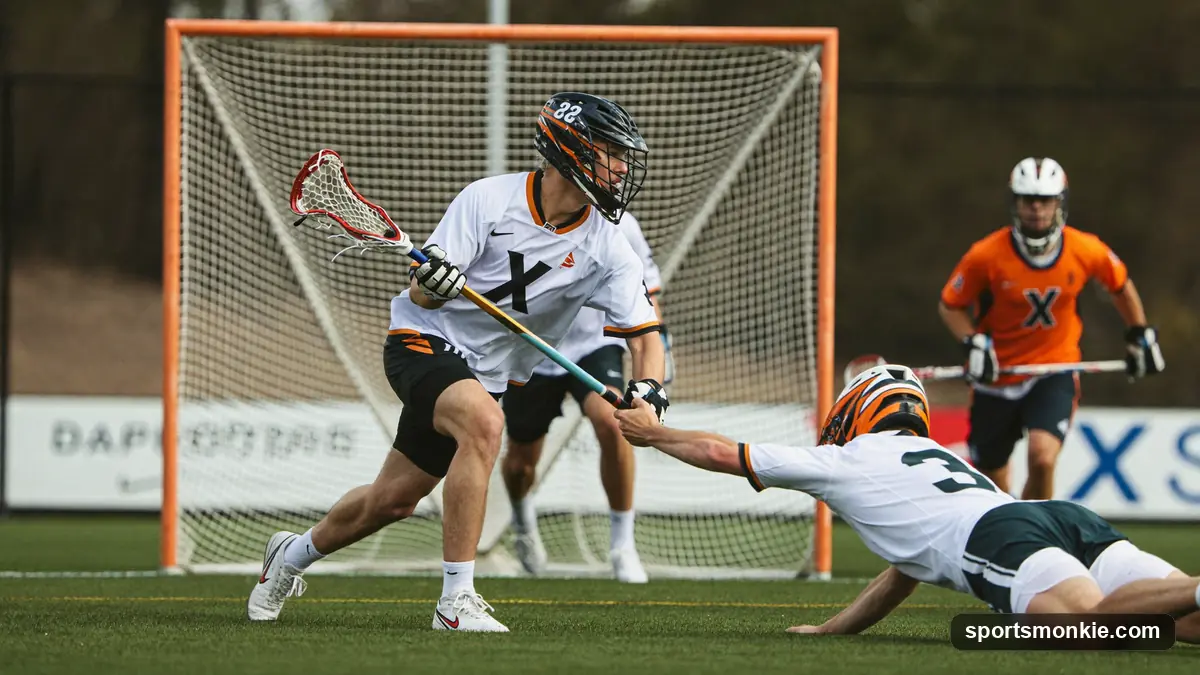
X in lacrosse is the spot directly behind the goal, roughly centered, and it is the most valuable piece of real estate on the offensive end. A player set up at X can drive to either side of the cage and sees the entire offense laid out in front of them, which is why attackmen quarterback the whole offense from there. There is nothing to shoot on directly behind the net, so the defender guarding X can never pin the ball carrier the way they can up top.
The name is literal: coaching diagrams mark that position behind the goal with an X, and the label stuck.
Why X is the best spot on the field
Position at X gives an attackman two things no other spot does: a two-way threat and a full field of view. From behind the goal the player can drive to the left pipe or the right pipe, forcing the defender to honor both directions. Commit early to one side and the attackman goes the other way for an easy step-down finish.
The vision matters as much as the angle. Facing the goal from behind, the ball carrier sees every teammate, every cutter, and the goalie’s positioning, all in front of them. That is why X is where offenses are run from, the equivalent of a point guard bringing the ball up. USA Lacrosse coaching resources describe the attackman at X as the offensive initiator, the player who dictates whether a possession becomes a dodge or a feed.
Why defending X is so hard
Defending behind the goal is a losing proposition without help. Up top, a defender can use the cage and the sideline to trap a ball carrier and cut off an angle. Behind the goal there is no such backstop, because a shot from directly behind is impossible. The defender has to play honest, staying square and reacting rather than pressuring.
That structural disadvantage is why teams put their best dodger at X. Beat that first defender and you are attacking the front of the cage with a numbers advantage while the defense scrambles to slide. The whole offense is designed to make that first step from X unwinnable for the man guarding it.
The angles that make X dangerous
An attackman at X operates through a handful of repeatable actions, each exploiting the vision and two-way threat of the position. Here is how the position turns into offense.
| Action from X | What it does | Defensive problem it creates |
|---|---|---|
| Drive to the left pipe | Attacks the near corner for a step-down finish | Defender must commit or concede the angle |
| Drive to the right pipe | Mirror threat to the opposite side | Forces the defender to stay square, unable to shade |
| Feed to a cutter | Hits a teammate slashing through the crease | Draws a slide, opening the feed lane |
| Skip feed to the far side | Cross-crease pass to the back pipe | Goalie must slide, leaving a back-side finish |
| Invert dodge | Pulls a short-stick defender behind goal | Creates a mismatch the offense can attack |
| Feed then relocate | Passes and repositions for a return look | Keeps the defense rotating and out of shape |
Each of these works because the defender cannot cheat one way. The moment they shade toward the feed, the dodge opens; the moment they sit on the dodge, the feed lane appears.
Who plays X, and how to train for it
X belongs to the offensive initiator, usually the most creative attackman on the roster, the one with the best vision and the surest hands. It is fundamentally an attack role, distinct from the two-way lacrosse midfielder who runs the length of the field, and it demands a specific skill set: feeding under pressure, dodging in tight space, and finishing at sharp angles.
Training for X starts with the two skills it lives on. First, dodging, since every possession begins with beating your man from behind the cage; groove those moves with our guide to lacrosse dodges. Second, the feed, which is really an accurate pass thrown while dodging, built on the same soft hands you develop catching a lacrosse ball and finishing with a quick stick.
Understanding X also sharpens how you defend it. Knowing why the position is so dangerous tells a lacrosse defenseman to play patient, stay square, and never overcommit behind the goal. Whether you are learning to run an offense or shut one down, X is where a lacrosse possession is won or lost.
Freshness note: X is a stable positional concept rather than a rule; re-check USA Lacrosse coaching resources for updated offensive-scheme guidance each season.
Frequently asked questions
What does the X mean in lacrosse?+
X is the name for the spot on the field directly behind the goal, roughly centered. It comes from coaching diagrams that mark that position with an X. A player set up at X can drive to either pipe and faces the entire offense, which makes it the launch point for most feeding and dodging.
Why do attackmen play behind the goal?+
Behind the goal a player sees the whole field in front of them and can attack either side of the cage, forcing the defense to respect two directions. There is no scoring threat directly behind, so the defender must play honest and cannot simply pin the ball carrier against the net as they might up top.
What is the hardest position in lacrosse?+
Goalie is most commonly called the hardest, facing shots at high speed with split-second reactions, while faceoff specialist is the most narrowly demanding. The attackman at X carries a different pressure: quarterbacking the offense, making the right feed under a slide, and finishing tight angles around the crease.
What are the four positions in lacrosse?+
Men's field lacrosse has four positions: attack, midfield, defense, and goalie. Attackmen play near the opponent's goal and often operate from X. Midfielders cover the whole field, defensemen protect their own goal with long poles, and the goalie guards the net. X is a spot on the field, not a fifth position.
Sources
Play & tools
Free browser games and tools — no account, no download.
- Play today's Sports Connections — Today's Sports Connections — daily hints, answers, and play the grid.
- Play Guess the NFL Player — A new mystery NFL player every day. Eight guesses, with a clue on each — plus free unlimited mode.
- Explore all our games →
Related guides
The Attackman Position in Lacrosse
An attackman is an offensive lacrosse player who stays on the attacking half to score and feed. The role, sticks and skills explained.

How Many Players Are on a Lacrosse Team?
Men's field lacrosse plays 10 per side, women's 12, and box lacrosse 6. How many players are on the field and on the roster, by format and level.
What Is an SSDM in Lacrosse? The Short-Stick D-Middie Explained
An SSDM in lacrosse is a short-stick defensive midfielder who covers opposing middies. Learn the role, how it differs from an LSM, and how to play it.

What Is a FOGO in Lacrosse? Faceoff Specialists Explained
A FOGO in lacrosse is a Face-Off, Get-Off specialist who wins the faceoff and subs off. Here is how the position works, the rules, and its famous names.

Women's Lacrosse Positions Explained: All 12 Roles
Women's lacrosse fields 12 players a side. Here are all 12 positions — attack, midfield, defense and goalie — with each role and field zone explained.
Lacrosse Defenseman Guide: Role, Skills and Stick Setup
A lacrosse defenseman uses a 52-72 inch long pole to stop attackmen. Learn the role, the checks, the stick rules, and how many long poles a team can field.