
Lacrosse Defenseman Guide: Role, Skills and Stick Setup
On this page6
A lacrosse defenseman is one of three close defenders who protect the goal alongside the goalie in men’s field lacrosse. He carries a long pole measuring 52 to 72 inches (a short stick is only 40 to 42 inches), plays defense mostly with his feet, and uses poke and slap checks to strip the ball from attackmen. A team may put at most four long poles on the field at once.
If you are new to the sport, the defenseman is the tall-sticked player backpedaling in front of the net, doing the least glamorous and most punishing job on the field.
What does a defenseman do?
Men’s field lacrosse puts 10 players per side on the field: three attackmen, three midfielders, three defensemen, and a goalie. The three defensemen are called “close defense,” and each one is usually matched up against a specific attackman.
The core job is simple to state and hard to do: keep your man from scoring. That breaks down into four constant tasks:
- Positioning: stay between the attacker and the goal, moving with your feet rather than lunging with your stick.
- Sliding: leave your man to help a beaten teammate, then recover, all on communication.
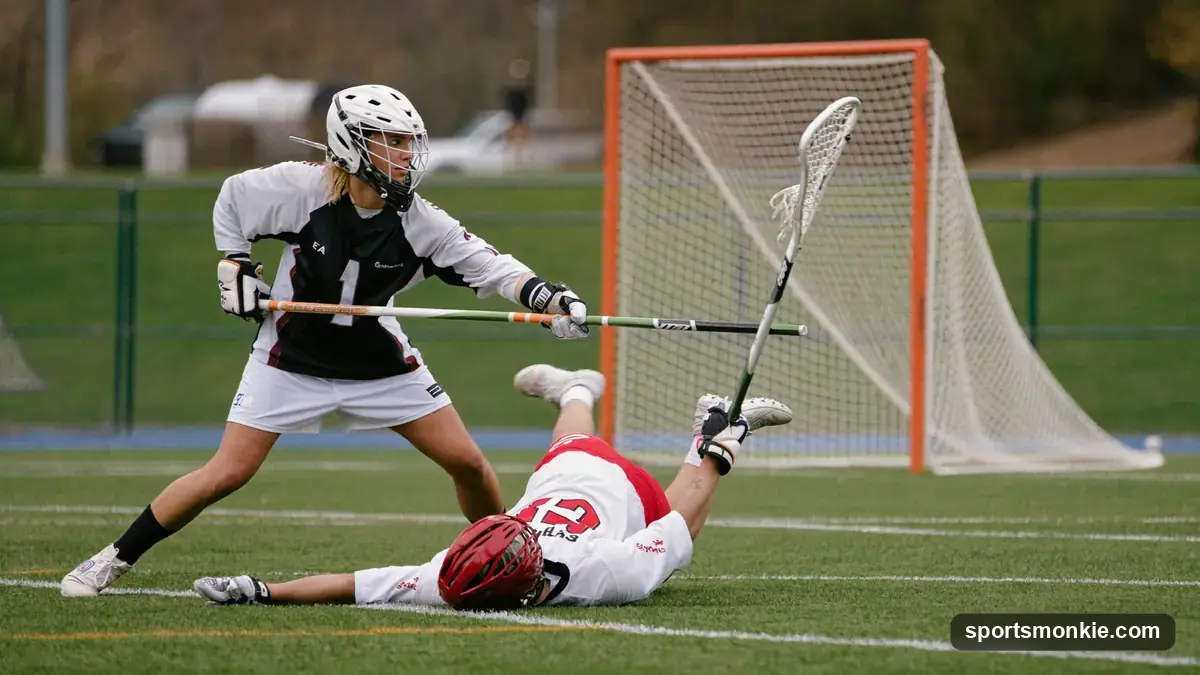
- Checking: use the long pole to poke or slap at the attacker’s stick and hands to dislodge the ball.
- Clearing: once you win possession, carry or pass the ball up the field to start the offense.
Good defensemen are the loudest players on the field. They organize slides and call out picks, and you can usually hear them from the stands.
Why the long pole (d-pole) matters
The defenseman’s signature tool is the long pole, or d-pole. Under NCAA and high school rules, a legal defensive stick runs 52 to 72 inches in total length, head included, versus 40 to 42 inches for the short sticks that attackmen and most midfielders carry.
That extra 12 to 30 inches of reach changes the geometry of defense. A poke check can jab at an attacker’s gloves from a stride away, and a longer lever makes it easier to knock down passes and rake through ground-ball scrums. The trade-off is control: the pole is heavier and slower to handle, so a defenseman who relies on it instead of his footwork gets beaten badly.
The four checks a defenseman uses
Not every check is legal, and knowing the difference keeps you out of the penalty box. The poke and the slap (or lift) are the everyday tools; a cross-check, using the shaft between both hands, is a foul in the men’s field game.
| Check | How it works | Legal in men’s field? |
|---|---|---|
| Poke check | Jab the shaft one-handed at the attacker’s stick or gloves | Yes |
| Slap check | Quick, controlled slap at the stick or gloves | Yes (uncontrolled slaps to the body are fouls) |
| Lift check | Lift under the attacker’s bottom hand to disrupt a shot | Yes |
| Cross-check | Push with the shaft held between both hands | No (personal foul) |
That last row is the one that catches new defenders. In box (indoor) lacrosse the cross-check is a legal, everyday tool, which is exactly why field and box defenders develop very different habits. We break that down in our guide to cross-checking in lacrosse.
How many long poles can be on the field?
Four. A team almost always uses its four allowed long sticks as three close defensemen plus one long-stick midfielder (LSM), who is really a defender allowed to roam. A fifth long pole draws an illegal-procedure penalty. Everyone else, goalie aside, carries a short stick.
If you are weighing which position fits you, or want to see how defenders differ from the two-way runners in the middle of the field, read our companion lacrosse midfielder guide next. And for a sense of how the greats built their careers, several names on our list of the greatest lacrosse players of all time made theirs on defense.
Defense vs the rest of the field
Here is how the close defenseman compares to the other stick-carrying roles on a men’s field lacrosse team.
| Role | Stick length | Where they play | Main job |
|---|---|---|---|
| Attackman | 40-42 in | Offensive half | Score and feed |
| Midfielder | 40-42 in | Both halves | Two-way transition |
| Long-stick midfielder | 52-72 in | Both halves | Defend the midfield, force turnovers |
| Close defenseman | 52-72 in | Defensive half | Guard an attackman, protect the goal |
| Goalie | 40-72 in | The crease | Stop shots, run the clear |
The goalie lives inside a protected circle with its own rulebook; if that part of the field is new to you, our explainer on the lacrosse crease covers who can go where around the net.
The bottom line
A defenseman wins with feet, voice, and a long pole, not with highlight-reel checks. Master positioning and the poke check, learn when to slide, and get comfortable clearing under pressure, and you become the player attackmen least want to face. The stick is long and awkward at first, but the reach it buys is the whole point of the position.
Freshness note: stick-length limits (52-72 in poles, 40-42 in short sticks) and the four-long-pole cap are stable NCAA/NFHS rules; re-check against the current men’s rulebook each season in case of tweaks.
We dig into a related angle in What Is Warding in Lacrosse? The Rule Explained.
Frequently asked questions
What does a defenseman do in lacrosse?+
A defenseman guards an opposing attackman and tries to stop him from scoring. The job is footwork first: staying between the attacker and the goal, sliding to help teammates, communicating the defense, and using stick checks to knock the ball loose. Defensemen also clear the ball up the field to start the offense.
How long is a lacrosse defenseman's stick?+
A defenseman's long pole measures between 52 and 72 inches in total length, including the head, under NCAA and high school (NFHS) rules. That is why it is nicknamed the d-pole. A regular short stick used by attackmen and most midfielders is only 40 to 42 inches long.
How many long poles can a team have on the field?+
A maximum of four. A team usually fields three close defensemen plus one long-stick midfielder (LSM), all carrying 52-72 inch poles. A fifth long pole on the field is an illegal-procedure penalty. The rest of the team uses 40-42 inch short sticks.
Is defenseman the hardest position in lacrosse?+
It is one of the most demanding. A defenseman controls a heavy, unwieldy long pole while moving backward against fast attackers, and one mistake often becomes a goal. Many players argue goalie is hardest, but close defense carries the most one-on-one pressure with the least margin for error.
What is a d-pole in lacrosse?+
A d-pole is the long defensive stick, 52 to 72 inches long, carried by defensemen and long-stick midfielders. The extra length gives a longer reach for poke and slap checks, knocking down passes, and scooping ground balls. Only four d-poles are allowed on the field per team at a time.
Sources
Play & tools
Free browser games and tools — no account, no download.
- Play today's Sports Connections — Today's Sports Connections — daily hints, answers, and play the grid.
- Play Guess the NFL Player — A new mystery NFL player every day. Eight guesses, with a clue on each — plus free unlimited mode.
- Explore all our games →
Related guides
What Is a D-Pole? Long Poles vs Short Sticks
A lacrosse d-pole is the long defensive stick, 52 to 72 inches. How long poles differ from short sticks, who carries one, and the four-pole rule.
What Is an SSDM in Lacrosse? The Short-Stick D-Middie Explained
An SSDM in lacrosse is a short-stick defensive midfielder who covers opposing middies. Learn the role, how it differs from an LSM, and how to play it.

Lacrosse Midfielder Guide: The Two-Way Grind Explained
A lacrosse midfielder plays both offense and defense and does the most running on the field. Learn the role, the midfielder types, and the stick rules.

Is Lacrosse a Contact Sport? Contact Rules by Version
Is lacrosse a contact sport? It depends which lacrosse. Body checking is legal in men's field and box, banned in the women's game. Rules and injury data compared.

The 8-Meter Arc in Women's Lacrosse: Free Position Shots
The 8-meter arc in women's lacrosse is the fan in front of goal where a major defensive foul gives the attacker a free position shot. Rules and procedure inside.
Can You Kick the Ball in Lacrosse? The Rule Explained
Yes, you can kick the ball in men's lacrosse, and you can even score by kicking it. The women's game restricts it more. Here is exactly what the rules allow.