
The Lacrosse Crease Explained: Rules Around the Goal
On this page7
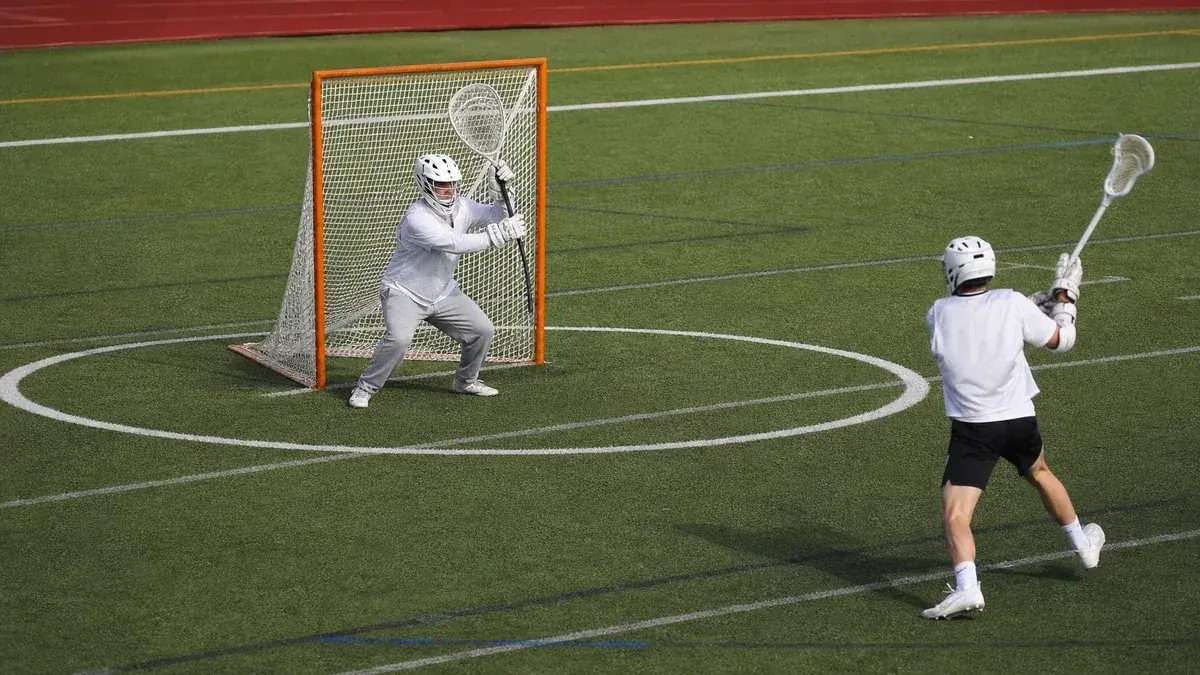
The crease is the marked circle around each lacrosse goal — 9-foot radius in men’s field lacrosse — and it exists to give the goalkeeper a protected space. Attacking players may not step inside it or contact the goalie within it, and any goal scored while an attacker is in the crease is disallowed. Defenders, by contrast, may enter freely.
It is one of those rules that quietly decides games. Attackers who forget where the edge is can wipe out their own team’s goal in an instant.
What the crease is
The crease is a marked circular area surrounding each goal. In men’s field lacrosse it is a circle with a 9-foot radius, so 18 feet across, centered on the goal. Women’s lacrosse and the indoor box game use their own crease dimensions and shapes, but the idea carries across all of them.
Inside that circle, the goalie has rights that field players do not. The crease is essentially the keeper’s office, and the rules keep the offense out of it.
The key rules for attackers
Three restrictions matter most for offensive players:
- You cannot step into the crease with any part of your body.
- You cannot make contact with the goalie while they are inside the crease.
- A goal does not count if an attacking player is in the crease when it is scored.
Break any of these and it is a crease violation. The defending team typically gets possession, and any goal scored in the process is waved off.
What the goalie gets
Inside the crease, the goalie is protected and privileged:
| Goalie inside the crease | Rule |
|---|---|
| Contact from attackers | Not allowed |
| Time to clear the ball | Usually a set count (e.g. 4 seconds in men’s field) |
| Re-entering with the ball | Not permitted once they leave the crease with it |
That clearing count is important. The goalie can gather the ball and organize a clear, but cannot camp in the crease indefinitely, and once they carry it out they cannot dive back in to reset.
Sticks vs bodies
A common point of confusion: can an attacker reach into the crease? In most rule sets, yes, the stick can enter to play a loose ball, as long as the player’s body stays out and they do not interfere with the goalie. It is the player crossing the line that draws the flag, not the stick.
Defenders play by different rules
The crease restriction is one-directional, and this surprises people watching their first game. Defensive players may enter the crease freely. They routinely step in to help the goalie, screen a shooter, or clear a rebound, and none of it is a violation.
The one common limit is that a defender inside the crease generally may not play the ball with their hands or scoop a loose ball there under most rule sets, since those are goalie privileges. Otherwise the circle is open to them. The crease protects the goalie from the offense, not from their own team.
The crease dive
The most spectacular thing the crease rules allow, in some codes, is the crease dive: an attacker launches from outside the circle, releases the shot in mid-air above the crease, and lands inside it. Because the rule bars your body from being in the crease rather than passing over it, the shot counts as long as it leaves the stick before the player touches down.
It is legal in men’s field lacrosse under World Lacrosse rules and in box lacrosse. The NCAA bans it on safety grounds, which is why college fans almost never see one and professional highlight reels are full of them. If you have watched a lot of lacrosse and disagree about whether crease dives are legal, you and the other person are probably both right about different leagues.
Why it matters
The crease keeps the goalie from being bulldozed and keeps scoring honest. Understanding it changes how you watch a scramble in front of net: the attacker fighting for a rebound has to stay outside that circle, and a great defensive stop often comes down to forcing an opponent to put a toe where it does not belong. Like the shot clock in basketball, it is a small piece of geometry that shapes the whole flow around the goal.
Frequently asked questions
Can an attacking player enter the crease in lacrosse?+
No. Offensive players cannot step into the crease. If an attacker's body enters the crease, or a goal is scored while an attacker is in it, the goal is disallowed and possession usually goes to the defending team.
Can a player's stick reach into the crease?+
Yes, in most rule sets an offensive player may reach their stick into the crease to play a loose ball, as long as their body stays out and they do not interfere with the goalie. The restriction is on the player entering, not the stick.
How big is the lacrosse crease?+
In men's field lacrosse the crease is a circle with a radius of 9 feet, so 18 feet across, centred on the goal. Women's field lacrosse uses a smaller circle of roughly 8.5 feet radius, and box lacrosse creases are typically 9 to 12 feet across depending on the league.
Can a defender enter the crease in lacrosse?+
Yes. The crease restriction applies to attacking players only. Defenders may move through it freely, and defensive players commonly step in to help their goalie. A defender may not, however, pick up the ball with their hands or play it while in there under most rule sets.
How long can a goalie hold the ball in the crease?+
Four seconds in men's field lacrosse. The goalie may gather the ball and organise a clear, but must pass it or carry it out before the count expires. Once they leave the crease with the ball, they cannot re-enter it while still holding possession.
What is a crease dive in lacrosse?+
A shot where an attacker leaps from outside the crease, releases in mid-air over it, and lands inside. It is legal in men's field lacrosse and box lacrosse if the shot is released before the player touches down. NCAA rules disallow it, which is why you rarely see it in college play.
Sources
Play & tools
Free browser games and tools — no account, no download.
- Play today's Sports Connections — Today's Sports Connections — daily hints, answers, and play the grid.
- Play Guess the NFL Player — A new mystery NFL player every day. Eight guesses, with a clue on each — plus free unlimited mode.
- Explore all our games →
Related guides
Lacrosse Goal Size: Official Dimensions for Every Level
A lacrosse goal is 6 feet wide by 6 feet high at every field level, from youth to NCAA. Here are the official dimensions, pipe specs, and box differences.

Is Lacrosse a Contact Sport? Contact Rules by Version
Is lacrosse a contact sport? It depends which lacrosse. Body checking is legal in men's field and box, banned in the women's game. Rules and injury data compared.

Cross-Checking in Lacrosse: Legal or Penalty?
Is cross-checking legal in lacrosse? It's a penalty in men's field but a core tool in box lacrosse. Learn the rule, penalty, and difference by version.

The Lacrosse Offsides Rule Explained Simply
The lacrosse offsides rule keeps four players on defense and three on offense at all times. Learn how it works, the penalty, and why it isn't soccer.

The 8-Meter Arc in Women's Lacrosse: Free Position Shots
The 8-meter arc in women's lacrosse is the fan in front of goal where a major defensive foul gives the attacker a free position shot. Rules and procedure inside.

Can You Kick the Ball in Lacrosse? The Rule Explained
Yes, you can kick the ball in men's lacrosse, and you can even score by kicking it. The women's game restricts it more. Here is exactly what the rules allow.