
Can You Kick the Ball in Lacrosse? The Rule Explained

On this page6
Yes, you can kick the ball in men’s lacrosse, and a kicked ball can legally go in for a goal. Kicking a loose ball on the ground is a normal, legal play, and if a kicked ball crosses the goal line, it counts. Women’s lacrosse is more restrictive: kicking a loose ball is allowed in limited situations, but the women’s game does not treat a kicked goal the same way the men’s game does. In no version can you kick the ball while it sits in another player’s stick, and you can never kick an opponent.
So the honest one-line answer: in men’s lacrosse, kick away on loose balls, and yes, you can score with your foot.
Kicking in men’s lacrosse
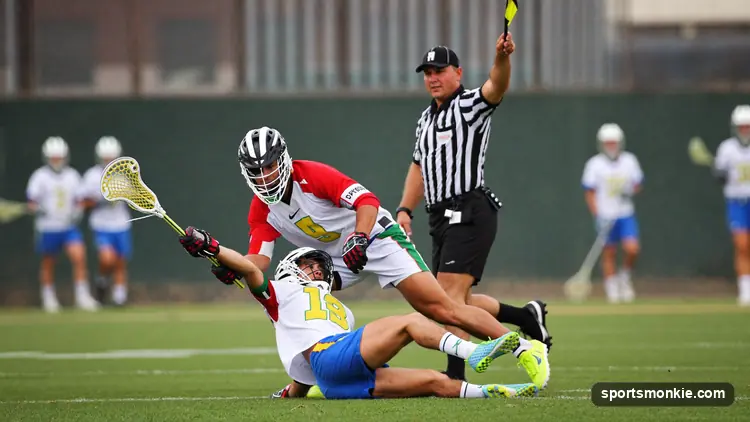
Under both NCAA and NFHS men’s rules, a player may kick a loose ball. This comes up more than newcomers expect. When a ground ball is bouncing awkwardly, sitting under a scrum of sticks, or rolling faster than you can scoop, kicking it to a teammate or toward open space is a legitimate way to keep the play alive. It is not a trick or a loophole; it is written into the rules.
There are limits. You cannot kick, or attempt to kick, the ball while it is in an opponent’s crosse, and you obviously cannot kick a player. You also cannot use your foot to hold or trap the ball indefinitely; the ball has to stay in play. But a clean kick of a genuinely loose ball is always legal.
Can you actually score by kicking it?
Yes, and it happens. In men’s lacrosse a ball that is kicked into the goal counts as a legal goal, the same as a shot from a stick. Picture a shot that rebounds off the goalie’s pads and drops in the crease crowd. An attackman who kicks that loose ball across the goal line has scored a legal goal.
The main caveat is the crease and dangerous or deliberate contact rules near the net, plus the general principle that you cannot kick the ball out of a defender’s stick to create the chance. But a loose ball kicked into the net is on the scoreboard.
Men’s vs women’s kicking rules
The two codes diverge here, and the difference matters if you are moving between them.
| Rule | Men’s lacrosse | Women’s lacrosse |
|---|---|---|
| Kick a loose ground ball | Legal | Allowed in limited situations |
| Score a goal directly off a kick | Legal | Not treated the same; restricted |
| Kick the ball in an opponent’s stick | Illegal | Illegal |
| Kick or contact an opponent | Illegal | Illegal |
| Goalie kicking the ball | Legal, in and out of the crease | Allowed within goalkeeper privileges |
| Overall emphasis | Physical, kicking is a routine tool | Stick-focused, kicking is a fallback |
The pattern reflects the two games’ philosophies. Men’s field lacrosse is a contact sport where kicking a loose ball is just another tool. The women’s game is built around controlled stick play and limited contact, so kicking exists but is not a core tactic, and officials watch it closely for safety. If you want the fuller picture of how differently the two codes police physical play, our explainer on cross-checking in lacrosse shows the same men’s-versus-women’s split on contact rules.
Where kicking actually helps
The practical value of kicking is in the ground-ball scramble. A ball you cannot scoop cleanly, because a defender has a body on you or the bounce is wrong, can still be advanced or kept alive with a kick. Skilled players use a quick kick to nudge a loose ball toward a teammate or into space, then scoop it a step later without a defender draped on them.
This is why kicking and ground balls are the same skill in disguise. The best loose-ball players know when the scoop is on and when a kick buys them a better angle. The faceoff lacrosse heads built for the draw exist precisely because the center faceoff is the biggest loose-ball fight in the game, and the two together are how transitions get won.
The goalie’s kicking privileges
The goalie is the one player with extra room to use his feet. Inside the crease, a keeper can kick, block, and play the ball with his body and stick freely, which is essential for clearing rebounds out of a crowded crease. Once he carries the ball out of the crease and becomes a field player, though, he plays under the same kicking rules as everyone else: loose balls only, never out of an opponent’s stick.
The bottom line
Kicking in lacrosse is legal, useful, and, in the men’s game, capable of scoring. Treat it as a supporting skill to your stick work rather than a first option: scoop when you can, kick when the scoop is not there. Learn the loose-ball rules alongside the rest of the code, and you will stop being surprised when a scrappy kicked goal counts. New to the men’s game? Pair this with our rundown of lacrosse drills for beginners so your feet and your stick work together on every loose ball.
Freshness note: kicking and loose-ball rules are stable in the NCAA, NFHS, and World Lacrosse codes; women’s rules on kicking and scoring are the most likely to be reworded, so re-check the current women’s rulebook each season.
Frequently asked questions
Can you kick the ball in men's lacrosse?+
Yes. In men's lacrosse under NCAA and NFHS rules, a player may kick a loose ball on the ground, and it is a common way to advance or gain control of a ball you cannot scoop cleanly. You cannot kick the ball while it is in another player's stick, and you cannot kick an opponent, but kicking a loose ball is fully legal.
Can you score by kicking the ball in lacrosse?+
In men's lacrosse, yes. A ball kicked into the goal counts as a legal goal, as long as it was not kicked or batted deliberately with a defender's or the shooter's foot in an illegal manner near the crease. Players regularly kick loose balls in front of the net, and if one crosses the goal line, it counts.
What are the 10 basic rules of lacrosse?+
Core rules include: use your stick to carry, pass, and shoot; no touching the ball with your hands except the goalie in the crease; teams have offside limits on how many players cross midfield; body checks must be legal and to the front; no slashing, tripping, or cross-checking; offensive players cannot enter the crease; a shot clock or advancing count keeps play moving; and loose balls can be kicked.
Can girls kick the ball in lacrosse?+
Women's lacrosse allows kicking in limited situations, such as playing a loose ball, but it is more restricted than the men's game and does not treat a kicked ball the same way for scoring. The women's code emphasizes stick play, so kicking is a fallback for loose balls rather than a routine tactic, and officials watch closely for dangerous play.
Can a goalie kick the ball in lacrosse?+
Yes. A goalie can kick a loose ball inside and outside the crease, and kicking a rebounding or loose ball is a normal part of the position. The goalie has extra privileges in the crease, including using the body and hands on the ball there, but once he leaves the crease with the ball he plays under the same rules as everyone else.
Sources
Play & tools
Free browser games and tools — no account, no download.
- Play today's Sports Connections — Today's Sports Connections — daily hints, answers, and play the grid.
- Play Guess the NFL Player — A new mystery NFL player every day. Eight guesses, with a clue on each — plus free unlimited mode.
- Explore all our games →
Related guides

Men's vs Women's Lacrosse: Every Major Difference
Men's vs women's lacrosse differ in players, checking, equipment, field, and stick rules. Here's every major difference in one clear breakdown.

The 8-Meter Arc in Women's Lacrosse: Free Position Shots
The 8-meter arc in women's lacrosse is the fan in front of goal where a major defensive foul gives the attacker a free position shot. Rules and procedure inside.

Lacrosse Equipment List: Everything You Need to Play
The full lacrosse equipment list: a men's player needs a helmet, gloves, and pads; a girls' player needs eyewear, a mouthguard, and a stick. Checklist inside.
What Is a Slash in Lacrosse? The Penalty Explained
A slash in lacrosse is an illegal, uncontrolled stick swing at an opponent's body or head. It is a personal foul carrying a 1-to-3 minute penalty. Full rules here.

How to Cradle a Lacrosse Ball: Technique for Beginners
To cradle a lacrosse ball, move the stick head in a smooth curved arc so the ball stays pressed in the pocket. Learn one-hand and two-hand cradling here.
How Lacrosse Scoring Works: Goals, Assists and Points
In lacrosse, every goal is worth one point in almost every version of the game. The lone modern exception is the PLL's 2-point arc. Here is how scoring works.