
What Is the Halo in F1? The Titanium Bar That Saves Lives
On this page5
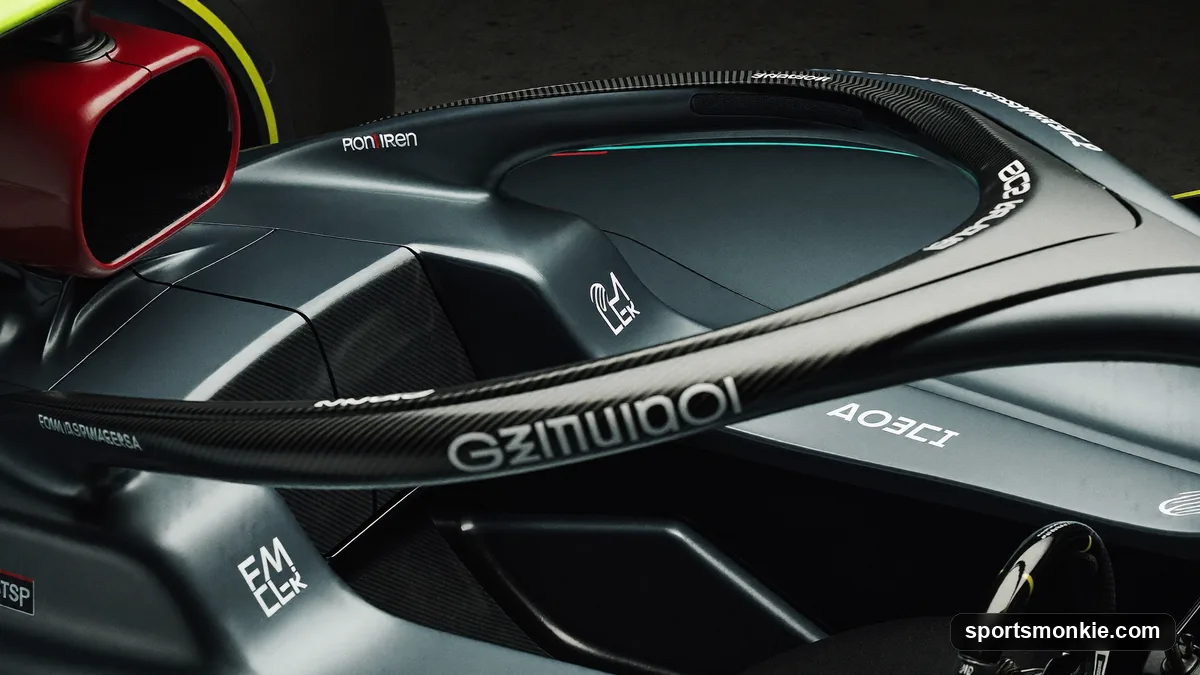
The halo is a curved titanium structure fixed above the cockpit that protects a Formula 1 driver’s head from flying debris, another car, or a barrier. The FIA made it mandatory in 2018 across F1, F2 and F3, and it is built to withstand roughly 15 times the weight of the car pressing down on it. It looks like a thin hoop; it is one of the most important safety devices motorsport has ever adopted.
Open-wheel racing has one glaring vulnerability the closed-cockpit world does not: the driver’s head is exposed. For decades the sport accepted that risk. The halo is the answer it finally settled on.
What the halo actually is
The halo is a three-point titanium structure that arcs over the top of the cockpit opening. Two rear mounts bolt to the survival cell behind the driver, and a single central pillar rises up in front of the helmet, splitting the driver’s forward view for a few centimetres before the ring curves up and back.
It is made from grade-5 titanium, the same class of alloy used in aircraft, and weighs around 7kg by itself. Because the chassis has to be reinforced to hold it, the true weight added to the car is closer to 9kg. Only three FIA-approved suppliers are permitted to manufacture halos, and each one is subjected to the same brutal load tests before it can race.
How strong is the halo?
Strong enough that the numbers sound made up. The homologation test applies a static load of 125 kilonewtons, about 12 tonnes, to the top of the structure. That is roughly the mass of a London double-decker bus, and roughly 15 times the weight of a current F1 car.
| Halo fact | Figure |
|---|---|
| Material | Grade-5 titanium |
| Weight (structure alone) | ~7kg |
| Load test applied to the top | 125 kN (~12 tonnes) |
| Roughly equal to | ~15x the car’s weight |
| Mandatory since | 2018 (F1, F2, F3) |
The point of that margin is simple. In a heavy accident the halo must deform very little while a car, a wheel, or a wall tries to reach the driver’s head. Over-engineering is the feature, not a flaw.
Why the FIA introduced the halo
The halo did not appear because of one crash. It came from years of research into head injuries in open-wheel cars, prompted by a run of tragedies: Henry Surtees, killed by a loose wheel in Formula 2 in 2009; IndyCar’s Justin Wilson, struck by debris in 2015; and the injuries that ended Felipe Massa’s 2009 season and, in a different kind of accident, contributed to Jules Bianchi’s death. The FIA tested several concepts, including an aeroscreen and a forward shield, before the halo won on the strength of its crash data.
Teams and drivers pushed back hard. The complaints were about looks, heritage, and the idea that F1 should stay an open-cockpit sport. The FIA made it compulsory anyway, judging the safety case as non-negotiable. Within two seasons, almost nobody was still arguing.
The lives the halo has saved
The proof arrived quickly. According to the F1 record of these incidents:
- Charles Leclerc, Spa 2018 — Fernando Alonso’s car was launched over the top of Leclerc’s Sauber, and the halo took the impact inches above his helmet.
- Romain Grosjean, Bahrain 2020 — his car speared through a steel barrier at 190mph and burst into flames; the halo parted the barrier and gave him the space to climb out of the fireball.
- Lewis Hamilton, Monza 2021 — Max Verstappen’s Red Bull rode up over the Mercedes and a rear tyre struck the halo directly above Hamilton’s head.
- Zhou Guanyu, Silverstone 2022 — his car flipped and slid upside down into the barriers, with the halo protecting his head as it scraped along the ground.
Any one of those could have been fatal in a pre-2018 car. That is the whole argument in four crashes.
The bottom line on the halo
The halo is a piece of titanium that looks slight and does something enormous: it puts a 12-tonne-rated barrier between a driver’s head and everything that used to be able to reach it. It cost the sport some of its open-cockpit romance and gained it a string of drivers who are still alive because of it. That is a trade the paddock stopped questioning years ago.
Safety devices are only half the story of what keeps drivers in one piece at these speeds. To see how fast the cars the halo protects actually go, read our breakdown of the fastest F1 cars, or find out how a driver reacts when the safety car is deployed after an accident like Grosjean’s.
Frequently asked questions
What is the halo made of?+
The halo is made from grade-5 titanium, a strong, light aerospace alloy. Each unit weighs around 7kg on its own, but adding it plus the mountings and reinforced chassis needed to hold it adds closer to 9kg to the car. Only three approved manufacturers are allowed to build halos for F1.
When did the halo become mandatory in F1?+
The FIA made the halo compulsory across Formula 1, Formula 2 and Formula 3 from the 2018 season. The decision followed years of research into head injuries and several fatal accidents in open-wheel racing, and it was pushed through despite strong initial opposition from teams and some drivers.
How much weight can the halo take?+
The halo must survive a static load test of 125 kilonewtons applied to the top, roughly 12 tonnes, which is about 15 times the weight of a modern F1 car. That is comparable to the mass of a London double-decker bus resting on the structure without it failing.
Whose lives has the halo saved?+
The clearest cases are Charles Leclerc at Spa in 2018, Romain Grosjean's fiery crash in Bahrain in 2020, Lewis Hamilton at Monza in 2021 when Max Verstappen's car landed on his cockpit, and Zhou Guanyu's flipped car at Silverstone in 2022. Each driver walked away.
Why did drivers dislike the halo at first?+
Many objected on looks and heritage, arguing the halo spoiled the open-cockpit character of F1 and blocked forward vision. Drivers report the central pillar is barely noticeable at speed because the brain filters it out, similar to a car's A-pillar. The safety case quickly silenced the aesthetic complaints.
Does the halo block the driver's view?+
Barely. The central strut sits low enough that it interrupts vision far less than expected, and drivers adapt within a few laps. The bigger practical issue was getting in and out fast enough for the FIA's mandatory extraction test, which teams solved with revised cockpit sides and seat designs.
Sources
Play & tools
Free browser games and tools — no account, no download.
- Play 24-0 — Draft an F1 chassis and two drivers, then chase a perfect 24-0 — win every race on the 24-round calendar.
- Explore all our games →
Related motorsport guides
View all →
F1 Cost Cap Explained: The Budget Limit and What Counts
F1's cost cap limits team spending to roughly $135M a year, adjusted for inflation. Driver pay is excluded. Breach it and fines and testing cuts follow.
F1 Flags Explained: Every Racing Flag and What It Means
A full reference to every F1 flag — green, yellow, double yellow, red, blue, white, black, meatball, black-and-white, chequered and the striped flag.
F1 Formation Lap Explained: Purpose, Rules and Aborted Starts
The formation lap is the single lap to the grid before an F1 race starts. Drivers warm tyres and brakes, hold position, and stop for the standing start.
F1 Porpoising Explained: The 2022 Bouncing and How It Was Fixed
Porpoising is the violent vertical bouncing that hit F1's ground-effect cars in 2022. Here's the aerodynamics behind it and how teams and the FIA cured it.
F1 Red Flag Explained: What It Means and How Restarts Work
A red flag stops an F1 session immediately. Cars slow to a delta and return to the pit lane, teams can work on them, and the race restarts from there.
Parc Fermé in F1 Explained: The Rules That Lock a Car's Setup
Parc fermé is F1's restricted-work condition from the start of qualifying to the race. Change the setup and the car has to start from the pit lane.