
F1 Blue Flag Meaning: Get Out of the Way, Fast
On this page5
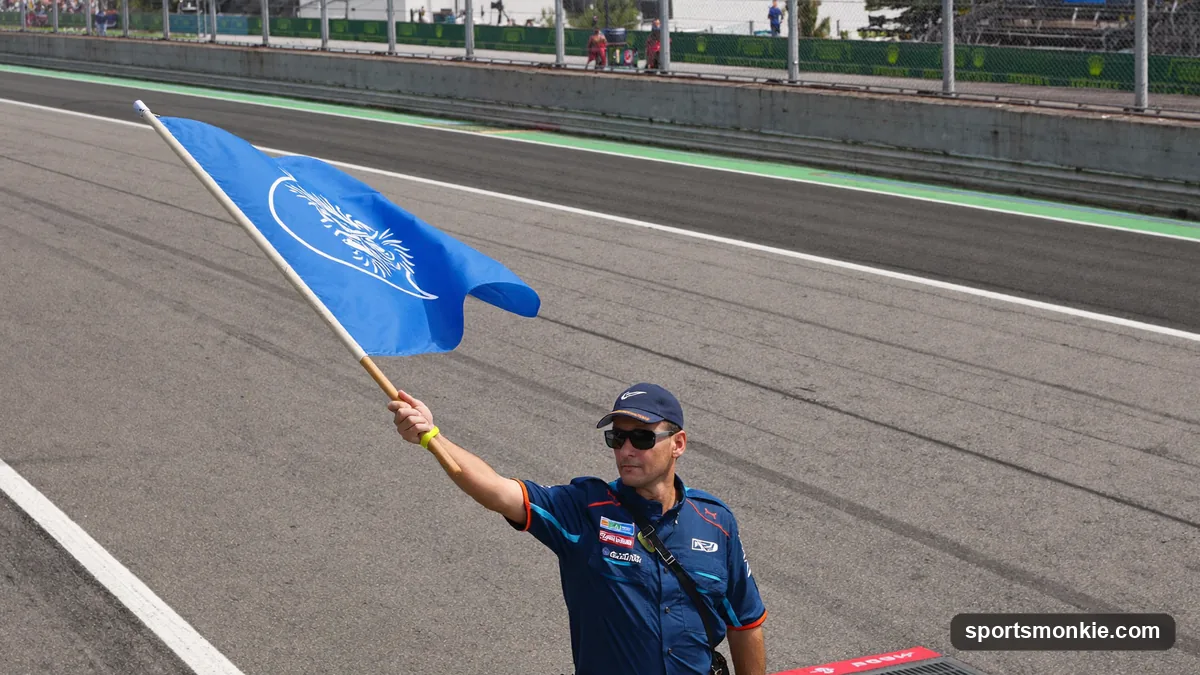
A blue flag in Formula 1 tells a driver who is about to be lapped that a faster car is right behind them and they must let it past as soon as it is safe to do so. It is a direct instruction, not a suggestion. Crucially, it only applies to cars being lapped — two drivers fighting over the same position are never subject to it.
The rule exists to protect the race for the win. A car a lap down has no business slowing the leaders, so the sport makes it get out of the way.
What the blue flag actually orders
When a backmarker sees blue — whether waved by a marshal or flashed on the steering-wheel dash panel — the car closing behind is a full lap ahead on the road. The FIA regulations require that driver to yield at the first safe opportunity, typically lifting on a straight and moving off the racing line rather than defending.
The important limit: blue flags say nothing about drivers on the same lap. If two cars are racing for eighth place and one is quicker, the slower driver is fully entitled to hold position and defend. The blue flag is purely a lapping tool.
The three-flag rule and the penalties
There is a hard limit on how long a backmarker can hold up a faster car. A driver is expected to let the car by within three blue flags. Ignore three in a row without yielding, and the stewards act.
| Situation | Likely outcome |
|---|---|
| Yields within three blue flags | No action — normal lapping |
| Slow to react, but lets car by | Usually a warning |
| Ignores three consecutive blue flags | Time penalty (commonly 5 seconds) |
| Repeated or deliberate blocking | Drive-through and/or penalty points |
In practice most drivers move over cleanly, because holding up a leader is both against the rules and a good way to annoy people who will remember it. Penalties for genuine blue-flag breaches are relatively rare precisely because the threat of them works.
Where you’ll see blue flags
There are two distinct uses, and they are easy to blur:
- On track, at marshal posts and on the dash, to warn a backmarker they are being lapped.
- At the pit exit, shown to a driver rejoining the circuit that cars are approaching at racing speed and they must not impede them.
Same colour, related idea — traffic awareness — but different context. The pit-exit blue is about a car leaving the pits, not about lapping.
Blue flag versus yellow flag
This trips up new fans constantly, so it is worth stating plainly. A yellow flag warns of danger ahead: slow down, be ready to stop, no overtaking. A blue flag is about traffic and asks the opposite — let a car past. One means “careful, hazard”; the other means “move aside, faster car.” Confusing them is a genuine mistake, because they call for nearly opposite actions.
The bottom line on blue flags
A blue flag means a car is about to lap you and you must let it through, within three flags or face a penalty. It never applies to same-lap racing, and it is not a hazard warning like a yellow. It is one of the simplest rules in F1 once you separate lapping from racing, and it quietly keeps the fight at the front fair.
Blue flags are only one entry in F1’s flag vocabulary and its wider rulebook. To see how those rules are enforced when a driver crosses a line, read our full guide to F1 penalties, or find out what happens to the whole field when danger is bigger than a single flag in our F1 safety car explainer.
Frequently asked questions
What does a blue flag mean in F1?+
A blue flag tells a driver that a faster car, one that is about to lap them, is close behind and that they must let it past at the first safe opportunity. It is an instruction, not a warning, and applies to backmarkers being lapped, not to cars fighting for position on the same lap.
How many blue flags before a penalty?+
A driver is required to let the faster car by within three blue flags. Ignoring three consecutive blue flags without yielding is treated as failing to obey them, and the stewards typically hand out a time penalty, a drive-through, or penalty points on the driver's superlicence depending on the severity.
Do blue flags apply to cars on the same lap?+
No. Blue flags only concern lapping, where the car behind is a full lap ahead on the road. Two drivers racing for the same position, even if one is much faster in that moment, are not subject to blue flags. The slower one is entitled to defend within the normal rules of racing.
Where are blue flags shown?+
They are displayed by marshals at trackside posts and shown on the driver's dashboard panel when a car is closing to lap them. A separate blue flag or light is shown at the pit-lane exit to warn a driver rejoining the track that cars are approaching at racing speed.
Why do backmarkers have to move over?+
To keep the race for position clean. A driver being lapped is, by definition, not racing the leaders, so making them yield stops a slower car from interfering with the battle at the front. It is a fairness rule: your own race shouldn't be allowed to distort someone else's fight for the win.
Is a blue flag the same as a yellow flag?+
No. A yellow flag warns of a hazard ahead and means slow down and no overtaking. A blue flag is about traffic, not danger, and actually requires you to let a car past. Mixing them up is a common beginner mistake, but they signal almost opposite actions.
Sources
Play & tools
Free browser games and tools — no account, no download.
- Play 24-0 — Draft an F1 chassis and two drivers, then chase a perfect 24-0 — win every race on the 24-round calendar.
- Explore all our games →
Related motorsport guides
View all →
F1 Safety Car Explained: When It Comes Out and the Rules
The F1 safety car neutralises the race behind a real car when there's danger on track. Learn when it deploys, the rules, and how restarts work.
F1 Sprint Race Explained: Format, Length and Points
An F1 sprint is a short 100km Saturday race that awards points to the top 8. Learn the format, how it fits the weekend, and how it differs from the GP.
Virtual Safety Car vs Safety Car: The Key Differences
The safety car is a real car that bunches the F1 field; the virtual safety car uses a delta time and no car at all. Here's when each is used and why.
What Is DRS in F1? Drag Reduction System Explained
DRS opened a flap in an F1 rear wing to cut drag and aid overtakes. It was dropped for 2026, replaced by active aero and Override Mode. See how it works.

F1 Flags Explained: Every Racing Flag and What It Means
A full reference to every F1 flag — green, yellow, double yellow, red, blue, white, black, meatball, black-and-white, chequered and the striped flag.
F1 Red Flag Explained: What It Means and How Restarts Work
A red flag stops an F1 session immediately. Cars slow to a delta and return to the pit lane, teams can work on them, and the race restarts from there.