
What Is DRS in F1? Drag Reduction System Explained
On this page4
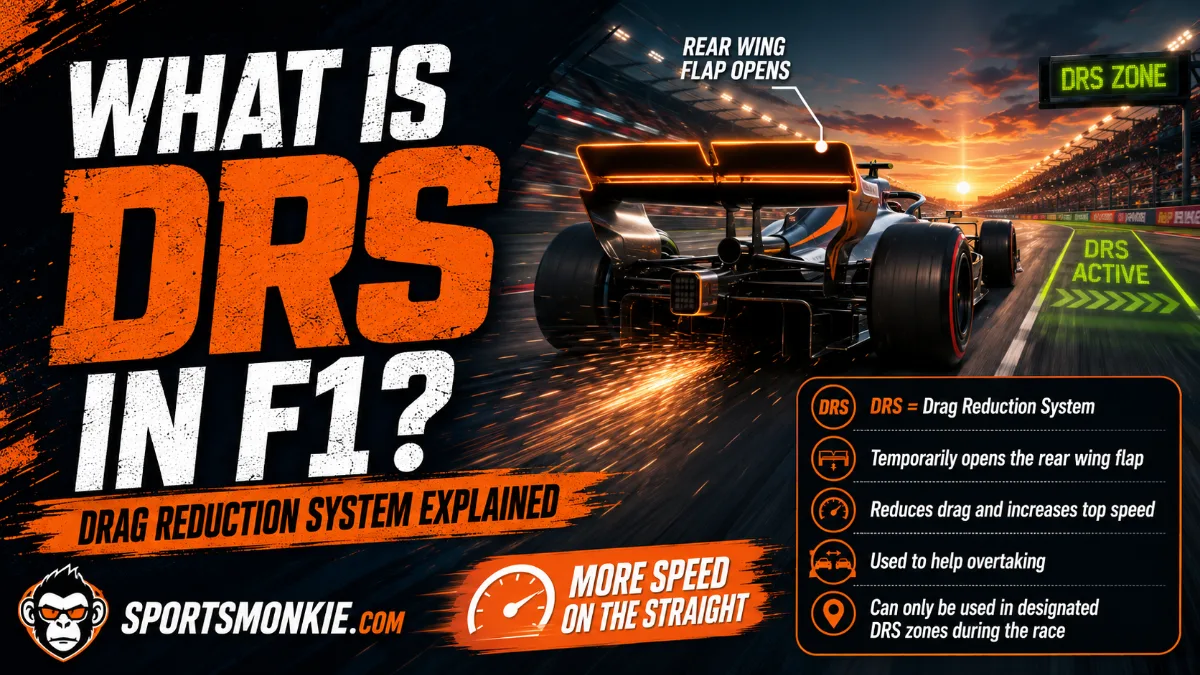
DRS stands for Drag Reduction System: a flap in the rear wing that a chasing driver could open to cut drag and gain straight-line speed, available only within one second of the car ahead and only inside marked zones. Formula 1 used it from 2011, and dropped it for the 2026 season. Its job is now split between active aerodynamics, which every car uses, and Override Mode, which gives the attacking driver extra electrical energy.
Overtaking in F1 is hard. The cars punch a big hole in the air, and the one behind loses downforce in that turbulent wake, making it tough to follow closely and pass. DRS was the sport’s answer for fourteen seasons.
What DRS actually did
DRS was a movable flap in the rear wing that the driver opened with a button on the steering wheel. Open, it let air pass through more freely, cutting aerodynamic drag and raising top speed down the straight.
Less drag meant more speed exactly where a car needed it to complete a pass. The trade-off was less downforce, which is why DRS only worked on straights. The flap closed automatically the instant the driver touched the brakes or lifted off for the next corner, restoring grip before it mattered.
When a driver was allowed to use it
DRS was never available on demand. Three conditions had to line up:
| Condition | Rule |
|---|---|
| Location | Only inside a marked DRS zone (each circuit had one to three) |
| Gap | The driver had to be within one second of the car ahead at the detection point |
| Timing | Disabled for the first two laps of a race, and after a safety car or red flag until racing resumed |
The one-second gap was measured at a fixed detection point before the zone. Close enough there, and a light on the dashboard told the driver DRS was available once they reached the activation line.
What replaced DRS in 2026
The 2026 regulations removed DRS entirely and split its function in two.
Active aerodynamics handles the drag. Both the front and rear wings now move, and drivers switch between two configurations at predetermined points on the circuit:
| Mode | Purpose | Who gets it |
|---|---|---|
| Z-mode | Default high-downforce setting for cornering | Every car |
| X-mode | Flattens the wings to cut drag on the straights | Every car |
That is the key change. X-mode is not an overtaking aid, because everyone has it — it is simply how a 2026 car goes fast in a straight line, and it removes the artificial gap DRS created between the car in front and the car behind.
Override Mode is the actual overtaking tool. A driver within one second of the car ahead at the detection point unlocks extra electrical energy from the MGU-K to deploy against them. The one-second principle survives from DRS; the mechanism does not. Instead of an aerodynamic freebie, the chaser gets a finite battery allocation they have to spend at the right moment.
The underlying reason for the swap is the new power unit. From 2026, every driver’s MGU-K deployment tapers off from around 290km/h and reaches zero near 355km/h, so straight-line energy is a managed resource for everyone. Override Mode lifts that ceiling for the attacker alone.
Why DRS was dropped
Two reasons, one technical and one philosophical.
The technical one: with movable front and rear wings on every car, a separate drag-reduction flap for one driver was redundant. Active aero does the same physics, better, for everybody.
The philosophical one is the argument fans had for a decade. DRS worked, and that was the problem. On some circuits the pass was settled before the braking zone, and a “DRS train” of cars each too far back to use it became a familiar way for a race to die. Moving the assist to stored electrical energy makes it a decision rather than a gift: deploy early and you might not have it when you need it, and the driver defending can spend theirs too.
Whether that produces better racing is the open question of the 2026 season. The core aim has not changed since 2011: give drivers a way to actually race each other rather than parade in a line.
Frequently asked questions
What does DRS stand for in F1?+
DRS stands for Drag Reduction System. It was a driver-controlled device that opened a flap in the car's rear wing to reduce drag and raise top speed on the straights, making overtaking easier. F1 used it from 2011 until the end of 2025.
Does F1 still have DRS in 2026?+
No. The 2026 technical regulations dropped DRS entirely after 14 seasons. Its two jobs were split: active aerodynamics now handles drag reduction through movable front and rear wings, and a separate Override Mode gives the chasing driver an electrical power boost to attack with.
When could a driver use DRS?+
Only inside a marked DRS zone, and only when within one second of the car ahead at a fixed detection point before that zone. It was also disabled for the first two laps of a race, after a safety car or red flag until racing resumed, and in wet conditions.
What are X-mode and Z-mode in F1?+
They are the two settings of the 2026 active aerodynamics. Z-mode is the default high-downforce configuration for cornering. X-mode flattens the front and rear wings to cut drag on the straights. Unlike DRS, every driver can use them at set points rather than only a chasing car.
What replaced DRS for overtaking?+
Override Mode, sometimes called Overtake Mode. A driver within one second of the car ahead at the detection point gets extra electrical energy from the MGU-K to deploy. It aids only the attacking car, keeping DRS's one-second principle while changing the mechanism from aero to power.
Why did F1 get rid of DRS?+
Because the 2026 cars were designed around active aero, which made a separate drag-reduction flap redundant, and because DRS drew persistent criticism for making some overtakes too easy. Shifting the boost to stored electrical energy gives drivers a finite resource to manage rather than a free pass.
Sources
Play & tools
Free browser games and tools — no account, no download.
- Play 24-0 — Draft an F1 chassis and two drivers, then chase a perfect 24-0 — win every race on the 24-round calendar.
- Explore all our games →
Related motorsport guides
View all →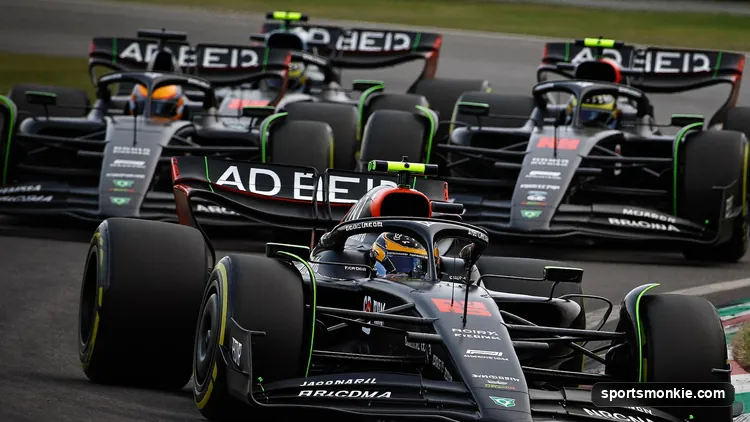
What Is a DRS Train in F1? Why a Queue Cancels the Advantage
A DRS train is a line of F1 cars each within one second of the next, so every car opens DRS at once and nobody gains — the passing aid neutralises itself.
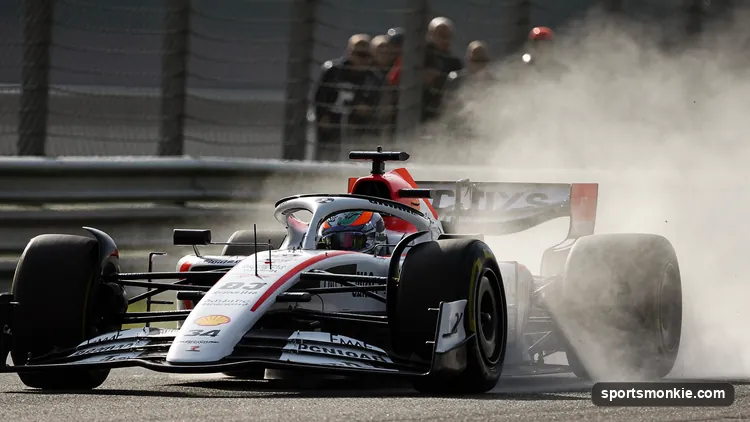
What Is Dirty Air in F1? Why It Kills Overtaking
Dirty air in F1 is the turbulent wake behind a car that robs the following car of downforce, making it slide and struggle to follow closely or overtake.
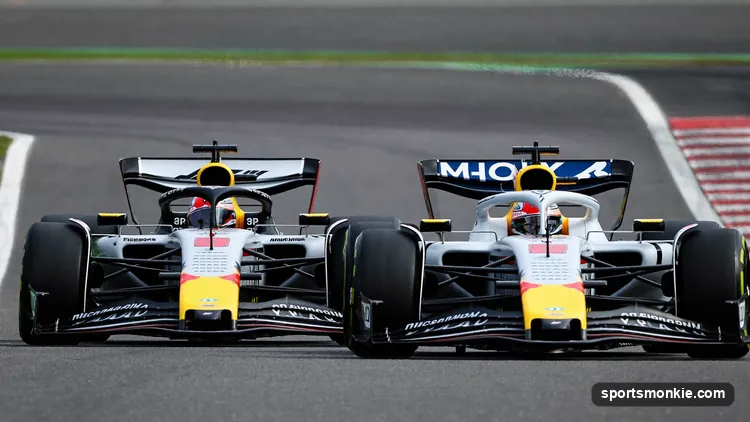
F1 Slipstream and Tow Explained: The Physics of Drafting
A slipstream, or tow, is the low-drag pocket of air behind an F1 car. Follow closely and you gain top speed on the straights — the base that DRS builds on.
F1 Blue Flag Meaning: Get Out of the Way, Fast
A blue flag in F1 tells a slower, about-to-be-lapped driver to let a faster car past. Ignore it three times and you're penalised. Here's the full rule.
F1 Ground Effect Explained: The Floor That Sucks Cars Down
F1 ground effect uses the car's floor to create downforce, sucking it to the track. It returned in 2022 via venturi tunnels, and brought porpoising too.
F1 Porpoising Explained: The 2022 Bouncing and How It Was Fixed
Porpoising is the violent vertical bouncing that hit F1's ground-effect cars in 2022. Here's the aerodynamics behind it and how teams and the FIA cured it.