
Pickleball Lob Shot: When to Use It and How to Defend One
On this page4
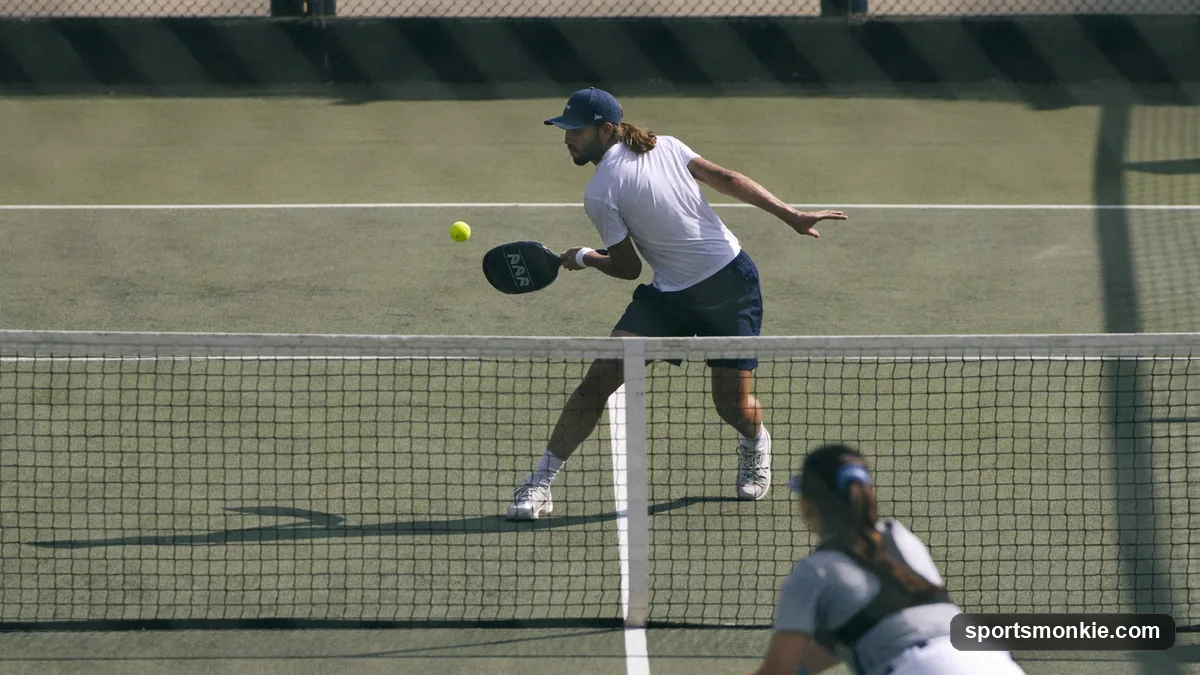
A pickleball lob lifts the ball high over opponents at the net — either to win the point outright with an offensive lob, or to buy recovery time with a defensive one. The offensive version works best out of a dink exchange, disguised until the last moment and aimed over the backhand shoulder of a net player leaning in. Hit it with an open paddle face and a low-to-high lift, high enough to clear the reach but deep enough to land near the baseline. Use it sparingly: a floated lob is an easy overhead put-away.
Offensive vs defensive lobs
The two lobs share a motion but serve opposite purposes.
| Offensive lob | Defensive lob | |
|---|---|---|
| Purpose | Win the point over the net players | Buy time to recover |
| Situation | Opponents pressed and leaning in | You are stretched wide or pushed back |
| Disguise | Critical — hide it as a dink | Not needed, you are just resetting |
| Target | Over the backhand shoulder, deep | High and deep, anywhere safe |
| Margin for error | Small — must clear reach and land in | Bigger — height matters more than placement |
The offensive lob is a precision shot; the defensive lob is a survival shot. Knowing which one you are hitting tells you how much risk to take.
How to hit an offensive lob
- Set up like a dink. From a kitchen-line exchange, keep your body language identical to your dink so the net players do not read it early. Disguise is half the shot.
- Open the paddle face slightly to launch the ball upward.
- Lift low to high with a smooth, controlled swing from the shoulder. This is a lift, not a hard swing — power sends it long.
- Aim over the backhand shoulder of the net player and deep toward the baseline. The backhand side is slower to cover overhead.
- Give it height and depth. High enough to clear their outstretched paddle, deep enough to land near the baseline. That combination is what makes it un-smashable and still in bounds.
The narrow margin is the whole challenge. Too short and it is an easy overhead; too much pace and it sails out. Drill the depth before you trust it — a lob you cannot land consistently costs more points than it wins.
How to defend a lob
When you get lobbed, the instinct to backpedal is the enemy — it is slow and leaves you hitting off-balance or falling backward.
- Turn and run with the ball, not straight back. Get your feet moving sideways-and-back so you can set up behind it.
- If you get behind it, let it bounce and hit a controlled reset or drive rather than a desperate swing.
- In doubles, communicate. Whoever has the better angle takes the lob and calls the switch, and you rotate sides cleanly — the same coordination that makes stacking and poaching work. A lob that forces a switch is only won by the other team if you scramble in silence.
Use it as a change-up, not a habit
The lob’s power is surprise. Thrown in once every ten or twenty balls against a team that crowds the kitchen line, it either wins the point or plants enough doubt that they stop leaning in — which quietly makes your dinks and drives more effective. Overuse it and it becomes a predictable feed for their overhead.
Want the lob to actually land where you aim? It is a touch shot, so it belongs in your practice rotation — our pickleball drills guide covers how to groove the depth with a partner. Master the disguise and the depth, keep it rare, and the lob becomes the shot that punishes anyone who camps on the line.
Frequently asked questions
When should you lob in pickleball?+
Use an offensive lob when opponents are pressed right up to the kitchen line and leaning in, especially during a dink rally where they are not expecting it. Use a defensive lob when you are stretched wide or pushed back and need time to recover position. Avoid lobbing into the wind or against tall, quick opponents who track down overheads easily.
How do you hit an offensive lob?+
From a dink exchange, disguise it like another dink, then open the paddle face and lift low to high with a smooth, controlled swing. Aim over the backhand shoulder of the net player and deep toward the baseline, high enough to clear their reach but with enough depth to land in. Touch and disguise matter more than power — a rushed lob floats short and gets smashed.
How do you defend against a lob?+
Turn immediately and run with the ball rather than backpedalling, which is slow and off-balance. If you can get behind it, let it drop and hit a controlled reset or drive; if it is over your backhand, an overhead is riskier. In doubles, whichever partner has the better angle takes it and calls the switch so you rotate sides cleanly.
Why do my lobs keep going out or getting smashed?+
Out means too much pace or launch — a lob is a lift, not a swing, so ease the power and aim for depth near the baseline. Smashed means it was too short or too low, giving the net player an easy overhead. The margin is narrow: high and deep enough to clear the reach, but landing inside the line. Practice the depth before you trust it in a match.
Is the lob a good shot in pickleball?+
It is a useful surprise weapon, not a staple. Overused, it becomes predictable and hands opponents easy overhead smashes. Used occasionally against a team that crowds the line, it resets the point or wins it outright and plants doubt that keeps them from leaning in. Treat it as a change-up, roughly one in ten or twenty balls, not a go-to.
Should you lob in singles or doubles?+
Both, but the timing differs. In doubles the offensive lob targets a team packed at the kitchen line and forces a scramble and switch. In singles it lifts over a lone player who has come to the net, and because there is no partner to cover, a good lob over their backhand side is especially punishing. In both, a defensive lob buys recovery time when you are stretched.
Sources
Play & tools
Free browser games and tools — no account, no download.
- Play today's Sports Connections — Today's Sports Connections — daily hints, answers, and play the grid.
- Play Guess the NFL Player — A new mystery NFL player every day. Eight guesses, with a clue on each — plus free unlimited mode.
- Explore all our games →
Related racket sports guides
View all →
How to Play Pickleball Singles: Strategy and Court Coverage
Pickleball singles strategy: where to serve, how to cover the court, when to attack, and why it rewards fitness and placement over doubles touch.
Pickleball Return of Serve: Hit Deep and Get to the Net
How to return serve in pickleball: hit deep to pin the server back, follow your return to the kitchen line, and target the backhand for control.
Third-Shot Drop in Pickleball: Why It Wins Points
The third-shot drop is a soft arc from the baseline into the opponent's kitchen that lets the serving team advance to the net. Here's how to hit it.
Pickleball Backhand Technique: One-Handed vs Two-Handed
Pickleball backhand technique: one-handed vs two-handed, plus how to hit the backhand dink, drive and volley with control and depth.
Around the Post Shot in Pickleball (ATP): Legal and Deadly
The around-the-post shot is legal in pickleball — you hit the ball around the outside of the net post, and it can travel below net height. Here's how.
How to Hold a Pickleball Paddle: Grips and Grip Pressure
How to hold a pickleball paddle: the continental and eastern grips, the neutral ready grip, and how much grip pressure to use for control.