
What Is a Dink in Pickleball? The Soft Shot Explained
On this page4
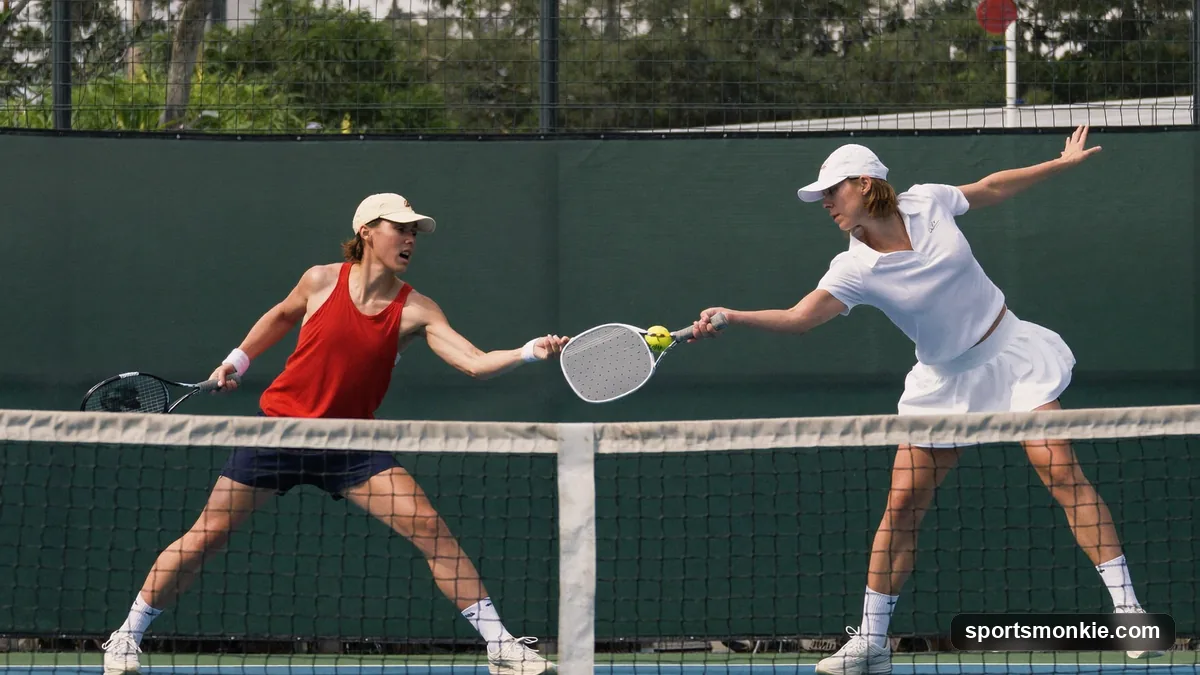
A dink is a soft, controlled shot hit from at or near the kitchen line that arcs just over the net and drops into the opponent’s non-volley zone. It is deliberately gentle, and that is the point: a ball landing that low in the kitchen is too low to smash back, so your opponent is forced to hit up softly too. Dinking is how the entire net game — the “soft game” — is built.
New players see pros patting the ball back and forth at the net and assume they are stalling. They are not. They are competing for the one mistake that ends the point.
Why the dink works
To attack a ball in pickleball you need it above the height of the net, so you can hit down on it. A well-placed dink lands in the kitchen and never rises above net height, which strips away the smash. The best your opponent can do is dink it back.
So a dink rally is really a waiting game. Two teams trade soft shots, each keeping the ball low, until someone gets impatient or misjudges and floats one a few inches too high. That ball gets attacked, and the point is won. The player who can dink calmly under pressure usually wins the exchange — which is why the soft game separates intermediate players from beginners more than any power shot does.
How to hit a dink, step by step
- Get to the kitchen line. Dinks are hit from the non-volley-zone line, not the baseline. If you are not up at the net yet, you are not dinking — you are hitting a drop.
- Relax your grip. Hold the paddle loosely, around a 3 or 4 out of 10. A tight grip sends the ball too hard and pops it up.
- Contact the ball out in front, below the net’s height where you can. Reaching down to a low ball is better than letting it rise into an attackable zone.
- Lift from the shoulder, not the wrist. Use a gentle, compact push with a stable wrist. Wristy flicks are inconsistent and add unwanted pace.
- Aim for the opponent’s kitchen — near their feet or to an angle. The target is the zone, not the line. Landing near the feet is the hardest ball to answer.
- Follow through low and short. Little swing, little follow-through. The paddle almost stops at contact.
Master the bounce dink (letting the ball land, then lifting it back) before you try taking dinks out of the air.
Where to place the dink
Placement beats power every time in a dink rally.
- Cross-court is the safest target: the ball crosses the lowest part of the net, in the middle, and has more court to land in. Most dink rallies live cross-court.
- At the feet forces an awkward reach and often produces the pop-up you are hunting for.
- Down the line is riskier — the net is higher on the sides and there is less court — but it changes the pattern and can catch an opponent leaning cross-court.
When to speed it up
Dinking is not the goal; the pop-up it produces is. Keep the ball low and patient, and the instant a dink bounces or floats above net height, change gears — drive it hard at the opponent’s body or into a gap. The whole soft game exists to manufacture that one attackable ball. Firing at a low dink is how you gift points away.
Dinking is the shot that lives at the kitchen line, but you have to get there first, and that is a different soft shot — the third-shot drop, which carries the whole court to set up the dink game. If you are still learning where you can and cannot volley, our guide to the kitchen and the non-volley zone covers the rule the entire dinking game is built around.
Want more on the theme? Read What Is a DUPR Rating in Pickleball? The 2.0–8.0 Scale next.
Frequently asked questions
Why do players dink instead of hitting hard in pickleball?+
Because a ball that lands low in the kitchen cannot be attacked. To smash a ball downward you need it above net height, and a good dink stays below it. Dinking forces the opponent to also hit up softly, and the rally becomes a patience contest until someone pops a ball high enough to put away.
Where should a dink land?+
In the opponent's non-volley zone (the kitchen), ideally near their feet or angled to a sideline. Landing it in the kitchen guarantees they must let it bounce or reach down to it, keeping the ball low. A dink that drifts deep past the kitchen line sits up at an attackable height.
Should you dink off the bounce or out of the air?+
Both are used. A bounce dink (letting it land first) is safer and easier to control, and it is what beginners should master first. Taking the dink out of the air — a volley dink — is faster and gives the opponent less time, but it demands soft hands and is riskier near the kitchen-line fault.
What is a cross-court dink?+
A cross-court dink is hit diagonally rather than straight ahead. It travels over the lowest part of the net (the middle) and has more court to land in, so it is both safer and harder to attack. Many players build the whole dink rally cross-court and only go down the line to change the pattern.
What's the difference between a dink and a drop shot?+
A dink is hit from up at the kitchen line and travels a short distance into the opponent's kitchen. A third-shot drop is hit from near the baseline and has to carry the whole court to die in the kitchen. Both are soft, but the drop is the shot that gets you to the net, and the dink is what you do once you are there.
How do you attack a dink rally?+
You wait for a dink that bounces or floats above net height, then speed it up — drive it at the opponent's body or into a gap. The whole point of dinking patiently is to induce that one high ball. Attacking a low dink is a low-percentage play that usually hands the point away.
Sources
Play & tools
Free browser games and tools — no account, no download.
- Play today's Sports Connections — Today's Sports Connections — daily hints, answers, and play the grid.
- Play Guess the NFL Player — A new mystery NFL player every day. Eight guesses, with a clue on each — plus free unlimited mode.
- Explore all our games →
Related racket sports guides
View all →
Third-Shot Drop in Pickleball: Why It Wins Points
The third-shot drop is a soft arc from the baseline into the opponent's kitchen that lets the serving team advance to the net. Here's how to hit it.
Pickleball Backhand Technique: One-Handed vs Two-Handed
Pickleball backhand technique: one-handed vs two-handed, plus how to hit the backhand dink, drive and volley with control and depth.
Pickleball Lob Shot: When to Use It and How to Defend One
The pickleball lob explained: offensive vs defensive lobs, when to use each, how to hit one over the net players, and how to defend a lob.
What Is an Erne in Pickleball? The Legal Kitchen Bypass
An erne is a pickleball shot where you jump around the outside of the kitchen to volley right at the net — legal because your feet land outside the zone.
How to Hold a Pickleball Paddle: Grips and Grip Pressure
How to hold a pickleball paddle: the continental and eastern grips, the neutral ready grip, and how much grip pressure to use for control.
How to Play Pickleball Singles: Strategy and Court Coverage
Pickleball singles strategy: where to serve, how to cover the court, when to attack, and why it rewards fitness and placement over doubles touch.